Gelbfisz/ Goldfish/ Goldwyn: the face of a spink

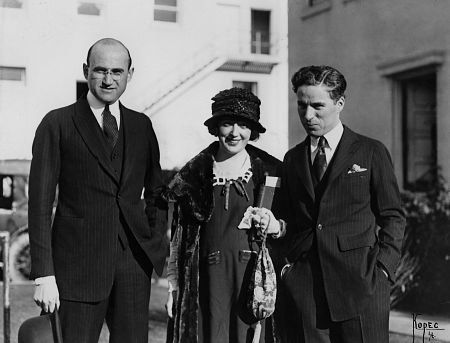
[Samuel Goldwyn on the left]

I am 3/4 or so through (to 1942) A. Scott Berg’s 1989 biography of Samuel Goldwyn and loving it.  Really juicy, filled with great/hilarious/unbelievable tales about movie stars, directors, and producers of the 1910s-1950s (with an emphasis on the earlier decades), and offering a well-informed, panoptic history of early Hollywood– I’m learning a lot.

  • This is one of the best Americanized-name stories I’ve heard.  Born Schmuel Gelbfisz, Goldwyn became Samuel Goldfish in the ghetto of Birmingham, England in the 1890s. (If you’re going to Americanize your name, do you really want to choose “Goldfish”?)  In 1916, Goldfish and Edgar Selwyn formed a film distribution company they named “Goldwyn” (a portmanteau name combining Selwyn and Goldfish).  A few years later, audaciously, Goldfish changed his own name to Goldwyn.  What a power move.  His partner sued him, but a judge ruled that the name change was legal.  The now Samuel Goldwyn was subsequently forced out of Goldwyn Pictures, the company that now bore what was his name, and he was never (bizarrely) part of Metro-Goldwyn-Mayer.  Very weird.
  • Gelbfisz/Goldfish/Goldwyn’s emigration story from Poland to the U.S. (he arrived Jan 1, 1899) is pretty wild.  At age 16, “in 1895, Schmuel Gelbfisz walked alone, almost three hundred miles due West to the Oder River.”  After paying off border police guarding the German/Russian border, “he walked another two hundred miles to Hamburg.”  There he stayed with some family acquaintances who put him to work learning glovemaking, and then raised money from neighbors to pay for his ship fare to London.  “The next leg of his odyssey was the 120-mile walk from London to the Midlands.  He lived for two days on a single loaf of bread.”  He found his mother’s sister in Birmingham and became an apprentice to a blacksmith and then worked as a sponge salesman.  “By the fall of 1898, Sam Goldfish felt the urge to move on.  He journeyed another hundred miles, northwest to Liverpool and eventually got a boat that left him in New Brunswick.  “Once he had his legs back, Goldfish took to the road again…. Over the next month, he trudged through more snow than New England had seen in ten years.  Sometime in late January 1899, he arrived in Manhattan.”  Wow!  That’s a tough dude.
  • It’s just amazing how many of Hollywood’s biggest moguls were Jews from modest (or impoverished) backgrounds in Eastern Europe.  “In the 1880s alone, the  family of Louis B. Mayer left Demre, near Vilna, in Lithuania; Lewis Zeleznick (later Selznick) ran away from Kiev;  William Fox (formerly Fuchs) imigrated from Tulcheva, Hungary; the Warner family uprooted itself from Krasnashiltz, Poland, near the Russian border; Adolph Zukor abandoned Ricse, Hungary; and Carl Laemmle left Wurttemberg, Germany — gamblers with nothing to lose, all from within a five-hundred-mile radius of Warsaw.”
  • The first part of the book, about Hollywood prior to the advent of sound in 1927, is full of amazing stories about silent-movie stars I’d never heard of or knew almost nothing about.  E.g. Banky Vilma & Rod La Roque.  Or Mabel Normand:  “One interview for a family magazine [in 1917] went well until the reporter asked her hobbies.  ‘I don’t know,’ Mabel replied.  ‘Say anything you like but don’t say I liked to work.  That sounds like Mary Pickford, that prissy bitch.  Just say I like to pinch babies and twist their legs.  And get drunk.”
  • One of my favorite strands in the book has to do with Goldwyn’s famous malapropisms and vexed relationship to the English language.  During the editing of the 1929 Bulldog Drummond, Goldwyn noticed a line in which a colonel declares, “the eternal din around this club is an outrage.”  “Goldwyn asked his staff, ‘what is that word “din”?’  He was told it meant noise.  ‘Then why didn’t the writer say noise?'”  He insisted that the actors be called back into the studio and the set rebuilt in order to re-shoot the entire scene, until someone finally convinced him that “din” was a real word.   More Goldwynisms: of his Russian discovery Anna Sten, whom he thought would be the next Garbo (she flopped– that whole story is great, albeit slightly tragic): “She has the face of a spink.”  Or the time the Gershwins, Lillian Hellman, and George Balanchine were waiting for Goldwyn in his living room.  “Goldwyn appeared at the staircase in his bathrobe.  ‘Hold on, fellas,’ he yelled down.  ‘I’ll be right there.  And then we’ll get into a cuddle.”  “Include me out” was his most famous coinage.  “Anyone who goes to a psychiatrist needs his head examined” another famous line.  William Wyler called him “a titan with an empty skull, not confused by anything he read, which he didn’t.”  Wyler still liked him, however.

Someone comments at some point that all of the studio heads, without exception, in this period were “monsters,”  but that Goldwyn at least could laugh at himself.  He was a terrible person in many ways (treated his children really badly, was always chasing starlets), but possessing a certain charm all the same… You have to admire him, to some degree, for his bald bull-headed energy & determination & hook or crook determination to get movies made (often by lying, cheating & stealing). He bet incredible amounts on cards (in 1940 he calls in a gambling debt from fellow mogul Jack Warner for $425,000 — imagine what that would be in today’s currency) and for much of his career was continually leveraging his own company such that a major flop at the wrong moment would have bankrupted him.  (“The only way he could tolerate a baseball game was by betting on every pitch”).  The whole enterprise was high-end, high-risk gambling based on bluff and bluster, and producing strings of masterpieces and great movies.

Ruth Rendell’s *A Judgment in Stone*- murderous illiteracy

I was at the public library and decided I’d find a Ruth Rendell novel or two to read — did a quick scan of Amazon reviews and grabbed two that had strong reviews and looked interesting.  The first one I read was her 1977 A Judgment in Stone which, I just learned, was adapted by the French director Claude Chabrol as La Ceremonie — a movie I remember liking very much and which I’d vaguely thought of as I read, but had not realized was an actual adaptation of the book.  (There was also an American adaptation of the novel, The Housekeeper.)

Here is the book’s arresting first sentence: “Eunice Parchman killed the Coverdale family because she could not read or write.”  The book is pretty daring for several reasons, one that it gives everything away immediately.  Early on I did feel, “gee, can I really wade through all this, waiting for the final bloody end that has already been described to me” (although we have to wait for the end to learn most of the details of what went down).  But it works very well and you get caught up in the psychology of the murderer and your curiosity about how exactly things will go terribly wrong.

The premise is also daring because so apparently prejudicial.  Here we have an ignorant, illiterate working-class woman who, we are told, commits motiveless mass murder because of her ignorance and illiteracy.  On the one hand, the novel is so well-done that one can defend it by pointing out simply that this is a very particular story about particular circumstances — a knot of events and actions that can’t be reduced to sociology or generalizations about types of people.  On the other, this is a nasty piece of work, in some ways, and I wouldn’t be prepared to defend it absolutely against class bias in its depiction of a psychologically stunted, uneducated woman whose unreasoned hatred and resentment of her, yes, slightly smugly rich and liberal (but far from cruel or unkind) employers leads her to a senseless act of violence.  (They are educated, cultured people and Eunice’s phobia about writing, and her defensiveness about her concealed illiteracy, plays a strong role in the events.)

Rendell reminds me a little bit of Patricia Highsmith, partly in her willingness to ignore liberal or right-thinking pieties in her cool, sometimes slightly amused from-the-inside depiction of murderers and other criminals.

The novel also made me think of the brutal and random 2007 Connecticut home invasion murders committed by Joshua Komisarjevsky and Steven Hayes.

Here’s a transcript of a BBC interview with Rendell about the novel in which Rendell defends herself against a charge of cruelty or prejudice in her depiction of Eunice by saying,

I’ve had quite a lot of protest from people saying that this is cruel, including various societies who are proponents of illiterate people and who champion them, but I don’t think it’s cruel because I particularly feel that it’s unjust to say that I am stating that every illiterate person is likely to commit murder, which was alleged against me. It’s no more really than saying that every woman in my books where there is a female murderer is capable of murder, or every man is in that case. I don’t think it’s cruel but I do think, and I hope this isn’t harsh, that any illiterate person who feels burdened by his or her illiteracy can go to classes to learn to read. There are ample opportunities, even more these days than whenever I wrote that book, which I think was 1975.

Not too sympathetic…

The illiteracy angle is important enough to the book that it crossed my mind that perhaps this could be a text in our Introduction to Criticism and Theory course in a cluster on literacy — including Levi-Strauss’s famous passage from Tristes Tropiques in which he describes literacy and writing as a malign invading force in the lives of the Amazonian tribespeople he studies, bringing with it new priestly hierarchies, deceptions, and forms of oppression.  (This Levi-Strauss passage is one of many Jacques Derrida analyzes and criticizes in Of Grammatology).

The book made me think about the novelistic history of depictions of the illiterate.  Dickens’ Jo from Bleak House is one that comes to mind:

It must be a strange state to be like Jo! To shuffle through the streets, unfamiliar with the shapes, and in utter darkness as to the meaning, of those mysterious symbols, so abundant over the shops, and at the corners of streets, and on the doors, and in the windows! To see people read, and to see people write, and to see the postmen deliver letters, and not to have the least idea of all that language—to be, to every scrap of it, stone blind and dumb!

Hmm, that line “stone blind and dumb” makes me think that Rendell may have thought of Jo too.  Although whereas for Dickens, Jo is “stone blind and dumb” to the meaning of writing but is otherwise deeply feeling, Eunice is herself stone-like.

*Songs from the Second Floor*: Occupy Stockholm

I recommend this film (from 2000) which I somehow completely missed until now; had never heard about it and the name of the director rang no bells.   Roy Andersson’s first film, A Swedish Love Story, was a hit & won several prizes at the Berlin Film Festival in 1970.   Subsequently his second movie was less successful and he spent the next 25 years as a successful director of commerical ads.  Songs from the Second Floor, his long-delayed third movie, won the Jury Prize at Cannes in 2000.

The movie is difficult to describe.  Terry Gilliam’s Brazil comes to mind, maybe Lars von Trier’s Zentropa (although I don’t recall that being at all funny).  It doesn’t have a plot, exactly, though does have a few central characters who inhabit what seems to be a nameless contemporary European city within a society undergoing apocalyptic collapse.  Traffic jams last for days, and businessmen stride in unison through the streets, flagellating themselves and one another in rhythm.  The government’s financial technocrats take recourse in soothsayers’ crystal balls and eventually to child sacrifice, which is presented as a thoroughly rational (albeit desperate) last recourse.

Each of the film’s scenes is a kind of stylized tableau that looks very much like a still life.  Here are a few factoids about the film’s creation (taken from this piece, which is good and includes several clips): “The film consists of 46 scenes, all rendered in static tableaux (the camera moves once), and it took about four years to produce;” “None of the scenes were scripted or storyboarded. They were constructed under Andersson’s direction, on two giant soundstages, with non-professional actors;” “Some scenes took as much as five weeks to set up and required as many as 100 takes.”

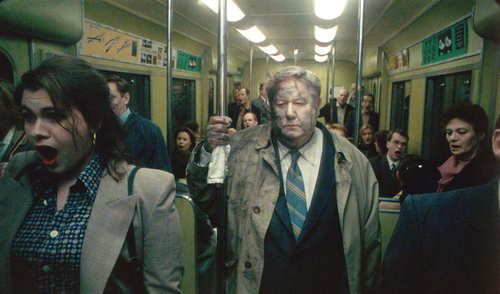
Our protagonist Palle has cheated his best friend and has burned down his own furniture store for the insurance money.  He moves through the city and the subways with his face streaked with soot from the fire.  His son is a poet who has been hospitalized for catatonic depression. Palle is followed the the ghost not only of his friend (dead of suicide) but of several others, somewhat plaintively trailing him through the city.

He now tries to get by selling crucifixes, but no one is buying.  In the final scene, a fellow salesman angrily unloads his unsold collection, throwing them on a garbage pile, asking “what made me think I could make money on a crucified loser?”  In a sense many of the film’s character can be seen as “crucified losers” within a stagnating European economy that has left them stranded and hopeless.  In an early scene, a man who has been laid off simply grasps his boss’s ankles, repeating “but I’ve been here thirty years…” as his boss awkwardly moves away from our perspective in a long hallway, dragging his burden.

“Ingmar Bergman meets Monty Python” is a line that people keep citing about the film (from the Village Voice I believe) and it does capture the feeling well.  On the one hand, this is challenging foreign film art, with austere style, grim themes, and a forbiddingly erudite range of reference and allusion to film, visual art, and literature (the film begins with a dedication to the Peruvian poet César Vallejo and this line of his is a recurring manta: “beloved is he who can sit down”– his work is given to Palle’s hospitalized, catatonic son.)  But, it is also often quite hilarious and filled with deadpan physical humor and absurdist wit.

I will admit that although I loved it, I started to fall asleep on Friday night and had to stop halfway through, then we finished it on my laptop the next night; I think I preferred it with the greater intimacy and closeness of the laptop in bed.

As the author of the Onion article I cite above suggests, the film, although made 11 years ago, feels very of the moment, very Occupy Stockholm, a depiction of a world/Europe collapsing under the strain of capitalist shock-doctrine tactics, greed, failed economic plans, mass underemployment, magical thinking of a sometimes pernicious kind.  Many of the characters are pasty, overweight white men with pancake makeup that can make them look either or alternately like vampires, or silent-film or theater clowns.  Mechanical rats scurry through the streets.

This was one of our favorite scenes, as inhabitants flee the city, trying to make a train, burdened by their enormous piles of their possessions.  The film is filled with  spectacular set-pieces like this one, in highly artificial, sterile, painstakingly constructed stages.  The laid-off businessmen in their suits struggle, grunting and heaving, to move their piles of junk as their own golf clubs fall down on them.

In what seems an allegory of panicked 21st century neo-liberalism, one of Pelle’s fellow displaced workers, shuffling his possessions like an injured turtle towards escape, shouts to him, “There’s a time for misery… But it’ll soon be over.  Just a few more yards, and we’ll have left this damned dump under the clouds for good!  As free men… Free at last!  And then we’ll only have ourselves to think about.  And we’ll do what we feel like.  Do we not deserve that?  Aren’t we worth it, when we’ve worked so hard?”

Meanwhile the uniformed railway employees wait silently.  We doubt Pelle and his friends will make it.

It is a pretty one-of-a-kind movie!  And, I have a feeling I did not capture this, but hilarious.

Eugenides’ *The Marriage Plot* as Neuronovel

Just finished Jeffrey Eugenides’ The Marriage Plot which I enjoyed very much.  [The following contains no big spoilers but I do discuss the book as a whole, which requires some hinting at the way the plot unfolds.] Of course, as someone who went to school at Brown/ in Providence (a decade after the book’s 1980s setting and graduate rather than B.A., though), there was some strong nostalgia operating for me or, perhaps not nostalgia, but personally interested recollection & testing of details (e.g., the diner where two character go to eat seems to be located right by my old apartment, although there was no diner there — could it have folded before my time?).

The book seems practically to be begging to be adopted as a final text in a course on “Anglo-American Fiction and the Marriage Plot.”  Consider this early riff about a class one of the three protagonists, Madeleine, is taking:

In [Professor] Saunders’s opinion, the novel had reached its apogee with the marriage plot and had never recovered from its disappearance.  In the days when success in life had depended on marriage, and marriage had depended on money, novelists had had a subject to write about.  The great epics sang of war, the novel of marriage.  Sexual equality, good for women, had been bad for the novel.  And divorce had undone it completely.  What would it matter whom Emma married if she could file for separation later?  How would Isabel Archer’s marriage to Gilbert Osmond have been affected by the existence of a prenup?  As far as Saunders was concerned, marriage didn’t mean much anymore, and neither did the novel.  Where could you find the marriage plot nowadays?  You couldn’t.  You had to read historical fiction.  You had to read non-Western novels involving traditional societies.  Afghani novels, Indian novels.

Eugenides does cash out this key early riff in various ways, as the eventual winding of the plot involves marriage, a choice between two suitors, a prenup, travel to India, and, for the sake of avoiding spoilers, I’ll just say consideration of various post-marriage options.

I am not sure I feel that these themes and ideas are played out in deep enough ways, though, to make this book that perfect choice for the contemporary final text in the marriage course that I’d been imagining (e.g. a course including books by Austen, Eliot, Wharton, Henry James, then finally Eugenides).  The problem is that the book seems to suggest in the end that Professor Saunders is correct.  The characters do still struggle over marriage and the question of whom to marry, but not very much is at stake in the literal or legal fact of marriage.  For a young couple today or in the 1980s who have not yet had kids, it is not too difficult to sever all ties, whether or not a marriage has occurred.  A divorce or annulment requires a lawyer, and individuals may (probably will) invest extra meaning in a marriage (as opposed to a “relationship” or what they used to call concubinage in the old days!), but Professor Saunders’s basic point (about society, anyway) seems true, and this novel bears it out.

So, I guess I was slightly disappointed by this aspect of the novel; if I had hoped that the novel would ultimately prove that Saunders was wrong — that “the marriage plot” still endures as a powerful structure for the contemporary novel — I was not really satisfied on this score.  Madeleine comments at one point on her honeymoon that

She felt as if she’d aged twenty years in two weeks.  She was no longer a bride or even a young person.

This reminded me of Dorothea after her honeymoon with Casaubon (an intentional reference I’m sure), but what has given Madeleine this feeling is her husband’s mental illness (which renders him Casaubon-like in certain respects, including in the bedroom), not marriage as such.  If Madeleine exits the marriage, will she be irrevocably changed, altered and damaged in the eyes of the world?  Not in the least, so The Marriage Plot can not really be a modern/domestic “epic” in the way Professor Saunders (and George Eliot) assert that nineteenth-century novels were.

One could make the case that The Marriage Plot jibes with the claim some have been making recently that the really crucial topics for the contemporary novel are not marriage & love but consciousness and neurology– in that we have a protagonist who is mentally ill and whose drama, as it unfolds throughout the book, necessitates intensive consideration of drug intake and the management of his faulty/erratic interior wiring.  (On Fresh Air, Eugenides flatly refuted the suggestion that the brilliant, manic, and bandana-wearing Leonard is modeled on David Foster Wallace; it’s indeed tempting to read him this way, as it gives the novel as whole additional layer of self-conscious reflection on recent literary history.  However, in support of Eugenides, it has to be said that Leonard can’t play tennis and finds the game off-puttingly elitist (D.F. Wallace of course was a teenage tennis champion); this almost seems suspiciously planted as a red herring, though…)

In fact, Madeleine’s error, as a nascent scholar of Victorian fiction, may be that she misreads literary history and her own lover: she believes she is living in a Marriage Plot but she is actually a protagonist of a Neuronovel: “What has been variously referred to as the novel of consciousness or the psychological or confessional novel—the novel, at any rate, about the workings of a mind—has transformed itself into the neurological novel, wherein the mind becomes the brain” (Marco Roth).