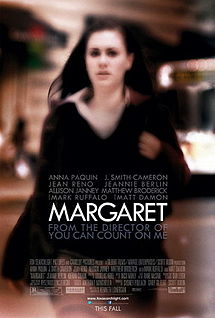
*Margaret* as Gerard Manley Hopkins film adaptation

Kenneth Lonergan’s 2011 movie Margaret, his vexed sequel to You Can Count on Me (you may have read the NYT Magazine piece on “Lonergan’s Thwarted Masterpiece”), could plausibly considered as a film adaptation of Gerard Manley Hopkins’ great poem “Spring and Fall.”  That’s pushing the boundaries of how we usually define an adaptation, but the movie can serve as an intriguing limit case for how far the concept can be stretched.

Here’s the poem:

Márgarét, áre you gríeving
Over Goldengrove unleaving?
Leáves like the things of man, you
With your fresh thoughts care for, can you?
Ah! ás the heart grows older
It will come to such sights colder
By and by, nor spare a sigh
Though worlds of wanwood leafmeal lie;
And yet you wíll weep and know why.
Now no matter, child, the name:
Sórrow’s spríngs áre the same.
Nor mouth had, no nor mind, expressed
What heart heard of, ghost guessed:
It ís the blight man was born for,
It is Margaret you mourn for.

One of many details about the film that the producers probably were not crazy about is the fact that there is no character in it named Margaret.  The movie stars Anna Paquin as Lisa Cohen, a troubled Manhattan private school teenager (Paquin is 30 now with twins but was only 23 or so when the movie’s shooting wrapped in 2005), raised by an actress single mother, who witnesses and bears some responsibility for a tragic bus accident that leads to a pedestrian’s death.  The movie reminded me to a surprising degree of the excellent recent Iranian art-house hit A Separation: both movies use a similar structure to explore the legal, psychological, and ethical aftermath of a deadly accident, paying close to attention to the impact on this process of class differences and class privilege.

I thought Paquin gave a really good performance as Lisa, a pretty insufferable yet, to me, still sympathetic, spoiled and unhappy teenager trying to figure out how to be an ethical person or how to respond ethically to a tragedy.

Lisa is Hopkins’ Margaret (King Lear is another intertext, by the way).  The main thrust of the movie explores the process by which she “weeps” and “know[s] why,” coming to “sights colder” and encountering the “blight man was born for”, namely an understanding of death and loss.

The movie is very interested in pedagogy and classroom experience and how “learning” of various forms occurs.  Two of the primary supporting roles are played by Matthew Broderick (who apparently ended up bankrolling part of the film) and Matt Damon as teachers at this Dalton or St Ann’s-like NYC tony private school.  The Damon character is specified as being from Indiana, so you know he’s upstanding and a bit naive. You really start to feel for these earnest teachers (or at least I did) as they struggle to teach and expand the horizons of their very bright, privileged, rather unbearably narcissistic charges.  (Although I also felt a little envious at how quick the students are to talk and argue in class!)  The title of the movie comes from a particular scene where Broderick is teaching “Spring and Fall”, but the themes of the poem extend throughout the movie as Lisa undergoes hard lessons in self-awareness and moving beyond her self-centered worldview.

I just found this “interactive feature” that tries to match short clips from the film to particular lines in the poem— I think the connections could use some further glossing, though (I just watched the video for “And yet you will weep and know why” and am not clear why the makers of this widget chose that scene in particular for this line).

We watched the 150-minute theatrical release, but now I kind of wish we’d gone for the three-hour director’s cut.  The version we saw is a strange and somewhat awkward movie but also at times a ravishingly beautiful one that offers all kinds of food for thought — I haven’t even touched on what it does with theater and opera (the moving final scene involved a kind of catharsis as Lisa and her Broadway actress mother watch Offenbach’s The Tales Of Hoffmann at the Met) or how it works as a post- 9/11 movie exploring the consequences of that trauma in and for NYC (remember, shooting was completed back in 2005).

This is a good piece, from a blog about music in film, that presses on a line from the movie, Lisa’s protest, “My life isn’t an opera!”  As the author of the blog argues, Margaret ultimately does become not just operatic but a kind of opera in film.  And I think one could make a similar claim about the film’s relationship to Hopkins’ poem.  All in all, it’s a movie with interesting things to say about cross-media representations and influences.

Don Winslow’s *Savages*: A Narrative of the Captivity and Restoration of O.

Is there a verb for going back to read the book that inspired a new movie?  Retroreading or some such?  I have not seen Oliver Stone’s adaptation of Don Winslow’s novel Savages but was inspired by the coverage of the movie (and reviews of the novel’s sequel) to check it out.

I get why it was popular/successful… it has a Quentin Tarantino/ Elmore Leonard / James Ellroy hipness, speed, sex, violence and general nastiness that makes for a quick and in some ways fun read.  I didn’t love it, though.

One problem: I found the basic premise of much of the story to be implausibly silly.  (Spoilers to follow, but I won’t give away the actual ending.) The high-end Berkeley Laguna Beach [Ben’s parents are Berkeley liberals and he went to UC Berkeley] pot dealers Chon and Ben cross a brutal Mexican drug cartel who respond by kidnapping their friend/ shared girlfriend/ girl-toy Ophelia a.k.a. “O” and threatening to behead her if Chon and Ben fail to comply with every demand.  Our Laguna stoner young men in turn start putting on masks and robbing the drug cartel… who for some inexplicable reason can’t seem to decide if this sudden string of bold robberies, performed by two tall white men in masks, might just possibly be connected to Chon and Ben.  So they leave “O” alone and allow plenty of time for the revenge/recapture of O plot to unwind.

I also think the book is ultimately racist in effect in ways that turns up the general nastiness/nihilism factor to an uncomfortable degree.  Every brown-skinned person in the book, pretty much, is a disgusting, sadistic, torturing thug. (There are some semi-exceptions like O’s relatively good-hearted guard.  Aww, he loves his girlfriend!)  The book turns into what’s hard not to read as an allegory of slacker white America shaking off its pot lethargy and rising up to kick the ass of the brutal brown invaders.

This theme is laid out explicitly towards the end:

Chon has read a lot of history.

The Romans used to send their legions out to the fringes of the empire to kill barbarians.  That’s what they did for hundreds of years, but then they stopped doing it.  Because they were too distracted, too busy fucking, drinking, gorging themselves.  So busy squabbling over power they forgot who they were, forgot their culture, forgot to defend it.

The barbarians came in.

And it was over.

Winslow to some degree protects himself against accusations of racism with occasional ironic shifts in perspective when we see that to some of the Mexican narco-terrorist types, it’s Chon and Ben and O., in their shiftless Anglo ways, who are are the “savages.”  I didn’t really buy it, though, and it’s not enough of a counter-weight against the morbid wallowing in visions of the sadistic kingpin Lado contemplating the rape and then beheading of O.  It’s a classic old-fashioned captivity narrative with the beautiful Anglo in the clutches of the dark-skinned savage, with all the suspense of the narrative depending on the question of whether she will be rescued before she is raped.

[That one of our heroes is named “Chon” is perhaps symptomatic of the tensions/ambiguities around ethnicity in the novel… it sounds like a Hispanic name, but it’s actually a nickname for John]

The nastiness is often witty but felt too xenophobic/racist in worldview in the end for my tastes.  And the premise of the revenge plot just didn’t make sense to me.  That said, it does have style to burn and can be pretty funny.

I’ve read very mixed reports on the Oliver Stone movie: some seem to see it as a return to form and his best film in years, but I’ve seen a couple reviews that call it borderline unwatchable and absurd.

“‘Good-bye, everybody!'”: Hart Crane Revival in *The Paris Review*

I started subscribing to the Paris Review a while ago and enjoy it– find it consistently interesting/good to great.  I think what may have spurred me to start subscribing was the serial publication of the Roberto Bolano novel The Third Reich last year.  Other good recent-ish contents that come to mind: the Wallace Shawn interview in #201; a portfolio of “anonymous photographs of children from the personal collection of Terry Castle” in issue #198.  The art portfolios always tend to be interesting and the fiction is almost never boring or predictable.

Got the new issue #202 the other day.  What has leapt out at me about it, thus far, is that it contains TWO different stories that include reference to Hart Crane’s supposed last words.

David Gordon’s “Man-Boob Summer”: the 38-year old narrator seems to have recently finished a Comp Lit thesis and is depressed and living for the summer with his parents.  He starts flirting with the young lifeguard at the apartment complex’s pool who is reading Crane’s Collected Poems.

“You know what his last words were? As he jumped off the steamship?”

She was watching me very closely now.  She shook her head.

“‘Good-bye, everybody!'”

She laughed abruptly, a short burst, and covered her mouth with her hand.

“It’s true,” I said.  “I think, anyway.  I read it somewhere.”  And then while I wasn’t looking, she kissed me.  (p. 28)

And Sam Savage’s strange, long “The Meininger Nude,” narrated by a dyspeptic, dying art collector:

I was always fascinated by great-artist suicides.  By Hart Crane, for example, who called out, ‘Good-bye, everybody,” before leaping from the stern of a steamship.  He was 270 miles North of Havana, returning from a year in Mexico, where he had written nothing.  (p. 90)

Coincidence?  Something else?  Will I find any additional citations of this line as I keep reading the issue?

Dylan’s *Tempest*, *Where’d You Go, Bernadette*, *Homeland*

Several great things I have recently read/seen/heard:

The new Bob Dylan album Tempest (I try not to buy everything on Amazon these days but I will note that it is $5 for the Mp3s on Amazon).  I’ve only listened to it 2-3 times can say that it continues his amazing late-career run.  For a long time I took for granted that nothing Dylan had done since 1975 (Blood on the Tracks) was even remotely in the same ballpark of quality or significance of much of his music before that point.  But ever since, I guess, World Gone Wrong in 1993 it’s all been great, much of it amazing.  (I don’t know about Christmas in the Heart, I gave that to my dad for Xmas but have not really checked it out myself!)   Some of the new one sounds like, I don’t know, Western Swing, Johnnie Cash, Nashville Skyline; weird, craggy, old-timey; funny, tender, & mean.

Where’d You Go, Bernadette.  This is the funniest book (novel) I have read in quite some time– totally sharp, witty, entertaining, and moving too.  The author, Maria Semple, used to write for Arrested Development so the funny part is not surprising.   One reviewer sums it up pretty accurately as “a wry slice of a life– one that’s populated by private school helicopter parents, obsessively eco-conscious neighbors, and green-juice swilling, TED-talking husbands.”  The social satire is hilarious and spot-on even for someone who doesn’t know Seattle– Seattle stands here for a certain kind of techie contemporary bourgeois bohemian that one finds everywhere.  The private school shenanigans are priceless. What’s most immediately impressive and amusing is Semple’s facility with the different voices, jargons, and styles contained in all the documents she incorporates seamlessly into the novel — which is a dossier of texts, somewhat in the style of Clarissa or Wilkie Collins’ The Moonstone, I suppose, with no real central narrator but only Bernadette’s 8th-grade daughter, who (we eventually figure out) has collected the set of texts and is collating them and turning them into a narrative.  There are emails back and forth from various parties; a psychiatrist’s report; memos from the head of the not-quite-A-list Seattle private school; a cruise ship’s log; a news article or two; tributes by famous architects to the protagonist Bernadette, who designed an influential early “green”/eco house, won a MacArthur, and mysteriously retired; some IM messaging within Microsoft’s system, etc.  In this way it brings to mind A Visit From the Goon Squad a tiny bit — and there’s one riff about the pauses between songs on a CD that almost seems a homage to Egan’s novel — but the mode is more brightly comic and satirical.

Homeland, the Showtime show starring Clare Danes.  Season one is recently out on DVD and we are devouring it (waiting for the 3rd and final DVD to arrive).  Danes is fantastic and the show is addictively suspenseful– I’ve never seen 24 but I imagine it has some things in common with that?  It is, interestingly, a remake of an Israeli t.v. series.  Danes plays a somewhat unstable C.I.A. officer who has become convinced that Nicholas Brody, a war hero and former POW recently captured and brought back from Iraq, is in fact a mole or double agent who was turned by Al Quaeda.  Three episodes left and I do not know how it’s going to turn out, although I have some theories.  Season Two starts pretty soon.