Budos Band & Charles Bradley rectify the situation

Some of the Daptone Records gang came to town on Friday.

I had not heard of Charley Bradley, and so was happy to learn when we arrived that he was another Daptone recording artist who’d be singing with members of the Budos Band.
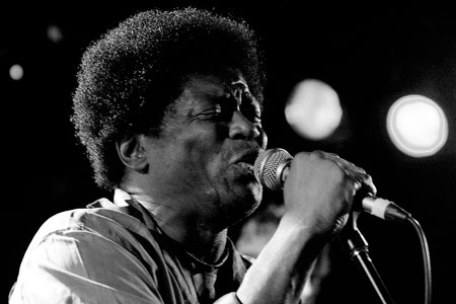
He was great!  A very affecting performance.  Bradley was born in Brooklyn in 1948 and saw James Brown at the Apollo in 1962.  “Brown’s energy formed a lasting impression on Charles. He went home and immediately began practicing microphone tricks with a broom attached to a string, imitating the Godfather’s every move.”  He first put together a band in Bar Harbor, Maine (!)– but all his bandmates were drafted for Vietnam, and he ending up finding “work as a chef in Wassaic, New York at a hospital for the mentally ill” and working as a cook for years while playing music on the side.

“Charles finally found an audience when he began making appearances in local Brooklyn clubs performing his James Brown routines under the alter ego “Black Velvet”” and he was discovered by Daptones Records at a Black Velvet performance at Bushwick.

It makes sense that Bradley is/was a professional JB imitator, as his voice is a dead ringer for the King of Soul’s, minus a lot of the vocal/melodic range; it’s a blunt instrument, but on stage he combines it to entertaining effect with JBesque moves, mostly performed fairly slowly and deliberately; he still does some of those “microphone tricks.”  Bradley’s a stocky guy, not too tall, in his early 60s and not unusually spry for someone of that age, dressed last night in very shiny and loose suit pants.  The crowd gave him a lot of love and he kept saying “I love you too!” and touching his heart and gesturing out to us all.

Here he is (at SXSW this year) performing “Heartaches and Pain,” about the murder of his brother.  Bradley starts singing about 2 minutes in.  The guy can really wail, and he exudes emotion. There’s something potentially awkward in this 60-something year-old African-American soul singer who’s been somewhat battered by life, “discovered” and brought on tour for a 95% white hipster college-town audience, but in practice it all felt very sincere and authentic.  The soul was real!

The Budos Band are an interesting group — an all-instrumental band with 10 or so people on stage, lots of horns and percussion, playing music that sounds straight out of 1972 or so, a heavy Afro-Cuban groove with a particular debt to Fela Kuti and other Afrobeat music of the 1970s.  It’s great dance music, and in person was a bit harder-hitting and decadent-feeling than I’d expected.  The music is so retro (& in eminently good/hip taste) that I thought they might have a slightly music-nerd/curatorial vibe, but they were sloshing down the Jameson’s (one of the percussionists kept sharing his bottle with two drunk girls w/ pigtails in front) and the front man (well, the guy who spoke to the audience) was prone to make comments like “so if you don’t have a copy of the Cobra [meaning Budos Band III] in your fuckin’ hands, now’s your chance to rectify that motherfuckin’ situation.”

In appearance, every member of the band could be placed on a Venn diagram chart somewhere between these poles: Al Pacino as Serpico; Zack Galifianakis; Hasidic student.  Scraggly beards up the wazoo.  The guy in the middle of this photo dropping dirt from his hands roamed the stage wielding his bass to charismatic and somewhat intimidating effect.  Here’s a video from 2010 (although they looked less hairy then).

It was fun to be at a rock show with so much dancing.  A maybe 50-ish woman next to us was rocking out in a major way.  We had to leave early for the sitter, but I bet they played for quite a while.  They’d be great for the Lotus Festival.

Heathens: Belief & Believing in the Drive-by Truckers

I finally saw the Drive-by Truckers live at the Bluebird a couple nights ago.   Great show! In a usefully thorough recent overview piece, Robert Christgau dubs them “the most productive good band on the planet” since 1998.  It’s not as catchy as “the only band that matters” or something like that, but there is something about the DBT’s that calls for that kind of measured exuberance.  I think it may be partly a matter of genre.  I’m tempted to call them the best/ most consistently good “rock” band of the past decade or so (all of their albums are good and there are really no crappy songs; Xgau considers Brighter Than Creation’s Dark clearly their best, but they tend to blend together for me on my ipod), but what is “rock” these days?  For my own archival purposes on iTunes, “rock” basically is only older pre-punk music.  I have the DBT’s under “Americana,” an admittedly stupid genre category that serves an organizational purpose in capturing a particular slice of a Venn diagram between country and “alternative” w/ people like Gillian Welch, Frazey Ford, etc.  They live in the contemporary world, musically — they’re not throwbacks or classicists, and in a way, their Southern Rock Opera is to Lynyrd Skynyrd what the Dirty Projectors’ Rise Above is to the Black Flag original — a rethinking and appropriation that recognizes the musical past as a set of codes to play with and re-deploy. But they also stick to a country/soul/ rock approach to pre-punk structured song-craft, and work within pre-existing forms in a mode of acceptance that is technically “conservative,” that makes “rock” seem like the best catch-all category for them.  (That is, they lack that attitude, pretty basic to all post-punk or “alternative” rock, of needing to defy tradition and signal emphatically that they are something very much other than what you might hear on a classic rock station.)

They went on around 10:20.  I had just come back from a conference so was beat and left early, and heard the next day that they ended up playing until 1:00.   For a while I felt slightly confused by the crowd at the Bluebird.  It wasn’t a hipster crowd at all, but also didn’t quite seem like the roots/country/Americana Bloomington audience.  It finally hit me that there seemed to be a bunch of jam-band fans in the room — white guys with dreads, a number of Widespread Panic t-shirts.  I don’t fully understand the jam-band world, but the DBT are a great live band and they get a bit loosely stretched-out on the guitar solos — they really shred — so I guess I can see why a Dead and Phish fan might get into it.

A few of my favorite DBT songs–

“Dead, Drunk and Naked” (Southern Rock Opera). When I was a young boy I sniffed a lot of glue/Mom sent me to rehab, they told me what to do/ We didn’t have much money; the lord picked up the tab/ They made me write him love songs, sitting in my room./ Now I just drink whiskey and drive around my friends./ Get a haircut, get a job, maybe born again/ And if you’re living badly, we’ll tell you how to live/ Dead, drunk, and naked.”  This probably has their single catchiest/ most irresistible guitar riff. (“The Day John Henry Died” too, maybe.)

“Heathens” (Decoration Day).  A gently strumming one w/ pedal steel and plangent fiddle. The lyrics to this one absolutely kill me: “Something about the wrinkle in your forehead tells me there’s a fit about to get thrown / If we get the van out of the ditch before morning ain’t nobody got to know what I done/ And I never hear a single word you say when you tell me not to have my fun / It’s the same old shit that I ain’t gonna take off anyone./ And I don’t need to be forgiven by them people in the neighborhood/ When we first hooked up, you looked me in the eye/ And said Pa, we just ain’t no good/ We were heathens in their eyes at the time, I guess I am just a heathen still/ And I never have repented from the wrongs that they say I have done/ I done what I feel.” Patterson Hood describes this as one of a “divorce trilogy” of songs on the album, also including the very sad “Something’s Gotta Give:” “Something’s got to give, got to give pretty soon/ Or else we’re gonna hate each other/ And that would be the saddest thing I ever seen.”

So many of their songs are about religion, ministers, churches, god (the new album’s title track, “Go-Go Boots,” is about a minister who has his wife murdered: “He was a pillar and his alibi was sturdy/ It only took a little bit of cash and the deed was done”).   Whether or not there’s actual “belief,” even if they are “heathens,” they live in a world saturated with religion.  Even their early album title, Pizza Deliverance — they can’t stop making jokes about it; I guess growing up in Alabama does that to you.  “Heathens” is (like most of their songs) about class as well as religion: “Pa, we just ain’t no good” — growing up feeling like you’re not worth that much or don’t matter. (The deep South as a geographical ghetto of the U.S.; the DBT’s first album was called Gangstabilly.)  Patterson Hood has at least a touch of ministerial charisma at the mike, too, testifying with outstretched arms.

“I Do Believe” on the new one is interesting to consider in relation to belief.  It’s a super-catchy, poppy one, and one of those devastating lyrics, really moving, about Hood’s memories from childhood of his mother: “I do believe I do believe, I know that you would never leave me/ And when you slipped the earthly binds you still live in my mind/ And when I’m gone, again I’ll find/ My way back into your kitchen/ And see you standing there in the window’s shine.” So it’s not about belief as “faith” exactly, but belief that he can still picture or imagine his mother: “I do believe I saw you standing there/ Sunlight in your hair/ Reflecting in your eyes/ I was only five years old.”  So, maybe it’s belief in something supernatural or spiritually transcendent, or maybe it’s just an expression, i.e. “I do believe I can still picture you.”  But as often happens in their songs, some sense of “faith” or “belief” accompanies the song in a way that’s hard to pin down precisely.  Maybe it’s that see yourself as a “heathen” is to accept a religious worldview in a way that few non-country (or gospel) bands/singers today do.  They’re not exactly still writing the Lord love songs in their bedrooms — well, or maybe they are, the songs just got a lot more complicated and ambivalent. [Reader AS reminded me of another line that captures this dynamic well, from Hood’s “The Righteous Path:” “I don’t know God, but I fear his wrath/I’m trying to keep focused on the righteous path.”]

They played “Box of Spiders” on Sunday, that’s a great and weird one: “My great-grandmother’s about ninety-seven/ And she is sure when she gets to heaven,/ Old St. Peter’s gonna throw his arms around her and say/ ‘I’ve waited so long for us to meet’.”  Gran Gran seems to be losing it, and the song ends:”Too mean to die. Too mean to die. Too mean.”  It’s dedicated to Gran Gran.

[p.s.  I realize I’ve only written about Hood’s songs, but Mike Cooley has tons of great ones as well…]

They are so good!  As I’m writing this I’m poking around and remembering absolutely amazing songs I had forgotten (e.g. “One of These Days” from Pizza Deliverance). Go see them!

“Are we truly the crocodiles?”: Herzog’s “Cave of Forgotten Dreams” at IU

We were very excited to catch what was apparently the first commercial/non-festival showing of Werner Herzog’s Cave of Forgotten Dreams in the U.S.  This showing was introduced by Jonathan Sehring, president of IFC Entertainment, which is distributing the film.  He buttered us up in a nice way, effusing that “This is one of the best, if not the best, theaters I’ve ever been in… It’s a spectacular venue. You guys are very, very lucky.”  Maybe he says that to all the girls, but it gave me a warm & fuzzy (/smug & self-satisfied) feeling inside.

Apparently inspired by Judith Thurman’s article in The New Yorker about the neolithic cave paintings in Chauvet Cave in southern France, Herzog managed to receive permission from the French government to be the first and perhaps only filmmaker to be allowed in to see and film the paintings.  In 1994 some hikers/explorers stumbled on this incredible find: hidden within a rockslide from thousands of years ago, they discovered hundreds of spectacular wall paintings, mostly of animals, dating from about 32,000 years ago.  Here’s Wikipedia’s summary:

Hundreds of animal paintings have been catalogued, depicting at least 13 different species, including some rarely or never found in other ice age paintings. Rather than depicting only the familiar animals of the hunt that predominate in Paleolithic cave art, i.e. horses, cattle, reindeer, etc., the walls of the Chauvet Cave are covered with predatory animals: lions, panthers, bears, owls, and hyenas. Also pictured are rhinos. Typical of most cave art, there are no paintings of complete human figures, although there is one possible partial “Venus” figure that may represent the legs and genitals of a woman. Also a chimerical figure may be present; it appears to have the lower body of a woman with the upper body of a bison. There are a few panels of red ochre hand prints and hand stencils made by spitting pigment over hands pressed against the cave surface. Abstract markings—lines and dots—are found throughout the cave.

Because of the bad experiences at Lascaux, where (Wiki again) “since 1998 the cave has been beset with a fungus, variously blamed on a new air conditioning system that was installed in the caves, the use of high-powered lights, and the presence of too many visitors,” Chauvet is now completely inaccessible to the public.  So if you want to see the paintings, you gotta see Cave of Forgotten Dreams.

I found the movie to be a slightly odd combination of really excellent Discovery Channel-type archaeology documentary (this describes let’s say 75%-80% of the film) and characteristically whacked-out Werner Herzog film (the remaining 20% or so).  When I first heard the phrase “Werner Herzog 3D cave painting documentary” a year ago, I guess I imagined something different, something stranger, so at one level it was a bit disappointing to find scenes like the following: Shot of four scientists sitting in a generic white office-style florescent-lit room.  Herzog’s voice-over: “The scientists were housed in a nearby sports complex.  Although they each possess particular specialties, they share their work collaboratively” (something like that).  Cut to the laptop screen of two nerdy scientists explaining a graph.

That is to say that the two aspects of the movie, the earnest Discovery Channel-style documentary and the whacked-out Herzog film, often felt to me somewhat in conflict. Some of the most Herzogian scenes involve scientists and others involved in the project whose obsessions and idiosyncracies he draws out and dwells on to amusing or defamiliarizing effect.  There’s the “Perfumer” who walks around the surfaces outside the cave, smelling the ground, trying to sniff out undiscovered chinks or crevices.  (I remained a bit confused about whether he was an actual member of the investigating team or just a local amateur.)  Or the scientist whom Herzog films dressed in his deerskin Inuit costume performing a rendition of “The Star-Spangled Banner” on animal bone flute.  Or the affably nerdy, bristly-moustachio’d scientist (the 3D really brings out the moustache) who demonstrates, badly, the technique of spear-hunting with a small sling.  I guess the problem for me was that these scientists, unlike many of Herzog’s previous documentary subjects (e.g. Timothy Treadwell), do not in fact seem bizarrely or inexplicably obsessed.  They are dedicated to their work, for obvious and good reason; sometimes when Herzog tries to draw out their oddities (as with the anthropologist who, it turns out, used to work as a circus performer), these eccentricities seem somewhat beside the point.  This isn’t exactly Klaus Kinski in the jungle of Peru, and none of the scientists seem all that strange.  Herzog specializes in depictions of obsessives whose objects of fascination do not make rational sense; these cave paintings cannot be explained by reason alone, but anyone’s fascination with them is perfectly easy to comprehend.  (Sarah pointed out that it was a little surprising that Herzog spent so little time discussing competing anthropological/archaeological theories about the ritual practices of these neolithic peoples, which would seem to offer ample opportunity for Herzogian musing on primitive urges and practices.)

There’s also a sort of coda featuring some albino crocodiles, supposedly the product of genetic mutation from nearby power plants, who inspire Herzog to wonder, “Are we truly the crocodiles who look back into the abyss of time? at the neolithic artists of the cave paintings.  (Sehring wryly noted that at a public appearance last year, Herzog blithely declared that all the stuff about the albino crocs was completely fabricated, which Sehring implied poses a marketing challenge for a documentary.)

The crocs felt like classic Herzog (not least in their uncertain positioning on the fiction/documentary border), but then so much of the rest of the film is a much more earnest and straight-forward examination of the cave paintings, in the context of which some of his vatic pronouncements can seem a bit silly or extraneous.  (Speaking of his vatic pronouncements, ever since I discovered the brilliant “Werner Herzog reads classic children’s story books” series on Youtube I sometimes find myself giggling a bit at the sound of his voice.)

No question though that I would not want to miss the loving, rapturous exploration of these amazing and very mysterious images, which Herzog convincingly describes as “proto-cinematic” in their capture of animal motion; the 3D technology does not feel like a gimmick but an opportunity for something close to an in situ experience of them.  And, despite some of my reservations, Chauvet Cave does make perfect sense as one of Herzog’s sites of wildness and mysterious otherness, a sealed-off zone of otherworldly creation that, no matter how fully we study and chart it out, we will never fully understand.

Killing “The Yearling”

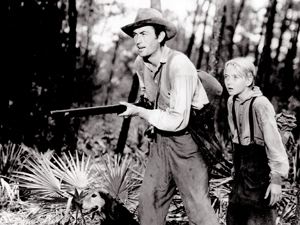
This was a heavy one. I’d taped it off TCM and before watching it with the kids, I did a quick look at the reviews on Netflix; on the first page they were all saying “classic film, great family movie,” etc. It’s really good: Gregory Peck and Jane Wyman as the husband and wife homesteading in the Florida swamps in the 1870s, and Claude Jarman Jr. as their 12 year old (?) son Jody. Jarman was one of those slightly melancholy child stars who never made it as an adult actor.

It was filmed on location in Florida and the sense of place is wonderfully vivid. Sarah had just read that new novel Swamplandia so she especially enjoyed the depiction of the swamps.  The basic plot is that the little family is, with difficulty, trying to eke out an isolated living with their only human companionship some slightly scary neighbors a couple miles away.  Jody has a warm relationship with his dad, but the Jane Wyman mother character is critical and cold; we soon learn that she lost three previous children (we see her looking at their gravestones) and so she withholds affection from Jody out of fear of being hurt once again.

There’s an intense scene of bear-hunting in the swamps: the black bear tussles with and tosses around the family’s dogs, and Pa’s rifle sticks so he nearly blows his own face off.  Later dad is bitten by a rattlesnake and only Jody’s valiant bravery allows him to (just barely) survive.

The main dynamic of the movie involves Jody’s desire for a pet, something he can love.  Ma doesn’t think they can afford the costs of keeping another animal in the house.  (I was never quite clear why the dogs couldn’t do it for Jody; he needs something all his own).  A pretty strange emotional system is operating in the household.  Ma withholds her love.  The son, as a response, needs something else to love, but Ma forbids this.  The stalemate breaks in a somewhat overdetermined manner.  After Pa is bitten by the snake, he pulls up his gun and shoots a doe, which he then commands Jody to go to, cut open her belly, and pull out her heart and liver to place on his wound to drain the poison.  Jody does this, which apparently saves his father; they then notice that the doe had a baby faun with her.  They rush back to the house, but once it seems that dad is pulling through, Jody asks permission to go fetch the faun as a pet.  This time Ma can’t say no, and so the adorable little creature becomes a member of the household.

Trouble develops when the faun, whom they’ve named Flag, turns into a yearling, a mischievous, hard-to-control older animal.  When Flag eats the family’s desperately-needed garden crop one time too many (they were counting on selling tabacco as a cash crop to pay for a new well so Ma would not need to carry water a half-mile), the still-bedridden Pa commands Jody to kill the deer.  He refuses, and so Ma has to do it.  She’s a bad shot and only wounds the animal, so Jody has to finish Flag off.  Jody tells his parents he hates them, runs away, collapses on an abandoned boat in the swamp, is found on the river and returned home.  He now accepts that Flag did have to be killed; he himself is now no longer a yearling but a man.  Ma can love him unconditionally (with no competition from Flag).

Now, on the one hand, there’s a realistic logic to all of this and I can imagine a scenario of this sort actually unfolding in these circumstances.  I even felt it was at some level a useful thing for the girls to think about, the hardship and difficulties people used to endure that would lead them to such a dilemma.

That said, the whole movie does play out as a somewhat bizarre lesson in the necessity of killing the creature you love.  After all the upbeat reviews on Netflix I came across this more critical (one-star) one:

This is another one of those message films about animals that were so popular during the 1940s and 1950s. These films warn that if a child or adult dares to elevate an animal to the level of a human, they will pay for it. The main theme is this: Beware of loving an animal too much–this is a childish notion and practically a sin. This misguided love will come back to hurt you in the end. Another example would be The Red Pony with Robert Mitchum. Fine actors such as Gregory Peck and Jane Wyman (or Robert Mitchum in Red Pony) cannot take away from the terrible sadness of these films. If you’re an animal loveing adult or a child, this is one you should avoid.

This commentator does have a point; there’s a certain sadism in the way the movie encourages you to love Flag as much as Jody does and then to face up to the necessity of destroying him.  Again, these sorts of choices did have to made, I’m sure, but there’s something pointed in the way this movie (and some others of the period) develop the narrative around precisely this dynamic.  And in this case there seems to be an especially odd sacrificial logic at play.  (A) Jody’s siblings all died, so his mother cannot love him fully.  (B) He therefore needs an animal to love.  (C) But the necessary cost of earning his mother’s unequivocal love is to kill that animal (which was literally taking water and food out of her mouth). (D) Also: to be a man is to kill the animal (Ma can’t actually kill Flag, Jody must do it in the place of his father).   (E) And don’t forget that Flag could only join the family because its mother, the doe, served as an organ donor to save Pa.  So the animal is needed, but not to love, only as a resource, something to be “harvested” like a crop.  (Jody had actually allowed Flag to curl up on his bed, which seems a fundamental taboo.)

The girls were not as upset by it as we expected, possibly b/c we took a break and then watched the last 45 minutes the next day after explaining what happens.

This is Your Life, Genocide Edition

I take This American Life for granted and often it can seem too familiar and predictable. Some of the more famous voices on the show grate on me, and the giggles, awkwardness and teenager-y cuteness can feel contrived; sometimes I just want them to sound like grownups.  Yet, not so rarely they come through with something pretty great that you wouldn’t hear elsewhere.  Jogging the other day I listened to this pretty amazing piece about a few episodes of This Is Your Life from the 1950s that brought the show’s usual approach to the challenging realm of atrocity survivors.  TIYL was of course a hugely popular show with an audience of many millions; it was hosted by Ralph Edwards, who also taught Sunday School and was one of those 1950s reassuring voices of a benevolent status quo.

The This American Life piece (btw, it occurs to me that the show’s name must be indebted to This is Your Life — duh, I guess) is about a couple of jaw-dropping episodes in which Edwards brought (under false pretenses — guests were almost always surprised) on the show, to be confronted by friends and associates from their past, first, a Holocaust survivor (according to This American Life host Allison Silverman, the first person to discuss her experiences in the camps on American television), second, a Hiroshima survivor.  The first one:

“This is your life, Hanna Bloch Kohner.”

“Oh no!”

Oh, disturbingly, yes.  In May 1953 Edwards surprised Hanna Bloch Kohner, whose apparent dismay at having her life story told could have had something to do with the fact that a lot of her life was a staggering nightmare.

“Can I say, Ms Kohner, that looking at you, it’s hard to believe that during 7 short years of a still short life, you lived a lifetime of fear, terror and tragedy.  You look like a young American girl just out of college, not at all like a survivor of Hitler’s cruel purge of German Jews.”

Hanna Bloch Kohner is a Holocaust survivor, although the word Holocaust wouldn’t commonly be used for another eight years.

As Silverman goes on to explain, Kohler goes through the usual This is Your Life series of surprises, although the people she’s confronted with are not grade-school buddies or teachers but, for example, the friend with whom she went through Auschwitz.  The combination of Edwards’ patriarchally plummy tones, the 50s Hollywood game-show setting, and Kohner’s descriptions of her experiences in the camps (narrated in her pronounced Czech-Jewish accent) is just surreal and incredibly bizarre, like a George Saunders story, really.  Silverman’s best line is in regards to a promotional piece of jewelry presented to Kohner for appearing on the show; as Silverman quips, “it must be hard to design a Holocaust charm bracelet.”

The piece then discusses another TIYL episode, this one featuring Hiroshima survivor Kiyoshi Tanimoto.  As part of his big surprise, he gets to meet… Robert Lewis, one of the co-captains of the Enola Gay, who dropped the bomb that killed on the order of 100,000+ of Tanimoto’s friends and family.  Awkward, to say the least.  Lewis seems like a wreck.  Apparently he and Tanimoto kept in touch after the episode.

The episodes can certainly seem from our perspective to be in unbelievably poor taste, but as Silverman suggests, they were important in bringing this material to a U.S. mass audience in a sympathetic and basically respectful manner.  And both Kohner and Tanimoto seemed to have been very pleased with their episodes, regularly showing visitors the 16 mm. video they were given as a memento (I believe Kohner actually toured with the film to raise awareness).

A clip from the Kohner episode of This Is Your Life is on Youtube, I’ve just realized, check it out.  Also here’s a Der Speigel article about Kohner.

David Vann’s “Caribou Island:” Frost-Bound World

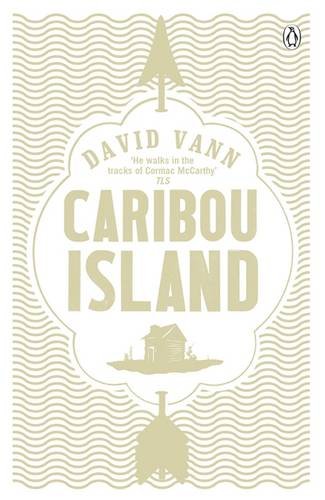
David Vann’s Caribou Island is a pretty intense read.  It’s the story of the disintegration of the marriage of Gary and Irene, who are in their late 50s or so.  They met at Berkeley where Gary was working on a (never-completed) PhD in Medieval Studies; they ended up in Alaska, where, it becomes clear, he has been pursuing some kind of fantasy about the sort of pure, pre-modern/pre-industrial community that he had formerly studied in Icelandic and English epics.  Gary recites lines from the Anglo-Saxon elegy The Seafarer in the woods — “frost-bound world/ hail fell on earth/ coldest of grains” — and obviously sees himself as some kind of modern Seafarer.  Gary has now decided they must move from the mainland to a deserted island where they will live in a simple wood cabin that Gary, with no training and having not even consulted a manual, will build by hand as the early Alaskan winter closes in.  Irene is sure Gary will leave her if she resists, so she goes along with it, sometimes complaining bitterly.

The level of bitter marital invective and bile is quite high, e.g. “Fuck you;” “You think you deserved someone better than me;” “Maybe I did.”  “Why not punch me in the face?”  And — this an especially memorable one — “You’ve destroyed my life, you fuck.” Gary and Irene’s grim spiral is intercut with the experiences of their sympathetic daughter Rhoda, who works as a veterinary assistant, and her awful dentist husband Jim and the young campground tourist he picks up and has an affair with.  The novel is somewhat odd, tonally.  Without giving too much away, it goes to some very bleak places, but it can also be mordantly amusing.  Much of the novel dwells on the landscape, the woods, the freezing water, and Gary and Irene’s desperate attempts to make their way through this beautiful but indifferent and overwhelming nature and to make a home in it.  (Vann is great on the claustrophobia of nature, the feeling of huddling in a plastic tent or a badly-constructed wood cabin and feeling the woods and weather pressing down at you.)  But there’s also social comedy in the depiction of the Alaska town with its bourgeois, hippies, tourists, druggies, wilderness freaks, etc., which feels sociologically accurate and sharply observed (Vann grew up in Alaska).

The novel made me think of Coetzee’s Disgrace occasionally in, again, its willingness to go all the way to extreme limit cases and to think about experiences of something like “bare life,” human beings pushed to a state of some kind of brute destitution: “Why did everything have to be taken?… All gone.  What was left?” Rhoda’s work as a vet’s assistant also made me think about Disgrace‘s David Lurie and his work incinerating the dogs killed at the pound; and both novels bear the influence of pre-20th-c English literature, albeit of different eras (the medieval epics here, Romantic poetry in Coetzee).

There were a couple moments when the implicit metaphor of the doomed cabin as a figure for Irene and Gary’s marriage threatened to become too explicit. “Maybe you can nail each layer down into the next, Irene said.  With longer nails.  That might bring them [the boards] closer together.  And she was thinking this was a kind of metaphor, that if they could take their previous selves and nail them together, get who they were five years ago and twenty-five years ago to fit closer together, maybe they’d have a sense of something solid.”  But, they’re literary people, he a former English PhD student, she a school teacher, and people who read a lot do think about metaphors in their lives in this way, so I decided this was OK.

I listened to the interview with Vann on WKCR’s Bookworm in which Vann discusses his father’s suicide (when Vann was 13) and the several other suicides within his recent family history.  I think he said that his step-mother’s mother shot herself while on the phone with his step-mother; or wait, was that his father’s suicide?  Too many.  Vann comes off as a pretty cheerful and funny guy, not grim at all in manner, although he says that he spent much of his early adult life consumed by a sense of “doom” that he would reenact his father’s experience. Bookworm‘s host Michael Silverblatt was somewhat relentless in pressing some of the implications, for Vann, of writing about these experiences (his previous work of fiction, Legend of a Suicide, was based directly on Vann’s own experience with his father).  Silverblatt said something like, “I can see how writing about this could be therapeutic, but on the other hand, did you ever worry that in doing so, you would bring yourself closer to enacting these tragedies yourself?”  Vann sort of laughed and said that he did think about that although no one has ever put it “quite so directly.” 

Antidisestablishmentarianism, you prick

A friend and Moonraking reader asked my advice about the nuances of British Victorian Antidisestablishmentarianism (that is, the “conservative” position of those who opposed the drive to disestablish the Church of England, e.g. to render it no longer the official state Church).  I didn’t have a very precise answer, but when I checked Wikipedia I was amused by these examples from popular song:

The word is often referenced in English-speaking popular culture on account of its unusual length of 28 letters and 11 syllables. It is one of the longest words in the Oxford English Dictionary.[2] It is commonly believed to be the one of the longest words in English, excluding coined and technical terms not found in major dictionaries.[2] A slightly longer but less commonly accepted variant of the word can be found in the Duke Ellington song “You’re Just an Old Antidisestablishmentarianismist”. Also, in an Eminem song “Almost Famous”, he raps “get off my antidisestablishmentarianism, you prick.[3]

I would not have guessed Eminem had a particular interest in Victorian theology, but it never pays to underestimate him.

Hanif Kureishi on the Kama Sutra

Hanif Kureishi on the Kama Sutra in the Guardian, great piece!

It suggests that the gentleman should keep away from lepers, malodorous women and anyone with white spots. It is arch, comical and amazing – less Byron and more the sort of thing that Jeeves would have said to a priapic Bertie Wooster had Bertie been Indian and PG Wodehouse without the sense to omit sex from his books. It states, for example, that “intercourse with two women who have good feelings for each other is known as the ‘combination’. The same with many women is called ‘the herd of cows’.”… If it turned out that the woman was also consulting a similar manual then the two characters in this drama would be playing roles that would ensure they’d remain outside the experience. Both would be in a fixed place and the relationship would merely be an exchange of fantasies….Like Alfred Kinsey’s reports at the end of the 1940s and early 50s, the Kama Sutra tries hard to turn passion into science.

A genuinely useful self-help guide to bearing pleasure might have to contain advice about putting up with the envy, contempt and hatred of oneself as well as of others, along with any self-disgust, guilt and punishment that may follow. It would be an education in determination and ruthlessness and, to a certain extent, in selfishness and in forgetting….It might be important to recognise that our pleasures have to be guarded from our own aggression, much as our freedoms are.

“An Endlessly Repeating Evil Loop:” “Taxi Driver” and Paul Schrader at IU

[image from Wikipedia]

Wow, what a treat: Paul Schrader himself introducing the film he wrote, Scorsese’s Taxi Driver, in its new 35 millimeter restoration at the IU Cinema.  I must have seen Taxi Driver in the 1980s at the Brattle Theater, and I’d seen it at least a couple times, but seeing this new print in the beautiful theater was a pretty amazing aesthetic experience, starting with the gorgeous-evil blurred lights of the porn theaters of Times Square seen through the rainy windshield of Travis Bickle’s taxi in the opening shots.

Schrader introduced it briefly and then spoken for at least 45 minutes afterward, doing an on-stage interview and then taking questions.  I didn’t take notes, but here are some comments & points that stuck out for me (wording not exact):

  • He started by saying (I think I’d heard this before) that when he wrote the movie he was “in a very dark, morbid place,” sleeping in a car, and that when he went to a hospital for what turned out to be stomach ulcers, he realized that this was the first time he’d spoken to a human being in a month.  He said that the idea for the film came to him in a vision of a metaphor: a yellow taxicab as a “metal coffin,” a container for a dead person, floating through the city streets.
  • Someone asked about the slightly jarring coda, which I actually did not remember.  I thought the movie ended with the bloodbath (when Bickle rescues 13 y.o. prostitute Iris (!) (played by Jodie Foster) from her pimp), but it’s followed by a few minutes explaining how Bickle became, improbably, a celebrated hero for his actions.  It ends with him picking up as a fare the Cybill Shepherd character (Betsy) who’d previously rejected him; she seems interested, but he basically blows her off, and the whole thing plays, I thought, as pure fantasy, Bickle’s hallucination as he’s dying in the Harlem East 13th street walkup covered with blood.  Schrader commented that people often assume that the studio forced this more upbeat coda to be added, but he said “just the opposite” (that was a common refrain of his), that this had always been in the script and was integral to his vision of the movie.  He pointed out that the final shot of the film essentially is the film’s first shot: or perhaps literally is the first shot.  We once again see Bickle’s face in the rearview mirror and the blurred lights outside.  “Nothing has changed,” Schrader said, it’s all going to begin again in “an endlessly repeating evil loop.”  Someone in the audience tried to make the case that Bickle had changed and progressed and had gotten over his obsession with Betsy, but Schrader cut him off: “he’ll find someone else, he hasn’t changed, he hasn’t learned anything.”  His rage and delusion trap him in an eternal repetition.
  • Schrader was discussing how much he and Scorcese had/have in common — “we’re both short, asthmatic, movie-obsessed” (I forget what else he specified), with the key difference being that “Marty” was Roman Catholic and urban, whereas Schrader was raised in a strict Calvinist household in rural Michigan (wiki: “When he disobeyed his mother, she would stab his hand with a pin, asking, “You think that felt bad? Hell is like that, only every second and all over your body”).  These rural/urban cultural differences played out in different metaphors Schrader and Scorsese used to think about the film and Bickle; Schrader said that for him Bickle was “a lone wolf on the frozen tundra staring at the fires of civilization with envy and rage.”  Interestingly, in a subsequent discussion of Hollywood and his current work financed by non-American investment sources, he commented that a screenwriter or filmmaker these days is “a stray dog picking up scraps from any table he can find.”
  • Schrader was famously Pauline Kael’s protege/discovery.  He says that when he sent her the original script for Taxi Driver, he never heard back from her about it.  Later she told him that she found it so disturbing that it was sitting on her bedside table and she first turned it over to face down; that wasn’t enough, so she moved it to a shelf in her closet and covered it with boxes so it wouldn’t be visible.  (She loved the movie, however.)
  • Someone asked him if he could say anything about the movie’s racial subtext.  His answer was disturbing!  He said that “the movie is sanitized; the original script was much more racist.”  “I’m unapologetic about it: that’s who this character was,” explaining that Bickle’s rage was “fundamentally racist” and that his final “rescue mission” was originally “all about killing black people;” Iris’s pimp and everyone else in the building were originally black.  He said the studio told them that if shot this way, “there would be riots,” saying that “you can make a movie with a racist character, but filmed this way, you’d be right on the line between that and a racist film.”  As a result, Scorsese asked Schrader to find an actual white pimp who could serve as a model for the Harvey Keitel character Champ.  Schrader said he began referring to this as “the Great White Pimp Search,” and said that he literally could not find a white pimp, so they eventually gave up and Scorsese just made up Keitel’s character (who does feel a bit fabulized).
  • As part of the Great White Pimp Search, he met the 16-17 y.o. prostitute who became the model for Iris; he says almost everything about Jodie Foster’s character was based directly on this girl, who you see walking with Iris at one point wearing a big hat (they hired her as a consultant).  Schrader said he brought her up to his hotel room and left a note for Scorsese saying “I found Iris; we’re all having breakfast tomorrow morning at 8,” and that this meeting was reproduced almost exactly in the scene with Iris in the diner.  Disturbingly, Schrader said “I didn’t want to get sexually involved with her because it would have been way too complicated.”  Hmm, good reason for not sleeping with the underage prostitute. Roman Polanski much??
  • Someone asked him about the comparisons people often make between this film and Altman’s Nashville, which also draws on material from actual political assassination attempts.  Schrader basically dismissed this and characterized Nashville as “technically imaginative, but why on earth an intelligent man would want to make a movie about country music, a genre he doesn’t like and doesn’t understand…”
  • I asked a question!: “This movie could obviously never be made by a major studio today.  Do you think it might be possible for it, or some version of it, to be made by an independent studio?”  He said something like “well, now you’re opening up a whole new topic that brings us into a very empty, hollow place,” or something.  He said that Hollywood no longer is in the business of making dramas: they only want to make action/technology based movies, comedies, and family movies.  “If you want to see drama, watch [HBO’s and Todd Haynes’] Mildred Pierce, it’s fabulous, but don’t expect it from Hollywood.”
  • He praised Bernard Herrman’s score to the skies and commented that he thinks this was one of Scorsese’s most brilliant/crucial aesthetic choices.  He said that he’d assumed that this film, like Scorsese’s previous Mean Streets, would have a “needle-drop” score.  I’ve never heard that term, but I guess it means punctuated by previously-released songs (in the case of Mean Streets, pop songs of the era) as opposed to an actual score.  But instead, Scorsese got this unforgettable “horror-movie score” that becomes the soundtrack of Bickle’s inner life.
  • Schrader was pretty gruff and irascible; as I commented, he several times responded to questions by saying, “basically, the opposite of what you just said.”  But, he was actually noticeably kind at one point.  The Q&A was wrapping up but then Schrader said, “oh, Reese Witherspoon has a question in the back.”  A presumably IU undergrad who really did have a Reese W. look asked a somewhat confused/confusing question which Schrader dealt with very generously and responded in a way that pretended it was perfectly clear.  Her question had something to do with Scorsese’s penchant for ensemble dramas as opposed to Schrader’s tendency to focus on single protagonists (at least that was what Schrader made of it, the question as spoken had something to do with “lifestyle”), and he commented that he tends to write “monocular” narratives where you “take one centimeter in some guy’s skull — sometimes a woman, but usually a guy — and bore all the way into that one head” (I forget the full wording).

Well, there was more, but those were some highlights for me.  I would have liked to catch his talk the next day about his entire career — Raging Bull, The Last Temptation of Christ, Blue Collar (which he directed, with Richard Pryor in a rare dramatic role), Mishima, Brian De Palma’s Obsession (I actually don’t recall what that movie is at all), etc — but didn’t make it.

Jacques Tati’s poujadiste “Mon Oncle”

The whole family went to see Jacques Tati’s Mon Oncle at the IU Cinema.  A pretty robust crowd for 3 pm on a beautiful Saturday.  In the introduction, it was mentioned that we were about to see the dubbed-English version; you could hear actual mais non!s from the audience, but then the speaker trumped us by pointing out that it was the Jacques Tati estate itself that chose the English-language version to restore.  I found this intriguing and counter-intuitive, and/but I have to say that the English dubbing made a certain sense to me — it underlined the movie as international, part of a global modernism.  Also, the movie has very little dialogue, so it’s close to a silent movie (albeit one in which sound if not language plays a key role).

The movie is so great!  I had never seen it.  The plot, such as it is, involves a few days in the life of the Arpels, husband and wife; he the boss of a plastics factory, she a housewife in a squeaking rubber house-dress, their son Gerard, and their semi-bohemian — or at least poor and unemployable — uncle/brother, M. Hulot (Tati himself), whom M. Arpel sets up with a job in his factory.  (This does not go well, in ways that evoke Chaplin’s Modern Times: a kind of Sorcerer’s Apprentice-like struggle with the factory ensues).  The movie is all about a clash between the forces of mid-20th-century-industrial modernity, planned culture, the plastic pipes manufactured by M. Arpel’s factory (shade of The Graduate — “plastics” — we don’t know what these rather perversely-coiling red tubes are actually used for), futuristic (Jetsons-like) gadgets, plants contorted into artificial shapes in the garden, and a top-down, status-oriented professional-managerial class that oversees these regimes of order, on the one hand; and on the other, everything associated with Mr. Hulot, the shambling, messy, wandering, erring, foggy-headed uncle filled with a spirit of improvisatory play who rides a rickety bike everywhere and lives in a shabby boarding house.  (We see him ascending the irrationally non-linear stairs to his room in a cut-away shot, bowing and dodging to avoid neighbors and hanging laundry.)

The girls seemed to enjoy it quite a bit too, seeming to relish all the weirdly hilarious, subtle physical comedy: the dolphin fountain which only goes on for high-status visitors; the absurd winding paving stones in the Arpels’ front yard; the comedy of the broken water pipe; the food carts, the boys who whistle at people to make them walk into signs, and the hilarious little gang of dogs racing through the movie as a force of aleatory randomness. Tati’s argument for chance and play is enacted in the filming of the dogs; Tati seems just to have let them go and tried to follow their crazily-criss-crossing itineraries as best he could.  The movie’s anti-industrial/modern themes sound a bit obvious or even smug, but it all plays out brilliantly and surprisingly.  The movie feels like a Rube Goldberg device, a hyper-stylized, perfectionist contraption (the sounds and the score are amazing).  It’s one of the most stylized and amazingly-designed movies I can think of, up there with The Umbrellas of Cherbourg — there’s a certain irony in that, of course, given the ways the movie always seems to favor “nature” over artifice.

This was maybe my favorite scene (on the bottom), when the Arpels accidentally lock themselves in their laser-motion-detector garage and are trying to convince the dog to walk through the beam to trigger the door.  (There are a number of shots in which round windows appear, with heads at the center, like giant eyeballs.)

The dogs are allied with the wayward boys whom Gerard falls in with when he can, to escape his parents’ oppressive oversight: swarms/packs of unruly creatures defying rules of order, propriety, and linear movement.  (Wiki tells us that, interestingly, “At its debut in 1958 in France, Mon Oncle was denounced by some critics for what they viewed as a reactionary or even poujadiste view of an emerging French consumer society, which had lately embraced a new wave of industrial modernization and a more rigid social structure” — I did not know that term, poujadiste: “Poujadism was opposed to industrialization, urbanization, and American-style modernization, which were perceived as a threat to the identity of rural France.”)