Taxidermy

Saw an interesting lecture today by a writer/cultural historian named Rachel Poliquin about the history of taxidermy and its legacy in contemporary art.  She’s curated an exhibit that just opened in Vancouver, where the museum has had sitting in its basement a collection of old taxidermy that no one wanted to see for 50 years.  So Poliquin got a grant to refurbish and re-purpose this creepy, abandoned old collection.

She didn’t mention the fact, but could’ve, that the most famous symbol of the excesses of contemporary conceptual art and the art market is Damien Hirst’s “The Physical Impossibility of Death in the Mind of Someone Living,” a taxidermy tiger shark preserved in a tank.  It’s interesting that this is so, that an art-form (or whatever it is) so strongly associated with archaic old Victorian practices became the signature of 21st century conceptual art.

One of Poliquin’s points I especially liked was that a shoe or an upholstered arm-chair is, essentially, taxidermy.  Abstract taxidermy, maybe.  We make a lot of things out of animal skins.  When they look enough like animals, we call them taxidermy.

What kind of sign is a taxidermy animal?  Is it indexical, iconic?  A taxidermy fox is often taken to represent the fox species, and so is an iconic sign of the larger group and concept.  But it is also indexical, a representation of the individual animal that it was.  In fact it is presented not as a sign but as the thing itself.

Here’s a bit of the handiwork of my favorite taxidermist, the Victorian Walter Potter:

rabbits372

I’m looking forward to Rachel Poliquin’s book Taxidermy and Longing which will supposed be published by Harvard UP in 2010.  Here’s her website.

Pleasure reading

A loyal Moonraking reader (thanks Judith) asked why it had been so long since I updated.  Oddly, I checked my stats and visits have been high lately despite no new updates.  Is it all random Google visits?  Who is out there?  To be honest, I think I crave more interactivity and lately have been more likely to take my random observations to Facebook.  But, I will see if I can get my blogging mojo back.

I’ll briefly mention some of the pleasure reading I’ve been doing lately.

My big recommendation is Lorrie Moore’s The Gate at the Stairs (I must say I dislike that title which seems very generic to me).  I’m a longtime fan of her short stories.  In preparation for reading the new one, while I waited to get my library copy, I read one of her two previous novels, Who Will Run the Frog Hospital?, which is excellent although not as memorable as the new one.  The Gate at the Stairs actually could easily be accused of being contrived in all kinds of way in terms of plot but the “voice” of the narrating protagonist is so funny and moving that I didn’t care so much.  Sentence by sentence it’s consistently sharp, resourceful & hilarious.  Very self-aware about language, fascinated by puns and wordplay and nuances of speech and idiolects.  A novel about race and adoption, about childcare in relation to class and power, a girl’s coming of age novel.  Also it all takes place in a Midwestern college town (Madison) so that was another plus.

In 1996 or 1997 I called up “the Connection” (Boston NPR talk show) and asked a question on-air to Lorrie Moore.  I had only read a few of her stories from Self-Help and asked some question about her uses of semi-experimental fictional form that kind of missed the point of her work, I think, and seemed mildly to annoy her.  Since that experience I’ve always thought of her as a bit imperious and intimidating, but I heard an interview with her last month that made her sound charming and almost kind of girlish.

Chess Story by Stefan Zweig.  New York Review of Books reissue of this novella, the last work Zweig wrote before his 1942 suicide.  Made me want to play chess again… just in case I’m put in solitary confinement by the Nazis.  I’ve never read Zweig and this made me want to read more.

Olive Kitteridge by Elizabeth Strout won the Pulitzer last year, has been recommended highly by various family members I respect, and is about characters in Maine, but I didn’t like it quite as much as I hoped I would.  It’s definitely good and involving fiction, well-observed, it draws you in; the character of Olive K. herself is kind of great — she’s a really difficult and in some ways unpleasant lady — but somehow I found it all just a little… predictable, or trying too hard to do what “good fiction” is supposed to do.  And/or, I liked some of the stories much more than others (it’s a kind of Winesburg Ohio-esque story cycle, with the Kitteridges coming in and out of the stories).  Also I have to say that I think that aspects of this novel may be pitched especially to an over-60 or so readership (hey, we have Y.A. fiction, why not Older Adult fiction?)

Wobble to Death — this is Peter Lovesey’s 1970 Victorian mystery, the debut of Sergeant Cribb.  The plot revolves around a competitive race-walking event in London in 1879 at which contestants keep dropping off.  I spent the whole time I read this thinking, “am I really reading a mystery about Victorian competitive race-walking?”

Arnaldur Indriðason’s Arctic Chill.  I am in the middle of this moody Icelandic mystery, by the author of Jar City which I read a year or two ago.  Very Henning Mankell-esque, a bit derivative maybe (the detective’s relationship with his daughter seemed a little too close), but/and totally gripping and enjoyable.  A bit more stripped down and focused, more of a straight procedural maybe, not as ambitious in terms of depicting a whole society.  Very similar dynamics involving immigrants in the closed Nordic society — here a young Thai boy is found murdered and the detective is probing into the life he and his immigrant mother and brother have lived, the racism they’ve faced, and so on.

Hüsker Dü

300x300

Emusic recently got the rights to the Husker Du catalogue which I’m pretty sure was also previously not available on iTunes.  Who do they think they are, the Beatles?  Anyway, good news even if you have to DL entire albums, can’t cherrypick songs, which disappointed me because I always saw Zen Arcade as a bit of a mess with a lot of somewhat-interesting stuff I didn’t actually want to listen to (“Hare Krishna”) along with a big handful of fantastic songs.

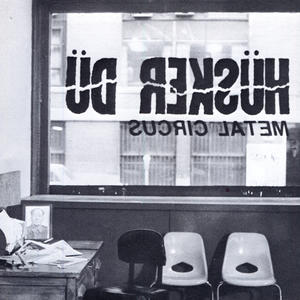
This may seem obnoxiously obscurantist in the “I prefer their early stuff” vein, but in some ways my favorite Husker Du record has always been Metal Circus from 1983, their first record with SST and I think their second more or less studio album, although it’s really a 19-minute 7-song e.p.  It’s all great, unrelenting, and has a kind of scrappy lightness of touch, with guitar leads that sometimes sound almost rockabilly, like X maybe, that reminds me a little of some of the early Replacements (their exact contemporaries) records like Stink from 1982.  I have this memory of trying to explain to my sophisticated NYC aunt in 1983 or 1984 that in fact, the most exciting new punk music was coming out of not NYC or San Francisco but Minneapolis of all places — not sure if she bought it.

Anyway, I loved everything about Metal Circus definitely including the black and white cover that looks like, what, the view out the window from inside a generic, depressing office room?  An employment agency for the down at the heels?

One of my favorite rock show experiences ever was seeing Husker Du in some community center or something in a suburb of Boston in maybe 1984; definitely before Zen Arcade came out.  I remember cramming into someone’s parents’ station wagon and ending up in this basement-y space not really knowing where we were.  (All the future Lemonheads were there, I think.)  I think the sound was atrocious so it was not exactly a “good show” properly but I loved them and it was a total thrill.  Actually now that I think about it, this was the second time I’d seen them because I also saw them opening for R.E.M. in a gymnasium at Harvard (!); I didn’t really know who they were at that point (must’ve been 1983?) and I didn’t really get it.

Metal Circus feels very 1983, very Ronald Reagan, Cold War, nuclear anxiety.  It’s conceptually coherent with lyrics defining an ambiguous political outlook, or maybe “political feeling,” angry, scared, apolitical as a variety of politics.  I love the lyrics to “Real World,” the fantastic first song:

People talk about anarchy And taking up a fight/ Well I’m afraid of things like that/ I lock my doors at night/ I don’t rape, and I don’t pillage Other peoples’ lives/ I don’t practice what you preach/ And I won’t see through your eyes/ You want to change the world By breaking rules and laws/ People don’t do things like that In the real world at all/ You’re not a cop, or a politician/ You’re a person too You can sing any song you want/ But you’re still the same

It’s about hardcore punk politics, a response/rebuttal to “anarchy” punk manifestos.  (I always heard it in relation to Minor Threat’s “In My Eyes.”)  I probably identified at the time with Bob Mould, a very normal homely/uncharismatic guy who was both a punk and a thoughtful, tormented liberal.  I guess the lyrics could be read as expressing pure political quietism, but I’ve always found them to be honest and brave, less a considered expression of a developed political philosophy than a kind of feeling — take it or leave it.  (In the equally great “It’s Not Funny Anymore” Mould signs sarcastically, “you can do what you want to do, say what you want to say… don’t worry about the result or the effect it has on your career” — wow, quite the college counselor!). “I’d like to protest but I’m not sure what it’s for/ I’ve heard it does some good if the television people are there… I know I’ve got no control over the threat of a nuclear war.”

One of my favorite songs from this era was Husker Du’s buddies the Minutemen’s “Bob Dylan Wrote Propaganda Songs.”  They were all trying to figure out: how can you write a punk protest song without falling into pompous liberal folk cliches, or predictable punk cliches?  How can a punk protest song express ambiguity and doubt along with anger?

The other really great track is Grant Hart’s ominous, anguished rape-murder dramatic monologue “Diane,” which has a lot in common with Robert Browning’s “Porphyria’s Lover:” “We could lay in the weeds for a little while/ I’ll put your clothes in a nice, neat little pile/ You’re the cutest girl I’ve ever seen in my life/ It’s all over now, and with my knife.”  “Diane”‘s bassline reminds me of Joy Division and of course, now that I think of it, the visual aesthetic and even title of Metal Circus may have been influenced by the Factory Records look/feel/sound.

When the definitive book is written on queer punk and post-punk, I hope Husker Du gets their due.  The indie/postpunk scene in the 80s was very homophobic; Mould finally came out of the closet in the early 1990s.  (I think everyone always figured Hart was gay.)  I love that Mould worked for World Championship Wrestling as a scriptwriter for a while.

“If you can’t play nice, play Rollerderby”

We finally made it to a Rollerderby match (or “jam” “bout,” to use the technical term).  Our local league is the Bleeding Heartland Rollergirls.  As the website explains,

Gone are the golden days of the 1940s and ’50s, when roller derby was more like a grueling test of endurance than a sport. Gone are the cheesy pro-wrestling-style derby bouts of the ’60s and ’70s, when the MANY fights were staged, scoring seemed like an afterthought, and oh my, that huge hair!   Today’s roller derby is a rough, tough, athletic competition, but with enough trash-talkin’ attitude, wipeouts and injuries, and short skirts and fishnets to keep audiences of all ages on the edge of their seats.

This turned out to be a match between two home teams, the Farm Fatales (who have really cool t-shirts — were out of Sarah’s size, unfortunately) and the Slaughter Scouts.  RG advised us that the atmosphere was a bit less heated than would normally be the case, since both teams were local and so there was no one obvious to root against.

The atmosphere was a bit more wholesome than I’d expected.  The players all have sort of pro-wrestling style names, often with a campy, Russ Meyer or John Waters twist, e.g. Boogie Tights, Lotta Trouble, Violet Outburst. (We were actually proud to realize that we know Boogie Tights, the mother of a kid who used to be in the girls’ preschool class.)  And many of them wear fishnet tights, leopard-skin short shorts, and other stripperish gear.  Yet, the matches take place in a brightly lit gymnasium with an eager crowd perched on bleacher seats munching on cheese sticks, and the players are all really focused on the game.

Here’s a good summary of the rules of play from a NY Times article about the resurgence of the sport:

Reduced to its basics, roller derby is a simple game. There are two 30-minute halves, during which each team fields five women at a time in shifts (called jams) that last up to two minutes. They skate counterclockwise around an oval track, slightly smaller in circumference than a basketball court. There’s one jammer per shift, who scores a point each time she laps an opposing skater. After her first, nonscoring pass through the opposing team, the leading jammer also has the strategic option of ending the jam prematurely by tapping her hands to her hips [this is called “Calling off the Jam”]. The other eight players skate in a pack and make judicious use of their hips and arms to clear space for their jammer and stymie her opposite number.

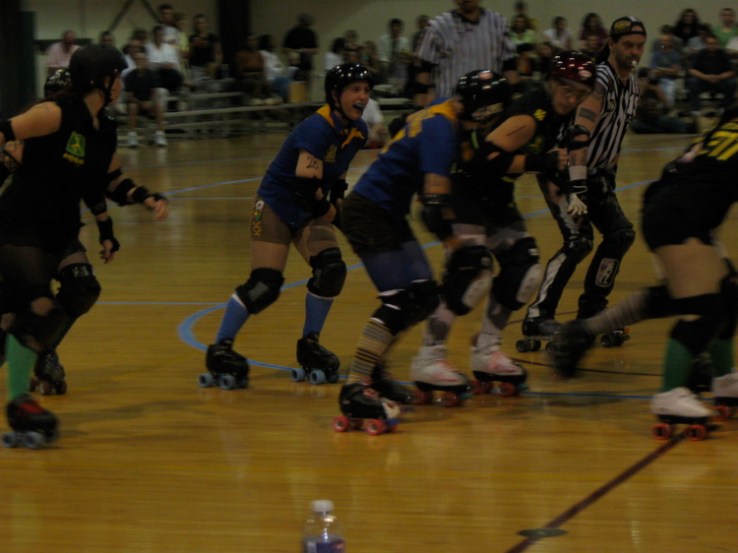
Here’s a few shots from last night.  The woman with the star on her helmet is the jammer.

IMG_0436IMG_0434

By the way, here’s a fascinating article from 2008 about Daniel Eduardo Policarpo, aka “Devil Dan,” the guy who created the first modern rollerderby league in Austin.  As the article explains,

under disputed circumstances, the man known as Devil Dan eventually sneaked out of Austin, or was chased out, leaving his weird brainchild to the women he had recruited as team captains. Widely acknowledged, perhaps reluctantly, as the progenitor of the modern roller derby, Daniel Eduardo Policarpo, now 39, settled here in Tulsa to watch the sport spread across the country, though not exactly in the form he had intended.

He explains that he “envisioned low lighting, quick flashes of red, blue and green, glow sticks, drummers, a cramped track, violence and microphones everywhere.”  He wanted women “with tattoos, Bettie Page haircuts and guts.”

Roller derby, he said, “exceeded my vision, actually; I had my vision of what things could have been, but it was so fanciful it wouldn’t reach that.”  (His original vision involved “a crazy circus with these clowns unfortunately stabbing each other, these bears on fire on these unicycles.”)

We’re hoping to take the girls to the next bout.  Seems like it can’t be a bad thing for them to see women (including the mothers of classmates) violently body-checking one another on wheels at high speed in the pursuit of athletic victory.

Asterios Polyp

polyp-2

Strongly recommend this new graphic novel, David Mazzucchelli’s Asterios Polyp.  It’s being hailed as a landmark of the genre, and I agree — it strikes me as among the best graphic novels I’ve read, along with the likes of Maus, Charles Burns’ Black Hole, Ghost World, Persepolis, Jimmy Corrigan, and I’m not sure what else (I’ve never gotten too into the neo-superhero stuff like Watchmen).

Mazzucchelli got a BFA at RISD and became a successful comics artist at Marvel Comics in the 1980s, then started doing non-superhero stuff, like the graphic novel version of Paul Auster’s City of Glass.  He’s apparently being working on Asterios Polyp for a decade.  Here’s the NY Times review, which dubs the book “a big, proud, ambitious chunk of a graphic novel, with modernism on its mind and a perfectly geometrical chip on its shoulder” and “a dazzling, expertly constructed entertainment.”

It’s a novel of academia, in part; Asterios Polyp is a famous “paper architect” and professor at Cornell who’s become famous for designs that are never actually built.  The story is told in circular, recursive cycles with a bit of a film noir type set-up: we begin with the collapse of Asterios’ elite life and his fall into impoverished obscurity, and then re-trace the steps that led him there.  These include his marriage to a shy, talented sculptor who feels overwhelmed by him (until her own success begins to threaten him), his obsessive-compulsive behaviors and deeply ingrained intellectual snobbism.  As with any really successful graphic novel, the art is thoroughly embedded in the story and vice versa; in this case the art is quite spectacular and even show-offy — it definitely repays close scrutiny and multiple readings, with different characters, plots, and time frames all given their own distinct styles.  (It probably reminds me most of Chris Ware’s work in the brilliantly fussy/minute attention to graphic design and the interest in retro and recherche 40s-50s style; kind of amazing that Mazzucchelli worked for years on Daredevil, although in fact I’m sure doing comics for Marvel was ideal training for this).

Creepy Farmers’ Market Simulacrum

Sarah snapped these pics of this extremely creepy Farmers Market simulacrum on display in the entrance to the Kroger’s near us.

“Hey, people seem to really like these ‘farmers’ markets.’  Let’s arrange our sterile fruits and veggies imported from South America, Australia, etc and present it all as the produce raised by a disturbing robot/Cylon ‘farmer’!  All we need are some wrap-around shades, overalls, and a flannel shirt.”

fake farmers market

fake farmers market 2

Music Roundup: Franco, Jay Reatard, Pains of Being Pure at Heart…

Franco

A few things I’ve been listening to…

Modest Mouse, “3rd Planet.”  This is from Modest Mouse’s major-label debut The Moon and Antarctica (2000), their third album, which didn’t really make too big of a splash at the time — their commercial breakthrough came with the next album and the big Pixies-ish hit “Float On.”  One thing I like about Modest Mouse and this album is the sense of largeness, ambition, attempt to evoke the oceanic/cosmic.  Indie rock by definition tends towards the minor, petty, internal — and yes, the modest… But notwithstanding their iconically indie name, on this album anyway they go for something kind of immodestly huge; it’s their Dark Side of the Moon or Ok Computer.  “3rd Planet” is one of my many favorite Modest Mouse songs — kind of about, maybe, what it feels like to lie with someone else on a blanket, naked, staring up at the stars: “The universe is shaped exactly like the earth/  If you go straight long enough you’ll end up where you were/ Your heart felt good, it was dripping pitch and made of wood/ And your hands and knees felt cold and wet on the grass to me.”

Franco, Francophonic – Vol. 1: 1953-1980. Franco, “the Duke Ellington of Congolese music.”  Some of it sounds like calypso, some of it like American soul or R&B, like Jamaican reggae, Cuban son.  Beautiful, funky, catchy, sinuous… Probably the album I’ve gotten most pleasure out of in the last year or so.

Dirty Projectors, Bitte Orca.  I missed the chance to see him/them when they played here after they released Rise Above, the retelling of Black’s Flag’s punk classic Damaged.  That seemed too arch and contrived, along the lines of Pussy Galore’s version of Exile on Main Street.  But they/he turns out to have some serious musical/conceptual chops — when Bjork invites you to collaborate with her, you probably do have something going on.  Anyway this album is really interesting and very listenable/engaging — part of that whole choirboy/orchestral-Afropop tendency in contemp. indie rock.  I’ve never heard an American indie album before that seemed clearly influenced by Zap Mama (polyphonic Belgian female a cappella group).  My favorite Dirty Projectors song isn’t on the album, though: “Knotty Pine” with David Byrne on the excellent Dark is the Night soundtrack.

K’naan The Dusty Foot Philosopher. This guy has a really great gimmick — it’s gangsta rap by a guy from a part of the world where little kids actually wander around with machine guns.  Yes, a gangsta rapper from Mogidishu, Somalia — take that, 50 Cent!    Who seems to be heavily influenced by Eminem of all people!   Although I haven’t checked out his second album yet, I expect K’naan to get really big eventually: he really does seem like some kind of weird Afro-Canadian combination of Bob Marley (or to be less grandiose, maybe Wyclef Jean) and Eminem with some super-catchy tunes (e.g. “In the Beginning,” “If Rap gets Jealous”).

Cocorosie, “Rainbowwarriors,” “Werewolf,” “K-Hole,” “Terrible Angels,” from La maison de mon rêve, Noah’s Ark, The Adventures of Ghosthorse and Stillborn.  I came to Cocorosie (twin sisters Sierra and Bianca Casady) a bit late, and the hip kids have probably moved on since Cocorosie have placed songs in perfume commercials and the like.  I noticed that Pitchfork condemns them as globe-trotting trust-fund poseurs, but hey, so was Henry James… What do they sound like?  Kind of mumbly-warbly experimental home recording pseudo-hip-hop poetry?  Sung by squeaky-voiced twin sisters performing on children’s instruments.   It’s sometimes a bit much, but often I find it enchanting and magical, e.g. the Rilke-inspired “Terrible Angels:” “If every angel’s terrible/ Then why do you welcome them/ You provide the bird bath/ I provide the skin/ And bathing in the moonlight/ I’m to tremble like a kitten.”

The Pains of Being Pure at Heart.  The Pains of Being Pure at Heart.  On my first quick listen this struck me as a tad generic, but I ended up loving it.  The NYC band is apparently named after (get this) an unpublished children’s book written by the singer Kip Berman, and heavily rips off a range of British indie pop — Belle and Sebastian, Jesus and Mary Chain, and the Wedding Present — so it doesn’t come much more twee than this.  On the other hand it also can get pretty guitar-squally (“Hey Paul”).   If you liked early Belle & Sebastian, here’s more songs about libraries and crushes: “between the stacks in the library/ not like anyone stopped to see/ we came they went, our bodies spent/ among the dust and the microfiche.”

Jay Reatard, Watch Me Fall.  I just got this one and haven’t really absorbed it, but I wanted to mention Mr. Reatard.  Not that he hasn’t gotten quite a lot of press, but I do think that he’d be a lot bigger in the crucial expendable-income young-adult yuppie market if he had a less tasteless moniker.  Nee Jimmy Lee Lindsey Jr., he became “Jay Reatard” as a 16 year old highschool drop-out with a chip on his shoulder in Memphis doing his best Iggy Pop imitation, and since then has released about 20 (!) home-recorded albums.  I also have the last couple of singles collections (Singles 06-07 and Matador Singles ’08). Robert Pollard (Guided by Voices) would be a good analogy: JR is a kind of human jukebox apparently able to produce irresistibly catchy singles at will.   They sound alternately like the Buzzcocks, Go-Betweens (he’s recorded a Go-Bes cover), Stiff Little Fingers, etc., all sung in a retro fake British accent with occasional amusing Britishisms (“Is this real or is this future?”), and filled with eruptions of aggressive/sarcastic put-downs.  (I.e. he kind of sounds like he was invented in the basement of WHRB’s Record Hospital circa 1988).  To my ears he’s recorded at least a handful of songs that I’d include in my list of the top ten Guided By Voices tracks ever.  The new one is a little poppier and layered than the earlier stuff — try “Before I Was Caught” or “Wounded” for ex.  The line is that he’s been influenced lately by New Zealand Flying Nun indie pop, but I’m not sure I hear that especially, I think that may just be a way to explain the frequency of Farfisa-style organ which imparts more of a 60s garage vibe.

Orchestra Baobab, Made in Dakar.  I listen to jazz and “world music” (primarily African pop) more than anything else these days, partly because it works as background music when I’m working, in the living room when we’re making dinner, etc. a lot better than, say, Jay Reatard.  I’m not very good at analyzing/discussing this music; I guess part of what I love about some of it is the way I fall into it as an unknown, somewhat disorienting sonic world.  Orchestra Baobab were founded in Dakar, Senegal in 1970, broke up in the late 1980s, and reformed in 2001.  The group “played an Afro-Cuban-Caribbean music fused with distinctly West African traditions. Unlike other Senegalese bands, they added Casamance harmonies and drumming (from southern Senegal), melodies from Togo and Morocco to the more common Wolof (from northern Senegal) influences” (wiki).  Since reuniting they’ve become well-known in the U.S. partly due, I regret to report, to a documentary filmed by/with Dave Matthews and the guy from Phish. (It’s a bit of a Buena Vista Social Club kind of phenomenon — Afro-Latin world-music classic revived for the NPR market.) Anyway, everything I’ve heard by them is fantastic with a special mellow, funky elegance.  Christgau puts it well: “Jazz, r&b, soul, disco, reggae–no African band has ever emulated a New World music as gracefully as this Cuban-style unit.”


How to Make a Fruit-fly Trap

Take a glass and put some fruit-fly bait in the bottom.  A piece of tomato or banana works well.

Cover the top with saran wrap and poke some decent-sized small holes in the top [just realized my holes have been too big — they should be tiny, made with a pencil tip or some such].  Use a rubber band to affix.

Put the trap on your counter and let the hunt begin.  Every morning and sometimes every few hours subsequently I have to cover it with my hand and bring it outside to release the catch.  (I feel kind of silly letting them go free, but it’s too much trouble to kill them).  I find it kind of fascinating that the cup is often hot from the methane emitted by the rotting banana.

It’s gotten hot and sultry, and too many fruitflies buzzing around makes me feel like I’m in Baby Doll.

Photo 419

Drain Pipe Ditches

When we came home after over a month away we found a very damp basement.  No actual puddles or leaks but a kind of miasmic moldy atmosphere and, we discovered, some actual mold in some cabinets.

We went out and bought a new energy-efficient dehumidifier (we had one that looks like it dated from the 1980s).  But Sarah also suspected that we had a gutter-drainage issue and when she dug down to look, it turned out that someone had once tried to repair a broken drainage pipe with a plastic shopping bag.  So, we dug a whole new drainage ditch after going to Lowes and getting what we needed (the piping, etc).  Of course I would never be able to do this competently but Sarah was able to chat with the Lowes guys and figure it out.

So we spent yesterday afternoon and some of today’s digging the ditch and cutting tree roots with a pole-axe thing that Sarah was calling an adze.  Especially today in 90 degree heat this was really hard work and good exercise.

I developed a blister on my hand so at the Los Campesinos! show I couldn’t clap very enthusiastically.

When I badgered her for a figure, Sarah claimed that we may have saved about $900 by doing this ourselves.  I don’t know if this is true but I like the idea.

Let it rain!