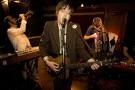
Okkervil River

I went to see Okkervil River at our downtown theater a week ago (I don’t usually see this many shows, Okkervil River and Feist are the only two I’ve seen in maybe 2 months?). I got there sort of early and met Ed in front — turned out the opening band Howlin’ Rain (I get the impression they are a faithfully retro 70s band concept?) were delayed so they’d roped in a local band to play while waiting… whose name is escaping me at the moment. We are both grouchy aging indie-rockers with limited patience so we went next door to have a beer and watch one of the NCAA final four games, what was it, Memphis vs…? Got back after Howlin’ Rain (sorry boys). Okkervil River were fun. I’d liked but never listened all that much to ‘Black Sheep Boy’ which I’d pegged as a bit earnest, so I was impressed by Will Sheff’s showmanship/ theatricality. He bounced around, flipped his floppy mane, flirted with the audience, emoted a lot.

He’s a smart guy, really good lyrics and ideas about celebrity, art, and related topics. “Our Life is Not a Movie or Maybe” is the best maybe?

“It’s just a life story, so there’s no climax.
No more new territory, so pull away the imax.
In the slot that you sliced through the scene there was no shyness.
In the plot that you passed through your teeth there was no pity.
No fade in: film begins on a kid in the big city.
And no cut to a costly parade (that’s for him only!).
No dissolve to a sliver of grey (that’s his new lady!)
where she glows just like grain on the flickering pane of some great movie.

From the speakers your fake masterpiece is serenely dribbling.
When the air around your chair fills with heat, that’s the flames licking
beneath the clock on the clean mantelpiece. It’s got a calm clicking,
like a pro at his editing suite takes two weeks stitching up some bad movie.”

Makes me think of Destroyer’s “The Bad Arts” — both songs partly about the feeling, endemic to indie rock, of being belated and minor, insufficient, aspiring to great art but just producing fake masterpieces in some phony canon.

Mediocre Steve Carrell movie

I’m slightly embarrassed to say that we watched the Steve Carrell movie “Dan in Real Life.” A.O. Scott gave it a pretty good review but I sensed that it would be so-so at best. It had its moments, Carrell wasn’t bad, I found his single-dad relationship with his three daughters to be kinda charming, but so much in it rang false or made no sense. The premise of the movie is that Carrell is with his extended family at their ancestral Rhode Island summer house when he meets cute with Juliette Binoche (is she actually supposed to be French in this movie? or does she just have the most unconvincing American accent ever?) at a bookstore. She tells him she’s involved with someone, but he has hopes. A couple hours later she shows up for inspection by the clan — she is now revealed as the new girlfriend of Carrell’s loutish brother played by that irritating comedian Dane Cook. Would-be screwball-ish antics ensue (Binoche has to get into the shower naked where Carrell is hiding! Family jazzercise session!), but it’s acted as if Carrell and Binoche actually had some kind of pre-existing relationship (rather than having talked for an hour). There are some really creepy, bad, or off moments — for me the worst was the scene where Carrell is supposed to be meeting a childhood acquaintance whose nickname was “Pigface” (or something) for a blind date. The jerk brothers lead an ostensibly wacky improvisation on piano about this “Pigface” girl. Then she shows up and she’s actually Emily Blunt and really hot (albeit awful). So this makes it OK that these adults were all, in front of young children, reveling in their mockery of a child’s physical appearance. Totally Lord of the Flies, and yet the movie seems to think it’s cute and funny.

I liked the Sondre Lerche cover of Elvis Costello’s “Human Hands,” a little-known (I think — anyway I’ve never heard it covered or anything) great track from Imperial Bedroom.

Billy Strayhorn


I’ve been reading David Hadju’s “Lush Life: a Biography of Billy Strayhorn.” Strayhorn, Duke Ellington’s arranger and collaborator, grew up as a poor African-American kid in Pittsburgh who somehow started reading The New Yorker and became entranced by a fantasy vision of sophisticated urban life. He eventually moved into this life himself, but what kind of amazed me was that he started writing songs like “Lush Life” based on this imagination before he had ever experienced it himself. And so his music (a song like “Lush Life”), which is now an iconic embodiment of this particular ideal, was weirdly proleptic and fantasy-based, but also seemed to have the power to create and substantiate its own fantasy.

Part of what surprised me was the idea that The New Yorker may have been a big influence on Ellington and Strayhorn’s music.

Feist


I saw Feist on campus the other night. First we all went to an MFA art opening. Two painters, one of whose work riffed on Sargent paintings of dancers, the other murky portraits of GI Joe toys. There was also a brief fashion show with a DJ. C&I were amused by the weird dresses including one made out of automobile seat cushioning, I think. Then I walked the 20 yards to the auditorium where Feist was playing. First opening was Hayden who I vaguely remember from the mid-1990s or so when I believe, in those days of giddy alt-rock hysteria, he was signed for a whole lot of money by a major label. I was sent a couple of his albums around then which I recall enjoying. [OK, checked Wikipedia, he was signed in 1995, dropped in 1998, has had a recent comeback.]

It’s tough to be the opening act in a big place like that filled with a lot of sorority girls, etc chatting, especially when half of your show is with acoustic guitar. He did pretty well though. I liked the weird song about how his apartment in Toronto got broken into while he was recording music (and so did not hear the window breaking).

Feist put on an excellent show filled with various visual tricks and artifices — she began as a silhouette behind a screen, and then for much of the show there was someone creating arty, pretty effects on a transparency projected on a big screen. A little bird; leaves moving around; beads and jewelry… Sometimes fairly corny (my daughters would’ve loved it), but it was nice to have something to look at. I thought Feist did a good job of creating warmth/intimacy in this fairly impersonal setting and she has a lot of great songs… I liked the Bee Gees cover a lot (more than I do on the album). She has going for her something you don’t always hear in more or less ‘indie’ rock, a really good voice that can do a lot.

At one point someone yelled out “you’re beautiful!” (I think) and she said “you’re sitting really far back, which is why you think that” — charmingly but oddly self-deprecating, I thought.

My two friends showed up after Hayden, which meant I was sitting alone amid all the undergrads for a while and one of them addressed me as “Sir” which makes me wince a bit in that context. I was remembering the time I went to see Sonic Youth at the Orpheum theater in Boston — this must’ve been a decade ago when I was in my late 20s –my friend and I never found one another so I was sitting next to some teenager. We made awkward smalltalk at one point and he opined that it was “nice to see that older people are into the band too” or something. This is Sonic Youth!!!! They must’ve had an average age of 49 at that point!!!? I guess my baldness had really kicked in…

How Puppies Die


I was a parent teacher the other morning at my daughters’ preschool and witnessed a kind of amazing moment. C&I and their new-best-friend A., who is 5 years old, and three boys (mostly younger) went in the corner of the yard and sat on this little structure and explained to me, “this is where we go to tell sad stories.” A. said she would tell about “how puppies die.” Her first story was about one sentence long – the puppy went out in the street and it got hit by a car. The boy F. was pretending to be a puppy and he put his hands up in a sad-paw gesture and whined, and C. and I. and A. all said consolingly, “don’t worry, puppy, we wouldn’t let YOU go in the street.” The next story was a little more complex: a puppy got into the playground and a big heavy slide fell on him and crushed him. And, it had a sharp point and it cut right through his back. Once again, F. whined and the three girls said “oh, don’t worry puppy, we would never let YOU go into the playground.” The mood was sort of excited and upbeat, maybe like telling ghost stories around the campfire? A student teacher said “oh they did that for about two hours the other day.”

Later I asked C & I about why they liked “sad stories” so much and they said “because we’re interested in what’s inside bodies.” So sad stories are apparently ones that involve injury to the body broaching the boundary between what’s inside and outside. I wonder how general a principle of narrative that might be.