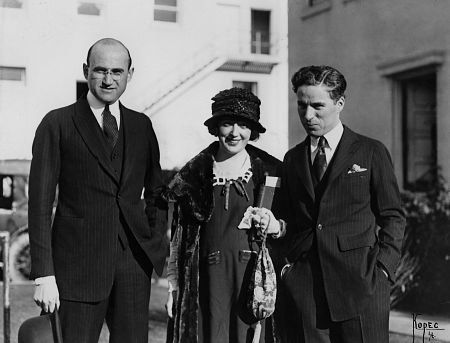
Gelbfisz/ Goldfish/ Goldwyn: the face of a spink

[Samuel Goldwyn on the left]

I am 3/4 or so through (to 1942) A. Scott Berg’s 1989 biography of Samuel Goldwyn and loving it.  Really juicy, filled with great/hilarious/unbelievable tales about movie stars, directors, and producers of the 1910s-1950s (with an emphasis on the earlier decades), and offering a well-informed, panoptic history of early Hollywood– I’m learning a lot.

  • This is one of the best Americanized-name stories I’ve heard.  Born Schmuel Gelbfisz, Goldwyn became Samuel Goldfish in the ghetto of Birmingham, England in the 1890s. (If you’re going to Americanize your name, do you really want to choose “Goldfish”?)  In 1916, Goldfish and Edgar Selwyn formed a film distribution company they named “Goldwyn” (a portmanteau name combining Selwyn and Goldfish).  A few years later, audaciously, Goldfish changed his own name to Goldwyn.  What a power move.  His partner sued him, but a judge ruled that the name change was legal.  The now Samuel Goldwyn was subsequently forced out of Goldwyn Pictures, the company that now bore what was his name, and he was never (bizarrely) part of Metro-Goldwyn-Mayer.  Very weird.
  • Gelbfisz/Goldfish/Goldwyn’s emigration story from Poland to the U.S. (he arrived Jan 1, 1899) is pretty wild.  At age 16, “in 1895, Schmuel Gelbfisz walked alone, almost three hundred miles due West to the Oder River.”  After paying off border police guarding the German/Russian border, “he walked another two hundred miles to Hamburg.”  There he stayed with some family acquaintances who put him to work learning glovemaking, and then raised money from neighbors to pay for his ship fare to London.  “The next leg of his odyssey was the 120-mile walk from London to the Midlands.  He lived for two days on a single loaf of bread.”  He found his mother’s sister in Birmingham and became an apprentice to a blacksmith and then worked as a sponge salesman.  “By the fall of 1898, Sam Goldfish felt the urge to move on.  He journeyed another hundred miles, northwest to Liverpool and eventually got a boat that left him in New Brunswick.  “Once he had his legs back, Goldfish took to the road again…. Over the next month, he trudged through more snow than New England had seen in ten years.  Sometime in late January 1899, he arrived in Manhattan.”  Wow!  That’s a tough dude.
  • It’s just amazing how many of Hollywood’s biggest moguls were Jews from modest (or impoverished) backgrounds in Eastern Europe.  “In the 1880s alone, the  family of Louis B. Mayer left Demre, near Vilna, in Lithuania; Lewis Zeleznick (later Selznick) ran away from Kiev;  William Fox (formerly Fuchs) imigrated from Tulcheva, Hungary; the Warner family uprooted itself from Krasnashiltz, Poland, near the Russian border; Adolph Zukor abandoned Ricse, Hungary; and Carl Laemmle left Wurttemberg, Germany — gamblers with nothing to lose, all from within a five-hundred-mile radius of Warsaw.”
  • The first part of the book, about Hollywood prior to the advent of sound in 1927, is full of amazing stories about silent-movie stars I’d never heard of or knew almost nothing about.  E.g. Banky Vilma & Rod La Roque.  Or Mabel Normand:  “One interview for a family magazine [in 1917] went well until the reporter asked her hobbies.  ‘I don’t know,’ Mabel replied.  ‘Say anything you like but don’t say I liked to work.  That sounds like Mary Pickford, that prissy bitch.  Just say I like to pinch babies and twist their legs.  And get drunk.”
  • One of my favorite strands in the book has to do with Goldwyn’s famous malapropisms and vexed relationship to the English language.  During the editing of the 1929 Bulldog Drummond, Goldwyn noticed a line in which a colonel declares, “the eternal din around this club is an outrage.”  “Goldwyn asked his staff, ‘what is that word “din”?’  He was told it meant noise.  ‘Then why didn’t the writer say noise?'”  He insisted that the actors be called back into the studio and the set rebuilt in order to re-shoot the entire scene, until someone finally convinced him that “din” was a real word.   More Goldwynisms: of his Russian discovery Anna Sten, whom he thought would be the next Garbo (she flopped– that whole story is great, albeit slightly tragic): “She has the face of a spink.”  Or the time the Gershwins, Lillian Hellman, and George Balanchine were waiting for Goldwyn in his living room.  “Goldwyn appeared at the staircase in his bathrobe.  ‘Hold on, fellas,’ he yelled down.  ‘I’ll be right there.  And then we’ll get into a cuddle.”  “Include me out” was his most famous coinage.  “Anyone who goes to a psychiatrist needs his head examined” another famous line.  William Wyler called him “a titan with an empty skull, not confused by anything he read, which he didn’t.”  Wyler still liked him, however.

Someone comments at some point that all of the studio heads, without exception, in this period were “monsters,”  but that Goldwyn at least could laugh at himself.  He was a terrible person in many ways (treated his children really badly, was always chasing starlets), but possessing a certain charm all the same… You have to admire him, to some degree, for his bald bull-headed energy & determination & hook or crook determination to get movies made (often by lying, cheating & stealing). He bet incredible amounts on cards (in 1940 he calls in a gambling debt from fellow mogul Jack Warner for $425,000 — imagine what that would be in today’s currency) and for much of his career was continually leveraging his own company such that a major flop at the wrong moment would have bankrupted him.  (“The only way he could tolerate a baseball game was by betting on every pitch”).  The whole enterprise was high-end, high-risk gambling based on bluff and bluster, and producing strings of masterpieces and great movies.

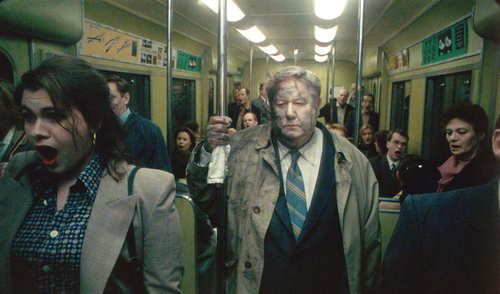
*Songs from the Second Floor*: Occupy Stockholm

I recommend this film (from 2000) which I somehow completely missed until now; had never heard about it and the name of the director rang no bells.   Roy Andersson’s first film, A Swedish Love Story, was a hit & won several prizes at the Berlin Film Festival in 1970.   Subsequently his second movie was less successful and he spent the next 25 years as a successful director of commerical ads.  Songs from the Second Floor, his long-delayed third movie, won the Jury Prize at Cannes in 2000.

The movie is difficult to describe.  Terry Gilliam’s Brazil comes to mind, maybe Lars von Trier’s Zentropa (although I don’t recall that being at all funny).  It doesn’t have a plot, exactly, though does have a few central characters who inhabit what seems to be a nameless contemporary European city within a society undergoing apocalyptic collapse.  Traffic jams last for days, and businessmen stride in unison through the streets, flagellating themselves and one another in rhythm.  The government’s financial technocrats take recourse in soothsayers’ crystal balls and eventually to child sacrifice, which is presented as a thoroughly rational (albeit desperate) last recourse.

Each of the film’s scenes is a kind of stylized tableau that looks very much like a still life.  Here are a few factoids about the film’s creation (taken from this piece, which is good and includes several clips): “The film consists of 46 scenes, all rendered in static tableaux (the camera moves once), and it took about four years to produce;” “None of the scenes were scripted or storyboarded. They were constructed under Andersson’s direction, on two giant soundstages, with non-professional actors;” “Some scenes took as much as five weeks to set up and required as many as 100 takes.”

Our protagonist Palle has cheated his best friend and has burned down his own furniture store for the insurance money.  He moves through the city and the subways with his face streaked with soot from the fire.  His son is a poet who has been hospitalized for catatonic depression. Palle is followed the the ghost not only of his friend (dead of suicide) but of several others, somewhat plaintively trailing him through the city.

He now tries to get by selling crucifixes, but no one is buying.  In the final scene, a fellow salesman angrily unloads his unsold collection, throwing them on a garbage pile, asking “what made me think I could make money on a crucified loser?”  In a sense many of the film’s character can be seen as “crucified losers” within a stagnating European economy that has left them stranded and hopeless.  In an early scene, a man who has been laid off simply grasps his boss’s ankles, repeating “but I’ve been here thirty years…” as his boss awkwardly moves away from our perspective in a long hallway, dragging his burden.

“Ingmar Bergman meets Monty Python” is a line that people keep citing about the film (from the Village Voice I believe) and it does capture the feeling well.  On the one hand, this is challenging foreign film art, with austere style, grim themes, and a forbiddingly erudite range of reference and allusion to film, visual art, and literature (the film begins with a dedication to the Peruvian poet César Vallejo and this line of his is a recurring manta: “beloved is he who can sit down”– his work is given to Palle’s hospitalized, catatonic son.)  But, it is also often quite hilarious and filled with deadpan physical humor and absurdist wit.

I will admit that although I loved it, I started to fall asleep on Friday night and had to stop halfway through, then we finished it on my laptop the next night; I think I preferred it with the greater intimacy and closeness of the laptop in bed.

As the author of the Onion article I cite above suggests, the film, although made 11 years ago, feels very of the moment, very Occupy Stockholm, a depiction of a world/Europe collapsing under the strain of capitalist shock-doctrine tactics, greed, failed economic plans, mass underemployment, magical thinking of a sometimes pernicious kind.  Many of the characters are pasty, overweight white men with pancake makeup that can make them look either or alternately like vampires, or silent-film or theater clowns.  Mechanical rats scurry through the streets.

This was one of our favorite scenes, as inhabitants flee the city, trying to make a train, burdened by their enormous piles of their possessions.  The film is filled with  spectacular set-pieces like this one, in highly artificial, sterile, painstakingly constructed stages.  The laid-off businessmen in their suits struggle, grunting and heaving, to move their piles of junk as their own golf clubs fall down on them.

In what seems an allegory of panicked 21st century neo-liberalism, one of Pelle’s fellow displaced workers, shuffling his possessions like an injured turtle towards escape, shouts to him, “There’s a time for misery… But it’ll soon be over.  Just a few more yards, and we’ll have left this damned dump under the clouds for good!  As free men… Free at last!  And then we’ll only have ourselves to think about.  And we’ll do what we feel like.  Do we not deserve that?  Aren’t we worth it, when we’ve worked so hard?”

Meanwhile the uniformed railway employees wait silently.  We doubt Pelle and his friends will make it.

It is a pretty one-of-a-kind movie!  And, I have a feeling I did not capture this, but hilarious.

Pedro Costa at I.U.: “Something happens, sometimes.”

I saw acclaimed Portuguese director Pedro Costa (dubbed “the Samuel Beckett of world cinema by The Guardian) at IU Cinema on Thursday before I actually saw any of his films, which made the experience that much stranger.  It was a little bit like one might imagine seeing a Portuguese Samuel Beckett interviewed on stage.  Long pauses, odd non sequitors, mysterious, brooding tangents landing up in apparently despairing conclusions often difficult to interpret.  But charming all the same.

Here are a few comments & remarks I recall:

  • In response to a question, he discussed his time studying medieval history in school.  “Film may have been invented to represent medieval history,” he proclaimed, somewhat inexplicably (as far as I know, all of his films take place in the present day or late 20th century).
  • “I hate the film world.  I think it should be destroyed.  A film set can be a … terrible thing.”
  • He described the making of his second film, Casa de Lava (1994), at some length.  He apparently intended for this to be a remake of the Jane Eyre Caribbean zombie film I Walked with a Zombie.  “It became a fiasco, a disaster.  It was like a mini-Apocalypse Now.  I wanted to make it a bad experience, and I think… I succeeded.”  (The Guardian writer selects this as Costa’s masterpiece. [no the writer was discussing Ossos (Bones)))
  • This was my favorite single moment, as he discussed his realization that he cannot film nature. “Set up a camera and film… the ocean?  The forest?  No, this is impossible… no… I cannot do this, I prefer interiors…. [discussed his desire to make a film about walls.]  And in fact, the people who do this, who show the ocean?  This is shameful!  I really do think these people should be ashamed of themselves.”  (Exact phrasing is as I recall it, but this was the gist.)

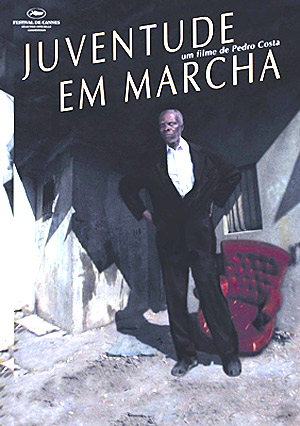
He’s best known for his so-called Fontainhas trilogy (Ossos (1997), In Vanda’s Room (No Quarto da Vanda, 2000) and Colossal Youth (Juventude em Marcha, 2006)), all set in the (former) Fontainhas slum of Lisbon, a now-destroyed neighborhood that housed Cape Verdean immigrants, drug addicts, and a range of other marginalized Lisbon residents.

The author of a liner notes essay in a Criterion Collection re-release of this trilogy explains how Costa stumbled on his quasi-documentary working method:

In 1997, Pedro Costa made Ossos in Fontainhas. This was a traditional production, shot in 35 mm, with tracks, floodlights, and assistants. Costa was a professional, a part of the Portuguese film industry. The shoot proceeded with everyone doing his job, following the routine of European art film. And the uneasiness grew, the feeling that a lie was being told, that an imbalance both moral and totally concrete was taking root on both sides of the camera. Costa later said: “The trucks weren’t getting through—the neighborhood refused this kind of cinema, it didn’t want it.” …So one night, Costa decided to turn off the lights and pack up the extra equipment, in an attempt to diminish the shameful sense of invasion and indecency. His action was doubly groundbreaking because in what he did, Costa found his own light, that quality of darkness and nuance he would constantly hone from that night on, and because he understood that the cinema of tracking shots, assistants, producers, and lights was not his. He didn’t want it. What he wanted was to be alone in this neighborhood with these people he loved. To take his time, to find a rhythm and working method attuned to their space and their existence. To start with a clean slate, from scratch. To reinvent his art. Three years after this leap into the void, In Vanda’s Room became the result of this departure—in Costa’s work but also in the history of the cinema.

So with this film Costa became, in effect, a Dogma-style film director, or his own Portuguese version of such.  At least in the film I ended up seeing the next day, Colossal Youth (Costa said this English-language name was imposed by a producer– is it a conscious reference to the Young Marble Giants album??  Or does that phrase come from elsewhere?  It does not seem to make any particular sense), is indeed, as the Guardian reviewer warned, “uncompromisingly difficult” and even “difficult and punishing;” “the movie itself, with its series of fixed camera positions, is closer in spirit to an exhibition of photography, a succession of cinematic tableaux” (actually he’s talking about In Vanda’s Room here).  The movie made me think at one time or another of simply made ethnographic films (e.g. Nanook of the North?) or documentaries made on the cheap (e.g. Dylan’s concert film Don’t Look Back), Michelangelo Antonioni movies, yes, a Beckett play (excruciatingly slow and drawn-out conversations leading nowhere; not much if any humor, though), and black and white photography of people living in poverty or straitened circumstances.  (I know I came across a comparison somewhere of In Vonda’s Room to Nan Goldin’s The Ballad of Sexual Dependency, which I can see, although Colossal Youth does not feature any drug-taking, which apparently constitutes a great deal of that earlier film.)  Also, painting: there’s a memorable scene in Colossal Youth where the camera focuses on a painting in a Lisbon museum by Rubens (?) while Ventura, who works a museum guard, lounges on an antique settee.  Costa momentarily invites a comparison between the painting and his own image, almost as unmoving.

I found Colossal Youth impressive & striking, often very beautiful, but quite tough going, agonizingly slow (2 1/2 hours long).  That Guardian reviewer observes amusingly, “I myself have seen critics and writers at festivals gird their loins reasonably happily for a Béla Tarr [Hungarian auteur] film. But at the words “Pedro Costa”, they flinch. A haunted look comes into their eyes.”  It does feel a bit like Antonioni in a Lisbon slum.

I made a low-quality iPad video of Costa discussing some of his experiences filming in Fontainhas, finding the performers, most of whom seem to play some version of themselves (Vonda was an actual heroin addict he met; the protagonist of Colossal Youth, Ventura, was a man who’d been hanging around the set during the making of In Vonda’s Room).  “I’m saying ‘in Fontainhas,’ but it’s a place that doesn’t exist,… it’s no longer there, like Greece.”  He also mentions, amusingly, the desire of the some of the Fontainhas residents that he direct “an action movie.”  I liked his comment about his method of casting and filming the residents he would meet in the neighborhood..  “One day you remember that guy and you say, “let’s go, let’s do… something.  And… something happens, sometimes.”

When I learned from an interview that Costa was a big fan of the English post-punk art-school band Wire as a student (their most famous album is the superb 1977 classic Pink Flag) it helped make sense of it all, somehow; this is cinema as uncompromising, minimalist, slightly apocalyptic post-punk.

No Future in Miranda July’s *The Future*

[image nicked from http://www.studio360.org/2011/jul/29/miranda-july-sees-future/%5D

This feels, for a while, like a typical mumblecore kind of movie: an arty, hipster L.A. couple, affectionate but not passionate, unfulfilled by work, hanging around their apartment, moving towards the big step of adopting a cat… But then things splinter into various forms of fantastical, sci-fi, & dreamlike modes that reminded me of The Eternal Sunshine of the Spotless Mind (M. July is very Michel Gondryesque as a filmmaker).  I liked it a lot.

The following does not really contain any spoilers.

The most audacious and potentially off-putting (but IMO brilliant) element of the movie is its narration by the above-mentioned cat, Paw-Paw (a nod to the best-known track from the Shaggs’ Philosophy of the World, “My Pal Foot-Foot”?).  Paw-Paw is an injured shelter cat (he burned his paw) whom Sophie and Jason (above-mentioned hanging-around-the-apartment hipsters) plan to adopt.  Turns out Paw-Paw needs a month’s recuperation time before coming home with them.  They decide that their carefree youth will in effect be concluded once they take on this responsibility (they are 35), so the movie plays out in this final month before “the future” arrives — whatever that will bring.

I realize I’m echoing similar points I made about the Mike Leigh movie (idee fixe?)… but I read the movie as being about care-taking and responsibility and the fear that one is unable to care for another — ideas that get extended in somewhat dizzying ways to environmentalist thoughts & feelings about care for the earth.  These underemployed slackers can barely hold down a job, and so the thought of adopting an injured and possibly traumatized cat frightens them (to be fair, I remember having thoughts like this when we got Figgy circa 1999 — ah, callow, childless youth!  How little we knew of what we could or could not, but must, take care of).  Also, the shelter will apparently give them no more than a one-day grace period, once this month is up, before euthanizing Paw-Paw (seems like a pretty harsh policy, but this is L.A.), so this month, the movie’s chronotope, becomes potentially either a period of healing and movement towards life or one towards abrupt termination of life.

The movie posits several different what we could call “objects of care” or of responsibility.  First, there’s Paw-Paw, our narrator who occasionally breaks in from his cage at the pound to explain his excitement and difficulty in waiting for his adoptive parents to take him home.  (Paw-Paw is narrated by Miranda July herself in baby-voice with the help of some crude prosthetic paws).  Then, there are the baby trees that Jason ends up “selling” in his job as a door-to-door solicitor for an environmentalist group called “Tree to Tree” that aims to re-forest L.A.  (A few of these are delivered to their apartment at one point, their roots wrapped in burlap; they seem like babies dropped off at the entrance to an orphanage.) There is also a child, someone’s nine year old girl, who ends up (in one of the movie’s various increasingly surreal/fantastical moments) in effect planting herself like a baby tree in the back yard.  (Is this akin to self-burial or suicide?  Or an attempt at self-care?)

Finally, at a more cosmic level, there’s the earth itself (as “object of care”).  In his depression, Jason at one point remarks to an uninterested customer something like, “you’re right.  It’s too late anyway.  You know that moment when the wrecking ball has hit the building, and for one moment, the building is perfectly still before it collapses?  That’s us, we’re like that building.”  When the guy asks why, if this is true, Jason is even bothering, Jason says (this is very approximate) “I don’t know.  I just liked it, you know?  Not just the trees and the birds and stuff, but the houses, cars, t.v., coffee shops… I liked the whole thing.”

[If we’re looking for keynotes of the art and culture of our moment, surely one major one will turn out to be moments like this, when a character articulates a frighteningly apocalyptic vision of environmental collapse.  E.g. the character in Franzen’s Freedom who loses it and screams at a news conference: “WE ARE A CANCER ON THE PLANET!  WE ARE A CANCER ON THE PLANET!”]

So the movie ends up drawing a parallel between Jason and Sophie’s desire to adopt an injured cat, and their perhaps well-founded fear that they will not be able to care for it properly, to our more general desire to care for our injured & traumatized planet.  (And along the way a few other objects of care: the baby trees, the self-planting little girl.)

The movie’s big question is, at various levels, is it too late?  Is there “a future” at all?– for this relationship, for Paw-Paw, for the girl who plants herself in the ground as if to try to care for or raise herself on her own, for the planet?

So I don’t agree with those who dismiss July as a twee, self-regarding slacker… She uses the materials & aesthetics of that kind of lifestyle/ attitude (Etsy crafts, self-documenting or curating, underemployment, found objects & texts, lost pets, obsession with youth and old age/ evasion of adulthood) but turns them into something pretty deep.

Fee Fi Fo Fum: *Trollhunter*

I’ve been waiting for Trollhunter, and it is as fun as I hoped.

The movie begins by explaining that DVDs containing 283 minutes of mysterious footage turned up in the mail (at a newspaper or t.v. station?  I forget).  What follows is that footage.  [e.g. the structure is just like The Blair Witch Project, a mock-doc based on supposedly found video.]

Three student journalists in Norway are looking into a story about bear poachers.  They start tracking a possible poacher, Hans, who drives around in a camper with strange dents and gashes in its side.  He rebuffs their efforts to question him on camera.  They follow him into the woods, where they hear strange howls and roars; he emerges out of the forest, screaming “Trolllllll! Run!”  They turn tail to flee (camera bouncing around) from a frightening three-headed troll standing 20 feet or so high, which Hans eventually kills with an industrial-strength flashlight (strong light either turns trolls to stone or, if they’re younger, makes them explode).

Turns out Hans works for an X-Files-esque government agency dedicated to the management and concealment of Norway’s considerable troll problem.  Hans is called whenever a troll is causing trouble or wandering too close to humans.   He’s disillusioned about the whole enterprise, partly, it seems, for ethical reasons: at one point he broods about the time he had to slaughter a whole community of trolls, including pregnant females and young ones not yet able to walk: “it was a massacre…”  But he’s also pissed off that he gets no overtime or night pay, and he’s sick of his boss, a hypocritical bureaucrat.  So he allows the student crew to tag along with him.

The movie is really funny about the bureaucratic apparatus of the secret troll-management program.  For every troll Hans kills, he has to fill out and file a Slayed Troll Form, which features, sort of like a car-accident report, outlines of a troll body that Hans needs to annotate based on cause and means of death.

Hans remains a slightly mysterious, brooding character of unplumbed depths.  The interior of his camper features rather lovely ink drawings of trolls made by Hans which seem to go beyond anything necessary for sheerly practical purposes.  By the film’s climax, he begins to seem like an Ahab, obsessively pursuing an implacable force of nature; or perhaps a more relevant comparison would be the Roy Scheider character in Jaws.  He’s very good at his job, perhaps in part because even as he characterizes trolls as stupid and cruel predators — “I once saw a troll trying to eat its own tail; it kept snapping at it through its legs until it fell over and rolled down the hill” — he also maintains some degree of sympathy for these ancient creatures, who are so out of place in a modern Norway.

The movie is very witty in the way it draws on and updates old Norwegian folk lore about trolls.  No Christian should participate in a troll-hunt, as trolls go absolutely crazy for the smell of the blood of a Christian man.  At one point Hans carries a bucket sloshing over with “a Christian man’s blood” as bait for a troll who is parked under a bridge in classic Billy Goat Gruff fairy-tale fashion.  (I guess the government supplies Hans with as much of the blood as he needs.)  Hans has outfitted himself in a full-body metal outfit which makes him look like the Tin Man in preparation for getting mauled by the creature: “God I’m sick of this job” he mutters.

Trollhunter, whose CGI special effects are really excellent, and I presume made on a tiny budget, made me think of the great Swedish vampire movie Let the Right One In: a smart independent Nordic film more influenced by Spielberg than Bergman. Of course part of what makes this one so excellent is the way it develops this American-blockbuster influence in an indigenous cultural context.  The trolls are closely modeled on illustrations from 18th-century Norwegian books (the director commented on a DVD extra feature).  And everything is shot on location in absolutely gorgeous Norwegian forests and coastal areas.

I’m sure the somewhat-disappointing U.S. remake will follow in good time (actually I never saw Let Me In, I guess it’s supposed to be pretty good).  If that does happen, I wonder what the filmmakers will do with the trolls’ instinctive hatred of Christians — there would seem potential for something interesting there in an American context.  But of course a lot would be lost if the film were set outside Norway.

Perhaps inevitably, the phrase “No trolls were harmed during the making of this film” scrolls at the end.  The joke reminds us of the film’s insistence that the trolls are really just animals.  They ultimately seem rather sad in their stupidity, rage, smelliness (they emit deadly farts) and obsolescence.

Ideas and Idealessness in *Rise of the Planet of the Apes*

I happened across these comments (by Vadim Rizov in GreenCine, via Jim Emerson’s Sun Times commentary) about the seeming paucity of allegorical meanings in Rise of the Planet of the Apes (especially considering how metaphorically laden the franchise has been in the past, particularly in reference to race):

“Rise” decides it doesn’t really need resonance or grown-up subtext. It has something better: digitally rendered monkeys that can move really fast. When the chimps make a run for the woods, they move at velociraptor speed. The ’60s and ’70s didn’t have such technology and relied on profundity, but “Rise” doesn’t need ideas…. Steve warns Will not to get too emotionally involved in his research since investors want results, not feelings. The metaphor applies to the movie—it’s mostly mechanical, honed on results rather than motivations—but it makes for good craft, and the chases rule.

I thought this was a good point that made me think of Neal Gabler’s thinkpiece in yesterday’s NYT Sunday Review (is that what they’re calling it now?), “The Elusive Big Idea,” in which he argues that “in effect, we are living in an increasingly post-idea world — a world in which big, thought-provoking ideas that can’t instantly be monetized are of so little intrinsic value that fewer people are generating them and fewer outlets are disseminating them, the Internet notwithstanding. Bold ideas are almost passé.”

I think there are some problems in Gabler’s claims… For example, “To paraphrase the famous dictum, often attributed to Yogi Berra, that you can’t think and hit at the same time, you can’t think and tweet at the same time either, not because it is impossible to multitask but because tweeting, which is largely a burst of either brief, unsupported opinions or brief descriptions of your own prosaic activities, is a form of distraction or anti-thinking.”  Thought cannot occur in fragments, in small bursts or pieces?  Tell that to Nietzsche or Oscar Wilde.  Thought cannot occur socially, manifested less in individual geniuses than in social networks?  Tell that to… I dunno, Addison and Steele.

But, I don’t think Gabler is entirely wrong that our culture today is less interested than it used to be in “ideas that can’t instantly be monetized” or instantiated in some technological form (or that Twitter has its limits as a vehicle for powerful or fully-articulated ideas!).  In that sense, I agree with Rizov’s reading of Rise of the Planet of the Apes, which abandons allegory or deep/”hidden” meaning for kinetic motion and technological spectacle and illusion.

The movie can be understood more positively in this sense through the lens of something like Sontag’s “Against Interpretation.”  It’s beside the point to plumb its depths for “meaning” or allegory.  One should instead meet it on its own terms via immersion in the flow and kineticism of its spectacle.  I was dazzled and entranced by the movements of the apes: hurling themselves through the air, confined in indoor spaces and then, in their freedom, unconstrained & released, turning San Francisco into a Parkour environment for flying, swinging, spinning, ricocheting.  The scene where the driver and the jogger stop at the strange sight of rustling trees and falling leaves on a suburban street, and then turn their gazes upwards to see the shadowy apes traversing the city above the treeline, is extraordinary.  At some level the apes have to be figures for the camera itself, released into three-dimensional exploits unimaginable before the rise of contemporary action film technologies, allowing human vision to transcend ordinary, ground-bound limitations.

The film arguably does enact a “meaning” which can be described as a fulfillment of a belief in ape species-being flourishing in kinetic movement and activity.  The trajectory of the movie is from confinement, and subordination to human control, to a unchecked flow of pack or tribe bodily expressiveness through movement, from tree to tree, structure to structure, and more broadly away from city towards the forest.  “Evolution becomes Revolution” (the film’s tagline), linear movement becomes the “monkeying around” of spinning, rotating bodily performance.  So when Rizov comments that “the chases rule,” he’s being a bit too dismissive, IMO, of the “deeper” (though that’s not really the right term) meaning of the chases, which enact and display the movie’s primary values in jaw-dropping ways.  And in this sense this is definitely a Planet of the Apes movie for our moment.

That said, the human acting [by this I mean by human beings portraying human beings; Andy Serkis as Caesar is fantastic] was really lousy!  James Franco called to mind his wooden Oscar-host performance (very little movement kinetic or otherwise).

*Cedar Rapids,* Eliot Coleman, and the Midwestern greenhouse dream

[image: http://www.urbanfarmonline.com/urban-gardening/backyard-gardening/small-scale-greenhouse.aspx%5D

We watched the El Helms movie Cedar Rapids: Ed Helms is Tim Lippe, a modest, upstanding, nerdy small-town Iowa insurance salesman who is sent to a conference in the glittering fleshpots of Cedar Rapids, IA, which functions (often wittily) in the movie as a very tame/toned-down version of Las Vegas in The Hangover.  “Sometimes a girl just needs to go somewhere where she can be someone else,” a character comments; what happens in Cedar Rapids stays in Cedar Rapids.  It’s not bad… Helms and his roommate, similarly modest/upstanding/pious salesman Isiah Whitlock Jr., are both very amusing in their shocked disapproval of the wild goings-on (swearing, drinking shots, swimming in the hotel pool after hours) at the conference, embodied in their other crass roommate played by a good John C. Reilly.  There’s a funny running meta-joke about Isiah Whitlock’s nerdy (African-American) character, who is “a fan of the HBO series The Wire” and at one point puts on his best ghetto Omar imitation for purposes of intimidation; Whitlock played corrupt State Senator Clay Davis in The Wire.

Ultimately I’d categorize this as one of those movies that if you stumbled upon, you’d be pleasantly surprised; not exactly a must-see, though.  Sadly these days that probably makes it one of only a small handful of decent recent Hollywood comedies?  Sarah made a good point that the movie would make more sense if the characters were teenagers, and that it’s probably (a la Hot Tub Time Machine) intended for 40-somethings with fond memories of 1980s teen movies; I immediately could see the whole thing taking place at a senior class trip or some such.

Anyway… we were both amused when the Anne Heche character asks Helms to tell her about his dreams and fantasies, and he starts explaining his desire to build a small backyard season-extending greenhouse.  “A greenhouse?  Come on…” she says, meaning, “I want to hear about major life fantasies, not little DIY backyard projects,” but Helms says, “no, really, it can be quite affordable if you build it yourself.”

This was funny to us and hit a bit close to home because Sarah has been obsessed with this very possibility even since our friend Judith offered us her quite-awesome built-in greenhouse which she does not use.  Of course, the question is whether it would be remotely practical to move the fragile, glass-filled thing the 7 blocks to our yard, but Sarah has been scheming about it and dreaming of December fresh lettuce and greens.

I’m reading & enjoying that Melissa Coleman memoir about her upbringing on her father Eliot Coleman’s famous Maine organic Four Seasons Farm (which we visited last month; Sarah even managed to schmooze with Coleman himself a bit), THIS LIFE IS IN YOUR HANDS: One Dream, Sixty Acres, and a Family Undone… Elliot Coleman was an innovator in popularizing organic farming techniques that allow for vegetables throughout the winter– greenhouses and root cellars playing a key role.  Sarah would also like a root cellar of course.

In a way, that a character in this kind of Hollywood comedy would be dreaming about a backyard greenhouse can be understood as a sign of how far the influence of Eliot Coleman and his ilk has spread in the U.S., far beyond the counterculture.  Next all Tim Lippe needs are some chickens.

*Another Year*: Care-giving and the Depressed Person

Remember that David Foster Wallace story “the Depressed Person” — controversial (it elicited many angry letters in Harper’s when first published) because it seemed so unsympathetic to the “depressed person” of the title, a woman whose evenings were organized around phone calls to those dwindling numbers of old friends who were still willing to listen to her endless self-pitying monologues?  (Of course the irony is that we now realize that this may have been a self-portrait on DFW’s part — at the least, the portrayal came from “inside” depression).

Mike’s Leigh’s Another Year made me think of the story, simply in that it is in part a portrait of depression.  The movie focuses on the lives of Jerry and Tom, a 60-something social worker/counselor and geological engineer couple who share a comfortable, happy life revolving around their fulfilling jobs, home, their gardening in the nearby “allotment” (public garden), and time with their 30-y.o. son and old friends.  It’s structured around a year, the “another year” of the title, divided into four seasonal breaks, each with somewhat different cinematography and mood — this organization indebted to Ozu’s seasonal movies, perhaps?  Also reminded me of Rohmer.

Limits of Care-Giving

As the movie develops, however, it becomes increasingly dominated by the tour de force performance of Leslie Manville as Mary, Jerry’s longtime coworker and their Depressed Friend.  Mary initially seems like a charming, effervescent mess who is clearly not altogether happy but still bubbles over with energy and emotion.  A few drinks in, though, and she starts to fall apart into self-pity about how badly she feels her life has gone, how stuck she feels, how unrewarded.  The movie actually begins with Jerry talking with a deeply depressed patient who has no will to try to improve her life — we never see the patient again, but Mary reenacts that scene in various ways, such that it becomes clear that Jerry’s friendship with Mary is difficult to separate from her profession as a care-giver and counselor.  The movie is all about care-giving — its meaning, limits, dilemmas. How much care can Jerry be expected to offer her depressed friend?

Psychological Wealth and Poverty

I also thought of it as being about different concepts of “wealth.”  Tom and Jerry are so “rich” — they are financially comfortable and own their lovely home, but more than this, the movie emphasizes their possession of an extravagance of different kinds of emotional & psychological capital.  They have so much happiness and comfort that they can afford to be generous with it.  Mary seems poverty-stricken next to them in her loneliness, desperation, self-involvement, inability to control her own emotions and moods.  The movie could be criticized for being very “bourgeois” in the link it implies between financial and emotional assets — when you consider, for example, Mary’s pathetically mis-firing dream of owning her own car, which turns out to be a used lemon that she can’t manage to maintain and eventually loses — by contrast, we see Tom and Jerry loading gardening supplies and vegetables in and out of their solid Subaru (I think?)– just one example of the way Mary’s unhappiness and T&J’s happiness are manifest in material possessions.  Mary is always dying to spend time in her friends’ home (this becomes a problem later when she starts showing up uninvited), and you can see why — Tom and Jerry’s own happiness and comfort are palpable in their home, and it’s easy to visualize Mary’s cheap, small rental apartment about which she complains bitterly.  It’s not simply a matter of ownership or money, however: part of the reason Jerry and Tom can have a nice house and nice car is presumably that they are on an even keel emotionally, are able to follow through on their plans, and don’t fall into bad financial decisions due to personal freakout or crisis.  That is to say, their emotional and financial “good health” are reinforcing and create a virtuous feedback loop (and precisely the opposite with Mary).

I can imagine some viewers feeling frustrated by a whiff of smugness in Tom and Jerry’s lives — and maybe on Leigh’s part, too; he seems completely to identify with these people who, in their late middle age, have been very lucky and can look back with pleasure on a life that has led them to a happy place.  And he seems to relate strongly to their difficulties in “managing” their various difficult, depressed friends and relatives (Mary’s male counterpart is their old buddy Ken who comes to visit for a weekend and reveals that the thought of getting on the train back to Hull makes him sick because there’s nothing left for him there other than work.)

Gathering of the Toxic Depressed

Here are Mary and Ken.  The depressed are all big drinker and smokers here.

Another potentially off-putting detail: the depressed people seem cut off from child-rearing and from any fully adult relationship to children and childhood.  Neither Ken nor Mary have kids.  Mary lights up a cigarette right next to a new mother holding her infant, who moves across the garden; Ken joins Mary for this little bitter gathering of the toxic.  And Mary comes on in a creepy way to Jerry and Tom’s adult son, whom she at once wants to see (in her nostalgia) as still a child but also as a love object.

The Narratability of Unhappiness

I watched the DVD track of Leigh’s own commentary.  He mentioned that the film is partly about the link between happiness and simple luck — Jerry and Tom’s good fortune at having things work out so well.  (Although as a friend commented to me, that luck is also linked to character; it’s difficult to imagine either Tom or Jerry having turned into Ken or Mary even if their life had taken wrong turns.)  Like Leigh’s last film Happy Go Lucky, this one is an exploration of happiness — a difficult quality to capture on film; it can seem “unnarratable” as per the famous Tolstoy line about happy families all being alike whereas every unhappy family is unhappy “in its own way.”  This view suggests that narrative itself or an interesting story requires unhappiness to break up the sameness of happiness.  Whereas Leigh seems to be suggesting that it’s in fact unhappiness and depression that approach unnarratability in their routine, redundancy, circular unprogressive movements.

Leigh emphatically rejects as flat-out wrong those who interpret the movie’s final scenes as implying a critique of Jerry and Tom.  At this point in the movie Mary shows up uninvited at just the wrong moment, and Jerry especially is, initially, quite cold and critical of Mary: the seemingly never-ending flow of care-giving gets abruptly turned off.   Leigh seemed a bit defensive — he spent some time explaining why Jerry’s reaction was absolutely reasonable and that to see the film as criticizing her or portraying her as smug or hypocritical is off base.

I actually agree with Leigh… Well, obviously he can’t be wrong about his intentions, but beyond that, I agree that given the circumstances and how narcissistic Mary’s behavior is, it seems wrong to demand of Jerry that she suppress any displeasure at having her small family gathering gate-crashed by her impossible friend.  It is interesting, however, to realize how fully Leigh seems to identify with the bourgeois worldview of his protagonists — I do think that the Leigh of 20-25 years ago (of his early films like Abigail’s Party, Bleak Moments, etc) would likely have identified more with the depressed outsiders and been quicker to look for complacency and hypocrisy among his more privileged & comfortable characters.

Just to be clear, I loved the movie (Leigh is my favorite current director; here as it usually the case, his unusual film-making methods lead to incredible performances from the actors) & don’t intend this as a criticism.  And I think the film is very humane and sympathetic to Mary.   But, I think this is a film that might look very different from different audience perspectives — e.g. for someone who identifies more with the life path of Mary (or Ken) than with the happy protagonists’.

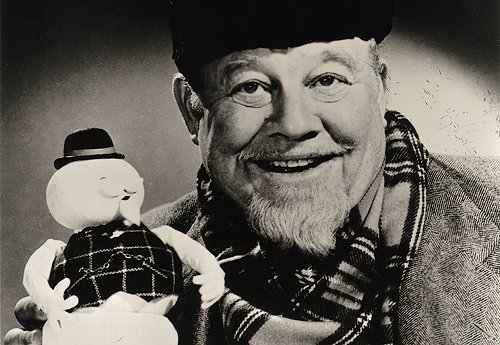
The darker side of Burl Ives

A guest post from Moonraking reader & friend Jen F. (first guest post ever!):

So, Z. and I have recently gotten into listening to a CD of Burl Ives singing “Little White Duck” and other kids’ songs that we got at the library. I had these two Burl Ives records as a child that I loved. Most of all, I remember they had these strange old minor-key folk songs full of mumbled nonsense phrases that I found very haunting and fascinating when I was little. One of these songs, “Buckeye Jim,” later turned up on an Elizabeth Mitchell CD. But most of them weren’t on the Little White Duck CD, so I decided to look for more Burl Ives on Amazon. It turns out the records I had were never released as CDs, but one of them, The Lollipop Tree, could be had in good shape (and a decent price) from a used LP dealer, so I ordered one. It’s definitely exactly the one I had. As J. commented, “Who knows, maybe it IS yours!” So Z. and I sat down to listen to these weird old songs (and also the title track, “Lollipop Tree,” which he had already gotten to know from a YouTube video; it’s much more cheery). As soon as I heard them, I immediately remembered them, though they’d been quite hazy in my mind. As a kid, though, I barely registered any of the actual lyrics. The one I remembered most was “Tam Pierce.” This turns out to be a story about a guy who lends his horse to a bunch of friends and never gets it back, and then you find out the horse is dead. The strange part, though, is that every verse has a list of the “friends” in question that Burl kind of mutters in this incantatory way: “Bill Brewer, Jan Stewer, Peter Gurney, Peter Davey, Daniel Whiddon, Harry Hawk…” This was the part that seemed most compellingly creepy to me as a kid. Even better, though, was “Wee Cooper o’ Fife,” which has this delightful nonsense refrain: “There was a wee cooper who lived in fife/ Nickety, nockety, noo, noo, noo/ And he has gotten a gentle wife/ Hey Willie Wallacky, hey John Dougall/ Alane quo’ rushety, roo, roo, roo.”

Well, as a kid I never really listened to the actual story in this one either, and it turns out the deal is the wife thinks because she’s of a higher class she doesn’t need to do any housework, so the cooper beats her into submission! Great song for a kids’ record! I was rather appalled, esp. since Z. always wants to know every word a song is saying. Maybe I’ll try to skip this one when we play it… (Here’s a complete transcription of the lyrics.)

Even stranger, though, is that it turns out the schoolchildren in Hitchcock’s The Birds sing an American version of this song (with different lyrics–no wife-beating) right before they get attacked by our feathered friends. Finally, to cap it all off, at the end of side 1 Burl sings a song called “Lavender Cowboy,” which is about a cowboy who wants to be like the other “he-men” but “only has two hairs on his chest”!!

Burl Ives! Who knew??

Meek’s Cutoff, Etsy Culture, and the Evacuation of Meaning

Meek’s Crossing is the excellent new movie by Kelly Reichardt, both of whose previous films are definitely worth watching.  (Actually there’s one more, her first, River of Grass, that I have not seen).  Wendy and Lucy (2008) was her breakthough: it features Michelle Williams as a young woman in the present day heading for Alaska for work with her dog Lucy, in an unreliable car with a small amount of money to last her until she can find employment.  Her car breaks down, she gets arrested for shoplifting, and Lucy disappears.  The movie is to a significant degree about her relationship with her dog… and about life in recessionary America for those with few resources.  It’s very good although I did find it a bit of a downer.  I prefer Old Joy (2006) which I see as a key representative film of the late Bush era, offering a haunting portrayal of varieties of liberal or counter-cultural states of mind in this period.  It co-stars (the alt-indie cult Americana singer) Will Oldham as an exasperating, sad slacker/hippie — his strong performance gave me new respect for him.  (Both films are based on short stories by Reichardt’s collaborator Jon Raymond.)

Anyway: the new one is in some ways a big departure, in others very continuous with Reichardt’s previous two.  A departure in that it must have had a larger budget and is a period drama — a revisionary, female-perspectived Western set in 1845 on the Oregon Trail.  Continuous in that it again features a Michelle Williams character on a sad, possibly doomed odyssey through the U.S. on a search for a better life, landing in what may turn out to be the dead end of an Oregon that delivers much less than promised to those without the means or skills to take advantage of it.  Williams’s character Emily Tetherow is part of a group of three couples, one child, and a disreputable guide named Meek (who’s kind of a cross between the Jeff Bridges character in True Grit and that scary character wearing the bear skin they encounter in the woods) they’ve hired to help them make their way to the Willamette Valley in Oregon in 1845.

Sarah made a good observation that Meek’s Crossing could be seen as an expression of Etsy culture.  Etsy of course is the very popular online forum for mostly homemade crafts made and marketed by nostalgic indie types: hipster embroidery, knitting, and the like.  The movie begins and ends with extremely-Etsy credits cross-stitched on homespun cloth, and the movie’s perspective is always that of the women on the journey who are locked into the “domestic” world of their wagons; they have little say in the major decisions of the journey which they (and we) often overhear the men discussing, and which frequently involve whether or not to hang or shoot someone.  (There’s an Altman-like effect in the way the men’s conversations are sometimes difficult to make out from our perspective positioned with the eavesdropping wives.)

The women are always making bread in little wooden bowls and knitting; the movie can be very slow, offering real-time depictions of the process of loading a gun or making bread or a new replacement wooden wagon axle.  In one scene, Emily Tetherow repairs (with cross-stitching) the leather mocassin of the Native American man they’ve captured and have been debating whether to kill on the spot (Meek’s preference) or to allow to accompany them as a guide.  The men either want to murder him or temporarily use him, but in repairing his leather shoe, Michelle Williams’s character demonstrates how Anglo women’s domestic knowledge and skills, along with their marginalized perspective, allow them to forge sympathetic bonds with Native Americans and to make a cross-cultural connection.

So one way to read the film would be to see it as a revisionary feminist Western that celebrates 19th-century “women’s work” and that arguably (in the Etsy manner) fetishizes homemade crafts and laborious manual labor as an implicit antidote to 21st century soulless white-collar work.   The critical reading of this could be that there’s a potential self-satisfaction or wishful thinking in the implication that this kind of craftsmanship, and the set of perspectives and attitudes associated with it, offers an utopian alternative to the masculine cruelty and ethnocentrism of the dominant culture.  Well, self-satisfied insofar as, as per Sarah’s reading, the movie implicitly suggests some kind of link between 21st century cross-stitching Etsy/home-crafting culture and that of the world depicted in the movie.  (J. Hoberman hints at such a link in his quip that the film’s women are “alt-Bedouin in their protective gingham dresses and heavy bonnets.”) I personally have no problem at all with hipster/indie/Etsy neo-hippie craftsmanship, but I do suspect that its practitioners can be prone to wishful thinking about how much of a challenge to mainstream culture their knit beer cozies and the like constitute.

The movie certainly doesn’t pan out in any kind of self-satisfied or celebratory manner, however.  [Spoiler alert — in what follows I will give away plot details from the movie’s conclusion).

In an imagined upbeat version of the movie, Emily Tetherow’s bond with the captive would save the group, with “the Indian” leading them to a source of water. (This is the only way he is identified, btw.)  In actuality, however, the journey apparently ends in disaster.  The Anglos interpret the Indians’ mutterings (he speaks no English) to be suggesting that water lies on the other side of a ravine and hill that will be difficult to cross in their wagons.  Desperate, they attempt to lower the wagons to the bottom of the ravine via ropes, but one rope breaks, crashing the cart and spilling their remaining water.  In the shocking final scene, the Indian simply walks off, muttering to himself, leaving the party to what would seem certain death.  Cut to embroidery/ cross-stitched credits.  As J. Hoberman observed, the movie ends up recalling Aguirre, the Wrath of God in its depiction of a journey into the wilderness that winds up in circular movement leading nowhere but to destruction and death.

The Tetherows and companions have been obsessed with the possibility that “the Indian” is either reading or transmitting signs to potential hidden companions.  He scrawls drawings and marks on stones as they travel — other rock drawings are visible throughout the journey — and when the party catch him leaving inscribed stones behind that may serve as markers of their path, they almost kill him on the spot, in terror that he is leading them to slaughter.  Yet as they realize their only hope may lie in his ability to read the landscape for signs of water, they must place their hopes in his signifying abilities.

But the final scene strongly implies the possibility that he may be insane or at least at least as confused as the Thetherows & friends; as he wanders away, he seems not purposeful but lost in his own world, and the film left me with the sense that all the speculations about his powers of receiving and transmitting signs have been beside the point, since he is neither a shrewd enemy nor a valued native informant but simply a confused soul severed (or “cut off”, as per the title) from any sustaining community or cultural system.  (Again, even more cut off than the white settlers, who at least can die together.)

This is just one possible interpretation, but my sense was that all “the Indian”‘s scrawlings on rock were meaningless… giving the whole movie a final sense of futility and evacuated meaning that’s quite powerful and that demands a rethinking of much that’s preceded it.  The film becomes an exploration of what it means to be culturally “cut off,” severed from any sustaining culture’s web of signs, wandering in a world filled with signs that appear pregnant with significance but ultimately reveal themselves as empty or at least conveying nothing to us.  If “the Indian” is slyly communicating with his people, at least we’re in a meaningful (albeit enemy) world; to realize that he has just been scrawling on rocks and can neither offer help nor harm is, in a sense, a much bleaker conclusion. And in one final turn of the screw, we could read the film’s “handmade” end credits as a parting allusion to our own futile desire to reconnect ourselves to lost whole pre-industrial cultures.  In this sense a revival of homemade crafting could be analogous to the Western as a nostalgic genre.

A fun Saturday night, in other words!  Actually, it’s really good — almost everyone in the theater sat through the entire final credits, just soaking it in.