Uncle Boonmee Who Can Remember His Past Lives

I saw this a week or two ago at the IU Cinema and keep meaning to write something about it.  Perhaps all I have to say, really, is that it’s like a cross between Akira Kurosawa’s 1975 Dersu Uzala and Donnie Darko.  In fact, it is so much like that that I’ll be surprised if no one else has pointed it out.  I don’t remember Dersu Uzala very well as I haven’t seen it since the 1970s, when a somewhat eccentric friend of my father’s took me to see it.  I had assumed that this was when it was released, but checking the date, did he really take me when I was six years old???  (More likely it was a showing somewhere at least a few years later.)  I do remember being absolutely mystified by the movie, which is a Herzogian account of an early 20th-century native of the Siberian forests:

The film opens to a forest that is being cleared for development, and Arseniev searching for an unmarked grave. The film then flashes back to Arseniev’s surveying expedition to the area of Shkotovo in Ussuri region in 1902. A topographic expedition troop, led by Captain Arseniev, encounters a nomadic, aboriginal Nanai tribesman named Dersu Uzala who agrees to guide them through the harsh frontier. Initially viewed as an uneducated, eccentric old man, Dersu earns the respect of the soldiers through his great intelligence, accurate instincts, keen powers of observation, and deep compassion. He repairs an abandoned hut and leaves provisions in a birch container so that a future traveler would survive in the wilderness. He deduces the identities and situations of people by analyzing tracks and articles left behind.

Dersu Uzala saves the lives of Captain Arseniev and one of his men not once, but twice…  [wiki]

Uncle Boonmee combines a similar mysterious immersion-in-the-primeval-forest setting with cheesy (or what you would assume would seem cheesy, though do not really) sci-fi elements, namely hairy, Yeti-like “monkey ghosts” whose eyes are little bright red LED flashlight dots.  I was charmed to read that the director Apichatpong Weerasethakul was heavily influenced in this film by fond memories of watching Thai sci-fi/horror B, C and D-movies on t.v., movies so cheaply made that the monsters had to stay in the shadows so you wouldn’t see how bad their costumes were.

It’s quite a beautiful, strange, sometimes droll movie.  The animated films of Miyazaki would be another analogy: Weerasethakul’s style is less accessible, weirder, but the film shares with something like The Princess Monaoke a respect for the natural or nonhuman world as animate, numinous, and at once alien and welcoming. Perhaps the most memorably strange scene involves a princess with discolored skin (possibly from a burn?) who prays to a catfish god to heal her.  She wades into the pool and, no other way to say it, has sex with the catfish god: you actually see it wriggling and splashing between her legs.  Otherwise most of the movie takes place in a recognizably contemporary Thailand where Uncle Boonmee, who owns a little farm where he raises bees, lives through his final days before death, a process that involves conversations with various family members including both the ghost of his wife and his lost son who has now returned as a Monkey God: turns out he got lost in the jungle and mated with a female Monkey God, after which he became one himself.  Said son is basically in a gorilla suit but the effect is not comic but movingly strange; the fantasy elements somehow allow for the expression of deep feelings of sadness, regret, and love.

I started to think about the movie differently when I read that Weerasethakul seems to have intended Boonmee’s death, shot in somewhat grainy 16 mm., to represent the death of cinema itself: “When you make a film about recollection and death, you realise that cinema is also facing death. Uncle Boonmee is one of the last pictures shot on film – now everybody shoots digital. It’s my own little lamentation.”  There is also a Thai political angle — as a young government soldier, Boonmee hunted for and killed communists in the forests, actions he now regrets — that I didn’t feel equipped to interpret very deeply.

This would be better to see on the big screen than on DVD — it helps to feel immersed in its visual world.

“Are we truly the crocodiles?”: Herzog’s “Cave of Forgotten Dreams” at IU

We were very excited to catch what was apparently the first commercial/non-festival showing of Werner Herzog’s Cave of Forgotten Dreams in the U.S.  This showing was introduced by Jonathan Sehring, president of IFC Entertainment, which is distributing the film.  He buttered us up in a nice way, effusing that “This is one of the best, if not the best, theaters I’ve ever been in… It’s a spectacular venue. You guys are very, very lucky.”  Maybe he says that to all the girls, but it gave me a warm & fuzzy (/smug & self-satisfied) feeling inside.

Apparently inspired by Judith Thurman’s article in The New Yorker about the neolithic cave paintings in Chauvet Cave in southern France, Herzog managed to receive permission from the French government to be the first and perhaps only filmmaker to be allowed in to see and film the paintings.  In 1994 some hikers/explorers stumbled on this incredible find: hidden within a rockslide from thousands of years ago, they discovered hundreds of spectacular wall paintings, mostly of animals, dating from about 32,000 years ago.  Here’s Wikipedia’s summary:

Hundreds of animal paintings have been catalogued, depicting at least 13 different species, including some rarely or never found in other ice age paintings. Rather than depicting only the familiar animals of the hunt that predominate in Paleolithic cave art, i.e. horses, cattle, reindeer, etc., the walls of the Chauvet Cave are covered with predatory animals: lions, panthers, bears, owls, and hyenas. Also pictured are rhinos. Typical of most cave art, there are no paintings of complete human figures, although there is one possible partial “Venus” figure that may represent the legs and genitals of a woman. Also a chimerical figure may be present; it appears to have the lower body of a woman with the upper body of a bison. There are a few panels of red ochre hand prints and hand stencils made by spitting pigment over hands pressed against the cave surface. Abstract markings—lines and dots—are found throughout the cave.

Because of the bad experiences at Lascaux, where (Wiki again) “since 1998 the cave has been beset with a fungus, variously blamed on a new air conditioning system that was installed in the caves, the use of high-powered lights, and the presence of too many visitors,” Chauvet is now completely inaccessible to the public.  So if you want to see the paintings, you gotta see Cave of Forgotten Dreams.

I found the movie to be a slightly odd combination of really excellent Discovery Channel-type archaeology documentary (this describes let’s say 75%-80% of the film) and characteristically whacked-out Werner Herzog film (the remaining 20% or so).  When I first heard the phrase “Werner Herzog 3D cave painting documentary” a year ago, I guess I imagined something different, something stranger, so at one level it was a bit disappointing to find scenes like the following: Shot of four scientists sitting in a generic white office-style florescent-lit room.  Herzog’s voice-over: “The scientists were housed in a nearby sports complex.  Although they each possess particular specialties, they share their work collaboratively” (something like that).  Cut to the laptop screen of two nerdy scientists explaining a graph.

That is to say that the two aspects of the movie, the earnest Discovery Channel-style documentary and the whacked-out Herzog film, often felt to me somewhat in conflict. Some of the most Herzogian scenes involve scientists and others involved in the project whose obsessions and idiosyncracies he draws out and dwells on to amusing or defamiliarizing effect.  There’s the “Perfumer” who walks around the surfaces outside the cave, smelling the ground, trying to sniff out undiscovered chinks or crevices.  (I remained a bit confused about whether he was an actual member of the investigating team or just a local amateur.)  Or the scientist whom Herzog films dressed in his deerskin Inuit costume performing a rendition of “The Star-Spangled Banner” on animal bone flute.  Or the affably nerdy, bristly-moustachio’d scientist (the 3D really brings out the moustache) who demonstrates, badly, the technique of spear-hunting with a small sling.  I guess the problem for me was that these scientists, unlike many of Herzog’s previous documentary subjects (e.g. Timothy Treadwell), do not in fact seem bizarrely or inexplicably obsessed.  They are dedicated to their work, for obvious and good reason; sometimes when Herzog tries to draw out their oddities (as with the anthropologist who, it turns out, used to work as a circus performer), these eccentricities seem somewhat beside the point.  This isn’t exactly Klaus Kinski in the jungle of Peru, and none of the scientists seem all that strange.  Herzog specializes in depictions of obsessives whose objects of fascination do not make rational sense; these cave paintings cannot be explained by reason alone, but anyone’s fascination with them is perfectly easy to comprehend.  (Sarah pointed out that it was a little surprising that Herzog spent so little time discussing competing anthropological/archaeological theories about the ritual practices of these neolithic peoples, which would seem to offer ample opportunity for Herzogian musing on primitive urges and practices.)

There’s also a sort of coda featuring some albino crocodiles, supposedly the product of genetic mutation from nearby power plants, who inspire Herzog to wonder, “Are we truly the crocodiles who look back into the abyss of time? at the neolithic artists of the cave paintings.  (Sehring wryly noted that at a public appearance last year, Herzog blithely declared that all the stuff about the albino crocs was completely fabricated, which Sehring implied poses a marketing challenge for a documentary.)

The crocs felt like classic Herzog (not least in their uncertain positioning on the fiction/documentary border), but then so much of the rest of the film is a much more earnest and straight-forward examination of the cave paintings, in the context of which some of his vatic pronouncements can seem a bit silly or extraneous.  (Speaking of his vatic pronouncements, ever since I discovered the brilliant “Werner Herzog reads classic children’s story books” series on Youtube I sometimes find myself giggling a bit at the sound of his voice.)

No question though that I would not want to miss the loving, rapturous exploration of these amazing and very mysterious images, which Herzog convincingly describes as “proto-cinematic” in their capture of animal motion; the 3D technology does not feel like a gimmick but an opportunity for something close to an in situ experience of them.  And, despite some of my reservations, Chauvet Cave does make perfect sense as one of Herzog’s sites of wildness and mysterious otherness, a sealed-off zone of otherworldly creation that, no matter how fully we study and chart it out, we will never fully understand.

Killing “The Yearling”

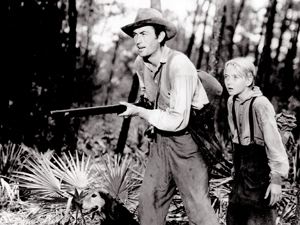
This was a heavy one. I’d taped it off TCM and before watching it with the kids, I did a quick look at the reviews on Netflix; on the first page they were all saying “classic film, great family movie,” etc. It’s really good: Gregory Peck and Jane Wyman as the husband and wife homesteading in the Florida swamps in the 1870s, and Claude Jarman Jr. as their 12 year old (?) son Jody. Jarman was one of those slightly melancholy child stars who never made it as an adult actor.

It was filmed on location in Florida and the sense of place is wonderfully vivid. Sarah had just read that new novel Swamplandia so she especially enjoyed the depiction of the swamps.  The basic plot is that the little family is, with difficulty, trying to eke out an isolated living with their only human companionship some slightly scary neighbors a couple miles away.  Jody has a warm relationship with his dad, but the Jane Wyman mother character is critical and cold; we soon learn that she lost three previous children (we see her looking at their gravestones) and so she withholds affection from Jody out of fear of being hurt once again.

There’s an intense scene of bear-hunting in the swamps: the black bear tussles with and tosses around the family’s dogs, and Pa’s rifle sticks so he nearly blows his own face off.  Later dad is bitten by a rattlesnake and only Jody’s valiant bravery allows him to (just barely) survive.

The main dynamic of the movie involves Jody’s desire for a pet, something he can love.  Ma doesn’t think they can afford the costs of keeping another animal in the house.  (I was never quite clear why the dogs couldn’t do it for Jody; he needs something all his own).  A pretty strange emotional system is operating in the household.  Ma withholds her love.  The son, as a response, needs something else to love, but Ma forbids this.  The stalemate breaks in a somewhat overdetermined manner.  After Pa is bitten by the snake, he pulls up his gun and shoots a doe, which he then commands Jody to go to, cut open her belly, and pull out her heart and liver to place on his wound to drain the poison.  Jody does this, which apparently saves his father; they then notice that the doe had a baby faun with her.  They rush back to the house, but once it seems that dad is pulling through, Jody asks permission to go fetch the faun as a pet.  This time Ma can’t say no, and so the adorable little creature becomes a member of the household.

Trouble develops when the faun, whom they’ve named Flag, turns into a yearling, a mischievous, hard-to-control older animal.  When Flag eats the family’s desperately-needed garden crop one time too many (they were counting on selling tabacco as a cash crop to pay for a new well so Ma would not need to carry water a half-mile), the still-bedridden Pa commands Jody to kill the deer.  He refuses, and so Ma has to do it.  She’s a bad shot and only wounds the animal, so Jody has to finish Flag off.  Jody tells his parents he hates them, runs away, collapses on an abandoned boat in the swamp, is found on the river and returned home.  He now accepts that Flag did have to be killed; he himself is now no longer a yearling but a man.  Ma can love him unconditionally (with no competition from Flag).

Now, on the one hand, there’s a realistic logic to all of this and I can imagine a scenario of this sort actually unfolding in these circumstances.  I even felt it was at some level a useful thing for the girls to think about, the hardship and difficulties people used to endure that would lead them to such a dilemma.

That said, the whole movie does play out as a somewhat bizarre lesson in the necessity of killing the creature you love.  After all the upbeat reviews on Netflix I came across this more critical (one-star) one:

This is another one of those message films about animals that were so popular during the 1940s and 1950s. These films warn that if a child or adult dares to elevate an animal to the level of a human, they will pay for it. The main theme is this: Beware of loving an animal too much–this is a childish notion and practically a sin. This misguided love will come back to hurt you in the end. Another example would be The Red Pony with Robert Mitchum. Fine actors such as Gregory Peck and Jane Wyman (or Robert Mitchum in Red Pony) cannot take away from the terrible sadness of these films. If you’re an animal loveing adult or a child, this is one you should avoid.

This commentator does have a point; there’s a certain sadism in the way the movie encourages you to love Flag as much as Jody does and then to face up to the necessity of destroying him.  Again, these sorts of choices did have to made, I’m sure, but there’s something pointed in the way this movie (and some others of the period) develop the narrative around precisely this dynamic.  And in this case there seems to be an especially odd sacrificial logic at play.  (A) Jody’s siblings all died, so his mother cannot love him fully.  (B) He therefore needs an animal to love.  (C) But the necessary cost of earning his mother’s unequivocal love is to kill that animal (which was literally taking water and food out of her mouth). (D) Also: to be a man is to kill the animal (Ma can’t actually kill Flag, Jody must do it in the place of his father).   (E) And don’t forget that Flag could only join the family because its mother, the doe, served as an organ donor to save Pa.  So the animal is needed, but not to love, only as a resource, something to be “harvested” like a crop.  (Jody had actually allowed Flag to curl up on his bed, which seems a fundamental taboo.)

The girls were not as upset by it as we expected, possibly b/c we took a break and then watched the last 45 minutes the next day after explaining what happens.

“An Endlessly Repeating Evil Loop:” “Taxi Driver” and Paul Schrader at IU

[image from Wikipedia]

Wow, what a treat: Paul Schrader himself introducing the film he wrote, Scorsese’s Taxi Driver, in its new 35 millimeter restoration at the IU Cinema.  I must have seen Taxi Driver in the 1980s at the Brattle Theater, and I’d seen it at least a couple times, but seeing this new print in the beautiful theater was a pretty amazing aesthetic experience, starting with the gorgeous-evil blurred lights of the porn theaters of Times Square seen through the rainy windshield of Travis Bickle’s taxi in the opening shots.

Schrader introduced it briefly and then spoken for at least 45 minutes afterward, doing an on-stage interview and then taking questions.  I didn’t take notes, but here are some comments & points that stuck out for me (wording not exact):

  • He started by saying (I think I’d heard this before) that when he wrote the movie he was “in a very dark, morbid place,” sleeping in a car, and that when he went to a hospital for what turned out to be stomach ulcers, he realized that this was the first time he’d spoken to a human being in a month.  He said that the idea for the film came to him in a vision of a metaphor: a yellow taxicab as a “metal coffin,” a container for a dead person, floating through the city streets.
  • Someone asked about the slightly jarring coda, which I actually did not remember.  I thought the movie ended with the bloodbath (when Bickle rescues 13 y.o. prostitute Iris (!) (played by Jodie Foster) from her pimp), but it’s followed by a few minutes explaining how Bickle became, improbably, a celebrated hero for his actions.  It ends with him picking up as a fare the Cybill Shepherd character (Betsy) who’d previously rejected him; she seems interested, but he basically blows her off, and the whole thing plays, I thought, as pure fantasy, Bickle’s hallucination as he’s dying in the Harlem East 13th street walkup covered with blood.  Schrader commented that people often assume that the studio forced this more upbeat coda to be added, but he said “just the opposite” (that was a common refrain of his), that this had always been in the script and was integral to his vision of the movie.  He pointed out that the final shot of the film essentially is the film’s first shot: or perhaps literally is the first shot.  We once again see Bickle’s face in the rearview mirror and the blurred lights outside.  “Nothing has changed,” Schrader said, it’s all going to begin again in “an endlessly repeating evil loop.”  Someone in the audience tried to make the case that Bickle had changed and progressed and had gotten over his obsession with Betsy, but Schrader cut him off: “he’ll find someone else, he hasn’t changed, he hasn’t learned anything.”  His rage and delusion trap him in an eternal repetition.
  • Schrader was discussing how much he and Scorcese had/have in common — “we’re both short, asthmatic, movie-obsessed” (I forget what else he specified), with the key difference being that “Marty” was Roman Catholic and urban, whereas Schrader was raised in a strict Calvinist household in rural Michigan (wiki: “When he disobeyed his mother, she would stab his hand with a pin, asking, “You think that felt bad? Hell is like that, only every second and all over your body”).  These rural/urban cultural differences played out in different metaphors Schrader and Scorsese used to think about the film and Bickle; Schrader said that for him Bickle was “a lone wolf on the frozen tundra staring at the fires of civilization with envy and rage.”  Interestingly, in a subsequent discussion of Hollywood and his current work financed by non-American investment sources, he commented that a screenwriter or filmmaker these days is “a stray dog picking up scraps from any table he can find.”
  • Schrader was famously Pauline Kael’s protege/discovery.  He says that when he sent her the original script for Taxi Driver, he never heard back from her about it.  Later she told him that she found it so disturbing that it was sitting on her bedside table and she first turned it over to face down; that wasn’t enough, so she moved it to a shelf in her closet and covered it with boxes so it wouldn’t be visible.  (She loved the movie, however.)
  • Someone asked him if he could say anything about the movie’s racial subtext.  His answer was disturbing!  He said that “the movie is sanitized; the original script was much more racist.”  “I’m unapologetic about it: that’s who this character was,” explaining that Bickle’s rage was “fundamentally racist” and that his final “rescue mission” was originally “all about killing black people;” Iris’s pimp and everyone else in the building were originally black.  He said the studio told them that if shot this way, “there would be riots,” saying that “you can make a movie with a racist character, but filmed this way, you’d be right on the line between that and a racist film.”  As a result, Scorsese asked Schrader to find an actual white pimp who could serve as a model for the Harvey Keitel character Champ.  Schrader said he began referring to this as “the Great White Pimp Search,” and said that he literally could not find a white pimp, so they eventually gave up and Scorsese just made up Keitel’s character (who does feel a bit fabulized).
  • As part of the Great White Pimp Search, he met the 16-17 y.o. prostitute who became the model for Iris; he says almost everything about Jodie Foster’s character was based directly on this girl, who you see walking with Iris at one point wearing a big hat (they hired her as a consultant).  Schrader said he brought her up to his hotel room and left a note for Scorsese saying “I found Iris; we’re all having breakfast tomorrow morning at 8,” and that this meeting was reproduced almost exactly in the scene with Iris in the diner.  Disturbingly, Schrader said “I didn’t want to get sexually involved with her because it would have been way too complicated.”  Hmm, good reason for not sleeping with the underage prostitute. Roman Polanski much??
  • Someone asked him about the comparisons people often make between this film and Altman’s Nashville, which also draws on material from actual political assassination attempts.  Schrader basically dismissed this and characterized Nashville as “technically imaginative, but why on earth an intelligent man would want to make a movie about country music, a genre he doesn’t like and doesn’t understand…”
  • I asked a question!: “This movie could obviously never be made by a major studio today.  Do you think it might be possible for it, or some version of it, to be made by an independent studio?”  He said something like “well, now you’re opening up a whole new topic that brings us into a very empty, hollow place,” or something.  He said that Hollywood no longer is in the business of making dramas: they only want to make action/technology based movies, comedies, and family movies.  “If you want to see drama, watch [HBO’s and Todd Haynes’] Mildred Pierce, it’s fabulous, but don’t expect it from Hollywood.”
  • He praised Bernard Herrman’s score to the skies and commented that he thinks this was one of Scorsese’s most brilliant/crucial aesthetic choices.  He said that he’d assumed that this film, like Scorsese’s previous Mean Streets, would have a “needle-drop” score.  I’ve never heard that term, but I guess it means punctuated by previously-released songs (in the case of Mean Streets, pop songs of the era) as opposed to an actual score.  But instead, Scorsese got this unforgettable “horror-movie score” that becomes the soundtrack of Bickle’s inner life.
  • Schrader was pretty gruff and irascible; as I commented, he several times responded to questions by saying, “basically, the opposite of what you just said.”  But, he was actually noticeably kind at one point.  The Q&A was wrapping up but then Schrader said, “oh, Reese Witherspoon has a question in the back.”  A presumably IU undergrad who really did have a Reese W. look asked a somewhat confused/confusing question which Schrader dealt with very generously and responded in a way that pretended it was perfectly clear.  Her question had something to do with Scorsese’s penchant for ensemble dramas as opposed to Schrader’s tendency to focus on single protagonists (at least that was what Schrader made of it, the question as spoken had something to do with “lifestyle”), and he commented that he tends to write “monocular” narratives where you “take one centimeter in some guy’s skull — sometimes a woman, but usually a guy — and bore all the way into that one head” (I forget the full wording).

Well, there was more, but those were some highlights for me.  I would have liked to catch his talk the next day about his entire career — Raging Bull, The Last Temptation of Christ, Blue Collar (which he directed, with Richard Pryor in a rare dramatic role), Mishima, Brian De Palma’s Obsession (I actually don’t recall what that movie is at all), etc — but didn’t make it.

Jacques Tati’s poujadiste “Mon Oncle”

The whole family went to see Jacques Tati’s Mon Oncle at the IU Cinema.  A pretty robust crowd for 3 pm on a beautiful Saturday.  In the introduction, it was mentioned that we were about to see the dubbed-English version; you could hear actual mais non!s from the audience, but then the speaker trumped us by pointing out that it was the Jacques Tati estate itself that chose the English-language version to restore.  I found this intriguing and counter-intuitive, and/but I have to say that the English dubbing made a certain sense to me — it underlined the movie as international, part of a global modernism.  Also, the movie has very little dialogue, so it’s close to a silent movie (albeit one in which sound if not language plays a key role).

The movie is so great!  I had never seen it.  The plot, such as it is, involves a few days in the life of the Arpels, husband and wife; he the boss of a plastics factory, she a housewife in a squeaking rubber house-dress, their son Gerard, and their semi-bohemian — or at least poor and unemployable — uncle/brother, M. Hulot (Tati himself), whom M. Arpel sets up with a job in his factory.  (This does not go well, in ways that evoke Chaplin’s Modern Times: a kind of Sorcerer’s Apprentice-like struggle with the factory ensues).  The movie is all about a clash between the forces of mid-20th-century-industrial modernity, planned culture, the plastic pipes manufactured by M. Arpel’s factory (shade of The Graduate — “plastics” — we don’t know what these rather perversely-coiling red tubes are actually used for), futuristic (Jetsons-like) gadgets, plants contorted into artificial shapes in the garden, and a top-down, status-oriented professional-managerial class that oversees these regimes of order, on the one hand; and on the other, everything associated with Mr. Hulot, the shambling, messy, wandering, erring, foggy-headed uncle filled with a spirit of improvisatory play who rides a rickety bike everywhere and lives in a shabby boarding house.  (We see him ascending the irrationally non-linear stairs to his room in a cut-away shot, bowing and dodging to avoid neighbors and hanging laundry.)

The girls seemed to enjoy it quite a bit too, seeming to relish all the weirdly hilarious, subtle physical comedy: the dolphin fountain which only goes on for high-status visitors; the absurd winding paving stones in the Arpels’ front yard; the comedy of the broken water pipe; the food carts, the boys who whistle at people to make them walk into signs, and the hilarious little gang of dogs racing through the movie as a force of aleatory randomness. Tati’s argument for chance and play is enacted in the filming of the dogs; Tati seems just to have let them go and tried to follow their crazily-criss-crossing itineraries as best he could.  The movie’s anti-industrial/modern themes sound a bit obvious or even smug, but it all plays out brilliantly and surprisingly.  The movie feels like a Rube Goldberg device, a hyper-stylized, perfectionist contraption (the sounds and the score are amazing).  It’s one of the most stylized and amazingly-designed movies I can think of, up there with The Umbrellas of Cherbourg — there’s a certain irony in that, of course, given the ways the movie always seems to favor “nature” over artifice.

This was maybe my favorite scene (on the bottom), when the Arpels accidentally lock themselves in their laser-motion-detector garage and are trying to convince the dog to walk through the beam to trigger the door.  (There are a number of shots in which round windows appear, with heads at the center, like giant eyeballs.)

The dogs are allied with the wayward boys whom Gerard falls in with when he can, to escape his parents’ oppressive oversight: swarms/packs of unruly creatures defying rules of order, propriety, and linear movement.  (Wiki tells us that, interestingly, “At its debut in 1958 in France, Mon Oncle was denounced by some critics for what they viewed as a reactionary or even poujadiste view of an emerging French consumer society, which had lately embraced a new wave of industrial modernization and a more rigid social structure” — I did not know that term, poujadiste: “Poujadism was opposed to industrialization, urbanization, and American-style modernization, which were perceived as a threat to the identity of rural France.”)

*Cyrus*’s mother love

We watched Cyrus, the creepy-funny (but unfortunately, ultimately too “sweet,” as well) indie movie.  John Reilly (John) has been divorced for years from his ex-wife Jamie, played by Catherine Keener, who, in the film’s opening scene, shows up at his grim bachelor apartment and finds him apparently masturbating while listening to loud hip-hop on headphones.  So, he’s stuck, regressed, auto-erotic, acting like a sad adolescent.  She drags him to a party with her fiance — they all get along, although the fiance seems a bit understandably exasperated by John’s presence (later, he’s with them as they choose the flowers for their wedding).  John makes a drunken fool of himself but still manages to hook up with sexy Marisa Tomei (Molly).  They bond dancing to the Human League’s “Don’t You Want Me,” so there’s a sense that she can meet him halfway in regressive nostalgia for the period of their adolescence (the 1980s). Molly’s first sight of John occurs when she stumbles on him drunkenly pissing in the bushes and cracks, “nice penis!” This is a re-play of the just previous scene when John’s ex-wife walked in on him masturbating, but now John’s self-exposure plays for laughs and even flattery: Molly offers the promise of a cheerful acceptance of his sexuality.  (N.b. “John” = penis.)

Then, John meets the guardian of Molly’s sexuality, her strange 21-year old son, Cyrus (Jonah Hill).  Cyrus easily could’ve been overplayed, but Hill turns him into an effectively restrained, yet very creepy presence. (Sometimes he almost reminds me of Peter Lorre; Manohla Dargis compares him to Norman Bates.)  Cyrus is a demonic figure, a “double” for John and an image of arrested, stunted male sexuality: what John fears he may be.  Cyrus disapproves of his mother’s relationship with John.  “Don’t fuck my mom, John,” he blurts out early on, adding, “you’ll have you get used to my sense of humor!”  John notices a photo on the mantelpiece of Molly breast-feeding an at-least three-year-old Cyrus.  Molly won’t close the bedroom door at night; Cyrus freely walks into the bathroom where his mother is showering in a transparent stall.  All in all, she and Cyrus are much too intimate.

Cyrus’s presence infuses John’s relationship with Molly — and adult sexuality generally — with undertones of incestuous desire.  The first time John sleeps with Molly, he’s amazed and grateful and calls her a “sex angel;” everything plays realistically (he’s been lonely and celibate for a while), but there’s always a more fantasy-based component: John is still the stunted adolescent who at some level is sleeping with a mother figure; Cyrus’s hulking, intrusive presence (he and John are physically comparable, big burly guys) haunts all sexual contact between John and Molly like John’s bad conscience.

So Cyrus is, according to the movie’s logic, John’s regressed, un-evolved double.  We first see John acting like a horny, confused teenager, shamefully caught in the act by a mother-figure; Cyrus embodies John’s fears that he can never in fact get past that phase.

Cyrus’s only occupation is “working on his music career” and composing his strange synth music.  The sight of Cyrus manipulating his keyboards and computers while staring fixedly at John to the throbbing strains of the music is simply amusing, but it also offers an interesting contrast to the pop music (the Human League) John and Molly first danced to.  On the one hand, “Don’t You Want Me?” is literally “regressive,” an oldie from the 80s, yet in another sense, Cyrus’s throbbing, wordless, and as such “pre-symbolic” music is more fundamentally regressive, and a possible figure for a sexuality that cannot accommodate itself to the real world and its language.  That is, the pop song simply asks, “do you want me?” and declares its own desire, but Cyrus’s music can only imply and insinuate, never state outright what exactly is desired.

John has to spruce up to go to the party, where he meets Molly, so there’s a sartorial transformation as he tries to present himself as an adult man, not an aging kid, putting away his aging-teenager outfits; the first act of aggression Cyrus commits is to steal and hide John’s ratty old sneakers (which Jamie has always tried to convince him to throw out).  It’s as if Cyrus is suggesting to John that he cannot dispose of his “adolescent” self or desire as embodied in those sneakers; Cyrus will hold onto the stained white Pumas (Adidas?) as a reminder or token of who John truly is.

At the end, John and Cyrus have it out in a big physical fight — at a wedding! — and then make up.  Cyrus admits he has “serious issues,” and in the final scene, Molly beckons John to come back to her in her home (they’d broken up).  Clearly, the movie should’ve ended in horror-movie fashion, with some either explicit or implicit suggestion that the unreformed Cyrus, as a figure for stunted, pre-adult male sexuality, will continue to haunt them — maybe John would see something out of the corner of his eye, someone looking through the window?  But no… it all ends with Cyrus apparently cured or willing to work towards a cure, no longer dedicated to thwarting John and his mother’s relationship, reconciled with the realities of adult sexuality and happy that his mother has “found someone” other than himself.

Very disappointing!  The movie was still worth watching, very amusing at times, but it could have been so much better if it had developed its own logic to its conclusion.  It also should have been titled Don’t Fuck My Mom.  I wonder if this was a classic case of the studio insisting on an ill-advised happy ending…

“Catfish” and “The Shop Around the Corner”: Opening the Envelope

We watched Catfish the other day.  It would make a good double feature with Banksy’s (fascinating) Exit Through the Gift Shop — both movies feel very of-the-moment in what they do with documentary form and what they say about 21st century mediated identity.  Catfish is hard to discuss without giving too much away.  It’s about Nev Schulman, a photographer who lives in NYC with his brother Ariel and friend Henry, and a long-distance relationship Nev develops via Facebook and email with, first, an 8 year-old girl and her mother, and then the girl’s 21 year old (or so) older sister (they all live in rural Michigan).  The young girl sees a photograph Nev had published in The New York Sun of a ballet dancer, and does a painting based on the photo which she mails to Nev.  She’s incredibly talented for such a young kid, and soon she’s sending Nev more paintings, and he’s in touch with her mother (initially as an artistic mentor for the girl), and then with her sexy older sister.  A flirtation develops, and then things start to get weird.

Apparently when it was first shown at Sundance, some accused the filmmakers (Nev and his buddies) of having faked the film — perhaps as a reaction to Exit through the Gift Shop, which is obviously faked in various ways.  I for one believe the Catfish boys, though, that it’s at least mostly legit and un-manipulated.

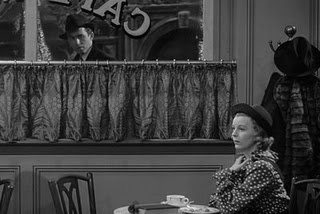
Coincidentally, we also watched (this one with the girls) the classic 1940 Ernst Lubitsch rom-com The Shop Around the Cornersuch a great movie.  The two films really have quite a bit in common in their portrayal of love and desire as mediated fantasy, routed through communications technologies — in this case, of course, the postal system and P.O. boxes (You’ve Got Mail is to some degree a remake, but let’s forget about that).  James Stewart and Margaret Sullavan work together in the shop, drive each other crazy, and maintain a postal/epistolary romance with what turns out to be one another.  In one great scene, Stewart goes to the cafe where his mystery love is waiting for him; he can’t bear to look, so asks his friend Ferencz (this all takes place in Budapest, btw) to peek in the window.

Ferencz: She has a little of the coloring of Klara.

Kralik (James Stewart): Klara? What, Miss Novak of the shop?

Ferencz: Now, Kralik, you must admit Klara’s a very good-looking girl.

Kralik: This is a fine time to talk about Miss Novak.

Ferencz: If you don’t like Miss Novak, I can tell you, you won’t like that girl.

Kralik: Why?

Ferencz: Because it is Miss Novak.

The imaginary object of desire now transforms into his disliked co-worker, metaphor into metonymy. Confronting the actual object of his desire is a bit like opening the holiday bonus envelope:

The boss hands you the envelope. You wonder how much is in it, and you don’t want to open it. As long as the envelope’s closed, you’re a millionaire. You keep postponing that moment and…you can’t postpone it forever.

Kralik, having peeked through the glass window of the cafe, has opened the envelope, and it takes him a while to reconcile what he sees in it with what he had imagined.  For Klara, for most of the rest of the movie, the envelope remains sealed.  There’s a running trope about “counterfeiting” and authenticity: “You don’t have to tell me that it’s imitation leather. I know that.”  (No one wants to be the dupe who mistakes the fake for the real.)  Or: “Are those real diamonds?” “They’re pretty near.”  This as Kralik puts the necklace on Klara, supposedly as a trial run for his actual girlfriend.  The idea of a “real” diamond suggests an escape from fantasy and mediation: fulfilled love as a transcendence of imitation and role-playing.  But of course the movie shows that desire is all of those things.  There is no “real” or authenticity that can rise above fantasy, just a “pretty near” matching up of desire with physical/bodily reality.

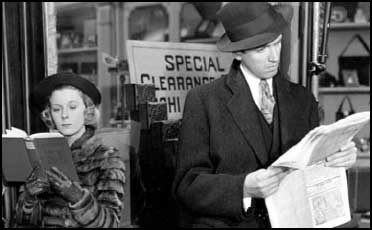
Reading books or newspapers offers another version of what Klara and Kralik had found in their epistolary relationships.  It’s Bovaryism, desire as mediated escapism:

Here’s another emblematic shot: Klara and Kralik are together in her bedroom. He’s come to visit her because she missed work, not physically sick so much as heartbroken (hard to keep the physical and the imaginative/psychic distinct).  He’s there with her — notice he is almost touching her — but is she in bed with him?  Yes and no: she’s there with his letter, which she reads to him, not understanding the circularity of this performance.  There’s a weird combination of all-saturating eroticism here along with chastity, in that she (at this point) has less than no interest in the physical Kralik.

In Catfish this all plays out through Facebook rather than mail, but with a comparable mix of misdirection, role-playing, and a sense that desire becomes revealed as a fantasy world of projection and invention.  There are matching shots: in Catfish, of the Facebook page as a new message pops up; in Lubitch’s film, of the actual P.O. box through which once or twice we actually glimpse Klara as she peers, looking for a new letter.  As befits a contemporary version of Lubitsch’s scenario, though, in Catfish the inventions manifest themselves less in words than in visual images (paintings, photographs, and especially Facebook images) and sounds (there are some interesting counterfeit singer-songwriter performances).

Some reviewers have found some condescension in the way the geography of Catfish plays out: the savvy but trusting professional-class boys from NYC head to the heart of rural, working-class Midwestern darkness where they find lies, invention, and a shamefully uncontrolled fantasy.  Nev moves, in a sense, from the media and the internet as we might like them to be today — facilitators of talents and emotional connections that can move swiftly across time and space, enabling new networks and expressions — to the media as they may in fact be: murky pools of potential deceit, role-playing, and solipsism.  (Although in the end, especially if you watch the DVD extra interview, the movie feels surprisingly sweet, I though.)

Catfish is all about what happens when Nev opens the envelope.

Kenneth Anger at the IU Cinema

I’ve been looking forward to Kenneth Anger‘s visit to the IU Cinema for quite a while.  The 300 tickets for the evening showing of some of his films sold out at least a month ago, so I was not the only one.  My understanding of Anger was actually pretty received and second-hand.  I own his scurrilous early-Hollywood tell-all history Hollywood Babylon (first published in France in 1959; the version I have is the 1970s one that sold 2 million copies, I believe) but had never seen full versions of any of his films.

The evening showing included two of his most famous, 1947’s Fireworks and 1964’s Scorpio Rising, along with a few very recent short films.

Fireworks is quite amazing.   It’s actually difficult to imagine it being made at that date.  It’s a 15-minute fantasia in which a good-looking young man played by the 19 or 20 year old Anger dallies with and is beaten up by some buff, muscle-flexing sailors.  Blood spurts out of Anger’s nose and milk pours on his head; it culminates with the fiery explosion of a Roman Candle sticking out of a sailor’s crotch.  Anger says he was influenced by early-cinema pioneers like the Lumiere brothers and Melies; it’s easy to see the influence Fireworks must have had on David Lynch and queer cinema of the 1980s and 1990s by Gus Van Sant and others.

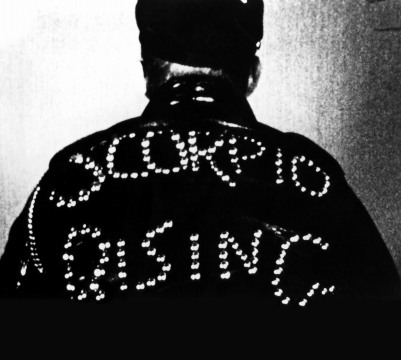
Scorpio Rising seems similarly way ahead of its time.  Anger himself has aptly described it as “a death mirror held up to American culture… Thanatos in chrome, black leather, and bursting jeans.”  Biker dudes caressing their motorcycles, reading comic strips, petting a Siamese kitty, buckling their leather jackets and slipping into leather boots.  Death’s heads, Nazi insignia, and grim reapers.  Pop songs of the moment:  “Blue Velvet” by Bobby Vinton, “Torture” by Kris Jensen and “I Will Follow Him” by Little Peggy March.  And “Wipeout” for the inevitable fiery crash.  David Lynch must have been inspired by Anger’s use of “Blue Velvet.” I believe Anger invented the jarring juxtaposition of cheerful, peppy pop songs with scenes of violence that directors like Martin Scorsese (who’s said he’s a fan of Anger’s) made so much a part of their method; there’s no question that Scorsese’s use of pop songs in Mean Streets had to be directly influenced by this movie.

We went (with our visiting friend Jane) to see Anger’s afternoon talk as well as the evening show, which also featured a Q&A.  Not sure we really had to go to both.  Anger was for the most part very unreflective about his work, sometimes almost hilariously so.  One example: someone asked a question about the origins of Fireworks.  Anger told a story about the 1943 Zoot Suit Riots in L.A. when sailors beat up zoot-suit-wearing Latinos, explaining that it was the inspiration for the movie.  OK, fair enough, but someone followed up to ask, “could you say a little more about how those events turned into this film?”  Anger basically had nothing more to say other than that it was based on a dream he had in which he the one beaten up by the sailors, and that he considers it to be an anti-war film.  In the two hours or so of on-stage discussion I saw, he had almost nothing to say about the homoeroticism of his films (though to be fair, he was asked very little about this directly) nor about their formal innovation and experimentation.  From his conversation, you might never guess that his movies were anything but fairly straight-forward narratives.  He seemed mostly interested in technical issues about the camera and film stock, and about his continual difficulties in finding funding.  (He’s never made a feature film, despite various efforts.)  Another example, when someone asked him about his ground-breaking use of sound and music in Scorpio Rising, his answer was something like, “well, those were the songs that were popular on the radio that summer.”

One funny thing happened.  In the Q&A he mentioned that he had been going to show three recent films, but that the IU Cinema director Jon Vickers (who was standing right there) had told him one of them was too racy for the “mixed audience.”  Anger implied that the film had one “explicit” scene as seen through a peephole, but that it was fairly tame.  Someone pressed him about this — the audience was not happy –and finally Vickers took the mike and explained that since the audience had not been warned about very explicit content, he had not wanted to spring this one on us.  He suggested that after the Q&A, there would be a brief break allowing anyone who wanted to leave to do so, and then the movie would be shown.

It was 9 p.m. and I was starving and sort of wanted to go eat dinner, but of course we could not be the prudes to get up and leave at that point!

The movie turned out to be, basically, a little piece of arty porn featuring closeups of some kind of wealthy industrialist receiving fallatio from his bodyguard while another titillated guard watches on a surveillance camera.  This to the soundtrack of the Police’s “I’ll Be Watching You.”  Pretty lame, actually — and definitely pornographic, so I felt kind of sympathetic to Vickers’ actions (after all, this is a public institution in Southern Indiana and you don’t necessarily want to get the attention of Republicans in state government), even though he came off initially as the bluestocking censor.

Despite Angers’ generally low-affect tone, his affection for the Kinsey Institute came through clearly.  He told a neat story about how he met Alfred Kinsey in the late 1940s, who turned up at an early showing of Fireworks and asked Anger if he could purchase it for the Kinsey collection.  Anger said, sure, you can have the reel we just watched, so they made the transaction on the spot, and Anger later (in the early 50s) visited Bloomington and did interviews with Kinsey.

IU Cinema/ John Ford

I moved to Bloomington about a decade ago and although I had never lived in such a small town, I was pleasantly surprised to realize that most of the things I needed or wanted existed here.  You don’t always have a dozen choices as you would in a big city, but there’s usually one or two of whatever you’re looking for — decent Japanese restaurant, good rock club, nice bar, etc.  OK, some of the shopping (for clothes say) is pretty limited, but you can always go to Indianapolis now and then.

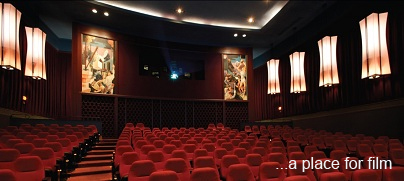
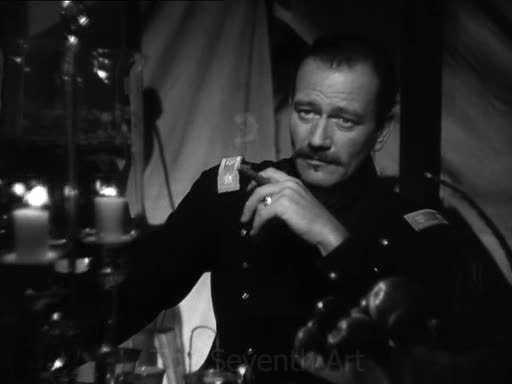
For me, the one single biggest absence has always been a good independent movie theater.  I grew up going to the Brattle and Orson Welles Theaters in Cambridge, and one of my favorite things about living in NYC was access to places like the fantastic MOMA theater and the Angelica, etc.  Cambridge still has the Harvard Film Archive and the Kendall Square Theater.  You might be hard-pressed to buy a pair of tube socks, say, in Hyde Park in Chicago (it never used to have a Target or anything, that may have changed), but you can see amazing movies every night at Doc Films.  In Bloomington, though, it’s always been the suburban mall experience of Kerasotes (now AMC) or bust, basically.  Yes, there’s the Ryder but I never enjoyed sitting in the uncomfortable seats in the classroom auditorium, it felt too much like school for me.  So, sadly, I focused my cinephilia on Netflix.  All this is to say that the opening of the IU Cinema is maybe the single biggest improvement to my quality of life in Bloomington since I moved here.  Can’t say how good it felt to sit with my daughters, waiting for John Ford’s Rio Grande (the final film in his “cavalry trilogy”) to begin, and watch the theater curtain rise as the two smaller curtains fell over the Thomas Hart Benton “Indiana Murals” (originally created for the 1933 World’s Fair).  I’d also seen Stagecoach a few days earlier, and watching both movies, I was strongly aware of the film as projected light.  One example– the amazingly beautiful scenes early in Rio Grande when John Wayne interviews his long-lost son in his candle-lit camp tent: shadows play on the tent as they talk in what seems an implicit allegory for the surface light effects of cinema itself, creating a Plato’s Cave-like effect.

The girls did pretty well with the movie, which is maybe pitched a bit above the 7-y.o. attention span.  Throughout, I tried to whisper basic explanations of the Civil War context which explains the John Wayne’s character’s estrangement from his wife (played by Maureen O’Hara), etc.  Celie commented that she liked the fact that the movie “really paid attention to the horses.  Usually when horses are in movies they’re just there for riding, but in this movie they really paid attention to them.”  Her example was the discussion over the theft of John Wayne’s own favorite horse.  There’s some fun stunt-riding, too (standing up on two horses at once).

Stagecoach is fantastic, of course. One moment I especially liked: the prostitute Dallas looks over at the town’s priggish society ladies and comments, “there’s some things worse than Apaches:” the movie ponders different forces of violence, including the social violence of shaming and ostracizing.  Dallas asks, “Haven’t I any right to live? What have I done?” and the alcoholic doctor replies, “We’re the victims of a foul disease called social prejudice, my child.”  Of course, it’s hard not to think about the question of the “right to live” of the Apaches who enter the film only as nameless, savage antagonists to civilization.

In both movies, the mowing down of the Indians (and their horses) is a bit hard to take.  Politics aside, just watching all the horses fall over (I assume) trip wires is kind of brutal — did they routinely break their legs?

So far, each film I’ve seen at the IU theater has ended in audience applause, which I think is partly sustained appreciation for the existence of the theater.

Beeswax/ Mumblecore

Watched — in pieces, on my laptop via Netflix, starting with a misbegotten attempt to watch on the Airtran flight — Andrew Bujalski’s Beeswax.  This is my favorite of the probably three movies of his I’ve seen.  He’s the standardbearer for the so-called Mumblecore movement.  I read an interview where he genially complained about the label, which he aptly compared to “shoegazer” (these were British bands influenced by American indie and My Bloody Valentine like Ride, Lush, Chapterhouse, Pale Saints, Slowdive) as an unwanted tag:

I certainly have no love for the label. I think it’s a real problem with trying to get people out to this film. It’s just a nasty term, like “shoegazer.” It’s the kind of thing where some of that music might be horrible, and some of it might be great, but if you just see the word “shoegazer,” it doesn’t exactly make you want to listen to it. It’s just an absurd concept. I’d like to think it won’t be with me for the rest of my days, but we’ll see.

Bad luck for Bujalski to get saddled with such a stupid but catchy label.  (It comes out of a now-diminished meme of spinning out increasingly absurd subgenres of hardcore punk, e.g. homocore, metalcore, grindcore.)

The other mumblecore films I’ve seen were appealing in their slice-of-life realism, focus on the trivial everyday, and naturalism — shades of Mike Leigh, Eric Rohmer — but are were a bit irritating too in their somewhat too-comfortable match with 20-something slacker Brooklyn/Somerville lifestyle… a bit too unambitious and navel-gazing… Beeswax is a more interesting movie and actually does remind me of Rohmer, it could in fact be a Moral Tale like that series of his, with the “moral” or ethical topic in question that of, perhaps, getting involved with others’ business, as in “mind/none of your your beeswax.”  (With a suggestion of the stickiness of other peoples’ business?– is that the etymology?*)  Part of what makes it more appealing is a fuller sense of grown-up lives and real things at stake; the twin sister protagonists seem to be about 30 and the plot, such as it, revolves around the Austin thrift/vintage store one of them owns and a fight she’s having with her business partner, who may be planning to sue her for breach of contract.  There’s still an interest in dating/sex/romance but it forms more of a backdrop to career/vocational problems and concerns; jobs are not just the places people go to worry about their love life.  Thus the title, I suppose: beeswax = business = what matters to you or concerns you personally; for Tilly, literally her business or store.

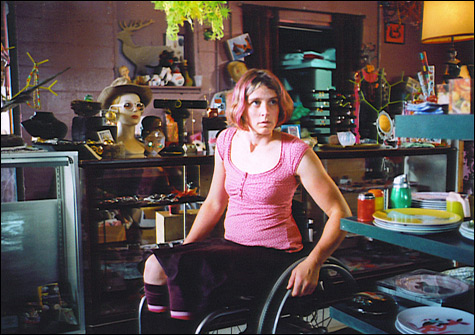
One striking thing about the movie is its representation of disability.  The twin who owns the store, played by Tilly Hatcher, is in a wheelchair and can’t use her legs.  What’s so unusual is that this never really comes up as a explicit topic or issue.  There’s a scene where she’s kind of stuck and has to flag down a pedestrian to help her get her wheelchair out of the trunk of her car; I briefly thought, as if this were a thriller, “oh gee, is this guy going to attack her?” — it effectively raised the topic of the everyday problems, risks, and vulnerabilities Tilly has to face, but in a very casual way.

A sex scene was even more surprising — it’s not at all explicit, but does show what needs to happen for a sexual encounter and the adjustments that need to be made to the usual routine with two non-disabled people.  I was almost wincing, I guess out of anxiety that the guy would react in a bad or shaming way (although he’s actually her ex, so knows what to expect); she’s also, although not unattractive, very far from a typical ingenue in a sex scene, with powerful arms and shoulders from wheeling herself around.

It made me miss Austin a bit.  Tilly’s store is an actual Austin boutique I remember, Storyville.  The movie is saturated with that bright Texas light.

*”none of your beeswax”: Eric Partridge apparently reports that

It seems that none of your beeswax, meaning none of your business, was originally a line spoken by the character Nanette in the musical No, No, Nanette (Youmans, Harbuch and Mandel, 1925). This catchphrase enjoyed a brief vogue in the later 1920’s. It is cited as children’s slang in a couple of later references mentioned by Partridge. There are no suprises as to its origin; beeswax is simply an obvious pun on the word business.