Drive-by Truckers The Big To-Do

Re: the newish Drive-by Truckers album The Big To-Do.  I get the sense that the Drive-by Truckers are slightly underestimated or perhaps ghettoized, ignored by listeners who presume they’re too Southern rock/country for their tastes.  For my money the Drive-by Truckers are probably the best rock band over the past decade, or at least have produced the most consistently excellent music.  Maybe living in Southern Indiana has slightly conditioned me to ‘get’ them in a way I might not have as much in Boston or wherever.  They definitely articulate a working-class Southern perspective that feels pretty authentic here.  E.g., from Brighter than Creation’s Dark, “You and Your Crystal Meth”:

I ain’t exactly a no-drug guy, Don’t dig the way that you get high
Hope your kids don’t see you throwing up, Hope they ain’t there if the house blows up
Hope you ain’t murdered in your sleep, Up all night with that cranked out creep
You ain’t eaten and you ain’t slept; You and your crystal meth
Indiana and Alabama, Oklahoma and Arizona.
Texas, Florida, Ohio, Small town America, right next door
Blood soaked your pillow red; You and your crystal meth

My favorite DBT songs are a bit less bleak than that one, though: “Heathens,” “Marry Me,” “Dead, Drunk, and Naked”(! one of their mythologizing tracks from the concept album Southern Rock Opera) and “Two Daughters and a Beautiful Wife,” about a guy who dies and realizes, up in heaven or wherever he is, that of all the little memories that replay in his mind, the ones he most remembers are: “Laying round in bed on a Saturday morning/ Two daughters and a wife/ Two daughters and a beautiful wife,” and he ends up thinking, maybe that’s what heaven will turn out to be.  “Heathens” is maybe my all-time favorite: “We were heathens in their eyes at the time, I guess I am just a heathen still.”

Anyway, the new one’s good too, more sometimes-joyful songs about death, diminished expectations, alienated labor, family, and self-medication, as ever very well-suited to our recessionary times: “The Fourth Night of my Drinking,” “Daddy Learned to Fly” (that one’s a real weepie, told from the POV of a kid who doesn’t understand his father has died, shades of “We Are Seven”), “This Fucking Job.”

Here they are performing “Daddy Learned to Fly” in Baltimore:

Patti Smith vs. Terry Castle

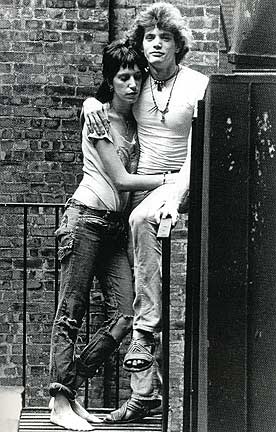
I recently read two really good memoirs, Terry Castle’s The Professor and Patti Smith’s Just Kids.  They would seem to have little in common.  On the one hand, the eminent professor of 18th-century British literature and lesbian writing at Stanford; on the other, the “godmother of punk” reflecting on her salad days in the late 60s and 70s.  (That’s her with Robert Mapplethorpe on West 23rd street in the early 70s.) But in fact they do share a few qualities– both are portraits of the artist as a young bookworm; both came from lower middle class families (Smith’s a bit scrappier/ more working-class than Castle’s) and latched on to literature/art as a vocation.  Both books are about passionate love attachments: Smith’s with Mapplethorpe, who was her lover/comrade for the crucial early years in NYC; Castle’s with her unnamed professor at grad school, the affair with whom scarred her for years.

Just Kids feels as if it may have been partly inspired by Dylan’s Chronicles Part 1.  It’s not as great as that, but then Chronicles was a somewhat astonishing book; Smith’s is more conventional, but is really lovely in a lot of ways, and it’s a lot of fun to follow her through her time with Mapplethorpe in the Chelsea Hotel, hanging out with Harry Smith, trying to break into the inner circle at Max’s Kansas City, living for art and poetry, making collages out of stuff they find on the street, dead broke, so broke they’d go to a museum with enough money for one admission, and then one of them would look at the art and come out to tell the other one about it.  Smith was a working-class South Jersey kid with no cultural or other capital, enraptured by Arthur Rimbaud and Diego Rivera.  That song “Piss Factory” is completely real — at age 16 she worked in a factory inspecting handlebars for tricycles.  She felt her only practical option was to become a schoolteacher, but she dropped out of junior college, moved to the city and met Mapplethorpe.  Everyone assumed she was on drugs but she didn’t even drink, lived almost completely for art.  I went back and listened to probably my favorite song of hers, “Free Money;” her account here of her years scraping by with barely enough to eat made it resonate in new ways for me (I’m sure it’s about him):

Every night before I go to sleep
Find a ticket, win a lottery,
Scoop the pearls up from the sea
Cash them in and buy you all the things you need.

Every night before I rest my head
See those dollar bills go swirling ’round my bed.
I know they’re stolen, but I don’t feel bad.
I take that money, buy you things you never had.

Kind of like Dylan’s Chronicles, this comes to an end just about when she’s about to really make it.  Just Kids obviously has the more world-historical story to tell, but to tell the truth, I probably liked The Professor better; I’m a sucker for academic novels and the long memoir part of it resembles that genre, but really raw, witty & hilarious, and also very moving sometimes.  She’s a fabulous stylist and truly funny.  (If you want a fuller review here’s a rave from TNR.)  I’d always remembered her essay about Susan Sontag in the LRB; this is in the book too, and in this context it seems like the lighter, less consequential twin of the more traumatic memoir about the grad school affair, both about Castle looking for intellectual and erotic attention & validation from a glamorous older lesbian woman.

I guess all memoirs are tales of survival, to some degree, saying to the world, “well, I made it this far.” A favorite line from The Professor: “Here indeed was a mystery worth plumbing: I was fat; I was mean; but I was alive.”

Big Star Revisited

Big Star was one of the handful of bands who most shaped my musical tastes at the crucial age of 14-18 or so.  Radio City and Sister Lovers/ Big Star Third are icons of my personal aesthetics (I never loved #1 Record as much), but ironically I haven’t had either of them on MP3, other than some tracks included on an Alex Chilton cd collection.  So Keep Your Eye on the Sky, the Big Star box set, which is full of demos, alternate tracks and some early live recordings, was a really cool birthday gift (thanks Jake).  Getting it also inspired me to pick up the Continuum 33 1/3 book on Radio City.

Carrie Brownstein has a nice little blog post in that Best Music Writing of 2009 book about the diminishment of “mystery and the mysterious” in pop music today.  Big Star is a perfect example of this.  As everyone comments, being a fan of the band in the 1970s usually involved stumbling upon one of their albums — maybe Radio City, with its William Eggleston photo of a bare light bulb on the cover — in a dollar bin or something, being blown away by how amazing the music was, and having no idea who these people were.  Peter Buck of R.E.M. is quoted in the box set liner notes:

No one I knew had ever seen them play.  I think I’d read that one of the guys had been in the Box Tops — which made no sense either.  Information was scarce.  So these records they’d put out, they were simply artifacts.  It was like seeing the heads of Easter Island or the Great Pyramids or something.  You didn’t know what they were or how they’d gotten there.

By the time I got into Big Star in 1984 or so they were a lot better known, but even so, you couldn’t Google them, there was so Wikipedia page, so you ended up relying a lot on the little Robert Christgau capsule reviews or the Rolling Stone Record Guide entry and the like.  Going through the box set and this book now offers a surplus of information and photographs that once and for all eliminates that numinous haze, born of a paucity of information, that used to surround the band — but at this point, that’s perfectly OK with me, as they deserve all-time-great historical status, with all the archival trappings.

Bruce Eaton’s 33 1/3 book is quite good.  It’s austere in its formalist focus on “the music itself” — Eaton starts out explaining that because of all the gossip, rumor and falsehoods surrounding the Big Star and Alex Chilton stories, he’s going to focus pretty exclusively on the actual process by which the band formed and made Radio City.  This involves a fair amount of to me, somewhat boring technical chitchat about production choices, recording and mixing, etc., but on the other hand, I did feel I got a better understanding of what was musically/technically special about the band and the importance of the producer John Fry.  I also suspect there may have been a strategic element here, as Eaton makes clear that Chilton has expressed zero interest, in recent years, in talking with any journalists, and it sounds as if Chilton agreed to participate on the condition that the interviews would be almost exclusively about the music and recording.

A few tidbits/insights I gleaned from the book:

  • Chilton grew up with a sometimes jazz musician father and was heavily immersed in Memphis/Stax R&B (Wilson Pickett, the Staple Singers, etc).  The Anglophiliac, British Invasion sound of Big Star was almost entirely a product of Chris Bell’s obsessions, and Chilton seems always to have viewed the band as a vehicle for this particular, very “white” approach to music which he saw as only a small part of what he himself was about.  Actually it’s kind of hilarious in Eaton’s book how much Chilton repudiates Big Star and Radio City, their masterpiece, in particular; he says he thinks “Back of a Car” (which he did not write) is the album’s “only good song” and that he thinks his lyrics on the album as a whole are terrible.  (Although this struck me as heresy, if you actually look up the lyrics to “O My Soul” or something you realize that they are pretty flimsy; it’s a great example of how little lyrics matter except in their musical context.)
  • Big Star opened for Badfinger in Boston in March 1974, one of their few performances ever outside Memphis; their instruments were stolen and they had to play with gear borrowed from Billy Squier (! — yes, of later “The Stroke” fame!) of local band Sidewinder.
  • Notwithstanding the point about Chilton’s partial disaffection from the “whiteness” of Big Star’s approach, Chilton himself says that he copped certain musical structures and ideas on Radio City from Bach and other Baroque music… which actually kind of makes sense.
  • During and after Big Star, Chilton was in a semi-/unofficial pickup studio band called the Dolby Fuckers.  Surprised no one’s ever borrowed that name.
  • Of course everyone knows that Big Star was a “critics’ band.”  But the book makes clear that Radio City never would’ve been recorded (after Chris Bell’s departure from the band) if it hadn’t been for the somewhat bizarre event called the Rock Writers Convention in Memphis in May 1973.  All surviving members of the band attest that the good response they got to their performance at the convention convinced them that they actually could have an audience.  Considering that the very idea of a rock critic was a fairly recent invention at the time, Big Star may have been in some respects the first band who recorded specifically for rock critics and with their tastes in mind.  (I was also surprised to learn that Chilton knew Richard Meltzer and other rock writers from his sojourn in NYC in 1970.)
  • Eaton makes some good points about the difference between Big Star and other “power pop” bands of the era sometimes associated with them (like the Raspberries or Badfinger).  While the latter were classicists trying to work entirely within pre-established musical structures, Big Star (after #1 Record especially) was always about taking and reproducing those kinds of pop structures but messing with them, disintegrating them, removing the ground beneath them.  This then builds to an extreme on Big Star Third which is still unparalleled as a woozy, druggy, depressive, achingly gorgeous collection of songs.

One more thought: I was fascinated to hear the Flying Burrito Brothers cover (“Hot Burrito #2”) in the live set on the box set.  Chilton seems to have more than a few things in common with Gram Parsons as a musically omnivorous, addictive, louche son of privilege (well, relative privilege in Chilton’s case) with an ambivalent relationship to pop music in what was becoming the New South.

I saw Alex Chilton in 1985 at the Rat in Boston.  I was 16 and had the most ridiculous fake I.D.  I was desperate to get in and was thrilled that I did.  If I recall correctly he played stuff from Feudalist Tarts and various R&B covers and then a few Big Star songs like “September Gurls” which made me very happy.  I think I ended up walking all the way back home to Cambridge from Kenmore Square at 2 a.m. or whatever.

The box set contains an amazing collection of photos.  My favorite is one of Chilton at age 20 in the Chelsea Hotel in NYC with long hair, tie-dyed tank top (!) and scruffy facial hair holding a copy of the Byrds’ Untitled.

This photo above is from the back of Radio City: Jody Stephens, Andy Hummel and Chilton — in the original T.G.I. Friday’s in Memphis!

Pleasure reading (late 2009/holidays)

Got around to reading Philip Roth’s 2004 counterfactual The Plot Against America which I found compelling and kind of scary.  It’s a re-imagining of American history in which Republican candidate Charles Lindbergh defeats F.D.R in 1940 on an anti-war, anti-semitic, covertly pro-German (or at least pro-accommodationist) platform.  What makes it really get under your skin is that Roth seems to be drawing heavily on his own Newark childhood, so it reads not as science fiction or fantasy but as a creepily plausible rethinking of both U.S. and his own family history if the country had taken a drastically different turn in the late 1930s.  So, for example, the depiction of his brother who embraces the new Lindbergh regime seems charged with real and intense family memories and conflicts.  The novel also feels obviously of its 2004 Bush administration moment in its detailed thinking through of how a truly fascist U.S. might play out.

Recently read both The Girl with the Dragon Tattoo and the sequel The Girl Who Played with Fire by Stieg Larsson, a Swedish journalist who, to what must have been the deep frustration of the international publishing world, had actually died at age 50 in 2004 prior to the publication of any of his novels.  The third of the trilogy is due out in the States soon.  These are interesting blockbusters.  They’re pulpy and have some of the limitations of most blockbuster fiction: the characters can be cartoonish, the plots implausible, sensationalist and heavily dependent on techno-thriller conventions of various sorts.  (For example, a whole lot of both novels involves descriptions of computer hacking.)  But, they’re total page-turners, really hard to put down and a lot of fun (I gave Sarah the second one at Xmas and over the last few days we were reading it simultaneously, with me picking it up when she put it down; we each had our own bookmark).  I guess I felt the second one was inferior and in the end closer to that techno-thriller cliche than the first, which is more thoughtful and interestingly broody about Swedish politics, patriarchy, and misogyny.  Has there ever been an international blockbuster series of novels whose major theme is male violence against women?  The Swedish title of the first one is Men Who Hate Women and the hero, Lisbeth Salander, is a female avenger against male sadists and abusers.  Salander is in some ways too Hollywood-ready, kind of Laura Croft-like in some ways, but she’s also a great heroine in her weird combination of Sherlock Holmes (she’s Asbergers-y, a genius/savant with a photographic memory), Jason Bourne or the Fugitive, and Batman or something.  The novels also reminded me a bit of a recent favorite of mine, the Danish thriller The Exception by Christian Jungersen of a couple years ago; they share a left-wing, anti-racist Scandinavian perspective on problems of contemporary globalism such as sex trafficking, war crimes, and the like.

One more thing: one of my favorite things about the novels and about Salander is that she’s a kind of superhero version of Pippi Longstocking: uses “V. Kulla” as a fake name on her doorbell at one point for example (cp. Pippi’s Villa Villakulla).

Read two Patricia Highsmith novels while in Cambridge for the holidays, inspired by reviews of the new Highsmith biography which make her sound like a very weird and fascinating character (did you know she worked as a writer for superhero comic books, for example?).  One of her most famous, Strangers on a Train, and a more obscure one, The Blunderer.  Similar plots and characters: “men who hate women,” actually, or men who want to get rid of their wives. Strangers on a Train is a brilliant “double” novel and a novel of homosexual panic — it would’ve fit perfectly into Eve Sedgwick’s Between Men.

Best Music Writing 2009, this year guest edited by Greil Marcus.  I threw this into an Amazon order as a stocking stuffer for myself.  Someone gave me the 2007 volume, which I loved, and I haven’t missed one since (ok, that only makes 3).  I’m a longtime fan (and erstwhile practitioner) of rock/pop music criticism, which can feel like a dying mainstream art.  But these collections inspire confidence that there’s loads of brilliant, imaginative and funny writing out there about pop music, albeit sometimes in hard to find places.  The books tend to collect a really diverse mixture of artist profiles from Rolling Stone or The New Yorker with pieces from little magazines and quasi-unpublished bits from blogs and whatnot.  A few favorites from this one:

  • Vanessa Grigoriadis “The Tragedy of Britney Spears” — a long investigative piece from Rolling Stone, itself a voyeuristic peek at this train-wreck of a career but also a thoughtful analysis of Spears’ downwardly spiraling dependency on celebrity/paparazzi culture (she is now romantically involved with a paparazzi she met on one of her daily chases).  Reads a bit like a Bruce Wagner novel.
  • John Jeremiah Sullivan, “Unknown Bards: the blues becomes transparent to itself.”  Reflections on John Fahey and other collectors and aficionados of early 20th-century blues recordings.  Really smart and interesting on the paradoxes and ironies attendant on old white men obsessing over old records made by Southern black men.  Also an argument for blues as great, transcendent art.
  • James Parker, “Unauthorized!  Axl Rose, Albert Goldman, and the renegade art of rock biography.”  Hilarious overview of the disreputable genre of the “unauthorized” rock biography, including analysis of several biographies of “persistent, near-magical malignancy.”
  • A nice short piece by Jonathan Lethem about the nature/meaning of rock vocals in “post-Elvis, post-Sam Cooke, post-Ray Charles popular music” in which he makes a case that “the singer in rock, soul and pop has to be doing something ineffable that pulls against any given context.”  I actually found this argument surprisingly original and persuasive.
  • An investigative piece by Josh Eells about “the eyeliner wars,” e.g. the harrassment and persecution of “emos” (androgynous fans of Dashboard Confessional and My Chemical Romance) in contemporary Mexico.  Reminded me of a good piece from the anthology of a year or two ago about the surprisingly enormous cult of Morrissey in Mexico.
  • Paul Ford’s “Six-word reviews of 763 SXSW Mp3s.”  Just what it sounds like: 763 reviews of 6 words or less (tweets, in effect) of bands performing at the South by Southwest conference, a reducto ad absurdum of the Blender-style capsule review genre.  In the introduction Greil Marcus aptly describes this feat of reviewing and of dismissal as “heroic, or demonic” and as a performance that implicitly dismisses “music and criticism at the same time.”  Maybe you’d have to have put some time in a music reviewer to fully appreciate this one.

Torture Porn Lit

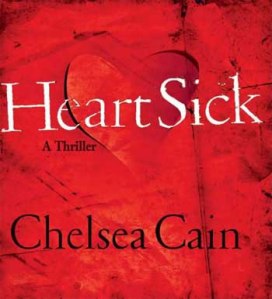
Heartsick-Chelsea-Cain-unabridged-compact-discs-Audio-Renaissance

Just read Heartsick by Chelsea Cain which I picked up looking for something else because, I think, Amazon named it the top thriller of 2007.

I didn’t altogether enjoy it — it seemed derivative (of Silence of the Lambs, although it does have the wit tacitly to acknowledge the debt when the psycho killer mockingly refers to the journalist as Clarice) and very, very gross.  It is gripping and well done in some ways — I wanted to read to the end to find out what would happen — but I was struck by the sheer bloody sadism of it.

It reminded me of a silly argument my brother and I had a while ago about the ethics and politics of so-called “torture porn” film, namely the Eli Roth Hostel movies.  It was silly because I think at that point neither of us had seen the movies… so if anything, I’d have to say he won the argument b/c it’s difficult to take a moral stance of condemnation about something you haven’t seen.   Although part of my point was, I refused to give in to the logic that because this on-the-face-of-it objectionable cultural object has become notorious, “you must see it yourself” to decide.  On the other hand, it’s hard to argue the position from ignorance.

Anyway, what I didn’t like about Heartsick is the back story involving the protagonist detective’s ten-day-long ordeal being slowly and lovingly tortured by the psycho serial killer he’d been investigating.  It actually works pretty well as back story to explain his particular trauma and what’s at stake for him in current case… but annoyingly, the novel is interwoven with day by day chronological accounts of that week and a half.  It’s really hard to take — painstaking description of what it’s like to drink drain cleaner, anyone? — and just seemed sadistic/self-indulgent in a mode of “can you top this” grossness.

I was mulling over the cultural meanings of ‘torture porn’ and thought of several possible explanations/causes for why this has trend emerged so clearly in the last decade or so.

  • Most obviously: sheer oneupsmanship in a modernist logic of greater and greater, purportedly more and more “daring,” transgressions.  This was basically the point I was making to Jake: within Modernist art of the early and mid 20th century, various forms of transgression, obscenity, and more and more realistic depiction of sex and violence became closely linked with artistic expression and a cultural vanguard.  One could think of this as the “First Amendment theory” of modernist transgression, in that to be “censored” or deplored becomes an almost necessary sign of artistic expression and integrity.  The thing is, though, that this dynamic has become tired and predictable when every gangsta rapper and thriller novelist or director participates in the same game.  Sorry, Eminem and Marilyn Manson, you are not James Joyce or Picasso bravely defying the philistines with your cds and DVDs sold at Walmart to every wanna-be radical tweener in America.  (Or for that matter Tarantino: I think he’s at his worst when he falls into this mode; most of the more interesting aspects of his movies have little to do with pushing the transgression envelope.)   And in this case, Chelsea Cain’s novel being that much grosser and more explicit than The Silence of the Lambs does not make it more daring.  Given that you can find stuff on the internet with a few keystrokes that would’ve made Henry Miller or James Joyce blush, that whole logic, which relies on certain dynamics of scarcity and concealment, is basically moot.  These days really radical, daring art is more likely to avoid this whole game of transgression entirely.
  • post-9/11 culture, Abu Ghraib and Guantanamo.  Needless to say a lot of the obsession with torture in pop culture comes directly out of this political/cultural dynamic: e.g. the t.v. series 24.  I’d assume that Saw and Hostel are part of this too, albeit less directly.
  • One other thought, a slightly less obvious one: in this novel anyway, there seemed to be a fascination with the idea of the body as art-work, and the serial killer as a kind of conceptual artist, carving and sculpting her victims’ bodies into new shapes.  A break in the original case came when the detective Archie noticed, looking at photos of all the crime victims, that the shape of a heart had been carved into all the torsos (hard to make out amid all the gore).  The journalist protagonist dyes her hair pink which I think is meant to link to this theme.   Like Jack the Ripper, these murderers are artist/author figures who leave their “signature” to be read by the police.  So here too we could link the trend to plastic surgery and various kinds of body-based conceptual art that views the human bodily as “plastic,” malleable and part of culture not nature.

Anything else going on here?  There’s always the possibility of whole-scale moral degeneration, I forgot that one…

Hüsker Dü

300x300

Emusic recently got the rights to the Husker Du catalogue which I’m pretty sure was also previously not available on iTunes.  Who do they think they are, the Beatles?  Anyway, good news even if you have to DL entire albums, can’t cherrypick songs, which disappointed me because I always saw Zen Arcade as a bit of a mess with a lot of somewhat-interesting stuff I didn’t actually want to listen to (“Hare Krishna”) along with a big handful of fantastic songs.

This may seem obnoxiously obscurantist in the “I prefer their early stuff” vein, but in some ways my favorite Husker Du record has always been Metal Circus from 1983, their first record with SST and I think their second more or less studio album, although it’s really a 19-minute 7-song e.p.  It’s all great, unrelenting, and has a kind of scrappy lightness of touch, with guitar leads that sometimes sound almost rockabilly, like X maybe, that reminds me a little of some of the early Replacements (their exact contemporaries) records like Stink from 1982.  I have this memory of trying to explain to my sophisticated NYC aunt in 1983 or 1984 that in fact, the most exciting new punk music was coming out of not NYC or San Francisco but Minneapolis of all places — not sure if she bought it.

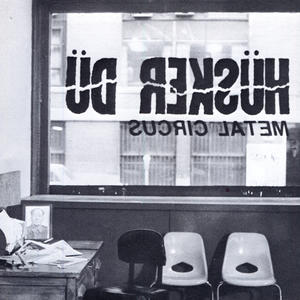
Anyway, I loved everything about Metal Circus definitely including the black and white cover that looks like, what, the view out the window from inside a generic, depressing office room?  An employment agency for the down at the heels?

One of my favorite rock show experiences ever was seeing Husker Du in some community center or something in a suburb of Boston in maybe 1984; definitely before Zen Arcade came out.  I remember cramming into someone’s parents’ station wagon and ending up in this basement-y space not really knowing where we were.  (All the future Lemonheads were there, I think.)  I think the sound was atrocious so it was not exactly a “good show” properly but I loved them and it was a total thrill.  Actually now that I think about it, this was the second time I’d seen them because I also saw them opening for R.E.M. in a gymnasium at Harvard (!); I didn’t really know who they were at that point (must’ve been 1983?) and I didn’t really get it.

Metal Circus feels very 1983, very Ronald Reagan, Cold War, nuclear anxiety.  It’s conceptually coherent with lyrics defining an ambiguous political outlook, or maybe “political feeling,” angry, scared, apolitical as a variety of politics.  I love the lyrics to “Real World,” the fantastic first song:

People talk about anarchy And taking up a fight/ Well I’m afraid of things like that/ I lock my doors at night/ I don’t rape, and I don’t pillage Other peoples’ lives/ I don’t practice what you preach/ And I won’t see through your eyes/ You want to change the world By breaking rules and laws/ People don’t do things like that In the real world at all/ You’re not a cop, or a politician/ You’re a person too You can sing any song you want/ But you’re still the same

It’s about hardcore punk politics, a response/rebuttal to “anarchy” punk manifestos.  (I always heard it in relation to Minor Threat’s “In My Eyes.”)  I probably identified at the time with Bob Mould, a very normal homely/uncharismatic guy who was both a punk and a thoughtful, tormented liberal.  I guess the lyrics could be read as expressing pure political quietism, but I’ve always found them to be honest and brave, less a considered expression of a developed political philosophy than a kind of feeling — take it or leave it.  (In the equally great “It’s Not Funny Anymore” Mould signs sarcastically, “you can do what you want to do, say what you want to say… don’t worry about the result or the effect it has on your career” — wow, quite the college counselor!). “I’d like to protest but I’m not sure what it’s for/ I’ve heard it does some good if the television people are there… I know I’ve got no control over the threat of a nuclear war.”

One of my favorite songs from this era was Husker Du’s buddies the Minutemen’s “Bob Dylan Wrote Propaganda Songs.”  They were all trying to figure out: how can you write a punk protest song without falling into pompous liberal folk cliches, or predictable punk cliches?  How can a punk protest song express ambiguity and doubt along with anger?

The other really great track is Grant Hart’s ominous, anguished rape-murder dramatic monologue “Diane,” which has a lot in common with Robert Browning’s “Porphyria’s Lover:” “We could lay in the weeds for a little while/ I’ll put your clothes in a nice, neat little pile/ You’re the cutest girl I’ve ever seen in my life/ It’s all over now, and with my knife.”  “Diane”‘s bassline reminds me of Joy Division and of course, now that I think of it, the visual aesthetic and even title of Metal Circus may have been influenced by the Factory Records look/feel/sound.

When the definitive book is written on queer punk and post-punk, I hope Husker Du gets their due.  The indie/postpunk scene in the 80s was very homophobic; Mould finally came out of the closet in the early 1990s.  (I think everyone always figured Hart was gay.)  I love that Mould worked for World Championship Wrestling as a scriptwriter for a while.

Music Roundup: Franco, Jay Reatard, Pains of Being Pure at Heart…

Franco

A few things I’ve been listening to…

Modest Mouse, “3rd Planet.”  This is from Modest Mouse’s major-label debut The Moon and Antarctica (2000), their third album, which didn’t really make too big of a splash at the time — their commercial breakthrough came with the next album and the big Pixies-ish hit “Float On.”  One thing I like about Modest Mouse and this album is the sense of largeness, ambition, attempt to evoke the oceanic/cosmic.  Indie rock by definition tends towards the minor, petty, internal — and yes, the modest… But notwithstanding their iconically indie name, on this album anyway they go for something kind of immodestly huge; it’s their Dark Side of the Moon or Ok Computer.  “3rd Planet” is one of my many favorite Modest Mouse songs — kind of about, maybe, what it feels like to lie with someone else on a blanket, naked, staring up at the stars: “The universe is shaped exactly like the earth/  If you go straight long enough you’ll end up where you were/ Your heart felt good, it was dripping pitch and made of wood/ And your hands and knees felt cold and wet on the grass to me.”

Franco, Francophonic – Vol. 1: 1953-1980. Franco, “the Duke Ellington of Congolese music.”  Some of it sounds like calypso, some of it like American soul or R&B, like Jamaican reggae, Cuban son.  Beautiful, funky, catchy, sinuous… Probably the album I’ve gotten most pleasure out of in the last year or so.

Dirty Projectors, Bitte Orca.  I missed the chance to see him/them when they played here after they released Rise Above, the retelling of Black’s Flag’s punk classic Damaged.  That seemed too arch and contrived, along the lines of Pussy Galore’s version of Exile on Main Street.  But they/he turns out to have some serious musical/conceptual chops — when Bjork invites you to collaborate with her, you probably do have something going on.  Anyway this album is really interesting and very listenable/engaging — part of that whole choirboy/orchestral-Afropop tendency in contemp. indie rock.  I’ve never heard an American indie album before that seemed clearly influenced by Zap Mama (polyphonic Belgian female a cappella group).  My favorite Dirty Projectors song isn’t on the album, though: “Knotty Pine” with David Byrne on the excellent Dark is the Night soundtrack.

K’naan The Dusty Foot Philosopher. This guy has a really great gimmick — it’s gangsta rap by a guy from a part of the world where little kids actually wander around with machine guns.  Yes, a gangsta rapper from Mogidishu, Somalia — take that, 50 Cent!    Who seems to be heavily influenced by Eminem of all people!   Although I haven’t checked out his second album yet, I expect K’naan to get really big eventually: he really does seem like some kind of weird Afro-Canadian combination of Bob Marley (or to be less grandiose, maybe Wyclef Jean) and Eminem with some super-catchy tunes (e.g. “In the Beginning,” “If Rap gets Jealous”).

Cocorosie, “Rainbowwarriors,” “Werewolf,” “K-Hole,” “Terrible Angels,” from La maison de mon rêve, Noah’s Ark, The Adventures of Ghosthorse and Stillborn.  I came to Cocorosie (twin sisters Sierra and Bianca Casady) a bit late, and the hip kids have probably moved on since Cocorosie have placed songs in perfume commercials and the like.  I noticed that Pitchfork condemns them as globe-trotting trust-fund poseurs, but hey, so was Henry James… What do they sound like?  Kind of mumbly-warbly experimental home recording pseudo-hip-hop poetry?  Sung by squeaky-voiced twin sisters performing on children’s instruments.   It’s sometimes a bit much, but often I find it enchanting and magical, e.g. the Rilke-inspired “Terrible Angels:” “If every angel’s terrible/ Then why do you welcome them/ You provide the bird bath/ I provide the skin/ And bathing in the moonlight/ I’m to tremble like a kitten.”

The Pains of Being Pure at Heart.  The Pains of Being Pure at Heart.  On my first quick listen this struck me as a tad generic, but I ended up loving it.  The NYC band is apparently named after (get this) an unpublished children’s book written by the singer Kip Berman, and heavily rips off a range of British indie pop — Belle and Sebastian, Jesus and Mary Chain, and the Wedding Present — so it doesn’t come much more twee than this.  On the other hand it also can get pretty guitar-squally (“Hey Paul”).   If you liked early Belle & Sebastian, here’s more songs about libraries and crushes: “between the stacks in the library/ not like anyone stopped to see/ we came they went, our bodies spent/ among the dust and the microfiche.”

Jay Reatard, Watch Me Fall.  I just got this one and haven’t really absorbed it, but I wanted to mention Mr. Reatard.  Not that he hasn’t gotten quite a lot of press, but I do think that he’d be a lot bigger in the crucial expendable-income young-adult yuppie market if he had a less tasteless moniker.  Nee Jimmy Lee Lindsey Jr., he became “Jay Reatard” as a 16 year old highschool drop-out with a chip on his shoulder in Memphis doing his best Iggy Pop imitation, and since then has released about 20 (!) home-recorded albums.  I also have the last couple of singles collections (Singles 06-07 and Matador Singles ’08). Robert Pollard (Guided by Voices) would be a good analogy: JR is a kind of human jukebox apparently able to produce irresistibly catchy singles at will.   They sound alternately like the Buzzcocks, Go-Betweens (he’s recorded a Go-Bes cover), Stiff Little Fingers, etc., all sung in a retro fake British accent with occasional amusing Britishisms (“Is this real or is this future?”), and filled with eruptions of aggressive/sarcastic put-downs.  (I.e. he kind of sounds like he was invented in the basement of WHRB’s Record Hospital circa 1988).  To my ears he’s recorded at least a handful of songs that I’d include in my list of the top ten Guided By Voices tracks ever.  The new one is a little poppier and layered than the earlier stuff — try “Before I Was Caught” or “Wounded” for ex.  The line is that he’s been influenced lately by New Zealand Flying Nun indie pop, but I’m not sure I hear that especially, I think that may just be a way to explain the frequency of Farfisa-style organ which imparts more of a 60s garage vibe.

Orchestra Baobab, Made in Dakar.  I listen to jazz and “world music” (primarily African pop) more than anything else these days, partly because it works as background music when I’m working, in the living room when we’re making dinner, etc. a lot better than, say, Jay Reatard.  I’m not very good at analyzing/discussing this music; I guess part of what I love about some of it is the way I fall into it as an unknown, somewhat disorienting sonic world.  Orchestra Baobab were founded in Dakar, Senegal in 1970, broke up in the late 1980s, and reformed in 2001.  The group “played an Afro-Cuban-Caribbean music fused with distinctly West African traditions. Unlike other Senegalese bands, they added Casamance harmonies and drumming (from southern Senegal), melodies from Togo and Morocco to the more common Wolof (from northern Senegal) influences” (wiki).  Since reuniting they’ve become well-known in the U.S. partly due, I regret to report, to a documentary filmed by/with Dave Matthews and the guy from Phish. (It’s a bit of a Buena Vista Social Club kind of phenomenon — Afro-Latin world-music classic revived for the NPR market.) Anyway, everything I’ve heard by them is fantastic with a special mellow, funky elegance.  Christgau puts it well: “Jazz, r&b, soul, disco, reggae–no African band has ever emulated a New World music as gracefully as this Cuban-style unit.”

Juliana Hatfield memoir

juliana-hatfield-1-sized

I got around to reading the Juliana Hatfield memoir When I Grow Up.  I read the Dean Wareham one recently (Black Postcards) too. The two books feel like they constitute a minor wave of memoirs of 1990s semi/almost rock stardom.  Wareham (of Galaxie 500 and Luna) and Hatfield both had comparable experiences as indie stars of the late 1980s plucked out for mainstream success which never quite came, leaving them struggling for diminishing returns throughout the 1990s and beyond.

I know/used to know Juliana a bit, from back in the late 1980s in Cambridge.  I played tennis with her a couple times under circumstances I can’t entirely recall (when I was home on college vacations).  She always seemed like a somewhat painfully shy, and sweet, person.  I found the memoir to be a good read, smart and sometimes moving in the recounting of her ongoing depression, struggles with anorexia, and feelings of hopelessness.

I liked this description of her realization that she is not suited to the rock and roll life (one focus of the book concerns her wrestling with the question of whether she should give up music altogether and try to find some other line of work):

At heart, I am not a rock and roller.  At heart I am a librarian, a bird-watcher, a transcendentalist, a gardener, a spinster, a monk…. I don’t want loud noise and fame and scandal and drugs and late nights and flashing lights; I want peace and quiet and order; solitude, privacy, and space for contemplation  I want to awake at dawn and listen to the birds, and drink a cup of tea.  I need to face facts.

The book, like  Wareham’s, wrestles with a formal/stylistic dilemma having to do with the attempt to narrate and describe the tedium and monotony of life on the road in a touring rock band.  Life on tour, playing over and over at the same kinds of dingy/crummy clubs, is mind-numbingly repetitive, marked by bad food, the ordeal of driving and lugging equipment, & depressing cheap hotels (and also occasional bursts of inspiration and the pleasure of performance).  So, how can you turn this mostly-tedious material into a story someone would want to read?  Juliana takes a somewhat literalist approach by narrating one entire long tour (around 2004 I think?) from start to finish: this constitutes one strand of the memoir which is also interspersed with a more chronological tale of her career from the early Blake Babies days through her solo career, getting a $400,000 advance from Atlantic in the 1990s, later getting dropped from the label and continuing to struggle on.   I’ll confess that I thought parts of the tour diary, with all its detailed accounts of the travails of a rock and roll vegan stuck in on the fast food highway, could have been compressed or edited out, but then, it does really give you a sometimes-excruciatingly vivid sense of what that experience is like.  (Part of the point seems to be demystification, for the sake of anyone who imagines that it’s a glamorous life to be in a band.)

The memoir ends with her climbing her way out of her depression and seeming to make peace with her status as a former/has-been pop star — deciding to stop punishing herself for failing to become the kind of pop success she was never destined to be. Juliana really suffered, it seems, from the weight of the burden of being a kind of token female alt-rocker, which wasn’t a very good identity match with her propensities towards shyness, depression, and anorexia.  It’s good to see that she seems relatively happy and together these days.

Reading the memoir also inspired me to download (legally! through emusic) her latest album, How to Walk Away, which works well as a companion piece to the book.  Some of the songs function both as relationship breakup songs and also as meditations on the possibility of “breakup” or walking away from the vocation of singer/artist.  In my view (this would probably piss her off) her solo records have sometimes suffered from an overvaluation of “rawness,” and I like the comparatively polished, careful pop production on this one.

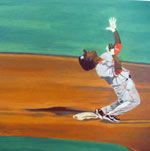
She’s been doing some painting lately, sometimes with a Red Sox/baseball theme.  Here’s one:

112108_paint1_151

My Dinosaur Jr. problem

Went to see Dinosaur Jr. last night.  They’re touring with the full original lineup, including Lou Barlow, whose bitter split with J. Mascis constituted one of indie rock’s best-known melodramas back in the 90s.  (It’s compellingly chronicled in Michael Azerrad’s Our Band Could Be Your Life.) Now almost 20 years on (!), after various kinds of solo careers and other projects, they are back together, tempted, I assume, by reunion cash & attention.

I think I over-invested, emotionally, in the band back in the day, such that I now find it difficult just to enjoy them in an uncomplicated way.  They were pretty much my favorite band around the time of the first two albums.  I loved Dinosaur, the first one, and was involved in bringing them to play to my college.  When You’re Living All Over Me came out I felt vindicated in my belief that they were pretty unique — some kind of strange amalgam of Neil Young, Black Sabbath, the Cure, Meat Puppets? –and I enjoyed seeing them get the recognition they deserved.  I saw J. Mascis as a post-punk Neil Young; deeply soulful, albeit semi-autistic seeming; completely inarticulate in person, but able to channel deep, weird emotions and let them out in the form of music that was at once overwhelmingly loud and somehow melodic, pretty, even sweet.   I still think songs like “In a Jar,” “Little Fury Things,” “Repulsion,” et al. are amazing and unmatched.

I was actually one of what couldn’t have been more than a few dozen people in the audience to witness the onstage fight Azerrad describes between J. and Lou in Naugatuck, CT in 1988 at a weird little strip-mall disco kind of place.  They smashed their guitars together, screamed at each other and stormed off the stage.  If I recall correctly, they came back in a couple minutes and did a sloppy Minor Threat cover as an encore.  (My friend Dan and I, who worshiped the band, were completely freaked out.)  Barlow said to Azerrad that the fight made him “psychotically happy…  I felt he’d finally proven to me that he had feelings.  He would never react to anything at all, ever”(372).

Maybe I just took the spurned Lou’s side in the divorce, but I ended up feeling that Mascis in fact contained no soulful depths, that he was, as far as I could see, a narcissistic & emotionally manipulative guy primarily into guitar and skiing/snowboarding equipment.   One of the songs they played last night, the one that goes, “I feel the pain of everyone, and then I feel nothing,” over and over, kind of sums it up.  On the one hand, this vivid, sometimes excruciating emotionality, conveyed through waves of sculpted guitar noise; on the other, a  passive-aggressive affectless and lack of real engagement or meaning.

Few of the songs are ultimately about much of anything other than emotional frozenness or inability to feel/connect, and I guess that stance seems less interesting or powerful than it once did to me.  Also, a 21 year old who experiences those feelings and expresses them musically is maybe inherently a lot more sympathetic than the same person who seems unchanged 20 years on.  There’s probably a kind of nostalgia/revulsion dynamic going on too where I associate them so strongly with myself at age 20.  I’ll freely admit that my reaction now is very likely a result of over-projecting into their music originally and having always wanted it to be be/mean more than it really was.

Also, J. Mascis now has this slightly pudgy, freaky-grandpa look which kind of kills the mystique he used to convey:

rtemagicc_j_mascis_02

I’m slightly amazed that there’s actually a market for Dinosaur Jr. sneakers.

Lou, on the other hand, doesn’t look too different from the way he did in 1988, and it was fun to see him perform.  His psychedelic ballad “Forget the Swan” was a surprising highlight of the night.

All that said, it was cool to hear all those great songs from the first two albums; I just felt kind of ambivalent about the whole thing.

Mountain Goats in Bloomington

darnielle11

Went to see the Mountain Goats.  If you don’t know them, the Mountain Goats is John Darnielle, a literate Pitzer College grad, former emergency room nurse, who used to record very primitive songs on boom boxes but since 2002 or so has been producing more polished, “produced” (even orchestral) music.  He tends towards the ambitious and high-concept in his recordings.  For example, there are various “series” of songs, across different albums, that constitute coherent or at least linked narratives of one sort or another; e.g. (from Wikipedia) the “Alpha Series”:

Songs in this category concern the same fictional couple, described as a heterosexual lower-middle-class man and woman who originally loved each other genuinely, and held generally ordinary concerns for one another’s well-being, but whose relationship has degraded for a variety of reasons, most often a series of fights or drug and/or alcohol abuse, possibly both. Whatever the causes for their current situation, their love has not so much died as warped into the sincere, all-consuming desire of each of them to see the other drink themselves to death; thus, to facilitate this “walk down to the bottom”, as described in the liner notes, the couple keep whatever liquor they can afford on hand for each other and stay together….The album Tallahassee, being entirely about the Alpha couple, begins with the pair buying a run-down house in the eponymous capital of Florida, follows their degradation, and ends with a vision of the house and both of them being consumed in flames.

Darnielle has something in common with the Decembrists’ Colin Meloy (whose sister is a novelist, Maile Meloy) in the way he thinks about lyrics in an almost novelistic or at least literary kind of way.  Anyway, I saw the Mountain Goats/ Darnielle in Boston with Jane a year ago at the Museum of Fine Arts and didn’t entirely love it.  The crowd was devoted and rapt in a slightly precious indie-rock mode, and Darnielle seemed deeply awkward to me, almost so much as to suggest the possibility of a touch of Asberger’s.   I enjoyed the show this week more — he was still awkward and nerdy, but he seemed comfortable and upbeat and was actually amusing & charming in his extended between-song patter (about such topics as his childhood love for pro wrestling, his own depression, meth addiction).

Darnielle was born in Bloomington, I haven’t completely figured out why; I think he said something on stage about his step-father’s father having been an English professor here?  Or was his step-father a grad student?  They moved to California when he was a toddler.  He chatted a lot about this connection; he said something about Bloomington having always had magical associations for him, and claimed that the lyrics to “Love Love Love” were inspired by/based on these associations with the town, I’m not sure how or why:

King Saul fell on his sword when it all went wrong,
and Joseph’s brothers sold him down the river for a song,
and Sonny Liston rubbed some tiger balm into his glove.
some things you do for money and some you do for love love love.

Raskolnikov felt sick but he couldn’t say why
when he saw his face reflected in his victim’s twinkling eye.
some things you’ll do for money and some you’ll do for fun,
but the things you do for love are going to come back to you one by one.

Love love is going to lead you by the hand
into a white and soundless place.
now we see things as in a mirror dimly.
then we shall see each other face to face.

Is Bloomington the “white and soundless place” for Darnielle, maybe?  Darnielle also has an entertaining blog, Last Train to Jakarta, largely devoted to his scholarly love for heavy metal music, and he has also published a book about Black Sabbath’s Master of Reality that takes the form of a diary written by a teenager in a Southern California mental hospital.

So in other words, just another flash in the pan rock star, seen one, seen ’em all…

Anyway — really good show; he has a million great songs so there are a lot to choose from.