Big-bragadochio and wavelike-swelling and swaggering writings

I did a search on the university library catalogue for the new-ish Red Hook-based thriller Visitation Street by Ivy Pochoda and this title (it is the actual title) from 1648, by one John Vicars, is what came up.

Coleman-street conclave visited, and, that grand imposter, the schismaticks cheater in chief (who hath long, slily lurked therein) truly and duly discovered. Containing a most palpable and plain display of Mr. John Goodwin’s self-conviction (under his own hand-writing) and of the notorious heresies, errours, malice, pride, and hypocrisie of this most huge Garagantua, in falsly pretended piety; to the lamentable misleading of his too-too credulous soul-murthered proselytes of Coleman-street & elsewhere. Collected, principally, out of his own big-bragadochio and wavelike-swelling and swaggering writings, full-fraught with six-footed terms, and flashie rhetoricall phrases, far more than solid and sacred truths. And may fitly serve (if it be the Lords will) like Belshazzars hand-writing, on the wall of his conscience, to strike terrour and shame into his own soul, and shamelesse face; and to un-deceive his most miserably cheated and inchanted, or bewitched followers.

I guess this is what I am actually supposed to read?  Sorry, Ivy Pochoda, you will have to wait.

But tell us what you REALLY thought of it, Michiko Kakutani

Wow.  Feels like a moment of self-revelation here: “Readers given to writing comments in their books are likely to find themselves repeatedly scrawling words like “narcissistic,” “ridiculous,” “irritating” and “pretentious” in the margins.”

The premise of this tiresome new novel by the critically acclaimed author Norman Rush sounds as if it had been lifted straight from “The Big Chill”… The result not only lacks that movie’s humor and groovy soundtrack but is also an eye-rollingly awful read.

The novel’s preening, self-absorbed characters natter on endlessly about themselves in exchanges that sound more like outtakes from a dolorous group therapy session than like real conversations among longtime friends. Its title, “Subtle Bodies” — which refers to people’s “true interior selves,” whatever that means — is a perfect predictor of the novel’s solipsistic tone. Readers given to writing comments in their books are likely to find themselves repeatedly scrawling words like “narcissistic,” “ridiculous,” “irritating” and “pretentious” in the margins…

Douglas (who seems to have driven a lawn mower too close to the edge of a ravine) was the leader of the pack. Reminiscent of the charismatic genius figures in Iris Murdoch novels, he was an intellectual guru for the others, though it’s baffling why anyone would look up to such a pompous jerk….

There’s a lot of mumbo-jumbo about Douglas’s philosophy …and more portentous gibberish about his current mysterious work… The other members of this novel’s cast are either as insufferable as Douglas or as flimsy as paper-doll mannequins….

Perhaps Mr. Rush means all this to read as black comedy, but it’s not remotely funny or compelling. In fact, it’s impossible to work up any interest in hearing what these absurdly self-important and poorly drawn characters might have to say as they drone on about themselves…

At one point, Ned says to Nina, “Why are we even talking about this?” It’s a question the reader might well ask about this claustrophobic and totally annoying novel.

I can definitely appreciate an enthusiastic critical pan, but sometimes I wonder if the NYT needs to assign MK a new beat, if only to lower her blood pressure.  Maybe something in the Verlyn Klinkenborg line, appreciating sunsets and birds in the backyard or some such?

Watching Hitchcock’s Classic Thriller Sextet on Family Movie Night

Well, actually just a third of it to date: The Lady Vanishes and The 39 Steps in the Criterion Collection reissues over the last two weekends.

Between 1934 and 1938, Alfred Hitchcock made six films in England that stand collectively as the highlight of his British period. Dubbed Hitch’s “classic thriller sextet” by theorists and critics, The Man Who Knew Too Much (1934), The 39 Steps (’35), Secret Agent (’36), Sabotage (also ’36), Young and Innocent (or The Girl was Young Indeed, 1937), and The Lady Vanishes (1938) all contain thematic and visual elements that he would later implement in his Hollywood films.

Cinefile.

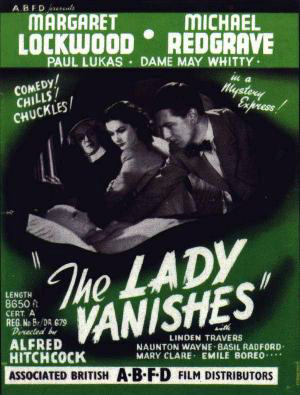
The_Lady_Vanishes_1938_Poster

Both are fantastic, but my nod goes to The Lady Vanishes even if the BFI list of the top hundred British films ranks it at #35 as opposed to #4 for The 39 Steps. My memories of it were so vague, and I am wondering how much of this relates to the likelihood that I previously watched a lousy public-domain video version; this is a recent, deluxe, beautiful Criterion two-disk version.  If you have not seen it in years, I highly recommend checking it out.  Comedy, chills, and chuckles are delivered in profusion as per the poster. I did not even have any memory of the not-so-brief beginning part of the movie that takes places off the train, in an inn in the nameless and oddly-imaginary Eastern European (?) country.  My most vivid recollection was the hauntingly uncanny moment when the writing in condensation on the train’s window, “Miss Froy,” re-emerges. The part of the movie where Margaret Lockwood can’t get anyone on the train to admit that her seatmate Miss Froy ever even existed is classic Hitchcock in its frightening atmosphere of sudden, inexplicable conspiracy.

Interestingly, in both movies a crucial plot point depends on the recollection & memorization of a certain tune or snatch of music.  The 39 Steps begins and ends in a music hall, and I think it “re-mediates” music-hall entertainment, in certain respects — i.e. it references and re-frames music-hall as a pre-existing representational code. In The 39 Steps the memorization of the tune is central to the plot and frames the entire story; in The Lady Vanishes it’s also important, albeit (as is typical of the movie) given a light spin: Michael Redgrave is some kind of musical ethnographer who, at the onset, is gathering examples of traditional native dance and music, so he is confident that he can easily memorize the crucial message encoded in the tune.  He actually loses the tune, but it turns out all right even so.
MV5BMTY5ODAzMTcwOF5BMl5BanBnXkFtZTcwMzYxNDYyNA@@._V1._SX640_SY950_

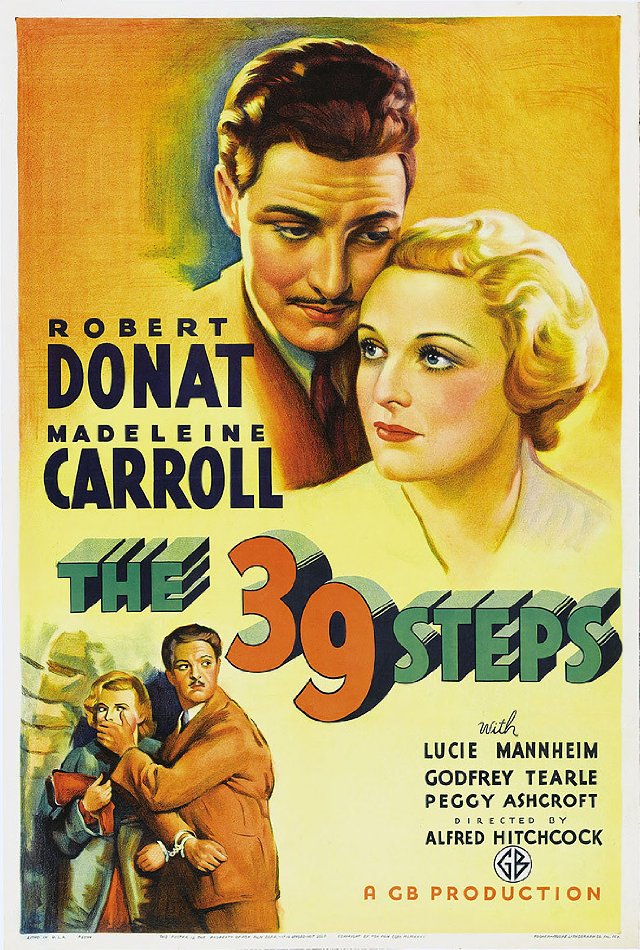
Some of the original taglines from The 39 Steps:

It’s Great…It’s Grand…It’s Glorious!
Handcuffed to the girl who double-crossed him
The MAN who put the MAN in roMANce.
A hundred steps ahead of any picture this year
The Most Charming Brute Who Ever Scorned A Lady
Fated to be Mated with the One Man She Hated
She Hated to be Mastered… But She Learned to Like it from the Man who put the MAN in roMANce [!!!]
Its gender politics are creepy in not-atypical Hitchcockian style (much more so than The Lady Vanishes), with a plot contrivance handcuffing Robert Donat to Madeleine Carroll and requiring him to knock and drag her around quite a bit. One senses some disgust at the female body and perhaps a suppressed desire to stab it in the back with a kitchen knife. I was glad the kids had gone to bed by the time I watched excerpts from the famous Francois Truffaut interview with Hitchcock in which he drawls about his favored archetypical Blonde: “we want her to be a lady in the drawing-room and a whore in the bedroom.”  Subtle, Hitch!

The Love Affairs of Nathaniel P.

LoveAffairsOfNathanielP_300dpi

I liked The Love Affairs of Nathaniel P. by Adelle Waldman (her 1st novel) more than I expected to.  This portrait of a caddish, former-nerd 30-year old Brooklyn freelance writer and his love affairs sounded very Girls-ish, and probably fun but shallow.  But it turned out to be a better novel than that.  Things I liked about it:

  • it offers a vividly detailed, often witty portrayal of a very particular place and time — hipster literary Brooklyn today — inhabited by equally particularized individuals who are also types; Nate and Hannah are quirkily particular, but one also always sees how they’ve been shaped by broad socio-cultural dynamics.  (Odd that she’d be named Hannah given the inevitable comparisons with Girls (whose protagonist is named Hannah Horvath)… But it seems that Waldman’s been working on the novel for a while.  There’s also the great Vampire Weekend song “Hannah Hunt” come to think of it.)
  • It’s good on the gender dynamics, and particularly the balances of power between men and women in the urban dating market (shifting more in the men’s favor by age 30). Waldman implied in an interview that she decided to make the male character the main protagonist as a challenge to herself and (I think she said this?) to ensure that the novel did not become too autobiographical. One does feel that Hannah, Nate’s love interest and one of his girlfriends — a smart, pretty but not gorgeous, witty writer-editor type — must have a lot of the author (and her friends) in her.  And I did feel that this strategy worked well; we sense a lot of personal investment and experience in the depictions, but the novel’s focus in Nate rather than Hannah keeps it from falling into certain autobiographical-novel paths.
  • [That said, probably my one criticism would be that at moments the free-indirect-discourse dipping into Nate’s thinking can feel rather broad in its critical perspective: “But did any of it make him an asshole?  He had never promised her anything…” Early on you quickly feel, “yes, this guy is an asshole,” and then the novel guides you toward at least limited sympathy for him.]
  • Perhaps along slightly comparable lines to Jeffrey Eugenides’ The Marriage Plot [my post about that one], it’s deeply steeped in a longer history of the novel and does some interesting things in updating marriage-plot novelistic conventions for our moment. Here is Waldman’s recent essay on how she stopped being a Richardsonian and learned to appreciate Henry Fielding.  And in this NYT interview she explains how Balzac’s Lost Illusions was a “lodestar” for her own book: “It nails the literary scene in every city, in every time,” she said. “A sense of people being motivated by a mix of idealistic commitment to the arts and love for it and vanity, ego, ambition.” [Oh and I just saw on Waldman’s Twitter feed that she’s an Elizabeth Gaskell fan and recommends Wives and Daughters.  Yes! — that might be my pick for the best-but-least-known Victorian novel.]
  • The novel is satirical and brightly amusing about Brooklyn/ NYC literary-world mores, but also has a strong undertow of sadness in its portrayal of relationships and the ways these young men and women use one another, strategize, and develop layers of self-protecting cynicism, irony, and low expectations about romance.
  • It was fun to think about possible models for certain characters– e.g. is Greer Cohen, the sexy & flirtatious recipient of a big advance for her “memoir about my teenage misadventures,” a version of Elizabeth Wurtzel?  (Or am I out of date…)