Lucking out/ real bitter? James Wolcott’s memoir

As a kind of followup to the Kael bio, I also read the James Wolcott memoir,  Lucking Out: My Life Getting Down and Semi-Dirty in Seventies New York.  I somehow did not realize that Wolcott (whom I associate with Vanity Fair) began his career and was generally known for years not only as a Village Voice writer but as a sometime rock critic.  (“Somehow” because I was a devoted reader of the Voice, especially its music section, in the early & mid 1980s, not long after his time writing for it.) Walcott dropped out of Frostberg State U. in Maryland as a sophomore after he sent a piece of his to Norman Mailer, who promised to put a word in for him to a Voice editor once Wolcott graduated.  Wolcott proceeded to quit school on the spot and move to NYC and eventually, through persistence/ refusing to go away, parlayed that recommendation into a job answering phones, from where he began to do some writing.  Pretty soon, at age 19-20, he was covering the nascent punk rock scene — he published one of the first raves about Patti Smith, well before the release of Horses — and covered television as a regular beat (not to mention the band Television, along with Talking Heads and other CBGBs bands). He soon became a protege/buddy of Pauline Kael’s (he became somewhat notorious for a later Vanity Fair take-down of her followers “the Paulettes,” which was taken as apostasy and an act of betrayal –one of her other rival proteges labels him a “self-promoting asshole” or some such in her biography; he does not discuss this in the book but it came up in the Fresh Air interview); became obsessed with the New York City Ballet; and he also dedicates a section of the book to Times Square pornography in the 1970s.  He doesn’t push this too strongly but there’s an implicit thread in the book in which Wolcott charts his own experience as a fan, critic, and consumer of these different parallel art forms and media (punk rock, movies, ballet, porn), within all of which in this period the representation and expression of bodies, sexuality, physicality, gender transformed.  Wolcott is very much a critic and an observer; he refers in passing to his own sex life, for example, but greater emphasis is placed on the represented bodies and lives he wrote about.  As “semi-dirty” in the title hints, Wolcott portrays himself as a watcher, a bit prudish and reserved even in the grimiest occasions in Times Square or the Bowery or otherwhere in a NYC that was close to falling apart entirely:

It wasn’t just the criminality that kept you laser-alert, the muggings and subway-car shakedowns, it was the crazy paroxyms that punctuated the city, the sense that much of the social contract had suffered a psychotic break.  That strip of upper Broadway [where Wolcott lived] was the open-air stage for acting-out episodes from unstable patients dumped from mental health facilities, as I discovered when I had to dodge a fully-loaded garbage can flung in my direction by a middle-aged man who still had a hospital bracelet on one of his throwing arms.

By and large he managed to side-step the garbage and keep himself more or less clean (not a drinker or much of a drug user).  Wolcott is an aesthete and a literary stylist — you have to have patience for his kind of elaborate sentences to enjoy the book — and you get the sense of this style as something he developed, in part, as a protection against the threatening urban scene.  (He talks about giving up on punk rock in the late 70s when it became too much about bad politics, skinheads, vomit, and spit– you can feel a visceral distaste.)

I was just checking out the customer reviews of the book on Amazon.  One person comments:

For anyone even mildly curious about New York, movies, punk, journalism, writing, ballet, or the Times Square of the “Taxi Driver” era, this book should not be missed. Think of it as Woody Allen’s “Manhattan,” only with real intellectuals as opposed to fake ones.

Another less appreciative reader observes,

Just can’t imagine many general readers caring about office politics at the Village Voice, fringe critic Lester Bangs, punk rock at CBGSs, why ballet makes him woozy, the seamy 70s porn scene, Wolcott[‘s] relationship with movie critic Pauline Kael…

Ha!  I guess I was a perfect reader for this, as just about all of those topics interest me to some degree.  (This reader does not mention Wolcott’s discussions of Ellen Willis and Robert Christgau, a power couple in counter-cultural journalism in the early 70s; especially indelible is an account of Christgau walking around his and Willis’s tiny downtown apartment in tight red speedos.)  As an occasional writer for the Voice’s music section in the 1990s, I was fascinated by the account of earlier days at the paper, and I thought Wolcott evocatively captured the special feeling of the Voice in the days before email, when all copy had to be dropped off on paper in a physical file.  Human presence, embodied personalities, were so much more central to the operations of publishing, criticism and writing, all of which, Wolcott suggests, have now become much more “lonely.”  When I was first doing freelance writing circa 1991, this was just beginning to change and I too remember dropping by the Spin offices to leave my copy (offering opportunities for schmoozing/ gossiping) or sitting down with Voice music editor Joe Levy to line-edit my reviews (of American Music Club and the Go-Betweens — those are the first two I remember); I recall those sessions as an intensive education in journalistic writing that I expect is difficult to come by today.  (I never did meet Robert Christgau, although he was around.)  Wolcott’s example shows that counter-cultural/arts journalism in the 1970s was a place where an (exceptionally) smart lower-middle-class kid without even a college degree could get an apprenticeship and eventually transform himself into a well-known writer and intellectual.  This is no longer true — that arts weekly journalism institutional space no longer exists.  Blogs to some degree have replaced it, but serious/rigorous arts criticism as such offers much less of a career opportunity these days (to understate it).

[btw, Wolcott comes up several times as well in Will Hermes’s new book, Love Goes to Buildings on Fire: Five Years in New York That Changed Music Forever, which I’ve so far only skimmed a bit.]

There’s a funny/poignant moment when Wolcott speculates about what might have been if he had specialized and chosen a stronger focus, as a critic, on literature, rather than covering such a wide range of topics.  “I sometimes wonder what would have happened if I had found true fruition in book reviewing and taken up literary criticism as my sole vocation, putting aside childish things” (he means here primarily writing about t.v.).  Next line: “I bet I’d be real bitter now.”

Slight ambiguity there: does he mean “real bitter” as opposed to just slightly bitter?  The title of the book underlines Wolcott’s sense that he was very lucky in his lucked-into career, but does he feel lucky now?  There’s an elegiac feeling to his story of, among other things, the decline of the Voice and of arts journalism and reviewing generally (film critic J. Hoberman was apparently just laid off from the Voice as I write this, by the way, eliminating one of the last remaining great arts critics there).  I’m not sure how secure Wolcott’s present position is (he is among other things a blogger for Vanity Fair), but he obviously feels something has been lost both personally and for the intellectual scene more generally.

Of course, there are other explanations for an elegiac sense to the book, such as Wolcott’s references of the coming onslaught of AIDS in the early 1980s, at the end of his narrative.  On a more personal note, his friendship with Kael also has a bittersweet feel, at least for a reader coming to his book from the Kael biography, which explains how she cut him off following his publication of the “Paulettes” piece in Vanity Fair.  I was a bit surprised he does not address this falling out, perhaps because it is still too painful?  or possibly simply because it occurred outside the 70s time-frame of the book, although Kael is such a major mentor figure here that it feels odd not to mention it.

Live-blogging the Pauline Kael biography

[Kael with French actor and producer Jacques Perrin an Cannes in 1977.  AP photo from NYT: http://tinyurl.com/82kg3z5]

Well, not really, I just finished it (Brian Kellow’s Pauline Kael: a Life in the Dark)… It might be of limited interest to anyone lacking at least some pre-existing interest in Kael’s career and movie criticism — most of the key events of her life did involve movie reviews — but it was irresistible reading for me and made me realize how influential Kael was on my thinking as a kid/teenager.  Among other things, the book is simply a great chronological digest of some of her most memorable pieces and greatest lines.  It would be a good double feature with the great Easy Riders and Raging Bulls: How the Sex-Drugs-and Rock ‘N Roll Generation Saved Hollywood (by Peter Biskind).  Kael with some justice viewed the late 1960s through the mid 1970s as “equivalent to some of the great literary epochs in history,” and she was lucky enough to take on her perch at the New Yorker just in time to cover this epoch.  She didn’t just cover it, she influenced it in a major way, the biography shows, including in some ethically questionable ones: she palled around with many of the directors and writers she wrote about, advised them about casting and script choices, visited them on set and engaged in overt boosterism (Robert Altman and Sam Peckinpah are the most obvious– she had very close relationships with them both, and unfounded rumors circulated that she was sleeping with one or the other.)

Part of her genius lay in her obsessive/overwhelming love for movies, a love so strong that it trumped almost any consideration of personal feelings.  You can see how she believed that her relationships with directors did not affect her judgments, since she was willing to turn rather viciously on anyone whose work took a direction she found mistaken (although someone like Altman seemed immune to such reversals).  In her writing, she talks you through her own process of response to a film, drawing you into the complex judgments and emotions she herself experienced.  She thought critical objectivity was a crock/delusion, and this sometimes led her astray, but also invested her writing with a special kind of passion.

A few memorable details/moments:

  • She grew up in a Jewish chicken-farmer family in Petaluma, CA.  “She was extremely precocious, and her older siblings delighted in the astonishing observations that routinely popped out of her mouth.”  One thing I’ve always loved about Kael is her late-bloomer quality.  She was a single mother (with a daughter with a congenital heart defect) who got by for years doing odd jobs like managing a dry-cleaner’s and, eventually, working as the manager of a repertory theater in Berkeley.  This is where she really got her start, writing eventually-legendary program notes and programming innovative double features in the 1950s.  (She was also an unpaid film commentator on WKPA, Berkeley’s listener-supporter FM station).  She didn’t write her first piece for the New Yorker until in her late 40s.
  • Her time in the 50s in Berkeley has a slightly idyllic quality in this account– it was the period when she found her voice and acquired a reputation but was still quite poor and mostly known only in film-aficionado circles.  She entertained all the time:  “She had two beloved basenji dogs, Polly and Bushbaby, who frolicked with her guests, and several of her friends noted the irony that a compulsive talker like Pauline chose to have dogs who couldn’t bark.  There was an upright piano in the living room with characters from The Wizard of Oz painted on it, and Pauline loved to sing Gilbert and Sullivan songs, with The Mikado‘s “The Moon and I” a particular favorite.”  She was always a Westerner and a rural California girl, never seemed completely to view NYC as a home.  (Once she made some money, she and her daughter moved to a big house in Great Barrington, MA, where she did most of her writing.)  There’s an intense moment late in the book when Kael is sitting at lunch with someone in the city in 1989 and sees a man knifed on the street; she goes out and holds his hand until the ambulance arrives.  “That cemented her loathing of New York.”
  • She could be hilariously crude/vulgar.  She found Billy Wilder’s 1961 comedy One, Two, Three, for example, “overwrought, tasteless, and offensive – a comedy that pulls out laughs the way a catheter pull out urine.”  A very funny developing theme concerns her endless battles with William Shawn at The New Yorker over her use of slang, vulgarisms, and references to violence and sex.  Here’s my favorite passage along these lines:  “In the opening sentence of her review of Goin’ South, Pauline rendered a vivid description of [Jack] Nicholson, an actor she was still trying to come to terms with: ‘He bats his eyelids, wiggles his eyelids, and gives us a rooster-that-fully-intends-to-jump-the-hen smile.’  Shawn’s note in the galley margin read, ‘This piece pushes her earthiness at us, as if she wants us to see how far she can push us, too.  It’s the tone of the whole review.’  Later in the same review she wrote of the actor, ‘He’s like a young kid pretending to be an old coot, chawing toothlessly and dancing with his bottom close to the earth.’  Shawn wrote in the margin, ‘Her earthiness, her focus on body functions.’  The description on Nicholson’s bottom being close to the earth was deleted, as was a later reference to Nicholson’s being a ‘commercial for cunnilingus.’  Shawn circled the phrase and wrote, ‘This has to come out.  We can’t or won’t print it.'”  !!  I really wanted to use that phrase as the title of this post but decided it would attract the wrong audience.
  • Another famous one along these lines: she pans Terence Malick’s Badlands and Shawn (whose son Wally Shawn was college buddies with Malick) tells her, “I guess you didn’t know that Terence is like a son to me.” Her reply: “tough shit, Bill.”

Don’t have time right now to write more, need to pack and return the library book!  The book ends with her memorial service at which Pauline’s daughter Gina delivers a rather sharp, albeit appreciative judgment: “When Pauline spoke to someone about their work as if it had been produced by a third party, it had repercussions.  There was fallout.  In my youth, I watched what she left, unaware, in her wake: flickering glimpses of crushed illusions, mounting insecurities, desolation.  Those she was not dismissive of, those who valued her perception, judgment, integrity, and extreme forthrightness, did feel her sting, but also felt that she was totally real and that she affirmed and valued them as human beings…. Pauline’s greatest weakness, her failure as a person, became her great strength, her liberation as a writer and critic.  She truly believed that what she did was for everyone’s good, and that because she meant well, she had no negative effects… She denied any motivations or personal needs.  This lack of introspection, self-awareness, restraint, or hesitation gave Pauline supreme freedom to speak up, to speak her mind, to find her honest voice.  She turned her lack of self-awareness into a triumph.”

I gotta say, I kind of love her, I would probably have been thrilled to be a Paulette.  Sarah got sick of me reading excerpts out loud.

This is my favorite image of her, from the mid 1950s when she was programming the Cinema Guild theater in Berkeley: “Friendly, gregarious, and bawdy, she was becoming something of a local character…[L]ocals grew accustomed to seeing her up on a ladder changing the Guild’s marquee, a hip flask filled with Wild Turkey dangling from a belt loop.”

By the way, this A.O Scott/ Manohla Dargis discussion of the biography is worth reading.  Also, here’s a chance to hear her voice — & check out the cute sneakers.

Gelbfisz/ Goldfish/ Goldwyn: the face of a spink

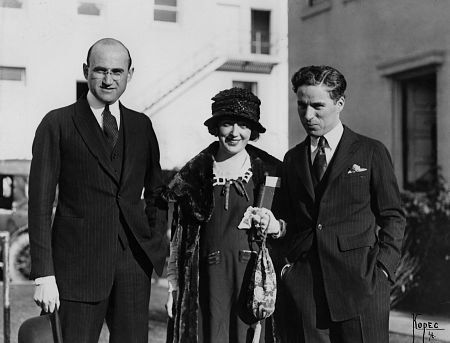
[Samuel Goldwyn on the left]

I am 3/4 or so through (to 1942) A. Scott Berg’s 1989 biography of Samuel Goldwyn and loving it.  Really juicy, filled with great/hilarious/unbelievable tales about movie stars, directors, and producers of the 1910s-1950s (with an emphasis on the earlier decades), and offering a well-informed, panoptic history of early Hollywood– I’m learning a lot.

  • This is one of the best Americanized-name stories I’ve heard.  Born Schmuel Gelbfisz, Goldwyn became Samuel Goldfish in the ghetto of Birmingham, England in the 1890s. (If you’re going to Americanize your name, do you really want to choose “Goldfish”?)  In 1916, Goldfish and Edgar Selwyn formed a film distribution company they named “Goldwyn” (a portmanteau name combining Selwyn and Goldfish).  A few years later, audaciously, Goldfish changed his own name to Goldwyn.  What a power move.  His partner sued him, but a judge ruled that the name change was legal.  The now Samuel Goldwyn was subsequently forced out of Goldwyn Pictures, the company that now bore what was his name, and he was never (bizarrely) part of Metro-Goldwyn-Mayer.  Very weird.
  • Gelbfisz/Goldfish/Goldwyn’s emigration story from Poland to the U.S. (he arrived Jan 1, 1899) is pretty wild.  At age 16, “in 1895, Schmuel Gelbfisz walked alone, almost three hundred miles due West to the Oder River.”  After paying off border police guarding the German/Russian border, “he walked another two hundred miles to Hamburg.”  There he stayed with some family acquaintances who put him to work learning glovemaking, and then raised money from neighbors to pay for his ship fare to London.  “The next leg of his odyssey was the 120-mile walk from London to the Midlands.  He lived for two days on a single loaf of bread.”  He found his mother’s sister in Birmingham and became an apprentice to a blacksmith and then worked as a sponge salesman.  “By the fall of 1898, Sam Goldfish felt the urge to move on.  He journeyed another hundred miles, northwest to Liverpool and eventually got a boat that left him in New Brunswick.  “Once he had his legs back, Goldfish took to the road again…. Over the next month, he trudged through more snow than New England had seen in ten years.  Sometime in late January 1899, he arrived in Manhattan.”  Wow!  That’s a tough dude.
  • It’s just amazing how many of Hollywood’s biggest moguls were Jews from modest (or impoverished) backgrounds in Eastern Europe.  “In the 1880s alone, the  family of Louis B. Mayer left Demre, near Vilna, in Lithuania; Lewis Zeleznick (later Selznick) ran away from Kiev;  William Fox (formerly Fuchs) imigrated from Tulcheva, Hungary; the Warner family uprooted itself from Krasnashiltz, Poland, near the Russian border; Adolph Zukor abandoned Ricse, Hungary; and Carl Laemmle left Wurttemberg, Germany — gamblers with nothing to lose, all from within a five-hundred-mile radius of Warsaw.”
  • The first part of the book, about Hollywood prior to the advent of sound in 1927, is full of amazing stories about silent-movie stars I’d never heard of or knew almost nothing about.  E.g. Banky Vilma & Rod La Roque.  Or Mabel Normand:  “One interview for a family magazine [in 1917] went well until the reporter asked her hobbies.  ‘I don’t know,’ Mabel replied.  ‘Say anything you like but don’t say I liked to work.  That sounds like Mary Pickford, that prissy bitch.  Just say I like to pinch babies and twist their legs.  And get drunk.”
  • One of my favorite strands in the book has to do with Goldwyn’s famous malapropisms and vexed relationship to the English language.  During the editing of the 1929 Bulldog Drummond, Goldwyn noticed a line in which a colonel declares, “the eternal din around this club is an outrage.”  “Goldwyn asked his staff, ‘what is that word “din”?’  He was told it meant noise.  ‘Then why didn’t the writer say noise?'”  He insisted that the actors be called back into the studio and the set rebuilt in order to re-shoot the entire scene, until someone finally convinced him that “din” was a real word.   More Goldwynisms: of his Russian discovery Anna Sten, whom he thought would be the next Garbo (she flopped– that whole story is great, albeit slightly tragic): “She has the face of a spink.”  Or the time the Gershwins, Lillian Hellman, and George Balanchine were waiting for Goldwyn in his living room.  “Goldwyn appeared at the staircase in his bathrobe.  ‘Hold on, fellas,’ he yelled down.  ‘I’ll be right there.  And then we’ll get into a cuddle.”  “Include me out” was his most famous coinage.  “Anyone who goes to a psychiatrist needs his head examined” another famous line.  William Wyler called him “a titan with an empty skull, not confused by anything he read, which he didn’t.”  Wyler still liked him, however.

Someone comments at some point that all of the studio heads, without exception, in this period were “monsters,”  but that Goldwyn at least could laugh at himself.  He was a terrible person in many ways (treated his children really badly, was always chasing starlets), but possessing a certain charm all the same… You have to admire him, to some degree, for his bald bull-headed energy & determination & hook or crook determination to get movies made (often by lying, cheating & stealing). He bet incredible amounts on cards (in 1940 he calls in a gambling debt from fellow mogul Jack Warner for $425,000 — imagine what that would be in today’s currency) and for much of his career was continually leveraging his own company such that a major flop at the wrong moment would have bankrupted him.  (“The only way he could tolerate a baseball game was by betting on every pitch”).  The whole enterprise was high-end, high-risk gambling based on bluff and bluster, and producing strings of masterpieces and great movies.

Ruth Rendell’s *A Judgment in Stone*- murderous illiteracy

I was at the public library and decided I’d find a Ruth Rendell novel or two to read — did a quick scan of Amazon reviews and grabbed two that had strong reviews and looked interesting.  The first one I read was her 1977 A Judgment in Stone which, I just learned, was adapted by the French director Claude Chabrol as La Ceremonie — a movie I remember liking very much and which I’d vaguely thought of as I read, but had not realized was an actual adaptation of the book.  (There was also an American adaptation of the novel, The Housekeeper.)

Here is the book’s arresting first sentence: “Eunice Parchman killed the Coverdale family because she could not read or write.”  The book is pretty daring for several reasons, one that it gives everything away immediately.  Early on I did feel, “gee, can I really wade through all this, waiting for the final bloody end that has already been described to me” (although we have to wait for the end to learn most of the details of what went down).  But it works very well and you get caught up in the psychology of the murderer and your curiosity about how exactly things will go terribly wrong.

The premise is also daring because so apparently prejudicial.  Here we have an ignorant, illiterate working-class woman who, we are told, commits motiveless mass murder because of her ignorance and illiteracy.  On the one hand, the novel is so well-done that one can defend it by pointing out simply that this is a very particular story about particular circumstances — a knot of events and actions that can’t be reduced to sociology or generalizations about types of people.  On the other, this is a nasty piece of work, in some ways, and I wouldn’t be prepared to defend it absolutely against class bias in its depiction of a psychologically stunted, uneducated woman whose unreasoned hatred and resentment of her, yes, slightly smugly rich and liberal (but far from cruel or unkind) employers leads her to a senseless act of violence.  (They are educated, cultured people and Eunice’s phobia about writing, and her defensiveness about her concealed illiteracy, plays a strong role in the events.)

Rendell reminds me a little bit of Patricia Highsmith, partly in her willingness to ignore liberal or right-thinking pieties in her cool, sometimes slightly amused from-the-inside depiction of murderers and other criminals.

The novel also made me think of the brutal and random 2007 Connecticut home invasion murders committed by Joshua Komisarjevsky and Steven Hayes.

Here’s a transcript of a BBC interview with Rendell about the novel in which Rendell defends herself against a charge of cruelty or prejudice in her depiction of Eunice by saying,

I’ve had quite a lot of protest from people saying that this is cruel, including various societies who are proponents of illiterate people and who champion them, but I don’t think it’s cruel because I particularly feel that it’s unjust to say that I am stating that every illiterate person is likely to commit murder, which was alleged against me. It’s no more really than saying that every woman in my books where there is a female murderer is capable of murder, or every man is in that case. I don’t think it’s cruel but I do think, and I hope this isn’t harsh, that any illiterate person who feels burdened by his or her illiteracy can go to classes to learn to read. There are ample opportunities, even more these days than whenever I wrote that book, which I think was 1975.

Not too sympathetic…

The illiteracy angle is important enough to the book that it crossed my mind that perhaps this could be a text in our Introduction to Criticism and Theory course in a cluster on literacy — including Levi-Strauss’s famous passage from Tristes Tropiques in which he describes literacy and writing as a malign invading force in the lives of the Amazonian tribespeople he studies, bringing with it new priestly hierarchies, deceptions, and forms of oppression.  (This Levi-Strauss passage is one of many Jacques Derrida analyzes and criticizes in Of Grammatology).

The book made me think about the novelistic history of depictions of the illiterate.  Dickens’ Jo from Bleak House is one that comes to mind:

It must be a strange state to be like Jo! To shuffle through the streets, unfamiliar with the shapes, and in utter darkness as to the meaning, of those mysterious symbols, so abundant over the shops, and at the corners of streets, and on the doors, and in the windows! To see people read, and to see people write, and to see the postmen deliver letters, and not to have the least idea of all that language—to be, to every scrap of it, stone blind and dumb!

Hmm, that line “stone blind and dumb” makes me think that Rendell may have thought of Jo too.  Although whereas for Dickens, Jo is “stone blind and dumb” to the meaning of writing but is otherwise deeply feeling, Eunice is herself stone-like.

*Songs from the Second Floor*: Occupy Stockholm

I recommend this film (from 2000) which I somehow completely missed until now; had never heard about it and the name of the director rang no bells.   Roy Andersson’s first film, A Swedish Love Story, was a hit & won several prizes at the Berlin Film Festival in 1970.   Subsequently his second movie was less successful and he spent the next 25 years as a successful director of commerical ads.  Songs from the Second Floor, his long-delayed third movie, won the Jury Prize at Cannes in 2000.

The movie is difficult to describe.  Terry Gilliam’s Brazil comes to mind, maybe Lars von Trier’s Zentropa (although I don’t recall that being at all funny).  It doesn’t have a plot, exactly, though does have a few central characters who inhabit what seems to be a nameless contemporary European city within a society undergoing apocalyptic collapse.  Traffic jams last for days, and businessmen stride in unison through the streets, flagellating themselves and one another in rhythm.  The government’s financial technocrats take recourse in soothsayers’ crystal balls and eventually to child sacrifice, which is presented as a thoroughly rational (albeit desperate) last recourse.

Each of the film’s scenes is a kind of stylized tableau that looks very much like a still life.  Here are a few factoids about the film’s creation (taken from this piece, which is good and includes several clips): “The film consists of 46 scenes, all rendered in static tableaux (the camera moves once), and it took about four years to produce;” “None of the scenes were scripted or storyboarded. They were constructed under Andersson’s direction, on two giant soundstages, with non-professional actors;” “Some scenes took as much as five weeks to set up and required as many as 100 takes.”

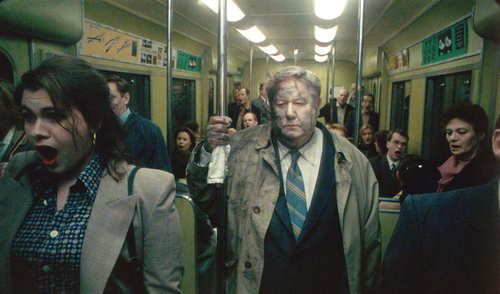
Our protagonist Palle has cheated his best friend and has burned down his own furniture store for the insurance money.  He moves through the city and the subways with his face streaked with soot from the fire.  His son is a poet who has been hospitalized for catatonic depression. Palle is followed the the ghost not only of his friend (dead of suicide) but of several others, somewhat plaintively trailing him through the city.

He now tries to get by selling crucifixes, but no one is buying.  In the final scene, a fellow salesman angrily unloads his unsold collection, throwing them on a garbage pile, asking “what made me think I could make money on a crucified loser?”  In a sense many of the film’s character can be seen as “crucified losers” within a stagnating European economy that has left them stranded and hopeless.  In an early scene, a man who has been laid off simply grasps his boss’s ankles, repeating “but I’ve been here thirty years…” as his boss awkwardly moves away from our perspective in a long hallway, dragging his burden.

“Ingmar Bergman meets Monty Python” is a line that people keep citing about the film (from the Village Voice I believe) and it does capture the feeling well.  On the one hand, this is challenging foreign film art, with austere style, grim themes, and a forbiddingly erudite range of reference and allusion to film, visual art, and literature (the film begins with a dedication to the Peruvian poet César Vallejo and this line of his is a recurring manta: “beloved is he who can sit down”– his work is given to Palle’s hospitalized, catatonic son.)  But, it is also often quite hilarious and filled with deadpan physical humor and absurdist wit.

I will admit that although I loved it, I started to fall asleep on Friday night and had to stop halfway through, then we finished it on my laptop the next night; I think I preferred it with the greater intimacy and closeness of the laptop in bed.

As the author of the Onion article I cite above suggests, the film, although made 11 years ago, feels very of the moment, very Occupy Stockholm, a depiction of a world/Europe collapsing under the strain of capitalist shock-doctrine tactics, greed, failed economic plans, mass underemployment, magical thinking of a sometimes pernicious kind.  Many of the characters are pasty, overweight white men with pancake makeup that can make them look either or alternately like vampires, or silent-film or theater clowns.  Mechanical rats scurry through the streets.

This was one of our favorite scenes, as inhabitants flee the city, trying to make a train, burdened by their enormous piles of their possessions.  The film is filled with  spectacular set-pieces like this one, in highly artificial, sterile, painstakingly constructed stages.  The laid-off businessmen in their suits struggle, grunting and heaving, to move their piles of junk as their own golf clubs fall down on them.

In what seems an allegory of panicked 21st century neo-liberalism, one of Pelle’s fellow displaced workers, shuffling his possessions like an injured turtle towards escape, shouts to him, “There’s a time for misery… But it’ll soon be over.  Just a few more yards, and we’ll have left this damned dump under the clouds for good!  As free men… Free at last!  And then we’ll only have ourselves to think about.  And we’ll do what we feel like.  Do we not deserve that?  Aren’t we worth it, when we’ve worked so hard?”

Meanwhile the uniformed railway employees wait silently.  We doubt Pelle and his friends will make it.

It is a pretty one-of-a-kind movie!  And, I have a feeling I did not capture this, but hilarious.

Eugenides’ *The Marriage Plot* as Neuronovel

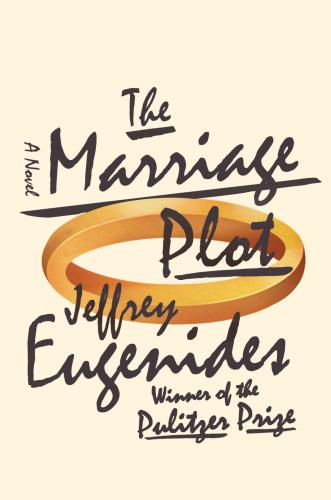
Just finished Jeffrey Eugenides’ The Marriage Plot which I enjoyed very much.  [The following contains no big spoilers but I do discuss the book as a whole, which requires some hinting at the way the plot unfolds.] Of course, as someone who went to school at Brown/ in Providence (a decade after the book’s 1980s setting and graduate rather than B.A., though), there was some strong nostalgia operating for me or, perhaps not nostalgia, but personally interested recollection & testing of details (e.g., the diner where two character go to eat seems to be located right by my old apartment, although there was no diner there — could it have folded before my time?).

The book seems practically to be begging to be adopted as a final text in a course on “Anglo-American Fiction and the Marriage Plot.”  Consider this early riff about a class one of the three protagonists, Madeleine, is taking:

In [Professor] Saunders’s opinion, the novel had reached its apogee with the marriage plot and had never recovered from its disappearance.  In the days when success in life had depended on marriage, and marriage had depended on money, novelists had had a subject to write about.  The great epics sang of war, the novel of marriage.  Sexual equality, good for women, had been bad for the novel.  And divorce had undone it completely.  What would it matter whom Emma married if she could file for separation later?  How would Isabel Archer’s marriage to Gilbert Osmond have been affected by the existence of a prenup?  As far as Saunders was concerned, marriage didn’t mean much anymore, and neither did the novel.  Where could you find the marriage plot nowadays?  You couldn’t.  You had to read historical fiction.  You had to read non-Western novels involving traditional societies.  Afghani novels, Indian novels.

Eugenides does cash out this key early riff in various ways, as the eventual winding of the plot involves marriage, a choice between two suitors, a prenup, travel to India, and, for the sake of avoiding spoilers, I’ll just say consideration of various post-marriage options.

I am not sure I feel that these themes and ideas are played out in deep enough ways, though, to make this book that perfect choice for the contemporary final text in the marriage course that I’d been imagining (e.g. a course including books by Austen, Eliot, Wharton, Henry James, then finally Eugenides).  The problem is that the book seems to suggest in the end that Professor Saunders is correct.  The characters do still struggle over marriage and the question of whom to marry, but not very much is at stake in the literal or legal fact of marriage.  For a young couple today or in the 1980s who have not yet had kids, it is not too difficult to sever all ties, whether or not a marriage has occurred.  A divorce or annulment requires a lawyer, and individuals may (probably will) invest extra meaning in a marriage (as opposed to a “relationship” or what they used to call concubinage in the old days!), but Professor Saunders’s basic point (about society, anyway) seems true, and this novel bears it out.

So, I guess I was slightly disappointed by this aspect of the novel; if I had hoped that the novel would ultimately prove that Saunders was wrong — that “the marriage plot” still endures as a powerful structure for the contemporary novel — I was not really satisfied on this score.  Madeleine comments at one point on her honeymoon that

She felt as if she’d aged twenty years in two weeks.  She was no longer a bride or even a young person.

This reminded me of Dorothea after her honeymoon with Casaubon (an intentional reference I’m sure), but what has given Madeleine this feeling is her husband’s mental illness (which renders him Casaubon-like in certain respects, including in the bedroom), not marriage as such.  If Madeleine exits the marriage, will she be irrevocably changed, altered and damaged in the eyes of the world?  Not in the least, so The Marriage Plot can not really be a modern/domestic “epic” in the way Professor Saunders (and George Eliot) assert that nineteenth-century novels were.

One could make the case that The Marriage Plot jibes with the claim some have been making recently that the really crucial topics for the contemporary novel are not marriage & love but consciousness and neurology– in that we have a protagonist who is mentally ill and whose drama, as it unfolds throughout the book, necessitates intensive consideration of drug intake and the management of his faulty/erratic interior wiring.  (On Fresh Air, Eugenides flatly refuted the suggestion that the brilliant, manic, and bandana-wearing Leonard is modeled on David Foster Wallace; it’s indeed tempting to read him this way, as it gives the novel as whole additional layer of self-conscious reflection on recent literary history.  However, in support of Eugenides, it has to be said that Leonard can’t play tennis and finds the game off-puttingly elitist (D.F. Wallace of course was a teenage tennis champion); this almost seems suspiciously planted as a red herring, though…)

In fact, Madeleine’s error, as a nascent scholar of Victorian fiction, may be that she misreads literary history and her own lover: she believes she is living in a Marriage Plot but she is actually a protagonist of a Neuronovel: “What has been variously referred to as the novel of consciousness or the psychological or confessional novel—the novel, at any rate, about the workings of a mind—has transformed itself into the neurological novel, wherein the mind becomes the brain” (Marco Roth).

Jonathan Richman and the eternal “Boston”/”New York” dialectic

We caught Jonathan Richman at the tiny (capacity 100 or so?) Bishop last night.

My first “rock show” ever was Richman at a folk club in Harvard Square (am forgetting the name, long gone… oh, Jonathan Swift’s!) in probably 1983, after he released the great Jonathan Sings! which was in effect his comeback album after disappearing for a while (after the demise of the Modern Lovers) in the late 1970s.  (I learned from Wikipedia that “following the Modern Lovers’ final breakup, Richman went on sabbatical for a few years staying in Appleton, Maine and playing at a local diner in Belfast, Maine, called Barb’s Place.” In those pre-internet days, did people even realize this was happening?)

Funny to look back and realize how little time had passed since the heyday of the Modern Lovers, whose first records were not even released until 1976/7 (although they’d been recorded several years earlier).  Richman was about 32 years old in 1983.  But from my perspective, as a 14 year-old who’d recently immersed myself in the rock and roll canon via Robert Christgau among others, he felt like a legendary elder coming in from the cold.  I went to the show with my father and I think my friend Sam (is that right Sam?).

Richman slowly turned into a new kind of institution in the later 1980s and 1990s, going further and further down his particular rabbit-hole of wide-eyed, child-like, earnest folk music with a slightly delusional/out-of-it edge.  I stopped paying close attention to the recordings long ago, but I was very glad when his role as Greek-chorus troubadour in the Farrelly Brothers’ There’s Something About Mary seemed to give him a new level of mainstream visibility (and presumably a good chunk of living money).

So I was surprised that he’d play a tiny place like the Bishop… and not necessarily even sell it out (it wasn’t clear to me if he did).  Someone said he’s played in Bloomington a lot, although if this is true I somehow missed it.

Here’s a video someone made a few days ago in Ithaca.  This, I think a new, unrecorded song, was also a highlight last night.

Bohemia by Jonathan Richman at The Haunt in Ithaca, 10/24/11 from Armin Heurich on Vimeo.

My parents didn’t stand in my way when I was 16 years old… They knew I had to find, they knew I was pining, for the door to the art world… They knew that I had to find the door — to Bohemia.  I had my pretentious artwork, but my parents didn’t laugh too bad… I needed to be reined in once in a while.  But they didn’t have a hateful vibe, they didn’t demean.  In fact, I’m grateful because they didn’t… stand in my way, when I was — standin’ in Harvard Square, pretentious artwork in my hand.  The New York hipsters saw me standin’ there, and they knew this young man was looking for the door…. To Bohemia.  There I was standin’ in the square, pretentious artwork folio, but they knew I had to find the way…. To Bohemia.

I was bratty.  Bratty… but sincere.  Yes, I was bratty… But I had to know, they knew I had to go.  Pretentious Artwork Folio, it showed me the door, to Bohemia.  High school was night.  But they showed me light.  When they helped me find the door to Bohemia.  Desperate, desperate, hook or crook… I searched for Bohemia in the high school dusty art book.  Faintly, faintly, conjured I — I searched for Bohemia in the darkened Boston sky.  And once they saw that I wouldn’t back down, well they showed me the door to Bohemia.

It reprises old themes of Richman’s, going back to the Modern Lovers album.  Boston vs. New York, “Old world” vs. modernity, parents vs. rock and roll, squares vs hipsters, “straight”/”stoned,” finding a life in art and music.  Richman moved to NYC in 1969 as a teenager and slept on the floor of the Velvet Underground’s manager, determined to make it in music; he gave up and came back to old Boston, but a few years later, John Cale produced the Modern Lovers sessions.  Keith Gessen argues in a nice piece of a few years ago that “the power of The Modern Lovers is that it’s simultaneously about leaving and not leaving Boston, or about leaving it and coming back,” with “Boston” representing tradition, family, resistance to the new.

I guess one could explain Richman’s career for the last 25-odd years as a full acceptance of “Boston,” in those terms (although what he does now can’t really be explained as simple “tradition”).  He certainly didn’t play a single song from the Modern Lovers or 1970s Richman songbook last night, although presumably at least some of us would have absolutely died for a “She Cracked” or “I’m Straight” or even “Government Center” — let alone “Road Runner.”  Does he ever play that?  How odd to have written one of the THE GREATEST ROCK AND ROLL SONGS EVER, up there with “Satisfaction,” “Like a Rolling Stone,” etc. (robbed when Rolling Stone named it the #269th greatest rock song, but hey, that was still a few notches above “Born to Run”), one of the few songs covered by the Sex Pistols, and never to play it, never apparently even to consider the possibility of playing it?

That’s some strange career management.  This aspect of Richman’s career made me think of Alex Chilton.  He knows everyone’s dying for him to play “September Girls” but instead he plays “Volare” — and this is a surprisingly exact parallel, as Jonathan now sings a bunch of songs in Italian for some reason and often seems to be going for some kind of louche Italian lounge/ folksong mode.

Perhaps because last night was a Friday, he sang “I was Dancing at the Lesbian Bar,” an audience favorite, with its catchy refrain, “In the first bar things were just alright/ At this bar things were Friday night,” spun off in numerous variations: “Well at the first bar things were stop and stare/ But in this bar things were laissez faire,” “Well in the first bar, things were okay/ But in this bar things were more my way,” “In the first bar things were so controlled/ In this bar things were way way bold.”  Another version of the Boston/ New York dialectic, I suppose.

He has a somewhat manic gleam in his eyes, and certain songs get pretty close to self-help or therapy-talk.  (He also dances a little like a Hare Krishna.)  I enjoyed “When We Refuse to Suffer” last night, in which Jonathan casts his lot in with suffering, sorrow, and stink against air conditioning, air fresheners, and Prozac.

There was something quite moving about the show.  I hope that Farrelly bros. and “Road Runner” money (there must be some of that, right?  Is it on Guitar Hero or anything like that?) is funding a comfortable late middle age –the guy’s 62!  Could pass for much younger, though.

Pedro Costa at I.U.: “Something happens, sometimes.”

I saw acclaimed Portuguese director Pedro Costa (dubbed “the Samuel Beckett of world cinema by The Guardian) at IU Cinema on Thursday before I actually saw any of his films, which made the experience that much stranger.  It was a little bit like one might imagine seeing a Portuguese Samuel Beckett interviewed on stage.  Long pauses, odd non sequitors, mysterious, brooding tangents landing up in apparently despairing conclusions often difficult to interpret.  But charming all the same.

Here are a few comments & remarks I recall:

  • In response to a question, he discussed his time studying medieval history in school.  “Film may have been invented to represent medieval history,” he proclaimed, somewhat inexplicably (as far as I know, all of his films take place in the present day or late 20th century).
  • “I hate the film world.  I think it should be destroyed.  A film set can be a … terrible thing.”
  • He described the making of his second film, Casa de Lava (1994), at some length.  He apparently intended for this to be a remake of the Jane Eyre Caribbean zombie film I Walked with a Zombie.  “It became a fiasco, a disaster.  It was like a mini-Apocalypse Now.  I wanted to make it a bad experience, and I think… I succeeded.”  (The Guardian writer selects this as Costa’s masterpiece. [no the writer was discussing Ossos (Bones)))
  • This was my favorite single moment, as he discussed his realization that he cannot film nature. “Set up a camera and film… the ocean?  The forest?  No, this is impossible… no… I cannot do this, I prefer interiors…. [discussed his desire to make a film about walls.]  And in fact, the people who do this, who show the ocean?  This is shameful!  I really do think these people should be ashamed of themselves.”  (Exact phrasing is as I recall it, but this was the gist.)

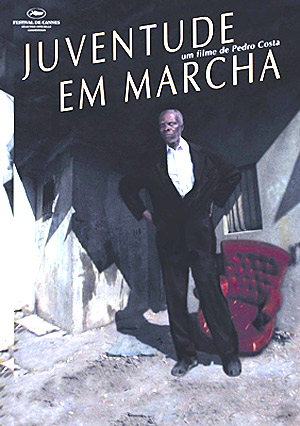
He’s best known for his so-called Fontainhas trilogy (Ossos (1997), In Vanda’s Room (No Quarto da Vanda, 2000) and Colossal Youth (Juventude em Marcha, 2006)), all set in the (former) Fontainhas slum of Lisbon, a now-destroyed neighborhood that housed Cape Verdean immigrants, drug addicts, and a range of other marginalized Lisbon residents.

The author of a liner notes essay in a Criterion Collection re-release of this trilogy explains how Costa stumbled on his quasi-documentary working method:

In 1997, Pedro Costa made Ossos in Fontainhas. This was a traditional production, shot in 35 mm, with tracks, floodlights, and assistants. Costa was a professional, a part of the Portuguese film industry. The shoot proceeded with everyone doing his job, following the routine of European art film. And the uneasiness grew, the feeling that a lie was being told, that an imbalance both moral and totally concrete was taking root on both sides of the camera. Costa later said: “The trucks weren’t getting through—the neighborhood refused this kind of cinema, it didn’t want it.” …So one night, Costa decided to turn off the lights and pack up the extra equipment, in an attempt to diminish the shameful sense of invasion and indecency. His action was doubly groundbreaking because in what he did, Costa found his own light, that quality of darkness and nuance he would constantly hone from that night on, and because he understood that the cinema of tracking shots, assistants, producers, and lights was not his. He didn’t want it. What he wanted was to be alone in this neighborhood with these people he loved. To take his time, to find a rhythm and working method attuned to their space and their existence. To start with a clean slate, from scratch. To reinvent his art. Three years after this leap into the void, In Vanda’s Room became the result of this departure—in Costa’s work but also in the history of the cinema.

So with this film Costa became, in effect, a Dogma-style film director, or his own Portuguese version of such.  At least in the film I ended up seeing the next day, Colossal Youth (Costa said this English-language name was imposed by a producer– is it a conscious reference to the Young Marble Giants album??  Or does that phrase come from elsewhere?  It does not seem to make any particular sense), is indeed, as the Guardian reviewer warned, “uncompromisingly difficult” and even “difficult and punishing;” “the movie itself, with its series of fixed camera positions, is closer in spirit to an exhibition of photography, a succession of cinematic tableaux” (actually he’s talking about In Vanda’s Room here).  The movie made me think at one time or another of simply made ethnographic films (e.g. Nanook of the North?) or documentaries made on the cheap (e.g. Dylan’s concert film Don’t Look Back), Michelangelo Antonioni movies, yes, a Beckett play (excruciatingly slow and drawn-out conversations leading nowhere; not much if any humor, though), and black and white photography of people living in poverty or straitened circumstances.  (I know I came across a comparison somewhere of In Vonda’s Room to Nan Goldin’s The Ballad of Sexual Dependency, which I can see, although Colossal Youth does not feature any drug-taking, which apparently constitutes a great deal of that earlier film.)  Also, painting: there’s a memorable scene in Colossal Youth where the camera focuses on a painting in a Lisbon museum by Rubens (?) while Ventura, who works a museum guard, lounges on an antique settee.  Costa momentarily invites a comparison between the painting and his own image, almost as unmoving.

I found Colossal Youth impressive & striking, often very beautiful, but quite tough going, agonizingly slow (2 1/2 hours long).  That Guardian reviewer observes amusingly, “I myself have seen critics and writers at festivals gird their loins reasonably happily for a Béla Tarr [Hungarian auteur] film. But at the words “Pedro Costa”, they flinch. A haunted look comes into their eyes.”  It does feel a bit like Antonioni in a Lisbon slum.

I made a low-quality iPad video of Costa discussing some of his experiences filming in Fontainhas, finding the performers, most of whom seem to play some version of themselves (Vonda was an actual heroin addict he met; the protagonist of Colossal Youth, Ventura, was a man who’d been hanging around the set during the making of In Vonda’s Room).  “I’m saying ‘in Fontainhas,’ but it’s a place that doesn’t exist,… it’s no longer there, like Greece.”  He also mentions, amusingly, the desire of the some of the Fontainhas residents that he direct “an action movie.”  I liked his comment about his method of casting and filming the residents he would meet in the neighborhood..  “One day you remember that guy and you say, “let’s go, let’s do… something.  And… something happens, sometimes.”

When I learned from an interview that Costa was a big fan of the English post-punk art-school band Wire as a student (their most famous album is the superb 1977 classic Pink Flag) it helped make sense of it all, somehow; this is cinema as uncompromising, minimalist, slightly apocalyptic post-punk.

No Future in Miranda July’s *The Future*

[image nicked from http://www.studio360.org/2011/jul/29/miranda-july-sees-future/%5D

This feels, for a while, like a typical mumblecore kind of movie: an arty, hipster L.A. couple, affectionate but not passionate, unfulfilled by work, hanging around their apartment, moving towards the big step of adopting a cat… But then things splinter into various forms of fantastical, sci-fi, & dreamlike modes that reminded me of The Eternal Sunshine of the Spotless Mind (M. July is very Michel Gondryesque as a filmmaker).  I liked it a lot.

The following does not really contain any spoilers.

The most audacious and potentially off-putting (but IMO brilliant) element of the movie is its narration by the above-mentioned cat, Paw-Paw (a nod to the best-known track from the Shaggs’ Philosophy of the World, “My Pal Foot-Foot”?).  Paw-Paw is an injured shelter cat (he burned his paw) whom Sophie and Jason (above-mentioned hanging-around-the-apartment hipsters) plan to adopt.  Turns out Paw-Paw needs a month’s recuperation time before coming home with them.  They decide that their carefree youth will in effect be concluded once they take on this responsibility (they are 35), so the movie plays out in this final month before “the future” arrives — whatever that will bring.

I realize I’m echoing similar points I made about the Mike Leigh movie (idee fixe?)… but I read the movie as being about care-taking and responsibility and the fear that one is unable to care for another — ideas that get extended in somewhat dizzying ways to environmentalist thoughts & feelings about care for the earth.  These underemployed slackers can barely hold down a job, and so the thought of adopting an injured and possibly traumatized cat frightens them (to be fair, I remember having thoughts like this when we got Figgy circa 1999 — ah, callow, childless youth!  How little we knew of what we could or could not, but must, take care of).  Also, the shelter will apparently give them no more than a one-day grace period, once this month is up, before euthanizing Paw-Paw (seems like a pretty harsh policy, but this is L.A.), so this month, the movie’s chronotope, becomes potentially either a period of healing and movement towards life or one towards abrupt termination of life.

The movie posits several different what we could call “objects of care” or of responsibility.  First, there’s Paw-Paw, our narrator who occasionally breaks in from his cage at the pound to explain his excitement and difficulty in waiting for his adoptive parents to take him home.  (Paw-Paw is narrated by Miranda July herself in baby-voice with the help of some crude prosthetic paws).  Then, there are the baby trees that Jason ends up “selling” in his job as a door-to-door solicitor for an environmentalist group called “Tree to Tree” that aims to re-forest L.A.  (A few of these are delivered to their apartment at one point, their roots wrapped in burlap; they seem like babies dropped off at the entrance to an orphanage.) There is also a child, someone’s nine year old girl, who ends up (in one of the movie’s various increasingly surreal/fantastical moments) in effect planting herself like a baby tree in the back yard.  (Is this akin to self-burial or suicide?  Or an attempt at self-care?)

Finally, at a more cosmic level, there’s the earth itself (as “object of care”).  In his depression, Jason at one point remarks to an uninterested customer something like, “you’re right.  It’s too late anyway.  You know that moment when the wrecking ball has hit the building, and for one moment, the building is perfectly still before it collapses?  That’s us, we’re like that building.”  When the guy asks why, if this is true, Jason is even bothering, Jason says (this is very approximate) “I don’t know.  I just liked it, you know?  Not just the trees and the birds and stuff, but the houses, cars, t.v., coffee shops… I liked the whole thing.”

[If we’re looking for keynotes of the art and culture of our moment, surely one major one will turn out to be moments like this, when a character articulates a frighteningly apocalyptic vision of environmental collapse.  E.g. the character in Franzen’s Freedom who loses it and screams at a news conference: “WE ARE A CANCER ON THE PLANET!  WE ARE A CANCER ON THE PLANET!”]

So the movie ends up drawing a parallel between Jason and Sophie’s desire to adopt an injured cat, and their perhaps well-founded fear that they will not be able to care for it properly, to our more general desire to care for our injured & traumatized planet.  (And along the way a few other objects of care: the baby trees, the self-planting little girl.)

The movie’s big question is, at various levels, is it too late?  Is there “a future” at all?– for this relationship, for Paw-Paw, for the girl who plants herself in the ground as if to try to care for or raise herself on her own, for the planet?

So I don’t agree with those who dismiss July as a twee, self-regarding slacker… She uses the materials & aesthetics of that kind of lifestyle/ attitude (Etsy crafts, self-documenting or curating, underemployment, found objects & texts, lost pets, obsession with youth and old age/ evasion of adulthood) but turns them into something pretty deep.

Piggy Swine: Maurice Sendak’s terrifying new book

[image nicked from http://mixingreality.com/2011/04/bumble-ardy-maurice-sendaks-first-book-in-30-years/%5D

The great Maurice Sendak has just published his first new picture book in thirty years, Bumble-Ardy.

It’s very disturbing.  Bumble-Ardy is a young pig who has never celebrated a birthday.  Initially because his parents “frowned on fun,” then because they just forgot, then because they were all fattened up and eaten: “forged and gained weight/ and got ate.”  That pigs are raised to be eaten is a major subtext of the book– Sendak does not let you forget this.

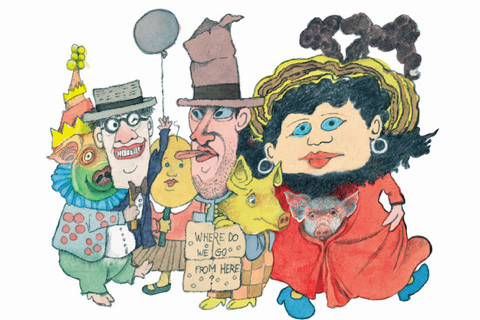
After the slaughter of his parents, Bumble-Ardy goes to live with his nice aunt Adeline, who is planning a 9th birthday celebration for the two of them.  While she’s at work, however, Bumble-Ardy puts the word out to all his buddies, who show up for a big party; in Sorcerer’s Apprentice-esque scenes that take up much of the book, these “piggy swine” “broke down the door and guzzled brine / And hogged sweet cakes and oinked loud grunts / And pulled all kinds of dirty stunts.”  These scenes recall Where The Wild Things Are, but it feels less like a wild rumpus, more like a scary and out-of-control house party — you see one pig sucking the “brine” directly from a hose — that’s threatening to devolve into an orgy (what are these “dirty stunts” precisely?).  Note, in the image above, the pig holding the vaguely apocalyptic sign, “Where Do We Go From Here?”

The WSJ reviewer describes the scene well: “As soon as Aunt Adeline leaves for work, a masked and costumed mob descends on her house. We see a pig in clown clothes carrying a ventriloquist’s dummy, a pig carrying the mask of a stubble-chinned man, a pig disguised as a yellow-eyed squaw, and a pig wearing a piratical skull and walking on chicken’s legs.”  Many of the figures look like gangsters with their molls.

There’s something distinctly malevolent and decadent about the images of masked pigs bent on mayhem — their dull, glazed eyes staring blankly — which put me to mind of Eyes Wide Shut.

It gets worse, though, when Aunt Adeline gets home.  Given how downright creepy Bumble-Ardy’s party has become, we assume that she will shoo everyone away and restore order.  She does, but in doing so, she becomes the most disturbing figure in the tale.  In a frightening series of images, her face darkens, twists, and metamorphoses into what is in effect another horrible carnival mask, as she pulls out a large cleaver and tells the guests that if they don’t leave immediately “I’LL SLICE YOU TO HAM!”  Her comment makes you realize that when these “piggy swine” have been “swilling brine,” they may simply have been pickling themselves in preparation for slaughter.

Bumble-Ardy now, terrified, blubbers to his aunt that he promises he will never turn ten– a comment that feels over-determined considering that his entire immediate family was recently killed.  There’s a more cheerful final scene of reconciliation, but as far as I was concerned, it was too little, too late for this fable to seem anything other than sheer vindictive nightmare.  We all know that the ovens in In the Night Kitchen hinted at concentration camps, but there the child’s fear of being devoured was buried a bit deeper, and transformed by a spirit of play and joy; here the fear that those one loves will be eaten, or will eat you, is right there on the surface (like the mother-figure’s rage).

The book is pitched to kids ages 4-7.  Holy moly, if my kids read this when they were 4 they would’ve had nightmares for months.

All respect to Sendak, a genius, and for the most part I’m with him that children’s lit could use a lot more Grimm, but I’d consider this one an envelope-pushing experiment in the genre more than something you’d actually want to read to your little tots before bed.