Perfect Game Paintings

In all the to-do about Mark Buehle of the White Sox’s perfect game (assisted by Dewayne Wise’s amazing 9th-inning catch), I was amused by one detail.  It’s apparently traditional for the pitcher of a perfect game to treat or honor his teammates in some way:

Buehrle is ordering special wine bottles for all of the White Sox, but [Dewayne] Wise and the catcher, Ramon Castro, will get something extra. Both will receive an original painting of their roles in the game, a work of art to commemorate the masterpiece Wise made possible.

Nice to see fine art painting playing a prominent role in this kind of story.

May I make one suggestion as to the painter — how about Juliana Hatfield?

I’d be curious to learn what painter gets this gig in the end.

Uncreative Destruction of Harvard Square

Creative destruction = Joseph Schumpeter’s account of capitalism’s dynamism based on innovation and the destruction and abandonment of the old.

I’m just the 10,001st person to complain about it in print, but Harvard Square has become an outdoor mall.  What’s distressing is not just the loss of all the old book stores, record stores, cafes and diners, but that they’ve mostly become outposts of multinationals — showcase locations for Adidas, Verizon, Bank of America, etc etc.

la flamme

I got my hair cut at La Flamme barbershop which is where it’s always been on Dunster Street.  I sometimes got haircuts here as a teenager.  Amusingly, I have a vague recollection that it was slightly pricey, and so I tended to prefer Central Barber on Mass. Ave. (where the Lemonheads got their trademark buzz cuts), but their current price is $14, so how much could it really have been in 1985?  I did not remember that it opened in this spot in 1898.  It’s very old-school with neat moldings, fixtures, and old-fashioned sinks.  I felt a little Rip Van Winklish, melancholy about all the transformation and loss of what used to make Harvard Square a distinct place rather than an abstract space for late capitalist consumption.  (Specifically, I was upset about the disappearance of the Harvard University Press display store, where I used to get Harvard UP paperbacks for $1, $5 or $10.  You could always find certain books on the dollar shelf: Harriet Jacobs’ Incidents in the Life of a Slave Girl, for example.)

What other Harvard Square institutions survive?  I just checked online and apparently Cafe Pamplona is still there, staffed (according to a Citysearch review) by “‘lanky, slightly despairing graduate students.”  (Sounds about right.)  Whew.  Any votes for most egregious transformation at a single address?

When and if the Harvard Book Store goes, I wash my hands of the place entirely.

Netflix/ Movie Roundup

I can No Longer Hear the Guitar. One of those movies that was on the Netflix queue but now I can’t remember exactly what led me to it.  It’s a 1991 Phillipe Garrell movie based on his ten-year affair with Nico (the German model/ original Velvet Underground singer).  What was disconcerting is that the Nico character, Marianne, is about the exact opposite of an icy Nordic beauty; she seemed so implausible as Nico that for much of the movie Sarah was convinced I’d gotten confused.  Also, notably, the film features no guitar or any music except for a few (admittedly somewhat Velvet Underground-sounding) brief snippets.  We found this slow and the characters gloomily pretentious.  Maybe it is a bad sign when a Heidegger quotation is uttered in the first ten minutes of a film?  Even so I did find it somewhat moving by the end.

Silk Stockings.  Fred Astaire and Cyd Charisse.  And Peter Lorre.  Charisse is the beautiful Soviet functionary who has come to Paris to demand the return of a Russian composer working on a musical.  Astaire is the film’s director.  Lorre is one of the three bumbling Soviets who’d previously failed in the mission.  Charisse has a big lingerie/silk stockings routine that Sarah thinks was referenced in ads for stockings she recalls from the 1970s.  Astaire and Charisse were fresh from The Band Wagon, one of the most famous musicals.  (Though Astaire looking a bit long in the tooth by now (1957).)  Hokey plot but lots of great/memorable song & dance numbers.

Waltz with Bashir. Amazing movie!  An animated documentary, perhaps the first of its kind?  Actually I bet they got the idea from Richard Linklater’s Waking Life, but whereas that movie is a kind of a woolly philosophical/stoner daydream, Waltz with Bashir is an intense dive into repressed personal and national memories.  (I.e. it uses the form to much more pointed ends.)   imdb plot summary: “An Israeli film director interviews fellow veterans of the 1982 invasion of Lebanon to reconstruct his own memories of his term of service in that conflict.”   Probably the scene I’ll remember the most is the opening, a nightmare of a pack of 28 terrifying dogs on the hunt; we learn that it’s the recurring dream of a man who, as an Israeli soldier in Lebanon, followed orders to shoot dead every dog that barked as they entered a small town, all 28 of them.  Made me think of Hitchcock’s Spellbound — the form of the film is almost like analysis.

Ball of Fire.  1941 Howard Hawks/ Billy Wilder movie.  Gary Cooper = stuffy Princeton English prof researching American slang.  Barbara Stanwyck = nightclub performer and gangster moll.  Cooper sees her as an ideal source for new slang, and she needs to go undercover anyway.  Screwball antics ensue.  Drags on a bit, but a lot of it is as great as Some like it Hot or the like.  A must for stuffy English profs.  Fantastic 1940s slang.  Worth seeing too just for the weird/great Gene Krupa matchbox drum solo.

Baby Doll.  “Written by Tennessee Williams, this 1956 black comedy tells the story of cotton gin owner Archie (Karl Malden) and his sexy teenage wife (Carroll Baker), who won’t consummate the marriage until she turns 20. When Archie battles a rival (Eli Wallach, in a BAFTA-winning performance), he could lose his business — and his beloved child bride” (Netflix).    Entertaining overheated Tennessee Williams.  Was denounced by the Catholic Legion of Decency and pulled from theaters in 1956.  Eli Wallach is supposed to be Sicilian but also has a bit of a nefarious Mexican gangster vibe– I guess it’s all-purpose ethnic otherness.  His scenes with Caroll Baker are pretty hot.  She comments that for years she was freaked out by people on the street calling her Baby Doll.

Ghost Town.  Recent flop romantic comedy that suggested that Ricky Gervais can’t open a big-budget movie as the lead.  Or, let’s be fair, maybe this just wasn’t the right one.  He plays a misanthrope dentist and is pretty funny at his most rude and hateful, inevitably less so as he is redeemed and finds love.  The movie is going for a kind of old-fashioned Hollywood romatic ghost comedy effect, a la Topper or the like.   Greg Kennear is good as the head ghost, a charming asshole lawyer.  Tea Leoni does her best as the love interest (she’s a paleontologist at the Museum of Natural History, a nod to Bringing up Baby I suppose) but doesn’t have much to work with.

Careful by Gay Maddin.  “In the remote Alpine village of Tolzbad at the turn of the century, people talk quietly and restrain their movements lest avalanches come and kill them…All this is shot in the style of an early German sound film, complete with intertitles, deliberately crackly soundtrack and ‘hand-tinted’ colour effects.”  Guy Maddin is brilliant and hilarious but this gets a bit much after an hour or so.  Kind of like a mad film student’s senior project.  Still glad I saw it.

Year of the Dog.  2007 directorial debut of Mike White (of Chuck and Buck, Freaks and Geeks, etc).  Molly Shannon (of SNL) is a sad office worker who finds meaning through animal rescue and veganism despite the scorn and incomprehension of her relatives and coworkers.   Not everything works but I enjoyed it.   Laura Dern excellent as the Molly Shannon character’s insufferable/smug rich sister-in-law.  The politics/ stance of the movie vis a vis animal rights issues is interestingly ambiguous: it kind of tries of have it both ways, I felt, making her politics seem aberrant & motivated by personal/psychological problems, but then in the very final scene presenting those politics as heroic and admirable.

Momma’s Man.  Mikey is 30-ish, with a wife and baby, and is back from California on a business trip to NYC, where he visits with his artist parents in their Tribeca loft.  He misses his flight out and never leaves — after a few days his parents start to wonder what’s wrong, but he’s stuck, paralyzed, agoraphobic, can hardly step out of the apartment.  It’s fascinating as transformed autobiography because Mikey’s parents are payed by the director’s actual parents (!) and it’s filmed in the crazy, ramshackle, overstuffed loft on Chambers Street where he grew up.  The DVD includes a really interesting interview the director conducted with his parents after they watched the movie’s premiere.  A recent American independent movie filmed on a shoestring that’s actually interesting and unpredictable.

Mount Desert Island Consumerism

A visit to Mt Desert Island is obviously all about Acadia National Park, the ocean, lakes, hiking trails, etc.   But I thought it would be fun, as we near the conclusion of a long stay, to comment on some of the consumer options available here.

Terrible crap in Bar Harbor.  Needless to say, you have to avert your eyes from some of the tourist-trap tschotshkes and whatnots clogging the store windows in Bar Harbor.  A lobster-fudge-hooded sweatshirt, could such a thing exist, would be the ideal souvenir to take home, or at least would be the mean average of what’s for sale.  That said, there’s some good stuff in Bar Harbor too.  We’re very partial to

Reel Pizza.  This is one of those places where you watch your movie while drinking beer and, in this case, eating quite good pizza.  (The beer is good too).  It’s an alternative to

The Criterion Theater, a gorgeous Art Deco theater built in 1932 when Bar Harbor was a swanky destination, is a somewhat melancholy institution.  It seats 877 and always used to guarantee that it never would never sell out a show.  I have many fond childhood memories of drives to civilization in Bar Harbor to see a movie (Return of the Jedi for example).  As time passed, though, it started to go to seed and get a bit dank and smelly.  Sometime 7 or 8 years or so ago we went and many chairs were covered by plastic, apparently victims of ceiling leaks, and it just smelled too bad; around then we switched our allegiances to Reel Pizza.  In 2007 new owners bought it and converted it into a nonprofit Theater and Arts Center; they now show some classic old movies and host musical performances.  Definitely the right way to go, but I am sorry to report that it’s still kind of smelly with uncomfortable seats, and the sound seemed a bit off when we saw Public Enemies a week or two ago.  I’m rooting for the Criterion, but I worry that it’s just too huge a white elephant to maintain.

Mt Desert Ice Cream.  Two locations in town.  I am too cheap to take my kids here because a small dish is $3.75 and there are no kids’ cones.  Great ice cream, though.  We split an enormous large bowl of Blackstrap Molasses Banana and some Salted Caramel.  The nice girl at the counter held onto it for us and I ran out to get it during the intermission at Reel Pizza.  A very creative place with all kinds of interesting things for sale (sorbet popsicles!).

I almost forgot this one: Morning Glory bakery in BH.  We got a bit too addicted to this place.  Great bread & pastries and other more lunch-y stuff like quiche.  I had a particularly memorable rhubarb pastry.

Burning Tree restaurant.  In Otter Creek near Bar Harbor.  Wonderful restaurant that uses very local ingredients, a lot of seafood and local vegetables, & very little (if any?) red meat.  We had a delicious clam pasta appetizer, I had an opulent bowl of bouillabaisse, and Sarah had grey sole with mushrooms.  A nice beet salad came on the side of any order.  Lots of edible flowers on the food; Sarah characterizes the place as a very “feminine” restaurant.  Dessert was the same amazing honey cheese cake we remembered from last year and a lemon mousse with figs.

Pectic seafood.  “When Things Get Hectic, Head to Pectic.” There were two retail tragedies this year.  The first was the closing of the original Pectic Seafood store on the road to Southwest Harbor.  They opened a bigger one of the way out to Ellsworth, and then I think the original place, which they operated out of their house, ran into some kind of zoning problem.  So we had a lot less seafood this year.  The second, in the greater scheme of thing more tragic, event was the closing of the

Port in the Storm Bookstore in Somesville.  For the past 15 years (?) or so, this has been a wonderful place to visit on the bay in Somesville, with water right below outside the window and a view of the mountains.  It was a community institution that hosted good authors’ readings too.  They’d recently expanded with a second small place in Bernard, and maybe it was a bad time to do that, but in any case, they’re both gone now.  I feel guilty, as I used to like to visit but did not buy much.  The independent bookstore problem.

Thurston’s lobster pound in Bernard.  Kind of pricey but a lovely place with every detail well done.  A beautiful location over the water, with an airy, mosquito-netting covered dining room, and everything down to the cole slaw and the hotdog bun on the lobster roll (deliciously buttery) is excellent.  I’m sure some locals laugh at this place as the ultimate yuppie lobster pound, but for my money it’s hard to beat the experience of a late lunch here in July (dinner can get pretty crowded).

I’ll conclude with an intriguing new place we stumbled upon the other day: The Naturalist’s Notebook.  This is in Seal Harbor very near to Martha Stewart’s home, and I imagine she must stop by (if she’s not somehow behind it or connected to it).  An eccentric little store.  They sell interesting notebooks, pens and pencils, and ink; knitted items; travel-related stuff; maps and globes; books; and I don’t know what else.  We bought some fancy honey.  They had a blanket woven with the Red Sox logo, if I recall correctly.  Upstairs were desks with drawers you could pull out filled with collections of shells and feathers and the like.  Some really nice art for sale including small ink drawings of barnacles, mussels, and the like.   You definitely sense a very particular guiding aesthetic behind the place.

I could go on — haven’t even gotten to Jordan Pond House — but apparently the one thing you cannot buy for love or money on this island is a working DSL connection, so I’ll end here.

Roberto Bolano’s 2666

We’ve been in Maine in the little cabin on Long Pond for 9 days or so.  No DSL.  My cellphone stopped working in Ellsworth.  Landline went out for three days.  I finally got it together to make dial-up work.

I associate time here in Maine with reading long novels.  Last summer I read The Magic Mountain.  I just finished Roberto Bolano’s 2666 (having read Bolano’s The Savage Detectives last year).  Meanwhile Sarah has been reading Moby Dick.

2666 (which was a 40th bday gift, btw – thanks George!) is an amazing and very weird, obsessive novel that invites comparison with some of the great long novels like The Magic Mountain, Ulysses, etc.  Having just read it, my initial feeling is that its flaw is probably a certain degree of incoherence.  To be specific, I am not sure all of its five “parts,” each of which Bolano intended to publish separately (he died just after completing it), belong together.  Part one, “the Part about the Critics,” and part five, “the Part about Archimboldi,” could constitute one novel, possibly also including part three.  And then parts four and five, “the Part about Fate” (about an African-American journalist named Oscar Fate; not sure if the pun seems as obvious in Spanish) and “the Part about the Crimes” could form their own novel.  Bolano’s executors decided to disregard his instructions about publishing the work as five separate shorter novels.  There’s a logic to this decision, because in fact overlaps do connect the different parts, and the end of the novel in particular links part five with part four… But at some level, it feels to me that there’s something slightly gerrymandered about declaring this a single 900 page novel.

I regret this a little, too, because I think many people would love the thread of 2666 that revolves around literature, novel-writing, and criticism (as well as many other things too), but will not have the stomach for the parts of the novel that are obsessively, disturbingly, focused on sexual violence against women, specifically the unsolved rape-murder of up to 200 women in a city on the Mexican-U.S. border.  Part four, “the Part about the Crimes,” is a mesmerizing nightmare of a reading experience.  It’s a policier, sort of, about the attempt to solve these murders, but it’s intentionally unsatisfying as an example of that genre since loose threads, lost evidence, indifference (towards the victims, primarily poor Mexican teenagers) and ignorance dominate the search.  Much of it takes the form of a dossier describing the discovery of the bodies of the women, nearly all of whom have been, as we’re told over and over, “vaginally and anally raped” (the novel is bizarrely obsessed with anal rape), and many of which are tossed aside, buried in pauper’s graves with only minimal, incompetent efforts to investigate the crimes.  It’s hard to think what to compare this aspect of the novel to – I’ve read one of the so-called policiers noir of Georges Simenon, Dirty Snow, a very disturbing, nihilistic novel taking place in Nazi- occupied Belgium, and that’s the closest analogy that comes to mind.  (In his review Jonathan Lethem mentions H.P. Lovecraft, Denis Johnson, David Lynch, and James Ellroy, all of which make some sense to me.)

What I found most pleasurable about the novel were the sections about Archimboldi, the German novelist whose identity is a complete mystery and whose work and career become the focus of the four academic critics who are the primary subjects of the novel’s first section.  The mystery of Archimboldi, whose identity seems to be known by no one other than his aged publisher in Germany, is revealed in the final section, which narrates his strange and picturesque life as a young man, then as a soldier in the Nazi army, then in various demi-mondes of Europe.  (I haven’t read The Tin Drum but I wonder if there are references or resemblances).  Like The Savage Detectives, 2666 in these sections is a wildly imaginative riff on the writing, reading, & publishing of literature as activities that take in all the rest of the world.

The novel is just amazing, sometimes jaw-dropping in its sheer verbal creativity.  It’s filled with countless passages, paragraphs, riffs that are like little prose poems or Kafka parables, hilarious, weird, wild, obscene.

To invoke another great big novel, what Richard Pevear writes about The Brothers Karamazov could apply to 2666 as well:

The Brothers Karamazov is a joyful book.  Readers who know what it is ‘about’ may find this an intolerably whimsical statement.  It does have moments of joy, but they are only moments; the rest of greed, lust, squalor, unredeemed suffering, and a sometimes terrifying darkness.  But the book is joyful in another sense: in its energy and curiosity, in its formal inventiveness, in the mastery of its writing.  And therefore, finally, in its vision.

To me the big interpretive questions remains, how is the “authorship/writing” theme linked to the sexual violence topos?  There are some implications than an Author might be something like a serial killer, and at one point it’s said that for Achimboldi writing is a bit like being a detective on the track of a killer.  But in the end these connections didn’t really seem that deep to me.

Reflections on the NBA Finals/ live-blogging Game 4

pau-gasol

I’m digging the globalism/cosmopolitanism of the NBA.  In these finals, on Orlando there’s Mickael Peteus (French-African, a big joker apparently, seems charming), Hedo Terkoglu (Turkish; fantastic, 6′ 10″ but can pass like a guard; the Prime Minister of Turkey called him to wish him a good game), Marcin Gortat (7′ Polish monster – a real badass; I would not want to meet him in a medieval Polish alley in the middle of the night); on the Lakers, Kobe (raised in Italy where he played soccer; fluent in Italian); Pau Gasol (sort of the counterpart of Turkoglu: 7′ Spanish star with a scruffy beard and mane of hair; seems mildly bohemian); Trevor Ariza (of Dominican descent, is planning to play for Dominican national team); Sasha Vujacic (Slovenian pretty-boy 3-point shooter; seems annoying); a Chinese guy who never plays named Sun Yue, and a Congolese player, Didier Ilunga-Mbenga.

And then of course there are the more traditional native N.B.A. types like the wonderful Rafer Alston, an Orlando guard, a former NYC playground/streetball legend formerly known as Skip to My Lou because of his habit of skipping while dribbling (!), the Duke shooter J.J. Redick; the larger than life, ridiculously muscled devout Christian Dwight Howard, a.k.a. “Superman,” etc.

They’re all playing N.B.A. basketball, and trained to death in standardizing ways, but you can really sense the different cultures on the court, which come out in gestures, ways of holding the body, expressions, and so on: Pau Gasol’s diffident shrug, Rafer Alston’s hyper blaze to the basket, Gortat’s lurching power.  It’s not that all of these players express some national or ethnic essence, but it’s neat the way you can suss out these different styles of playing and moving that can seem culturally expressive in one way or another.  Basketball used to be so black and white, Midwestern gym vs. inner-city playground; it seems so much culturally and symbolically richer and less predictable now.

And then, just the names alone: Kobe, Pau, Hedo, Rafer, Gortat, Skip to My Lou.

One other thought: I have to admit that I find the Kobe/LeBron puppet ads to be pretty amusing, even if they kind of fell flat when the Cavaliers were eliminated. OTOH the Charles Barkley/ Dwayne Wade ads are fairly lame.  I think the lesson is, when it comes to pro athletes, use puppets — don’t make them try to act.

Also, I miss the Birdman (Denver Nuggets’ Chris Anderson).  He makes it seem that if you’re just a white guy from Texas in the NBA, you really have to work hard to make an impression these days.

Go Magic!  (I grew up watching Larry Bird and the Celtics and so must root against the Lakers; mildly dislike Kobe; the Magic are a fun team anyway, or at least they seem that way when they’re shooting well)

the Hinkleburger

Hinckle's

I lost my debit card, Am Ex card, faculty i.d. and driver’s license last weekend.  My wallet had a ripped pocket and I think everything fell out somewhere in the farmer’s market.  I have enough faith in the friendly small-town experience that I kept waiting for someone to get in touch… but no dice.  To the 19 year-old who tries to use my i.d. to buy beer or get into clubs, TOO BAD FOR YOU that I’m a bald 40-year-old.  (Although if the truth be told, when I was 19 I had some 35 year old’s i.d. which did generally work to get me in to see bands… but of course, I was already starting to go bald: Q.E.D.)

Anyway, I had to drive to the West side to go to the B.M.V., which is really not too much of a pain here — it took me about 15 minutes and $10 to get the new license.  On the way home I realized that it was approaching noon and that I was going to drive by Hinkle’s Hamburgers, so I just had to stop.

Hinkle’s has been around since 1930:

Hinckle’s Hamburgers is a revered Bloomington eatery whose straightforward motto is “We Grind Our Meat Fresh Daily.” Famous for its burgers, Hinkle’s has grilled the “Hinkleburger”, a burger consisting of fresh ground chuck, fresh onions, pickles, salt and pepper, since opening in the 1930’s.

I try to eat only locally farmed/non-industrial meat, and I tend to doubt that describes what Hinkle offers, but I have to make an exception for the Hinkleburger.  They pop this little ball of meat on the grill and press sliced onions into the ball, so the onions get grilled into and with the meat.  Delicious!  Another trademark of the place is that they usually serve your food to you in little paper bags, even if you’re eating there.  (This is represented in the iconic “guy holding two paper bags full of burgers” on their t-shirts.)

A lady in her 70s or so was manning the counter.  Two dudes were ordering burgers.  “Onions and pickles?” she asked and the first guy said no apologetically.  “Weak, weak, weak,” she muttered, if I heard her correctly.  Then the next guy said “I’m going to be a wimp too,” and she said disapprovingly, “wimpy, wimpy wimpy.”  I was pleased to be able to be a man and get the onions and pickles.

Juliana Hatfield memoir

juliana-hatfield-1-sized

I got around to reading the Juliana Hatfield memoir When I Grow Up.  I read the Dean Wareham one recently (Black Postcards) too. The two books feel like they constitute a minor wave of memoirs of 1990s semi/almost rock stardom.  Wareham (of Galaxie 500 and Luna) and Hatfield both had comparable experiences as indie stars of the late 1980s plucked out for mainstream success which never quite came, leaving them struggling for diminishing returns throughout the 1990s and beyond.

I know/used to know Juliana a bit, from back in the late 1980s in Cambridge.  I played tennis with her a couple times under circumstances I can’t entirely recall (when I was home on college vacations).  She always seemed like a somewhat painfully shy, and sweet, person.  I found the memoir to be a good read, smart and sometimes moving in the recounting of her ongoing depression, struggles with anorexia, and feelings of hopelessness.

I liked this description of her realization that she is not suited to the rock and roll life (one focus of the book concerns her wrestling with the question of whether she should give up music altogether and try to find some other line of work):

At heart, I am not a rock and roller.  At heart I am a librarian, a bird-watcher, a transcendentalist, a gardener, a spinster, a monk…. I don’t want loud noise and fame and scandal and drugs and late nights and flashing lights; I want peace and quiet and order; solitude, privacy, and space for contemplation  I want to awake at dawn and listen to the birds, and drink a cup of tea.  I need to face facts.

The book, like  Wareham’s, wrestles with a formal/stylistic dilemma having to do with the attempt to narrate and describe the tedium and monotony of life on the road in a touring rock band.  Life on tour, playing over and over at the same kinds of dingy/crummy clubs, is mind-numbingly repetitive, marked by bad food, the ordeal of driving and lugging equipment, & depressing cheap hotels (and also occasional bursts of inspiration and the pleasure of performance).  So, how can you turn this mostly-tedious material into a story someone would want to read?  Juliana takes a somewhat literalist approach by narrating one entire long tour (around 2004 I think?) from start to finish: this constitutes one strand of the memoir which is also interspersed with a more chronological tale of her career from the early Blake Babies days through her solo career, getting a $400,000 advance from Atlantic in the 1990s, later getting dropped from the label and continuing to struggle on.   I’ll confess that I thought parts of the tour diary, with all its detailed accounts of the travails of a rock and roll vegan stuck in on the fast food highway, could have been compressed or edited out, but then, it does really give you a sometimes-excruciatingly vivid sense of what that experience is like.  (Part of the point seems to be demystification, for the sake of anyone who imagines that it’s a glamorous life to be in a band.)

The memoir ends with her climbing her way out of her depression and seeming to make peace with her status as a former/has-been pop star — deciding to stop punishing herself for failing to become the kind of pop success she was never destined to be. Juliana really suffered, it seems, from the weight of the burden of being a kind of token female alt-rocker, which wasn’t a very good identity match with her propensities towards shyness, depression, and anorexia.  It’s good to see that she seems relatively happy and together these days.

Reading the memoir also inspired me to download (legally! through emusic) her latest album, How to Walk Away, which works well as a companion piece to the book.  Some of the songs function both as relationship breakup songs and also as meditations on the possibility of “breakup” or walking away from the vocation of singer/artist.  In my view (this would probably piss her off) her solo records have sometimes suffered from an overvaluation of “rawness,” and I like the comparatively polished, careful pop production on this one.

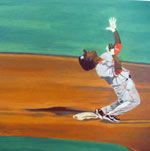
She’s been doing some painting lately, sometimes with a Red Sox/baseball theme.  Here’s one:

112108_paint1_151

The “Romanian abortion movie”

I finally watched “the Romanian abortion movie,” Cristian Mungiu’s 4 Months, 3 Weeks and 2 Days.  This was the film that won the Cannes Palme D’Or in 2007 and, along with The Death of Mr. Lazarescu (by a different director), has been heralded as a standard-bearer of a Romanian new wave of cinema.

I’ve had both movies in my Netflix queue for quite a while.  I really wanted to see them both, but somehow, it can be hard to find the right Saturday evening for the harrowing tale of a college girl’s illegal abortion in Communist Romania under Ceausescu, or the harrowing tale of the grim final hours of a dying old man in Communist Romania who is dragged in an ambulance from hospital to hospital, each turning him away.  And Sarah kind of has her eye on me in terms of getting ultra-grim fare for our movie nights.  There’s an implicit household rule in place saying that for every movie to which adjectives like “harrowing,” “unflinching,” or “uncompromising” would be likely to be applied (or phrases like “dark journey into…”), there should be one better described as “entertaining,” “fun,” or the like.  (OK, maybe I push it to a two to one or so ratio.  There just aren’t enough “fun,” light movies that are any good.)

I finally found the right moment for the illegal late-term abortion (in a society in which abortion is punished by jail sentence) movie: while Sarah is out of town.

It turns out to be a really great movie.  Is completely engrossing, compelling, like a good thriller.  Admittedly slow (filmed in real time, with no music) and definitely hard to take at some moments, but  humanistic and life-affirming in the end, not in fact “depressing” (but instead energizing and inspiring) although about some very depressing experiences.  But, maybe that’s just me.  And I don’t know, if you’re someone who’s had a difficult experience with an abortion, quite possibly the movie would be too excruciating.  I’ll make one small spoiler/ disclosure by saying that (a) you do actually see the dead fetus towards the end, in an extended shot, and/but (2) the movie does not end in an entirely brutal/horrifying way.

It reminded me of Mike Leigh’s Happy-Go-Lucky in some odd ways.  The abortionist is an unforgettably awful character who reminded me slightly of the taxi driver played brilliantly by Eddie Marsan in Leigh’s film, although the tonality is very different.  And the dinner party scene with the boyfriend’s parents is memorably terrible in a Mike Leigh kind of way (as Roger Ebert pointed out), as Otilia endures her boyfriend’s parents’ friends’ self-congratulatory palaver while she waits to return to her friend, who could be bleeding to death alone in her hotel room.  (The parents and their friends are professionals who have given into and accepted Ceausescu’s regime, and profited from it.  They patronize Otilia because her father was a common soldier.)

Also, both movies (this one and Happy-Go-Lucky) are very much about female friendship and loyalty, and more specifically, the young adult female friendship of roommates: both about the relationships of two women in their 20s who’ve lived together for years to the point where they feel almost like sisters.  Part of what’s moving about the movie is Otilia’s unquestioning, unwavering willingness to do whatever it takes (and it takes a lot) to help her friend.

And then there are the obvious Vera Drake analogies.  I wonder if any smart-aleck theater curator has ever organized a triple “abortion movie” showing of 4 Months, 3 Weeks and 2 Days, Vera Drake and Juno. Could be fun.

The film magazine Cineaste points out that one of Ceausescu’s

most notorious fiats—Decree 770 issued in 1966—outlawed abortion and proceeded to reward mothers of multiple children with medals and lavish praise for their efforts to build a populous socialist bulwark. Unlike campaigns against abortion in the West, Ceausescu’s imposition of mandatory motherhood (at least for women under forty-five) had nothing to do with religious or moral doctrines. It was instead aligned to what the Romanian author Norman Manea terms “the state ownership of human beings”—the obliteration of the private realm enforced by an intractable bureaucracy.

To get a bit academic about it, you could also think of the relevance of Georgio Agamben’s concept of “bare life” to the movie: the concept of a political order in which the definition of what counts as “life and the living” is determined and controlled by the state, and certain forms of life are defined as purely biological, living but symbolically cast out of the political realm.  To mount my hobbyhorse briefly, I’ll also point out that the movie does small but interesting things with domestic animals that seem to function as images of “bare,” orphaned, or absolutely vulnerable/exposed life: the goldfish in the opening scene, the kittens found abandoned in the boiler room, the roaming dogs.

Really, you should see it!  Pop up a bowl of popcorn and settle in.

Kenneth Branagh as Kurt Wallander

Watched the first (of three, I believe) installment of PBS Mystery‘s versions of the Henning Mankell Kurt Wallander thrillers.  Last night was Sidetracked and I think in the next two Sundays they’re doing Firewall and One Step Behind.

It wasn’t bad at all, was a creditable version, but was still mildly disappointing.  I didn’t really buy Kenneth Branagh as Wallander.  Wallander is an exhausted mess who drinks too much coffee, can’t sleep, is overweight and eats badly, and Branagh is just too good-looking.  Sarah pointed out that a major aspect of the novels and of Wallander’s character has to do with the mundanity of his daily life: the sad meals he ekes out of his empty kitchen, his fussing about whether or not to wear his thick sweater to the crime scene, endless pots of coffee.  Most of that sense of slow dailiness is excised.  Also, much of the pleasure of the novels depends on the suspense that builds over time, and the plot felt compressed and rushed into the 85 minutes or whatever.

It was odd that everyone spoke in British accents of one sort or another.  My guess is that they actually worked to translate specific Swedish accents/dialect into British versions.  I know film-makers have to face this problem routinely: should they speak in Swedish-accented English?  What would the logic for that be?  But this seemed a bit disconcerting.

Sidetracked is a pretty typical/exemplary Mankell novel in the way it reveals a modern Sweden scarred by various forms of global suffering, abuses, and evil.  The novels are obsessed with Sweden as country that sees itself as “traditional,” tolerant and liberal, but that doesn’t know how to handle the transformations of a new global economy, with its immigration and novel forms of inequity and corruption.  The theme of the traditional confronting the modern plays out in a striking way in this novel where the criminal turns out to commit his murders (of corrupt politicians and financiers, chiefs of the new economic order) in a kind of regressive psychopathic trance in which he reimagines himself as a Native American warrior.

I liked the Southern Swedish settings, beautiful photography.

It was disappointing that Wallander’s father now paints rather attractive-looking landscapes.  In the novel he paints basically the same painting of a wood grouse over and over; I guess they decided it would just seem too strange.

I’ll keep watching.  I wouldn’t watch if you haven’t read the novels, though.