Visit to New Harmony

The (grand)parents were in town and had arranged a road trip to New Harmony, site of the failed socialist/utopian community founded by Robert Owen in the 1820s. I’d always heard this was worth seeing, but the recommendations tended to sound a bit restrained, enough so here it is 7 years after we moved to Indiana and we hadn’t gone yet. We had a great time, though. The weather was gorgeous, which helped, and the sights were more plentiful and interesting than I’d anticipated. Lots of fun to wander around the historic/reconstructed section of town, a little bit of a Colonial Williamsburg sort of thing.

Highlights of the trip included:

-Golf carts. Though not part of the original Owen community, nor the preceding German Lutheran one of 1814-1820s, golf carts play a crucial role in today’s New Harmony. Vera was somewhat obsessed about them and insisted we go at 8 a.m. or so on Sunday to claim one at the Inn. We made fun of her, but we had to admit that it was great fun to zoom around town. By some oversight we don’t have a photo of us on our cart.

-Labyrinths. There are two, a three-dimensional one of bushes and shrubs — this in an early 20th-century re-do of a creation of the Lutherans — and a two-dimensional one of stone in a beautiful little garden. See above for a shot of the ladies working on this one (they gave up after about 5 mins, Sarah said she got dizzy.) Sarah returned on Friday night to see the monthly candle-lit Moonlight Labyrinth walk which sounded slightly witchy.

-The dog and cat at our B&B. See my previous post about the Grimm House B&B. The girls fell in love with the sweet dog Henry and the cat. They also really hit it off with Grafton, the 7 year-old boy.

-Some neat modern architecture: the Philip Johnson Roofless Church, and the Richard Meier visitors’ center; this latter is a late-1970s structure that sticks out of the landscape like a gleaming postmodern ship — doesn’t exactly blend in, but I liked it. We watched a little introductory/historical movie about the town here, which was extremely silly and full of bad reenactments and unconvincing beards. Iris found a snakeskin just outside the center.

Oh btw we also visited French Lick on the way to see the grand refurbished domed hotel, originally built in 1901. Supposedly Al Capone used to hang out here.

Iron Man

Iron Man was fun. Iron Man is a robot, HAL, 3CPO & R2D2, and especially, I thought, Gort from The Day the Earth Stood Still; he’s a cyborg, part machine part man (and a techie friend of various other pet/helper robots); he’s a golem (I wonder if the Jewish golem tradition ties in any covert way into the film’s surprisingly retrograde anti-Arab depictions — though of course the movie makes efforts to protect itself from this accusation: these are just the evil WARLORD Arabs, not the good family-minded ones). He’s a self-guided weapon: there’s something amusingly retro in the idea that a supercharged suit for an individual could be a crucial military tool in 21st century geopolitics (the Terrence Howard character comments at one point about how the instincts and intelligence of a human pilot will never be beaten by robotic intelligence — yeah, right.) And most explicitly, he is the Tin Man from The Wizard of Oz trying to get/find his heart.

Robert Downey Jr. was an inspired choice, of course. I thought Gwynth was charming as Pepper Potts although the gender dynamics are as pathetically pre-feminist as in most such movies; or even more so, as she is an indeterminate secretary/butler/girlfriend.

Some fun musical choices: Black Sabbath’s “Iron Man” blasts out over the final credits in a satisfying way. And early on Tony Starks is grooving to Suicidal Tendencies’ “Institutionalized” while he tinkers with one of his gadgets. Hope those guys got a fat royalty check out of it.

Btw, A.O. Scott observed that Jeff Bridges’ character confirms the Law of the Bald Villain; Bridges also clarifies that anyone who rides a Segway in popular culture (unlike our friend Susan, who looks really cool in on her Segway and is definitely good) must be evil.

Previews were almost entirely superhero. I have to admit, the new Hulk with Edward Norton looked pretty good, a bit of Jason Bourne to him.

Gap Whitney Museum artist edition t-shirts

Gap Whitney Museum artist edition t-shirts: by Kenny Scharf, Barbara Kruger, Chuck Close, Kiki Smith, etc., and Sarah Sze.

Why couldn’t Barbara Kruger appear in her own ad?

I wonder if the artists are being tagged as sell-outs for this, or is that concept too late-20th-century? The t-shirts are quite nice so I myself would not really make that accusation, although doing freelance design work for the Gap might well undermine one’s credibility as a scourge of corporate capitalism, if that’s your thing. (Is there a philanthropic angle here? $ to fund developing artists, hint hint?)

At $28 I’m tempted by the Glenn Ligon.

Panicked Republicans

Panicked Republicans, such a harmonious, euphonious phrase, I enjoy just repeating it to myself…

Here’s Josh Marshall on why the Republicans are feeling panicked about the loss of an open seat in a heavily Republican district in Mississippi:

And here’s the Adam Nagourney article:

Scott Reed, a former chief of staff to the Republican National Committee, said the defeat would dampen fund-raising. “Republican leadership needs to really take a good look in the mirror,” Mr. Reed said. “They’re taking the party off the cliff.”

Republican House members said the political terrain was tilted against them, and some expressed despair about the months ahead at the private meeting on Wednesday. One House Republican rated the panic expressed at the meeting as a 7 on a scale of 10.

Richard Price’s Samaritan

Richard Price is the author of Clockers and has also written film scripts (e.g. The Color of Money) and episodes for the Wire. I was going to check out his much-praised new one, Lush Life, but in the NY Review of Books Michael Chabon said that it was a slight let-down after Samaritan (which he calls one of Price’s two masterpieces along with Clockers), so I decided to start there. It has a mystery plot, with an unsolved crime and a policewoman looking into it: the sometime t.v. writer, former cokehead cab-driver Ray Mitchell lies in a hospital bed, floating in and out of consciousness. When he’s conscious, he won’t say who bashed in his head, although he seems to have at least some idea. The plot develops in two temporal strands, one leading to the act of violence, the other one a couple months later following the investigation, mostly at the hands of Nerese Ammons, a pudgy African-American cop who used to go to school in a tough neighborhood in New Jersey with Ray (who is white).

I won’t explain the plot in detail, but the novel plays out its epigraph: ”When thou doest thine alms, do not sound a trumpet before thee, as the hypocrites do in the synagogues and in the streets, that they may have glory of men.” It’s all about white guilt, privilege and shame in the face of the lack of opportunity, violence, and hopelessness in the inner city. (Although note that one of the quotations below questions how fundamental race is to the dynamic.) Ray has a few hundred thousand dollars left over from a stint writing for a t.v. show about an inner-city highschool much like the one he attended. The story begins with Ray’s impulsive act of generosity in giving an old neighborhood acquaintance several thousand dollars to pay for the funeral of her son, an O.D. From there we begin to realize that Ray has a compulsion to be a samaritan, to give away money, to try to help the needy people around him, and that this compulsion has all kinds of unresolved baggage, about which he is only partly self-aware. I saw that Michiko Kakutani criticized the novel as overly-schematic and insistent in this theme, but I found it compelling, Ray’s out-of-control desire to use his wealth to “console” and heal and to absolve him of all kinds of guilt and bad feeling with origins that are both personal/ psychological and sociological/structural. And perhaps to get “glory” for his “alms.” I’d guess that there’s at least something autobiographical in the novel’s representation of a former-addict t.v. writer who has become (relatively) rich and famous through gritty portrayals of the disenfranchised, an implicitly/potentially exploitative situation that leaves him confused and guilty.

Price is really great at dialogue, at delineating character with concise details, and at immersing the reader in a vivid consciousness: here, mostly Ray’s but also Nerese’s. The book has the form of a mystery novel but is much less about the plot than psychology and sociology. It’s hard to think of too many other contemporary fictions aside from the Wire and novels by George Pelacanos (who also writes for the Wire) that are this good and sharp in the depiction of race & class and interracial friendship and relationships. I was going to say “this good and comfortable” but of course “comfortable” is not quite the right word for Price’s depiction of race.

“Ray felt it lurch to life in him, the slightly suspect desire to give, to do, and attempted to police it, convert it into mere words of advice”(181).

This is Nerese, the cop: “the constant black-white casting made her uncomfortable — no, made her angry; but that anger was tempered by the intuition that this compulsion in him wasn’t really about race; that the element of race, the chronic hard times and neediness of poor blacks and Latinos was primarily a convenience here, the schools and housing projects of Dempsy and other places like a stocked pond in which he could act out his selfish selflessness over and over whenever and wherever the opportunity presented itself, and that he was so driven by this need, so swept away by it, that he would heedlessly, helplessly risk his life to see it played out each and every time”(215).

“the all too familiar urge to give something… something, some gift” (315); “Ray found himself burning with the desire to give this kid something both enduring and in some way consoling”(335)

The novel could be interesting to think about in a longer historical framework, considering the racial and class dynamics of charity, benevolence, and “gratitude.” (See Don Quixote’s book on the latter.) Nick Hornby’s How to be Good is definitely schematic and not really a great novel but is also kind of interesting on these issues.

Cleaning gutters

We cleaned our gutters for the first time ever. We never did it in the house we lived in from 2001-2007, and I’m a bit unclear on whether there was some reason we didn’t have to. We’ve been here for almost a year, since June, and had never done it here either. The gutters were packed full with thick, sludgy, stinky composty leaves. You had to dig in and pull the gunk out by the handful. How many of our family does it take to clean the gutters? Four: one to climb the ladder and pull out the leaves, one to hold the ladder and lift up the bucket, and two four-year-olds on Bucket Brigade to run the bucket to one of our several garden-waste enclosures around the yard. The Bucket Brigade was initially enthusiastic, then Iris’s interest flagged (she started delegating to Celie more than working), and Celie’s soon after.

Sarah climbed on the roof but it was too scary to get onto the top level. She wants to ask Jack to install a little handle thing to facilitate safe climbing onto the top.

It rained all the next day and it was satisfying to hear the exotic sound of water flowing down the gutters.

Swingtown

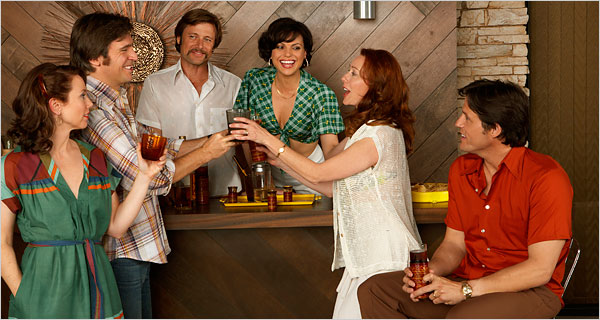
My sister-in-law Vanessa is a writer for this new CBS drama Swingtown, premiering on June 5. Here’s a NY Times article about it.

Family loyalties aside, I’m looking forward to it — some writers and producers from Six Feet Under are involved and it co-stars Molly Parker, who was so good in Deadwood. Here’s a description from the profile:

WHEN the television series “Swingtown” has its premiere on June 5, viewers can expect to see the following scenes in the first episode: a ménage à trois; a high school junior smoking pot and later flirting with her English teacher; the flagrant enjoyment of quaaludes and cocaine; and the sight of the neighborhood scold unwittingly stumbling upon a groaning and slithering orgy. “Why don’t you kick your shoes off, Mom, and join the party?” is how a middle-aged participant, clad only in mutton chops, says hello.

Debauchery, however, is only an appetizer for the main story line: the open marriage of an airline pilot and his wife, who, in pursuit of new partners, set about seducing the businessman and housewife who have just moved in across the street.

Melissa Henson, director of communications and public education for the watchdog group Parents Television Council, comments that “it’s sort of driving a stake through an institution most of us regard as being fundamental to our culture and to our society.” As my brother observed, I guess this assumes that the American family is a vampire. Or a tomato plant, maybe (what else gets a stake driven through it?)

Biodegradable Couches

An amusing lit-crit prof cameo in this article from the NYTimes House & Home session about biodegradable furniture.

In any case, there is something quixotic and poignant about makers of home goods — particularly large home goods, like sofas — advertising their wares for their evanescence.

Their longevity, in the past, has always been part of the thing that gives them value,” said Bill Brown, chairman of the English department at the University of Chicago, best known for his work on “thing theory.”

He explained how the value of a piece of furniture you come in contact with often, like a dining room table or a sofa, draws much of its worth from that contact: the longer we keep it around, the more psychologically valuable it becomes. “We use the ‘object world’ to stabilize human life,” he said. “Hannah Arendt said that sitting at the same table grants man his sameness, which is to say his identity.”

The idea of biodegradable furniture, he said, seemed perverse and comic. “We all live such cluttered lives in which so much of what we have we’d be better off without, yet most of us are better off with our dining room tables or our sofas,” he said. To thing theorists like Mr. Brown, who poses a kind of “my furniture, myself” worldview, degradable home goods suggest an identity crisis.

It would be nice if some of the couches on front porches around town were biodegradable and would eventually melt in the rain. They would probably get really disgusting in the intermediate stage, though.

The plot of one of the greatest British novels, George Eliot’s Middlemarch, revolves in part around the dangerous desire for expensive furniture, by the way. Lydgate “did not mean to think of furniture at present; but whenever he did so it was to be feared that neither biology nor schemes of reform would lift him above the vulgarity of feeling that there would be an incompatibility in his furniture not being of the best” (ch 15).

Eat Your Heart Out Chris Matthews

Hilarious/great talking head commentary on the Democratic race by two five-year-old twins, one a Barack supporter, one in Hillary’s camp. There’s some nuanced discussion of their respective willingness to vote for the other candidate if he or she gets the nomination, etc.

These girls are a bit more politically sophisticated than Celie and Iris, who are Obama supporters but can’t quite seem to get it through their heads that Sarah and I are not also candidates for office.