Teaching Gaffes

I am teaching again after a semester off. Summer Session I. Really enjoying it so far, the students seem motivated and good.

The Chronicle of Higher Ed had a funny discussion thread about Teaching Gaffes. This was the winner, by ‘hegemony’ — something to aspire to:

I brought in a plate of doughnuts for the last class of the term. Laid them out on the plate on the desk, all luscious and sticky and gooey, for the end of class. Then I got so involved in the topic of the class that I sat on the doughnuts.I didn’t realize until I was back at the board, writing, and there were muffled shrieks of laughter from the class.

This was two years ago. The students are still talking about it.

I tried to be very hip and ironic and with-it about the doughnuts on the seat of my pants. Of course I failed utterly. It didn’t help that they were so sticky that I had to go to the bathroom to try to sponge them off, and so then I had sticky doughnut mess plus big wet spots on the back of my pants. It also didn’t help that it was an intensive class, so I actually had to teach several more hours with doughnut leavings on my pants.

Whenever I see one of those students, which is all too often, they say, “Heya! Had any doughnuts lately?” And then they laugh themselves silly.

What’s the Matter With Kansas

This is incredibly condescending but also pretty funny: Kansas as a Burmuda Triangle of dullness and vacuity. “The last known communication from Corcoran was sent from somewhere within the Rectangle, and made reference to plans to marry a large blond woman and enroll in a local technical college.” I remember one holiday party in Cambridge, a year or two after moving to Indiana, when we had the distinct impression that people were racking their brains to remember something about the difference between Indiana, Illinois and Iowa. It was then, perhaps, that I truly started to become Midwestern (as a mode of resentment of/opposition to bi-coastal condescension/ indifference).

I guess since the Onion is Midwestern (at least in origin) it’s OK for them to make jokes like this.

30 Years Of Mans Life Disappear In Mysterious Kansas Rectangle

The Onion

30 Years Of Man’s Life Disappear In Mysterious ‘Kansas Rectangle’

Counting

I enjoyed this Keith Olbermann diatribe about which states & votes “count”, according to the Clintons. “When you boil it all down, only one vote really matters: the 50-something conservative registered Democrat who’s not independent but not part of the base, and skipped college so they could go straight into teaching rather than become a casino worker, who votes on domestic issues but not in a primary or caucus in a big state that doesn’t border Illinois….” etc.

It was exciting to count for once here in Indiana yesterday.

Pets in ‘The Savages’

I was pretty sure I’d like The Savages — Laura Linney as a depressed playwright/temp, Philip Seymour Hoffman as a thwarted, dysfunctional prof endlessly working on a book about Brecht, sibling rivalry, wounded narcissism, what’s not to like? But I liked it even more than I expected. (Maybe I just like movies about Buffalo — I loved Buffalo 66). One bit I especially liked (warning, spoiler ahead) was when Wendy (the Laura Linney character) tells her brother that she’s been awarded a Guggenheim to work on her play. We believe it too (we see her open the letter and gasp) although it seems a bit unlikely; eventually we learn that it was actually a FEMA grant that she applied for on the basis of losing her temp job after 9/11. This says so much so economically about her and their brother-sister relationship: she feels intellectually and creatively unrewarded, and not fully respected by him; she yearns for recognition, praise, support; and it’s fitting, given her sense of being generally traumatized by life, that the grant she does get would not be from the Guggenhein Foundation but the Federal Emergency Management Agency.

There are interesting things going on about animals and pets throughout. When Wendy is having bad sex with her married lover, she looks over at his sweet golden lab (I think) and kind of reaches out to its paw, with the obvious implication that she feels a more genuine connection with the dog than with its owner. She eventually dumps the guy because he neglects and almost kills her plant, and she’s always concerned about her cat Genghis, whom she drags around in a pet carrier. At one point the brother is awakened by a midnight phone call; we assume it’s about their father in the nursing home, but it turns out that it’s the cat that is the problem — Genghis has escaped in their father’s room. In other words, the filmmaker (Tamara Jenkins) plays a little with our sense of who can appropriately fill the position of “object of care.” The father is the primary such object but the role is also filled by a dog, cat, and plant.

The movie ends with a nice touch. The married boyfriend returns to Wendy to try to make up with a bouquet of flowers (after the plant episode). She asks where Marly (his dog) is and he explains that she’s going to be put to sleep tomorrow: her hips are shot, she can’t move around and is horribly depressed, there is an operation they could do but it’s complicated (and presumably expensive). “She’s just old,” he says. With sympathy — the point is not that he’s awful to his dog — but it’s a reminder of the expendibility of every creature: we are all, we’re reminded, in a process of decay, our bodies are falling apart (see the photo of the Seymour Hoffman character above in a neck brace), we’re all a bit like Marly, and look what has to happen to her, “put to sleep” (like the cat, she’s a proxy for the father.) The scene ends with Wendy asking “can I just ask you one favor?” and then it cuts to a year later when her play is being performed. We think, “did she ask him to help her produce her play?”– and then we see her jogging with Marly trotting behind in some kind of elaborate dog wheelchair contraption. She has adopted Marly, the old dog, and offered her the unconditional love and care she never got and always craved from her father, and that she could not herself give him. The impossible wish of the movie has been that the father, or maybe anyone, could get better, not be sick, not decay and fall humiliatingly apart; in these final scenes, Marly gets to fulfill this wish that has been otherwise denied.

Sarah’s MFA show!

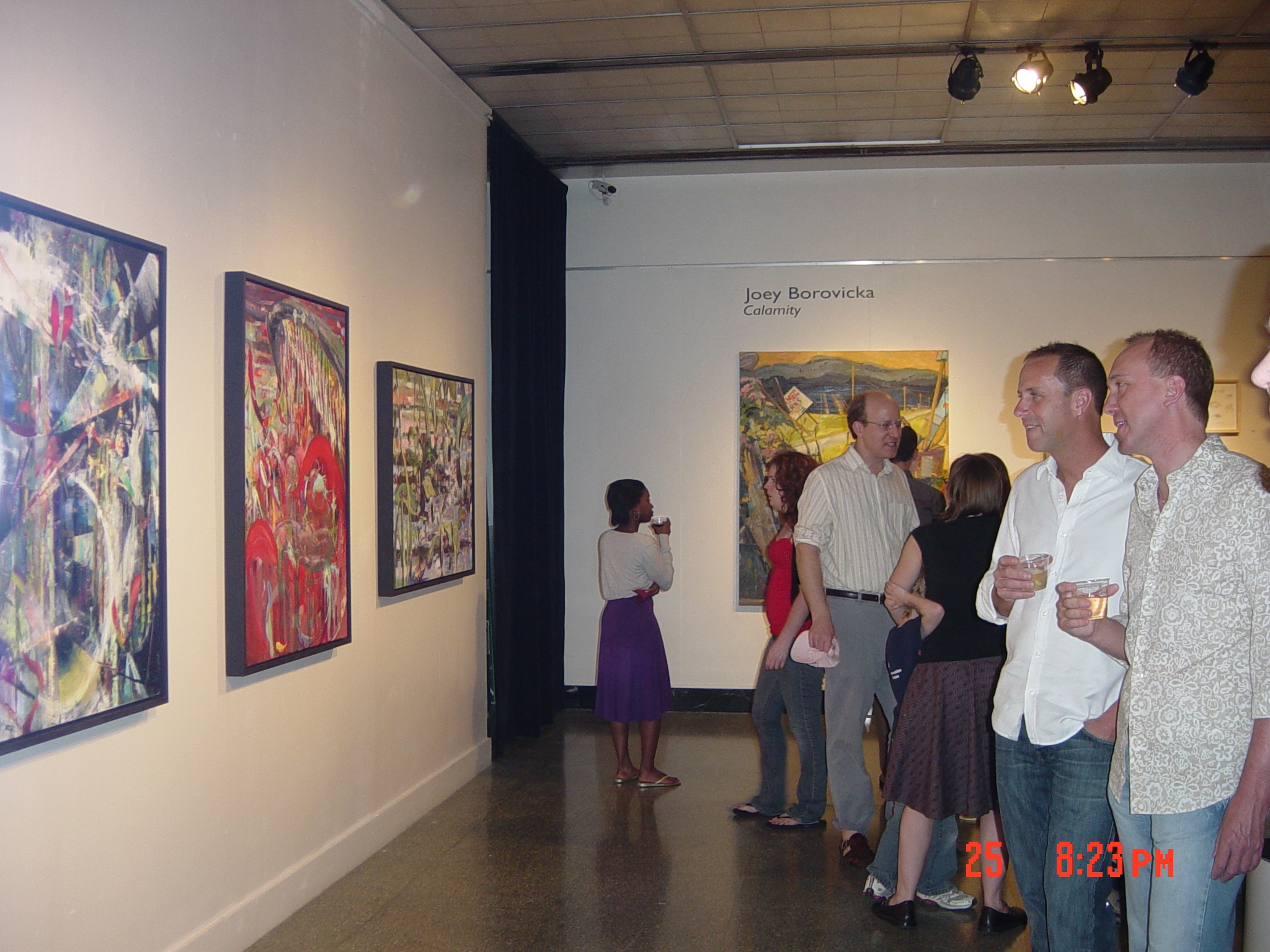
Sarah’s thesis show [not images, just an ad] is up! The reception was on Friday night. She was one of 7 MFA Fine Arts students in the show, along with two photographers, a metal-worker, ceramacist, sculptor.

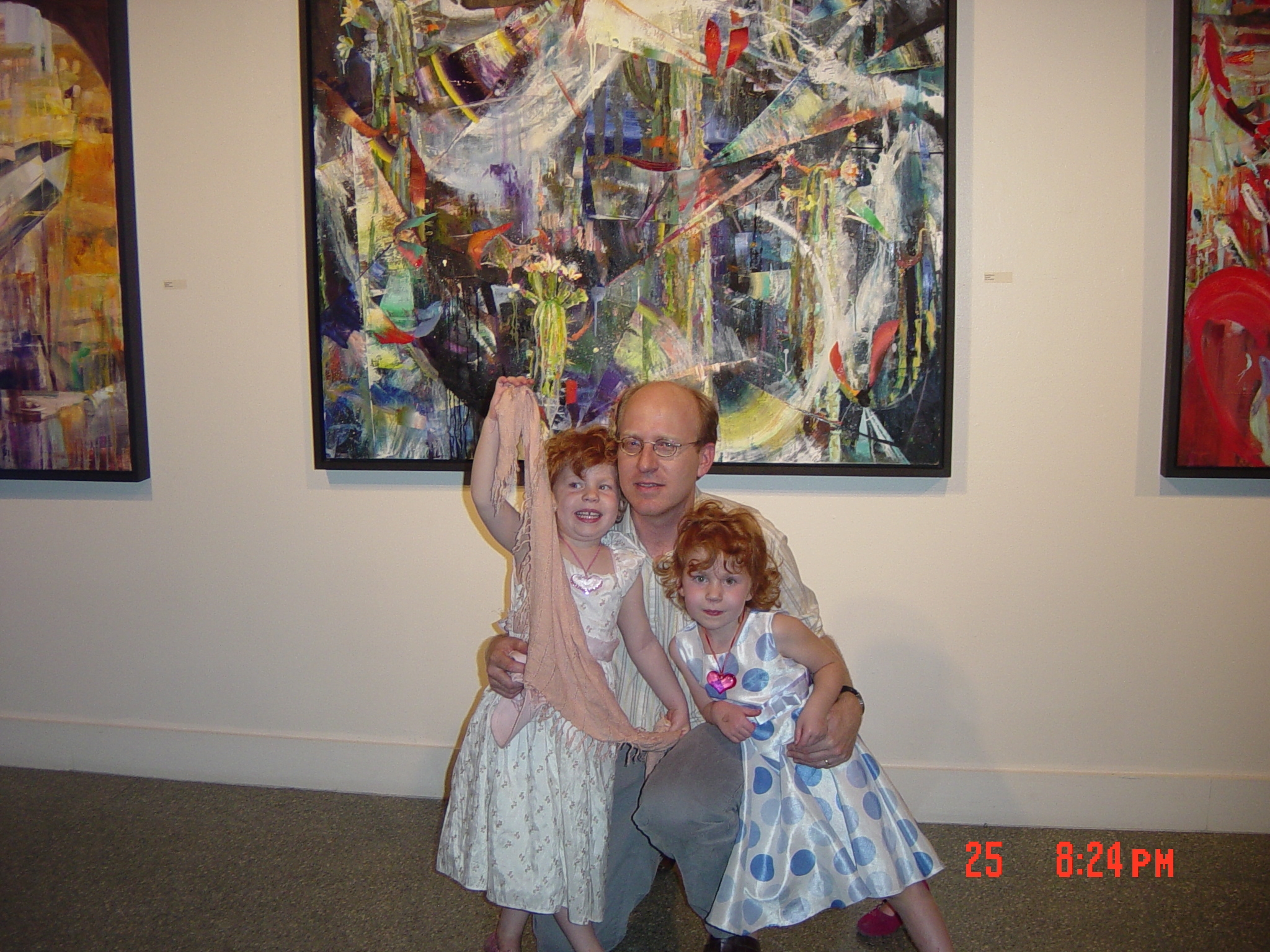
I think her paintings are fantastic — beautiful, strange, complex — and the show seems to be a big hit; she’s been receiving accolades from all sides, and she even sold the most expensive painting on Friday night — “Umwelt,” a.k.a. the bat painting, probably my favorite if I had to choose, so I feel a bit melancholy about its leaving our life so soon — to a complete stranger. The MFA has been long & hard in some respects but it’s now possible to look back and see all the stress, self-doubt, and very hard work as leading to this point and to painting that is (I think) richer and most original than the work she’d been doing previously. So I guess it was worth it.

I’m also proud of her for doing the work she wanted to do, when at times it must have been tempting to change her approach to something closer to the norm within her program (which tends to focus on representational, figure-based painting).

She’s going to put all the images up somewhere, but for now, here are two of the paintings, “Swamp,” one of several more representational paintings of plants and cacti, and “Full Moon Sushi Night,” which is one of a group of three somewhat wilder, more abstract paintings that grapple with the representation of nonhuman experience of time and space.

Here is her artist’s statement:

“How do you paint a living thing – for example, a bat? The lesser long-nosed bat migrates across the Sonoran Desert every year from Mexico to North America. It follows a specific nectar corridor across the burning desert. Columnar cacti like the Saguaro bloom at night, exuding a melon-like scent. Without the sustenance of the nectar from blooming columnar cacti, the bats wouldn’t survive the long trip, and the bat guano fertilizes the cactus. The two creatures are locked into a fragile interdependence resting on delicate timing. The bats use echolocation, not perceptible to human ears. The bat, or any living creature, embodies more times and spaces than my human eyes can perceive.

How do you paint a smell? How do you paint echolocation? – a bat’s, a whale’s? How do you tell the story of any living thing?”

Sarah can be emailed at: sarahp812 AT gmail.com, and the images can be seen at:

http://sarahpearce.blogspot.com/

\

\

Wallace Stegner’s ‘Crossing to Safety’

I just read Wallace Stegner’s novel Crossing to Safety, his last I think, published in 1987 when he was in his late 70s. Sarah read it and was somewhat blown away by its anthropology of certain institutions and icons of WASP New England life, especially the grandmother who’s on the board of the Shady Hill School and ritually reads the grandkids Longfellow’s “Hiawatha” in the lakeside cabin. Sarah experienced this herself, exactly, and found this kind of spooky.

I was surprised by the familiarity of the picture of life in the U. of Wisconsin English department in the late 1930 and early 1940s. All the stress over publication and promotion, the question of whether the department would respect creative work or work outside one’s field, the article on Browning rejected by PMLA. Somehow I thought that was the era of gentleman scholars who didn’t have to worry about such things. The publishing anxiety is more focused on articles than scholarly books, but otherwise the differences are slighter than I would have expected.

It’s a very rich, engrossing and often moving novel; in a way I felt it suffered just a bit from being, or seeming, just one step removed from memoir; at times I felt Stegner’s main goal was to “do justice” to an actual friendship, and that this goal controlled and determined the novel more than it might have if the events had been less closely based on his own life.

I felt a little jealous of the picture of social life among young college professors and their wives in the 1930s: dinner parties with singing, recitation of poetry and parlor games. I imagine my grandparents’ lives in Notre Dame along these lines. Maybe I idealize this as a less mediated life before DVDs and computers (and blogs).

Although speaking of those parties, one odd thing about the novel’s portrait of family life is that the children (one of the families, the Langs, has five) are almost literally absent and invisible until the later part of the book when a couple of them enter as adult characters. Perhaps this is a weakness in the novel’s masculine perspective: it’s so acute on married life and on friendship within marriage, but kind of bizarrely vacant on parenthood and kids.

9 Reasons I love Los Campesinos!

9. Phony World Music name meaning “the peasants” (they are from Cardiff, Wales)

8. Song title: “”This Is How You Spell ‘Hahaha, We Destroyed the Hopes and Dreams of a Generation of Faux-Romantics'”

7. Do justice to illustrious lineage of UK art-school punks (Mekons, Joy Division, Buzzcocks, Art Brut)

6. Simultaneously sound totally sarcastic and totally earnest (“I spent the last seven years perched on the edge of my bed/ Scratching ‘I am incredibly sincere’ into my forearm”)

5. Cover one of my favorite Pavement songs (“Frontwards”), which sounds like a terrible idea, I realize

4. Super-catchy sing-along guitar pop bubbling up with weird musical ideas (glockenspiels, etc.) that occasionally make the songs sound like U.K. holiday-season radio novelty singles

3. Video featuring rainbows, feathers, kittens, and a unicorn

2. Could not be more cute but somehow not twee; acknowledge sexuality, the economy, adult reality generally

1. Great nerd boy/cute girl dynamics (“Four sweaty boys with guitars tell me NOTHING about my life”)

The album on Emusic

Overheard during a viewing of Richard Kelly’s Southland Tales

“Why does he do that thing with his fingers?” [alluding to the Rock’s signature gesture, a nervous twiddling to express nervousness or fear]

“If he twiddles his fingers any more, I’m going to scream.”

“I didn’t realize he was a twin.” “Never mind.”

“That’s the guy from Highlander!”

“Why are the Red Hot Chili Peppers in charge of that ambulance?”

“Watching Wally Shawn french kiss Maggie Chung is upsetting.”

“The fourth dimension is about to collapse… you crazy bitch.” (That was actually in the movie, not something we said.)

I couldn’t watch any more after an hour or so and so turned to the web for some meta-analysis. I liked Roger Ebert’s review: “The dialogue consists largely of statements that are incomprehensible, often delivered with timing that is apparently intended to indicate they are witty. All of the actors seem to have generated back stories for their characters that have nothing to do with one another. Only Wallace Shawn emerges intact, because he so easily can talk like that, but a spit curl does not become him. Justin Timberlake is the narrator, providing what are possibly quasi-rational explanations for movies in other time dimensions…. These people mostly seem to have dressed themselves earlier in the day at a used costume store.”

You do have to give it credit for being completely nuts, though.