Rachel Aviv on compromised or despised people

I’m a fan of the New Yorker Out Loud podcast– that and Slate’s Culture Gabfest have recently moved past Fresh Air as my go-to podcasts for this kind of thing.  I listened to a conversation with author Rachel Aviv about her new piece about the medicalization of pedophilia and child pornography, The Science of Sex Abuse,” as well as “other articles she has written on socially marginalized, compromised, or despised people.”  Her topic in the new piece — organized around the arrest and legal odyssey of a man charged under the 2006 Adam Walsh Child Protection and Safety Act — is the ambiguous legal status of pedophilia, which is sometimes treated as something of a “thought crime”, such that what is criminalized are certain desires as opposed to actually committed acts.  Her tentative conclusion, articulated more explicitly in the podcast interview than in the piece, is that pedophilia may in fact not be a medical condition at all, but simply a crime like any other.  (I actually was not entirely sure I understood why we should not judge sexual desire for children to be a medical disorder.  It seems somewhat inevitable that such desires are going to be understood either as “evil” or as a medical condition, and the latter seems more palatable and manageable for any practical purposes.)

Anyway, this was a rearing-of-the-author-function case in which I suddenly realized that several of Aviv’s pieces had made a big impression on me without my realizing that they were by the same author.  Most recently, “Netherland: Homeless in New York, a young gay woman learns to survive” (Dec. 10 2012), a haunting portrayal of homeless gay teenagers in NYC; and also “God Knows Where I Am: What should happen when patients reject their diagnosis?” (May 30 2011), an investigation into a bipolar, psychotic woman’s death brought on by her own refusal of treatment.

Aviv is great — a mesmerizing narrative storyteller whose pieces always probe deeply into difficult questions about those our society marginalizes or who marginalize themselves.  She’s a 2004 Brown graduate and has also written for N+1, which the New Yorker seems to be treating as their development league lately.

Sounds like she’s working on a book — I’m sure it will make a splash.  Here’s her website with links to articles.

*We Killed*: Elayne Boosler driven crazy by bullshit

I read a lot of We Killed: the Rise of Women in American Comedy (by Yael Kohen) the other day; it’s an oral history and I started reading it in the 1970s or so, skipped the earlier parts of the history about Phyllis Diller, Joan Rivers, et al (I may go back to read that).

One figure I found fascinating in this narrative was a stand-up named Elayne Boosler, who grew up as the child of a Russian acrobat and a Rumanian ballerina in Brooklyn.  I’d never heard of her, although she was quite prominent in the 70s and into the 1980s.  She dated Andy Kaufman and achieved a fair amount of success; she even did a Dry Idea anti-perspirant commercial in what looks to me like 1982 or so:

There are three “nevers” in comedy.  Never follow a better comedian.  Never give a heckler the last word.  And no matter how badly a joke bombs — although it’s never happened to me personally — never let them see you sweat.

She is viewed as a pretty important figure by many of the commentators and she emerges as a slightly tragic or melancholy one in the sense that her career seems emblematic of female comics of this generation: she was super-talented, she did well, but she hit what seems to have been a kind of glass ceiling.  Richard Lewis comments that he always thought of her as “Jackie Robinson of stand-up in my class… There was like, a guy, a guy, a guy, a guy, and ‘Ladies and gentlemen, Elayne Boosler!’ And she would come on and rip up the joint, and I just found it astounding, because she had to overcome so many obstacles.”

As the author explains, one of the most problematic blocks to the advance of female comics in this era was The Tonight Show.  Appearing on the show was one of the crucial routes towards stardom and Johnny Carson admitted outright that he found most female comics “a little aggressive for my taste”; as Kohen comments, “the women who suited Carson’s taste were, for the most part, blond, buxom, and willing to play dumb.”

Someone else (Joanne Astrow) comments, “There are always complex stories.  There’s another side to it.  Elayne Boosler has what I would honestly call anger management problems.  And Elayne has an obsessive craziness about material being stolen from her.”  Then someone (Claudia Lonow) chimes in, “Did she have a chip on her shoulder or was she a creative person who was being driven crazy by bullshit?  That’s what I think.  She was systematically being driven crazy.”

I find this convincing partly because she was obviously so good and there seems no good reason why she would not have broken out in a bigger way (as many of her male peers did) were it not for the endemic structural sexism of the comedy scene of the era.

Check out this hilarious clip about the awkwardness of one-night stands:

And this clip of Boosler appearing on some kind of strange Andy Kaufman special, in which he sits high above her at a giant desk as they bicker about their breakup, is amazing:

Boosler now seems to have become a progressive activist of sorts (writes for the Huffington Post sometimes) and an animal rescue advocate.  I’m sure she’s doing fine but my sense is that she never got her due.

Following a victory lap about Amy Poehler and Tina Fey, the book concludes somewhat depressingly with the recent emergence of a new ideal of model-level hotness for female comedians; notwithstanding occasional exceptions that prove the rule like Melissa McCarthy, it’s pretty clear that nowadays if you don’t look like Chelsea Handler, Whitney Cummings or Natasha Leggero you are likely to get shunted away from performance towards the writers’ room.

Nicholas Ray’s *Bigger Than Life*

biggerthanlife1

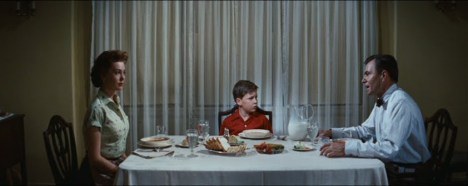
Nicholas Ray’s Bigger than Life (1956) got a fair amount of attention last year as a Criterion Collection DVD/Blueray rerelease.  I finally got around to watching it, and it’s pretty mind-blowingly great.  A must see!

Here’s Criterion’s summary:

Though ignored at the time of its release, Nicholas Ray’s Bigger Than Life is now recognized as one of the great American films of the 1950s. When a friendly, successful suburban teacher and father (James Mason, in one of his most indelible roles) is prescribed cortisone for a painful, possibly fatal affliction, he grows dangerously addicted to the experimental drug, resulting in his transformation into a psychotic and ultimately violent household despot. This Eisenhower-era throat-grabber, shot in expressive CinemaScope, is an excoriating take on the nuclear family. That it came in the day of Father Knows Best makes it all the more shocking—and wildly entertaining.

As is typical for Criterion, it’s a great package including a neat interview with Jonathan Lethem who subjects the movie to an obsessive & smart close reading.  I was pleased with myself because as we watched it I kept muttering to Sarah about The Invasion of the Body Snatchers and The Incredible Shrinking Man (the latter of which we watched with the kids recently) — the movie includes a fascinating subtext about masculinity and size, whether one is impressively large or diminished, “shrunken” — and Lethem mentioned both movies.  (I actually wondered if he’s working on a project about 1950s Hollywood films or something as the commentary was especially thorough.  Here’s an interview with Lethem about the film.) There’s also a 1977 public television interview with Ray that’s actually not so thrilling but which I nevertheless enjoyed watching (partly for the amusing PBS aesthetics).

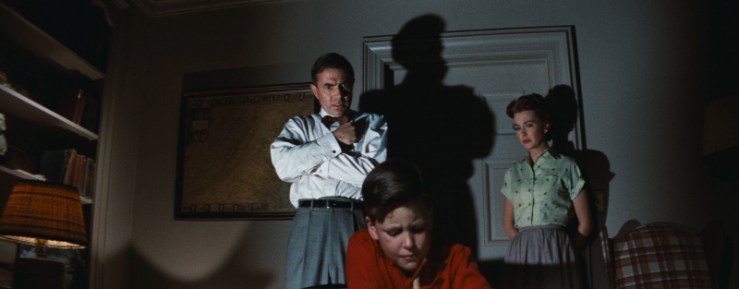
Here’s a screenshot from an amazing scene as Mason has turned into a terrifyingly menacing tyrant of a father, his shadow looming up behind him like a goblin (Lethem suggests that this shadow brings to mind James Brown or Elvis Presley and so invokes the 50s mass/pop culture that is otherwise seemingly absent from the film):

bigger_than_life_2

Sean Axmaker observes in Parallax View that as Mason becomes addicted to the cortisone prescribed to him for his mysterious affliction, he becomes

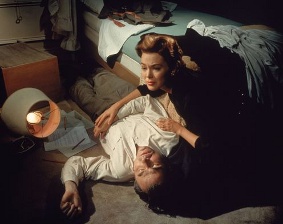
like a literal monster in the home, often dominating his family from on high on the stairs or looking down from the second floor. Ray, a master of widescreen film-making, beautifully isolates and distances characters in the horizontal frame while Mason progressively dominates the screen, finally physically looming from above. Yet the film’s most resonant image may be his midnight crying fit, curled up in the den and sobbing to himself, a scene that evokes depression, fear, shame and his complete helplessness in a situation out of his control. This isn’t some stoic show of emotion but a complete breakdown at the mercy of runaway emotions that he can’t contain or even process, and this scene of male vulnerability is almost unique in its era, as brave and bracing a confession you’ll see in American cinema.

bigger-than-life

In plot description, the movie could sound cheesy and like some kind of “disease of the week” message film — it was apparently based on a New Yorker article about prescription drug abuse — but it is deeply weird, resonant, and gorgeous, as good as All That Heaven Allows or Invasion of the Body Snatchers (to name two films from the same year or so)– we both loved it.  Made me muse about the possibility of a class about out-of-control/ in-crisis masculinity — I’d definitely recommend using it in that context.

Next on our list of Ray films, Bogart in In A Lonely Place (which I’ve seen but a while ago) and They Live by Night (never seen).

Todd Solondz and *Dark Horse* @ IU Cinema

427819_427278913986886_877429312_n

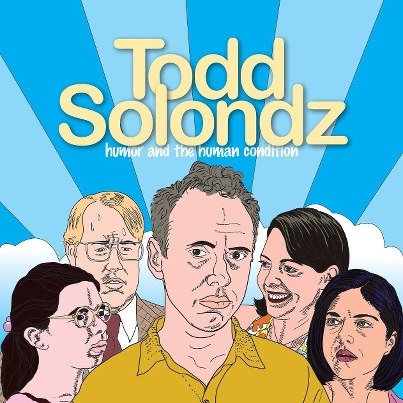
IU Cinema continued its mind-boggling (and seemingly endless?) series of visits by world-class film directors with an appearance by Todd Solondz (director of Happiness, Welcome to the Doll House, Palindromes) this week.  I missed the afternoon interview, but we made it to the evening showing of his most recent film Dark Horse followed by a Q&A by Solondz.

Solondz is a little older than I’d thought (53) — turns out he was 36 when his breakthrough film Welcome to the Doll House was released.  He grew up in New Jersey (and has an almost Gilbert Gottfried-esque accent), raised non-observant Jewish, but attended a Yeshiva school for a while as a kid, and then attended Yale as an undergrad.  He was very engaging in the Q&A, thoughtful and generous in his responses.

A few observations/facts-

  • I had been planning to ask him about the Seinfeld references in Dark Horse, but someone else beat me to it and Solondz confirmed that he viewed the film’s protagonist, Abe, as a “tragic George Constanza” figure.  Abe is a Long Island Jewish schlub in his mid-30s who lives with his parents, played by Mia Farrow and Christopher Walken (!), who are continually watching Seinfeld reruns when Abe sullenly walks past them to his childhood bedroom.  Fascinating fact: Sonoldz said that rights to any Seinfeld clips were totally unaffordable, and so Jerry Stiller and Estelle Harris (who play George Costanza’s parents) agreed to come in and record some new dialogue for Solondz.  It had actually occurred to me that none of the dialogue rang a bell at all, but I’d assumed it was from episodes I’d missed or forgotten.
  • Along similar lines, the scenes in Toys R Us were actually filmed in a Latin American alternate-universe big box store in, I think it was, the Dominican Republic.  In an early scene, Abe marches into the store in high dudgeon to return a superhero toy that he says he discovered was scratched once he opened the package.  (As part of his man-child schlub identity, he collects toys.)  We see him in the parking lot with the letters of the big recognizable “Toys R Us” sign obscured but almost-visible on screen, which struck me immediately as a reference or else simply a parallel to the famous censored sex scene in Storytelling which Solondz released with a large red square blocking out the scene.  Someone asked him about the sign and he said that, as with Seinfeld, they couldn’t afford or secure the rights to Toys R Us, which created a serious problem for the movie, since there was no practical way to create a duplicate non-proprietary version of the store. Finally through a Latin American contact they learned about this store in the Dominican Republic that would allow them to shoot there.
  • And along similar lines once again, the movie has a very funny soundtrack that sounds like recent teen-pop/ top-40/ American Idol-esque songs that you can’t quite place; it turns out that they are all in effect would-be imitation American Idol-top 40 songs by unknown singers that Solondz found on demo tapes or something.  As with the fake Seinfeld dialogue and the Dominican Toys R Us, this can be understood at once as thrifty/resourceful film-making, making a virtue of necessity, and also a slightly-disconcerting construction of a phony/imitation/shadow version of mainstream American entertainment reality.  That is, in all these instances, the mainstream or recognizable “successful” pop culture item is at once cited and referenced and also effaced, like the Toys R Us sign.  It creates something like a “under erasure” effect, e.g. Toys R Us.
  • Abe returning, or trying to return, the toy to Toys R Us is a running joke/thread throughout the movie– the motif recurs at the movie’s end when Abe, having come out of a two-months long coma, asks his girlfriend/fiance Miranda to take the receipt to return the toy.  I’d recently listened to some of a recent Mark Moran interview podcast in which Solondz observes that each one of his movies has “done about half the box office of the one before it,” with Welcome to the Dollhouse (1995) the commercial peak ($4,569,019) and Dark Horse (2011) the low ($166,000 according to Box Office Mojo, e.g. almost unwatched).  Having that comment in mind, the movie struck as as somewhat obsessed with its own status as a failed, low-performing, or unwanted commodity.  The film’s phony Toys R Us looks very much like a generic mall cineplex theater– which of course is simply reality: you go to the mall and walk into the same kind of ugly big-box structure whether you want to buy a Barbie or go see the new Transformers movie, or buy that movie as a DVD.  Abe has the collected Simpsons DVD collection on a shelf in his bedroom; Dark Horse struck me as clearly thinking about how it, or any “small”/independent movie, fits into this world in which a film is primarily valued according to its marketability as a consumable commodity or a monetizable income stream.  Is Dark Horse the equivalent of a defective toy that a consumer does not want?  Or, more positively, is it more like a prestigious niche-market item, one of those that Abe shops for on EBay, not for the mass consumer but desired by a more specialized audience?  I asked Solondz about this in the Q&A, and although he said he hadn’t been thinking of this theme in the Toys R Us scene — he wasn’t “going meta” intentionally — he then riffed interestingly for a bit about his thoughts about the commodification of films; he mentioned that he was old enough to have grown up before the proliferation of VCRs and DVDs and that he still to this day “does not watch DVDs for fun” (which struck me as surprising for a filmmaker).

I recommend Dark Horse; I started to feel a little impatient with it in its first half, when it feels like a more conventional, albeit ironic, take on the Apatow “man-child” film genre, but then the movie goes off in various weird, less-realist (almost Mulholland Drive-esque) directions that make it much more interesting than it seems at first.  Donna Murphy is brilliant as the dual-faceted Marie, who is alternately/either the frumpy secretary-administrator at the office where Abe works, or a vampy seductress/cougar.

The Coup, “Your Parents’ Cocaine”

Excellent depraved-muppets video to the Coup’s kazoo-driven “Your Parents’ Cocaine”:

The valet pointed me through the door
One more shot and you’re on the floor
If cash talks, yours is a lion’s roar
Ghesquière, Christian Dior
You’re the asshole ambassador
But your friends obey like Labradors
I vomited on the alpine décor
It’s okay, your daddy gon’ buy some more

Your daddy’s got a business
Which made wars in Afghanistan
It bought your house in Bangkok and
Your parents’ cocaine!

[lyrics thanks to Rap Genius]

Tinariwen in the Quiet Room

And so the volume has incrementally risen, the imbecilic din encroaching on one place after another — mass transit, waiting rooms, theaters, museums, the library — until this last bastion of civility and calm, the Quiet Car, has become the battlefield where we quiet ones, our backs forced to the wall, finally hold our ground. The Quiet Car is the Thermopylae, the Masada, the Fort McHenry of quiet — which is why the regulars are so quick with prepared reproaches, more than ready to make a Whole Big Thing out of it, and why, when the outsiders invariably sit down and start in with their autonomic blather, they often find themselves surrounded by a shockingly hostile mob of professors, old ladies and four-eyes who look ready to take it outside. – “The Quiet Ones,” Tim Kreider, NYT 11/18

I enjoyed this piece about the Quiet Car on the Amtrak NYC-to-Boston train; it reminded me of a recent encounter I had in the public library’s Quiet Room.

I was working there the other day in the company of a few other “professors, old ladies and four-eyes” (I occupying at least two of those three categories, perhaps more in spirit) also scattered around reading & writing. A cell phone went off loudly– the owner turned it off right away and ran out of the room to answer it. That’s the Quiet Room protocol, and you will get seriously glared at if you play it any other way. It’s considered slightly bad form for the phone to go off in the first place, but as long as you answer in a choked whisper on your way out of the Quiet Room, it’s OK.  (Answering it and having a quick sotto voce conversation in the room itself: definitely frowned upon.)

In any case, the guy’s ringtone played for a second or two, and although I couldn’t place it at first, I knew I recognized the song.  I thought for a minute trying to remember and then it hit me.  The guy, whom I thought might be Hispanic, came back and started clearing his things away.  I went up to him and in an apologetic Quiet-Room whisper said, “excuse me… your ringtone…” (I could tell he was worried I’d scold him for Q.R. protocol-violation…) “Was that Tinariwen?”

It took him a second to understand what I was saying, but then he beamed a mile wide.  We whispered about Tinariwen, the fantastic Malian “desert blues” group formed in a Libyan refugee camp, for long enough to risk some glares.  It turned out that this guy is himself Toureg, of the same Berber Saharan ethnic group as the band members.  He saw them in Chicago once and we agreed that it would be great if they could make it to Bloomington.

On his way out he turned back to me and said, “Very good!” with an impressed grin. I did think it was a pretty damn good I.D.

It was this song, “Imidiwan Winakalin”: amazing, with an eternal, hypnotic bass line and ullulations:

If you don’t know them, Aman Iman (Water is Life) was their breakthrough album from 2007 and is the one I first got really into.  They won a World Music Grammy for 2011’s Tassili, which does sound good, but not as intense as Aman Iman.

Occasionally even the Quiet Room benefits from a little noise.

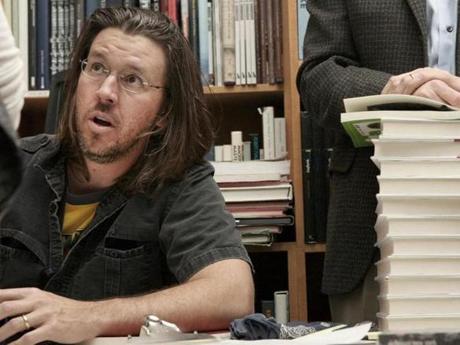
D.T. Max’s Life of David Foster Wallace

I just finished the recent biography of David Foster Wallace by D.T. Max, Every Love Story is a Ghost Story (come to think of it, I don’t know where that title comes from — can’t remember it appearing in any of Wallace’s work or in any other context).  It’s very good: there’s a blurb on the back by Dave Eggers that says “we should be grateful that this story was told by someone as talented and responsible as D.T. Max” and that seems true; it’s an inherently sensationalistic tale in a lot of ways and it would have been very easy for a biographer to tip it in a more voyeuristic direction.

Speaking of which, I have to cite the craziest moment in the book, about DFW’s tumultuous relationship with the married Mary Karr.  (I think I remember seeing some coverage of this when the book came out earlier this year.)  It’s like something out of Elmore Leonard.

One day in February [1992], he thought briefly of committing murder for her.  He called an ex-con he knew through his recovery program and tried to buy a gun.  He had decided he would wait no longer for Karr to leave her husband; he planned to shoot him instead when he came into Cambridge to pick up the family dog.  The ex-con called Larson, the head of Granada House, who told Karr.  Wallace himself never showed up for the handover and this ended what he would call in a letter of apology “one of the scariest days of my life.”  He wrote Larson in explanation, “I now know what obsession can make people capable of” — then added in longhand after — “at least of wanting to do.”  To Karr at the time he insisted that the whole episode was an invention of the ex-con and she believed him.

He was in and out of psychiatric hospitals for chronic depression, and he often behaved pretty oddly, but there’s nothing else quite like this. He got a tattoo of “Mary” on his arm– which is a pretty intense thing to do in re: a married lover (although maybe they were briefly an acknowledged couple at this point, I forget).  Later when he got married, he “had a strikeout drawn through the fading word ‘Mary’ on his tattoo and placed and asterisk under the heart symbol; further down he added another asterisk and ‘Karen,’ turning his arm into a living footnote.”  Too perfect!

One part I found especially sad has to do with DFW’s reaction to winning a MacArthur “genius” award.

…He was ‘paralyzed’ by fear of failure. He worried that whatever ‘magic’ or ‘genius’ people said they’d seen in his last two books would not be in evidence.  He would, he worried, be ‘obliterated or something (I say ‘obliterated’ because the fear most closely resembles some kind of fear of death or annihilation, the kind of fear that strikes one on the High Dive or if one has to walk a high tightrope or something).’  He was now frozen by his own need to be the person others saw him as.  They could let go of it more easily than he could.  And since the success of Infinite Jest the problem had gotten worse, so that he feared the ‘slightest mistake or miscue’ would knock the statue down.  The prospect terrified him…

I found fascinating the ways DFW’s chronic depression, addiction, and history of frequent hospitalization (for both) functioned as a kind of purloined-letter-style concealed absence in his work and biography.  In retrospect, it seems amazing that everyone didn’t catch on about this, but Wallace and his editors and friends provided various kinds of cover stories.  And perhaps he seemed so erudite & brilliant that people couldn’t quite imagine that he had in fact spent long stretches in the kinds of no-frills addiction treatment centers he describes in Infinite Jest.  So for example, after the publication of that novel, Frank Bruni wrote about him for the New York Times Magazine and the journalist “went along to a dinner at the home of a couple named Erin and Doug Poag.  They ate Kentucky Fried Chicken and heroes on trays and watched The X-Files… Wallace did not mention that his connection to the Poags was from his recovery circle — he claimed to have met them at a ‘Mennonite church.’  And, understandably, without that information, Bruni was left with the impression that Wallace’s fondness for ordinary Midwestern people might be a put-on.”

Max can be critical of DFW, as for example in his comment about Wallace’s famous 2005 Kenyon College commencement speech: “Over the past 25 years his mental life had run a huge circuit through the most astonishing complexities to arrive at what many six-year-olds and nearly all churchgoers already understood.”  Although actually Max evinces a lot of sympathy for DFW’s personal journey through heights of high-philosophical braininess, post-modernist fictional experimentation, sexual promiscuity (“Other than the classroom, his favored venue for meeting women was St Matt’s, the church in whose rectory his recovery group met”), and then eventually to a kind of serious earnestness and monogamy.  (Btw Jonathan Franzen was a big influence on him in this regard — Franzen was his most important long-term peer/ friend/ competitor/ correspondent).

Of course, the writing never stopped being extremely thorny, dense, and weird.

I now am finally going to read The Pale King!

p.s.  I mentioned the DFW story “The Depressed Person” here a year or two ago.  My take on it at that point was that the irony in retrospect — in relation to how angry the story made some readers for its seemingly cruel depiction of a depressed person — was that that person obviously was Wallace.  Max asserts that it’s in fact a depiction of Elizabeth Wurtzel, whom he was pissed off at for sexually rejecting him.  I actually don’t quite buy this…

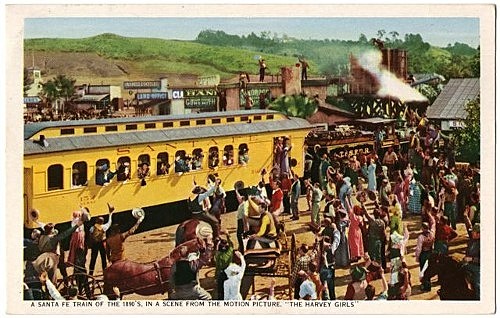
*The Harvey Girls*: “The Train Must be Fed”


The girls and I watched the wonderful The Harvey Girls (1946) with Judy Garland this weekend.  The plot is so silly and nonsensical that it made me think of something like The Umbrella of Cherbourg.

Judy Garland shows up by train in Sante Fe from Ohio to marry a man with whom she’s been engaged in an epistolary romance.  Turns out it was a Cyrano de Bergerac situation and the prospective hubby is a wizened old hick… who for some reason, after glimpsing the lovely Judy G., begs her to let him off the hook (I think the idea was that he knows he’s a terrible reprobate alcoholic and so will not make a good husband).  The letters were in fact written by Ned Trent, the owner of the local saloon.

It’s a battle for the soul of Sante Fe.  Ned Trent’s Alhambra saloon, featuring the primary colors-wearing dancing (bad) girls, led by the throaty seductress Angela Lansbury (!), vs. the Harvey House, an upscale, classy, family place featuring the pastel-color-wearing (good) Harvey Girls.  Any number of hijinks ensue such as, for example, the Alhambra girls stealing all the Harveys’ steaks and chops, leading Garland’s character to hold up the Alhambra with two six-shooters to reclaim all the raw meat.

I was glad to find this clip of perhaps my favorite song & routine, “The Train Must be Fed.”  There’s a bit of a Cheaper by the Dozen, mid-century time & efficiency management feel to this one.

The Harvey system, I must say, primarily pertains
To the absolute perfection in the way we feed the trains
Perfection in the dining room, perfection in the dorm
We even want perfection in the Harvey uniform
The apron must be spotless and must have the proper swirl
That’s the first requirement of a Harvey Girl!

“Please confine your underwear to camisole and rumor”!

Joyce Carol Oates’ *Blonde*

I emerged blinking and slightly dazed the other day from Joyce Carol Oates’ big novel based on Marilyn Monroe’s life, Blonde.   I got the idea to read it from the recent interview with Oates in the Times Book Review in which she comments,

I can say that the novel that exhausted me the most, wrung my emotions the most and left me determined never again to write a thousand-page novel with a sympathetic protagonist who must die on the last page is “Blonde,” imagined as a tragic-epic of the life of Norma Jeane Baker/“Marilyn Monroe.”

My edition was 738 pages, but it actually went pretty quickly for such a doorstop.  I’ve never been all that fascinated by Monroe, and didn’t know the details of her biography all that well beyond the broad strokes; not sure if that was an advantage or the opposite for reading this.  I’ve also only seen a few of her best-known movies e.g. (of course) Some Like it Hot, and the novel makes you see that movie a bit differently.  I did constantly find myself wondering to what degree various details were accurate, based on reality, or simply made up.  For example, for a long stretch in the novel “Monroe” maintains a kind of menage a trois relationship with the embittered sons of Charlie Chaplin and Edward G. Robinson, which is treated as a hugely important relationship for her, but as far as I can tell this is all in the category of unverified rumor.  I would have liked an annotated version of this novel with footnotes explaining what Oates is doing with the known facts and how she’s entering into Marilynology and engaging with the mythologies.  (Oates depiction of Marilyn’s death is pretty bold, for example, and could fall into the category of conspiracy theory.)

Marilyn with Arthur Miller, 1960 © Bruce Davidson/Magnum Photos

The novel sometimes brings to mind Nathaniel West and Bruce Wagner in its mostly nightmarish depiction of Hollywood and of Marilyn/Norma Jeane’s exploitation.  Even to call her Marilyn can feel like participation in that exploitation — she never liked the name and, in the novel, never really accepts it as her own.  The original reviewer in the Times back in 2000, Laura Miller, claimed that “‘Blonde,” although sometimes sloppy and sentimental, is perhaps the most ferocious fictional treatise ever written on the uninhabitable grotesqueness of femininity.”  That’s a pretty strong claim, but I don’t think it’s absolutely over-the-top. Oates’ Norma/Marilyn is a bottomlessly needy creature shaped and deformed by her desirability.  “Men’s eyes.  The hawk plunging its beak into the songbird’s breast.”  She is transformed and vivified and also destroyed by the camera.  Oates depicts her as seemingly in a “panic-fugue state” half the time, fundamentally bewildered by her own effects on men and viewers.  Watching herself in The Seven Year Itch: “maybe she’d been exhausted by melancholy, a combination of Nembutal and champagne and the strain of the divorce, and she’d seen the giant Technicolor screen in a haze as if underwater hearing laughter around her buzzing in her ears and she’d had to fight sleep in her gorgeous stitched-in body in a strapless evening gown so tight in the bust she could barely breathe, her brain deprived of oxygen, and her eyes glazing over inside the ceramic Marilyn mask her makeup man Whitey had sculpted over her sick sallow skin and bruised soul.”  I guess that sentence also typifies the rather hysterical pitch of the incantatory prose, which is often “too much” for sure, but generally in ways that fit the subject.

Another somewhat exemplary passage (not that the entire book is so horrific) that reminds me of Ellroy’s My Dark Places: “These killings in Los Angeles County, there’d been another one last month, a ‘red-haired model’ the papers described her, only seventeen years old.  Sometimes the murderer buried the girl in a ‘shallow grave’ and rain washed the sandy soil away to expose the body, or what remained of the body.  But no harm had ever come to Norma Jeane.  Each of the eight or nine or ten raped-and-mutilated girls was known to her, or might have been known to her, sister starlets at the Studio… yet were not ever her.  What did that mean?  That she was destined for a longer life?  A life beyond the age of thirty and a life beyond Marilyn?”

The novel does also, however, tap into Monroe’s occasional joy in performance and what Oates presents as the genius of that performance.  You feel that Oates loves her hapless and very sad protagonist– who could also be very funny, loving and insightful.  (Well, “hapless” may not be the word if it means luckless; Norma Jeane had the kind of incredibly good luck that turns out to be bad luck, I suppose.)  You really find yourself rooting for Norma Jeane, this girl from the L.A. orphanage with a completely crazy and abusive mother, to make it, to get to a place where she could achieve some sense of self-control and autonomy.  (Needless to say she does not quite get there.)

Marilyn reading Ulysses, 1955, © Eve Arnold/Magnum Photos