Netherland

So, about 4/5 of the way through The Savage Detectives I dropped it (do plan to go back to finish) for Joseph O’Neill’s Netherland, which is kind of the polar opposite of Bolano: where The Savage Detectives is sprawling, wild, passionately raw, and multi-voiced, every small chapter introducing a brand new speaker, sometimes, with his or her own worldview, cadence, & set of references — reminding me of On the Road more than anything — Netherland is a classically realist novel with everything focalized through the precise lens of its almost fussy central consciousness.  O’Neill’s protagonist, Hans van der Broek, is a Dutch banker living in NYC with his British wife and son.  After 9/11 the marriage founders and his wife takes the son back to London on a trial separation, and Hans in his loneliness and disorientation gets involved in a cricket-playing outer-boroughs subculture in which he is usually the only white man.

The novel revolves around Hans’s friendship with Chuck Ramkissoon, a Trinidadian cricket enthusiast and would-be entrepreneur who adds a jolt of ethnic striver/hustler energy to Hans’s rarefied life.  (When Hans drives around Brooklyn with Chuck, who is supposedly assisting him in getting his U.S. driver’s license, I thought of the car service in Jonathan Lethem’s Motherless Brooklyn).  Hans’s comment about his wife — “She has accused me of exoticizing Chuck Ramkissoon,… of perpetuating a white man’s infantilizing elevation of a black man” — serves as a tacit admission that the novel could almost be accused of (a very subtle version of) the same thing, in that Chuck brings a kind of “life” and vitality to an otherwise pallid elite white world.  (The novel made me think of Louis Begley, too, in the glimpse it offers into the higher reaches of NYC professional life.)  But cricket functions in this 9/11 novel as a hopeful model of polyglot globalization.  Cricket is loaded with colonialist legacies, but for both Hans and Chuck, the sport is all about form, ritual, skill, memory, and beauty:

the white-clad ring of infielders, swanning figures on the vast oval, again and again converse in unison toward the batsman and again and again scatter back to their starting points, a repetition of pulmonary rhythm, as if the field breathed through its luminous visitors.

Netherland made me want to go back to CLR James’s Beyond a Boundary.  I still really do not understand how cricket works.
Mother on Fire: A True Motherf%#$@ Story About Parenting!

Sarah and I have been reading Sandra Tsing Loh’s Mother on Fire: A True Motherf%#$@ Story About Parenting!— sort of stealing it back and forth from one another. It’s actually laugh out loud funny (and it takes a lot to make this grumpy old man laugh OL as opposed to just doing a sort of Cheney lip-curl of mild amusement). Sandra Loh is an NPR commentator and comic/performance artist (she does one-woman-shows); the book is partly a memoir about how she became a public-school parental activist in L.A.  It’s really smart and biting about parenting and especially the insanities of parental competitiveness, gifted-children mania, and private school admissions craziness.

The “motherf%#$@” in the subtitle is less gratuitous than it may seem in that part of the plot of the memoir involves her getting fired from her gig at the L.A. NPR station for the inadvertent use of an obscenity, which ends up temporarily turning her into a cause celebre.  (Coincidentally, this happened to me too — I was suspended from my college radio station for one week in a crackdown when I read something from the back of a New Jersey punk band’s record cover that contained a curse. Unaccountably, though, I did not become a first amendment hero on campus for this brave act.)

One moment I love occurs when she is bitterly regretting the quasi-bohemian life she and her husband Mike have lived in L.A. with no attention paid to property values and school districts:

And look at this house we bought.  What were we thinking?  It seemed so charming, this thirteen-hundred-square-foot 1926 Spanish-style bungalow.  We were the sort of wide-eyed, barefoot, idealistic, Joni Mitchell-style bohemians who were so amazed we could buy a structure that we bought it without FIRST VETTING THE NEIGHBORHOOD.  Our method of buying a house?  Look at that sunshine!  Look at that cactus!  So pretty!  Pretty cactus!  Pretty, pretty cactus!  Idiots!… We paid little attention as to whether we were doing the smart thing — moving to a good school district, next to lawyers or bankers or periodontal surgeons.  Idiots, we would have insisted on NOT living next to such bourgeois sellouts!  Oh, how we laughed and partied on this sagging deck, with its Chinese paper lanterns and Miles Davis records and Two Buck Chuck from Trader Joe’s.

Another hilarious recurring theme has to do with her dismayed realization that while certain friends’ children were preparing for private school exams with Baby Einstein and “kinderjazzbastics,” her own kids were engaged in random activities with no educational value:

I notice that there is quite a bit of pointless dancing around in underwear in this house, to wild keenings of jazz.  There is much fussy making of messy blanket nests in discarded cardboard boxes.  There is much random shampooing of bears.

Sarah and I keep chucking about the shampooing of bears.  So true!

In the end the book is also inspiring in its call for upper-middle-class parents to rethink their reflexive phobia of urban public schools. Here’s an interesting interview with Loh in Salon.com.

Maine: Reading

My pleasure reading in Maine was mostly occupied by Thomas Mann’s The Magic Mountain, the James Woods translation. I’d never read it, and I like to read a long thick novel in Maine — although the situation is prety different now as a parent of young kids, so I don’t have the endless uninterrupted hours that I used to read War and Peace and Middlemarch in high school. And the Mother West Wind and Freddy the Pig books when younger.

Anyway, I enjoyed it a lot and made my way through it off and on, and then a few nights before we left, I put it down on the front porch with 50 or so pages to go and went off on an outing. While we were away, it rained, and the book got soaked. I tried to dry it in the sun and made some progress, but it was still fairly damp when we left. Finally last night on getting back to Cambridge I used a combination of the microwave and a hair dryer on it. On Matt’s suggestion I tore off the last 75 pages of the book and concentrated on that piece, managing to dry it pretty well.

It’s a good holiday reading book, in a way: sort of about an endless vacation, unbroken leisure to the point of maddening tedium. At this point what may stick most in my mind is the scene where Hans Castorp (why is he always referred to by his full name?) goes skiing and gets lost in a snowstorm. Also his rival in love the amazing Mynheer Peepercorn. And the takings of one’s temperature several times a day and wrapping oneself up in a camel’s-hair sleeping bag for afternoon rest.  And the philosophical musings on time.  It is a strange book and often pretty hilarious. I’d like to read some criticism on the novel — I suppose it must be an allegory of pre-WWI Europe to some degree.

Also have read 2/3 or Orhan Pamuk’s Snow. Turned my attention to that as I waited for Thomas Mann to dry out. Also a strange and funny book with memorable snow as Ka the poet wanders around Kors during a military coup. I also want to read Pamuk’s nonfiction book about Istanbul.

Kathryn Davis’s The Thin Place

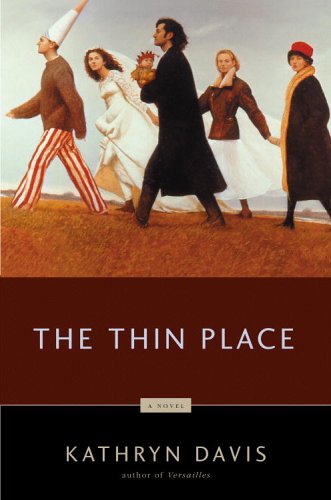
Kathryn Davis’s The Thin Place is a really unusual, enchanting novel. “Everyone prefers to stick with the subject of people” but this novel opens up the characterological range to include several dogs, moose, beavers, a pike, tadpoles, and even lichen. As well as old people, children, and a more usual range of human persons. It has a Virginia Woolf quality in its roving free-indirect-discourse that slips easily in and out of multiple consciousnesses and voices. “So many things are alive: lichen, moss, grass. Also people. So many people are alive and that’s what’s strange, not that things like stones aren’t.” Also, a range of written modes and forms including police logs, newspaper reports, a diary, an astrological report; and working within various time frames and registers including the present day, the late nineteenth century, and the geological or evolutionary time of glaciers and rock. The surprising thing is, though, that the novel does not feel contrived or very “experimental;” it’s involving and funny in its depiction of a New England town during a summer with some odd things happening; you could almost imagine it as an Oprah pick. Maybe it was Davis’s half-hearted attempt at selling out and writing a popular book — if so, I hope it worked.

It’s especially good on “the minds of twelve year-old girls,” filled with “human sacrifices, cockeyed sexual adventures both sadistic and masochistic, also kitties with balls of yarn… and disembowelings.”

Richard Price’s Samaritan

Richard Price is the author of Clockers and has also written film scripts (e.g. The Color of Money) and episodes for the Wire. I was going to check out his much-praised new one, Lush Life, but in the NY Review of Books Michael Chabon said that it was a slight let-down after Samaritan (which he calls one of Price’s two masterpieces along with Clockers), so I decided to start there. It has a mystery plot, with an unsolved crime and a policewoman looking into it: the sometime t.v. writer, former cokehead cab-driver Ray Mitchell lies in a hospital bed, floating in and out of consciousness. When he’s conscious, he won’t say who bashed in his head, although he seems to have at least some idea. The plot develops in two temporal strands, one leading to the act of violence, the other one a couple months later following the investigation, mostly at the hands of Nerese Ammons, a pudgy African-American cop who used to go to school in a tough neighborhood in New Jersey with Ray (who is white).

I won’t explain the plot in detail, but the novel plays out its epigraph: ”When thou doest thine alms, do not sound a trumpet before thee, as the hypocrites do in the synagogues and in the streets, that they may have glory of men.” It’s all about white guilt, privilege and shame in the face of the lack of opportunity, violence, and hopelessness in the inner city. (Although note that one of the quotations below questions how fundamental race is to the dynamic.) Ray has a few hundred thousand dollars left over from a stint writing for a t.v. show about an inner-city highschool much like the one he attended. The story begins with Ray’s impulsive act of generosity in giving an old neighborhood acquaintance several thousand dollars to pay for the funeral of her son, an O.D. From there we begin to realize that Ray has a compulsion to be a samaritan, to give away money, to try to help the needy people around him, and that this compulsion has all kinds of unresolved baggage, about which he is only partly self-aware. I saw that Michiko Kakutani criticized the novel as overly-schematic and insistent in this theme, but I found it compelling, Ray’s out-of-control desire to use his wealth to “console” and heal and to absolve him of all kinds of guilt and bad feeling with origins that are both personal/ psychological and sociological/structural. And perhaps to get “glory” for his “alms.” I’d guess that there’s at least something autobiographical in the novel’s representation of a former-addict t.v. writer who has become (relatively) rich and famous through gritty portrayals of the disenfranchised, an implicitly/potentially exploitative situation that leaves him confused and guilty.

Price is really great at dialogue, at delineating character with concise details, and at immersing the reader in a vivid consciousness: here, mostly Ray’s but also Nerese’s. The book has the form of a mystery novel but is much less about the plot than psychology and sociology. It’s hard to think of too many other contemporary fictions aside from the Wire and novels by George Pelacanos (who also writes for the Wire) that are this good and sharp in the depiction of race & class and interracial friendship and relationships. I was going to say “this good and comfortable” but of course “comfortable” is not quite the right word for Price’s depiction of race.

“Ray felt it lurch to life in him, the slightly suspect desire to give, to do, and attempted to police it, convert it into mere words of advice”(181).

This is Nerese, the cop: “the constant black-white casting made her uncomfortable — no, made her angry; but that anger was tempered by the intuition that this compulsion in him wasn’t really about race; that the element of race, the chronic hard times and neediness of poor blacks and Latinos was primarily a convenience here, the schools and housing projects of Dempsy and other places like a stocked pond in which he could act out his selfish selflessness over and over whenever and wherever the opportunity presented itself, and that he was so driven by this need, so swept away by it, that he would heedlessly, helplessly risk his life to see it played out each and every time”(215).

“the all too familiar urge to give something… something, some gift” (315); “Ray found himself burning with the desire to give this kid something both enduring and in some way consoling”(335)

The novel could be interesting to think about in a longer historical framework, considering the racial and class dynamics of charity, benevolence, and “gratitude.” (See Don Quixote’s book on the latter.) Nick Hornby’s How to be Good is definitely schematic and not really a great novel but is also kind of interesting on these issues.

Biodegradable Couches

An amusing lit-crit prof cameo in this article from the NYTimes House & Home session about biodegradable furniture.

In any case, there is something quixotic and poignant about makers of home goods — particularly large home goods, like sofas — advertising their wares for their evanescence.

Their longevity, in the past, has always been part of the thing that gives them value,” said Bill Brown, chairman of the English department at the University of Chicago, best known for his work on “thing theory.”

He explained how the value of a piece of furniture you come in contact with often, like a dining room table or a sofa, draws much of its worth from that contact: the longer we keep it around, the more psychologically valuable it becomes. “We use the ‘object world’ to stabilize human life,” he said. “Hannah Arendt said that sitting at the same table grants man his sameness, which is to say his identity.”

The idea of biodegradable furniture, he said, seemed perverse and comic. “We all live such cluttered lives in which so much of what we have we’d be better off without, yet most of us are better off with our dining room tables or our sofas,” he said. To thing theorists like Mr. Brown, who poses a kind of “my furniture, myself” worldview, degradable home goods suggest an identity crisis.

It would be nice if some of the couches on front porches around town were biodegradable and would eventually melt in the rain. They would probably get really disgusting in the intermediate stage, though.

The plot of one of the greatest British novels, George Eliot’s Middlemarch, revolves in part around the dangerous desire for expensive furniture, by the way. Lydgate “did not mean to think of furniture at present; but whenever he did so it was to be feared that neither biology nor schemes of reform would lift him above the vulgarity of feeling that there would be an incompatibility in his furniture not being of the best” (ch 15).

Wallace Stegner’s ‘Crossing to Safety’

I just read Wallace Stegner’s novel Crossing to Safety, his last I think, published in 1987 when he was in his late 70s. Sarah read it and was somewhat blown away by its anthropology of certain institutions and icons of WASP New England life, especially the grandmother who’s on the board of the Shady Hill School and ritually reads the grandkids Longfellow’s “Hiawatha” in the lakeside cabin. Sarah experienced this herself, exactly, and found this kind of spooky.

I was surprised by the familiarity of the picture of life in the U. of Wisconsin English department in the late 1930 and early 1940s. All the stress over publication and promotion, the question of whether the department would respect creative work or work outside one’s field, the article on Browning rejected by PMLA. Somehow I thought that was the era of gentleman scholars who didn’t have to worry about such things. The publishing anxiety is more focused on articles than scholarly books, but otherwise the differences are slighter than I would have expected.

It’s a very rich, engrossing and often moving novel; in a way I felt it suffered just a bit from being, or seeming, just one step removed from memoir; at times I felt Stegner’s main goal was to “do justice” to an actual friendship, and that this goal controlled and determined the novel more than it might have if the events had been less closely based on his own life.

I felt a little jealous of the picture of social life among young college professors and their wives in the 1930s: dinner parties with singing, recitation of poetry and parlor games. I imagine my grandparents’ lives in Notre Dame along these lines. Maybe I idealize this as a less mediated life before DVDs and computers (and blogs).

Although speaking of those parties, one odd thing about the novel’s portrait of family life is that the children (one of the families, the Langs, has five) are almost literally absent and invisible until the later part of the book when a couple of them enter as adult characters. Perhaps this is a weakness in the novel’s masculine perspective: it’s so acute on married life and on friendship within marriage, but kind of bizarrely vacant on parenthood and kids.

In the Puppet Gardens

My friend Jonathan Bolton has edited and translated (and written an afterward for) a selection of poetry from the long career of the Czech poet Ivan Wernisch, In the Puppet Gardens: Selected Poems, 1963-2005.

I was immediately drawn into these strange & memorable poems. Sometimes they reminded me a bit of Marianne Moore, perhaps because they are filled with eerie animals (a “dead frog-mouse,” a “blind lioness” who “will snatch anyone who shouts”). They also contain quite a number of puppets and other uncannily animate objects that made me think of the stop-action animation of the Svankmajers.

“I Arrived at Nangah Sibau at a Bad Time” describes the arrival of a hair-growth tonic merchant in a small riverside town in Indonesia. “Who knows who was shooting whom/ Beyond the shadow of a doubt/ I wouldn’t be selling much hair-growth cream in this place.” He is writing to his lover, describing the “floating flowers, ilong-ilongs with blue-violet calyxes.” Someone keeps filling up his glass; “I fell asleep for a moment and dreamed that I was dreaming all this.” He decides to stay, but in the final lines we hear no more of our protagonist, just his wares: “Further on they say there are people with tails and horns/ And a suitcase with ten dozen jars of hair elixir stayed behind in Nangah Sibau.”

Several poems describe an uncanny moment in which a speaker doubts he still inhabits his own life. “Is this the continuation of someone else’s story, or am I finally returning to my own life?” In another poem, a man is handed a message which is then snatched away: “Go where you are going, go, this message is not for you.” The message, it is implied, was to mark his own death, which he has for some reason been spared, for the moment. Wernisch is drawn to images of death, or of freeze-frame stasis, within life. In another poem about a group shipwrecked, thankful that “the natives are letting us live,” “not a single leaf has moved from the time the last people were here.” One poem reads in its entirety: “They are still waiting,/ The fish frozen in the ice,/ to see when it ends.” The title “Death is Waiting for Us Elsewhere” [click link for this poem] could have named the entire collection.

“When the old man, marching, steps in the water, the branches start swaying and the little mechanical animals on them come alive Aha, now I know: this is a shooting gallery from which we can hit a different world”

Billy Strayhorn


I’ve been reading David Hadju’s “Lush Life: a Biography of Billy Strayhorn.” Strayhorn, Duke Ellington’s arranger and collaborator, grew up as a poor African-American kid in Pittsburgh who somehow started reading The New Yorker and became entranced by a fantasy vision of sophisticated urban life. He eventually moved into this life himself, but what kind of amazed me was that he started writing songs like “Lush Life” based on this imagination before he had ever experienced it himself. And so his music (a song like “Lush Life”), which is now an iconic embodiment of this particular ideal, was weirdly proleptic and fantasy-based, but also seemed to have the power to create and substantiate its own fantasy.

Part of what surprised me was the idea that The New Yorker may have been a big influence on Ellington and Strayhorn’s music.