Uncreative Destruction of Harvard Square

Creative destruction = Joseph Schumpeter’s account of capitalism’s dynamism based on innovation and the destruction and abandonment of the old.

I’m just the 10,001st person to complain about it in print, but Harvard Square has become an outdoor mall.  What’s distressing is not just the loss of all the old book stores, record stores, cafes and diners, but that they’ve mostly become outposts of multinationals — showcase locations for Adidas, Verizon, Bank of America, etc etc.

la flamme

I got my hair cut at La Flamme barbershop which is where it’s always been on Dunster Street.  I sometimes got haircuts here as a teenager.  Amusingly, I have a vague recollection that it was slightly pricey, and so I tended to prefer Central Barber on Mass. Ave. (where the Lemonheads got their trademark buzz cuts), but their current price is $14, so how much could it really have been in 1985?  I did not remember that it opened in this spot in 1898.  It’s very old-school with neat moldings, fixtures, and old-fashioned sinks.  I felt a little Rip Van Winklish, melancholy about all the transformation and loss of what used to make Harvard Square a distinct place rather than an abstract space for late capitalist consumption.  (Specifically, I was upset about the disappearance of the Harvard University Press display store, where I used to get Harvard UP paperbacks for $1, $5 or $10.  You could always find certain books on the dollar shelf: Harriet Jacobs’ Incidents in the Life of a Slave Girl, for example.)

What other Harvard Square institutions survive?  I just checked online and apparently Cafe Pamplona is still there, staffed (according to a Citysearch review) by “‘lanky, slightly despairing graduate students.”  (Sounds about right.)  Whew.  Any votes for most egregious transformation at a single address?

When and if the Harvard Book Store goes, I wash my hands of the place entirely.

Roberto Bolano’s 2666

We’ve been in Maine in the little cabin on Long Pond for 9 days or so.  No DSL.  My cellphone stopped working in Ellsworth.  Landline went out for three days.  I finally got it together to make dial-up work.

I associate time here in Maine with reading long novels.  Last summer I read The Magic Mountain.  I just finished Roberto Bolano’s 2666 (having read Bolano’s The Savage Detectives last year).  Meanwhile Sarah has been reading Moby Dick.

2666 (which was a 40th bday gift, btw – thanks George!) is an amazing and very weird, obsessive novel that invites comparison with some of the great long novels like The Magic Mountain, Ulysses, etc.  Having just read it, my initial feeling is that its flaw is probably a certain degree of incoherence.  To be specific, I am not sure all of its five “parts,” each of which Bolano intended to publish separately (he died just after completing it), belong together.  Part one, “the Part about the Critics,” and part five, “the Part about Archimboldi,” could constitute one novel, possibly also including part three.  And then parts four and five, “the Part about Fate” (about an African-American journalist named Oscar Fate; not sure if the pun seems as obvious in Spanish) and “the Part about the Crimes” could form their own novel.  Bolano’s executors decided to disregard his instructions about publishing the work as five separate shorter novels.  There’s a logic to this decision, because in fact overlaps do connect the different parts, and the end of the novel in particular links part five with part four… But at some level, it feels to me that there’s something slightly gerrymandered about declaring this a single 900 page novel.

I regret this a little, too, because I think many people would love the thread of 2666 that revolves around literature, novel-writing, and criticism (as well as many other things too), but will not have the stomach for the parts of the novel that are obsessively, disturbingly, focused on sexual violence against women, specifically the unsolved rape-murder of up to 200 women in a city on the Mexican-U.S. border.  Part four, “the Part about the Crimes,” is a mesmerizing nightmare of a reading experience.  It’s a policier, sort of, about the attempt to solve these murders, but it’s intentionally unsatisfying as an example of that genre since loose threads, lost evidence, indifference (towards the victims, primarily poor Mexican teenagers) and ignorance dominate the search.  Much of it takes the form of a dossier describing the discovery of the bodies of the women, nearly all of whom have been, as we’re told over and over, “vaginally and anally raped” (the novel is bizarrely obsessed with anal rape), and many of which are tossed aside, buried in pauper’s graves with only minimal, incompetent efforts to investigate the crimes.  It’s hard to think what to compare this aspect of the novel to – I’ve read one of the so-called policiers noir of Georges Simenon, Dirty Snow, a very disturbing, nihilistic novel taking place in Nazi- occupied Belgium, and that’s the closest analogy that comes to mind.  (In his review Jonathan Lethem mentions H.P. Lovecraft, Denis Johnson, David Lynch, and James Ellroy, all of which make some sense to me.)

What I found most pleasurable about the novel were the sections about Archimboldi, the German novelist whose identity is a complete mystery and whose work and career become the focus of the four academic critics who are the primary subjects of the novel’s first section.  The mystery of Archimboldi, whose identity seems to be known by no one other than his aged publisher in Germany, is revealed in the final section, which narrates his strange and picturesque life as a young man, then as a soldier in the Nazi army, then in various demi-mondes of Europe.  (I haven’t read The Tin Drum but I wonder if there are references or resemblances).  Like The Savage Detectives, 2666 in these sections is a wildly imaginative riff on the writing, reading, & publishing of literature as activities that take in all the rest of the world.

The novel is just amazing, sometimes jaw-dropping in its sheer verbal creativity.  It’s filled with countless passages, paragraphs, riffs that are like little prose poems or Kafka parables, hilarious, weird, wild, obscene.

To invoke another great big novel, what Richard Pevear writes about The Brothers Karamazov could apply to 2666 as well:

The Brothers Karamazov is a joyful book.  Readers who know what it is ‘about’ may find this an intolerably whimsical statement.  It does have moments of joy, but they are only moments; the rest of greed, lust, squalor, unredeemed suffering, and a sometimes terrifying darkness.  But the book is joyful in another sense: in its energy and curiosity, in its formal inventiveness, in the mastery of its writing.  And therefore, finally, in its vision.

To me the big interpretive questions remains, how is the “authorship/writing” theme linked to the sexual violence topos?  There are some implications than an Author might be something like a serial killer, and at one point it’s said that for Achimboldi writing is a bit like being a detective on the track of a killer.  But in the end these connections didn’t really seem that deep to me.

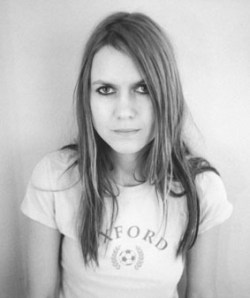
Juliana Hatfield memoir

juliana-hatfield-1-sized

I got around to reading the Juliana Hatfield memoir When I Grow Up.  I read the Dean Wareham one recently (Black Postcards) too. The two books feel like they constitute a minor wave of memoirs of 1990s semi/almost rock stardom.  Wareham (of Galaxie 500 and Luna) and Hatfield both had comparable experiences as indie stars of the late 1980s plucked out for mainstream success which never quite came, leaving them struggling for diminishing returns throughout the 1990s and beyond.

I know/used to know Juliana a bit, from back in the late 1980s in Cambridge.  I played tennis with her a couple times under circumstances I can’t entirely recall (when I was home on college vacations).  She always seemed like a somewhat painfully shy, and sweet, person.  I found the memoir to be a good read, smart and sometimes moving in the recounting of her ongoing depression, struggles with anorexia, and feelings of hopelessness.

I liked this description of her realization that she is not suited to the rock and roll life (one focus of the book concerns her wrestling with the question of whether she should give up music altogether and try to find some other line of work):

At heart, I am not a rock and roller.  At heart I am a librarian, a bird-watcher, a transcendentalist, a gardener, a spinster, a monk…. I don’t want loud noise and fame and scandal and drugs and late nights and flashing lights; I want peace and quiet and order; solitude, privacy, and space for contemplation  I want to awake at dawn and listen to the birds, and drink a cup of tea.  I need to face facts.

The book, like  Wareham’s, wrestles with a formal/stylistic dilemma having to do with the attempt to narrate and describe the tedium and monotony of life on the road in a touring rock band.  Life on tour, playing over and over at the same kinds of dingy/crummy clubs, is mind-numbingly repetitive, marked by bad food, the ordeal of driving and lugging equipment, & depressing cheap hotels (and also occasional bursts of inspiration and the pleasure of performance).  So, how can you turn this mostly-tedious material into a story someone would want to read?  Juliana takes a somewhat literalist approach by narrating one entire long tour (around 2004 I think?) from start to finish: this constitutes one strand of the memoir which is also interspersed with a more chronological tale of her career from the early Blake Babies days through her solo career, getting a $400,000 advance from Atlantic in the 1990s, later getting dropped from the label and continuing to struggle on.   I’ll confess that I thought parts of the tour diary, with all its detailed accounts of the travails of a rock and roll vegan stuck in on the fast food highway, could have been compressed or edited out, but then, it does really give you a sometimes-excruciatingly vivid sense of what that experience is like.  (Part of the point seems to be demystification, for the sake of anyone who imagines that it’s a glamorous life to be in a band.)

The memoir ends with her climbing her way out of her depression and seeming to make peace with her status as a former/has-been pop star — deciding to stop punishing herself for failing to become the kind of pop success she was never destined to be. Juliana really suffered, it seems, from the weight of the burden of being a kind of token female alt-rocker, which wasn’t a very good identity match with her propensities towards shyness, depression, and anorexia.  It’s good to see that she seems relatively happy and together these days.

Reading the memoir also inspired me to download (legally! through emusic) her latest album, How to Walk Away, which works well as a companion piece to the book.  Some of the songs function both as relationship breakup songs and also as meditations on the possibility of “breakup” or walking away from the vocation of singer/artist.  In my view (this would probably piss her off) her solo records have sometimes suffered from an overvaluation of “rawness,” and I like the comparatively polished, careful pop production on this one.

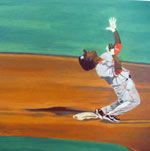
She’s been doing some painting lately, sometimes with a Red Sox/baseball theme.  Here’s one:

112108_paint1_151

Kenneth Branagh as Kurt Wallander

Watched the first (of three, I believe) installment of PBS Mystery‘s versions of the Henning Mankell Kurt Wallander thrillers.  Last night was Sidetracked and I think in the next two Sundays they’re doing Firewall and One Step Behind.

It wasn’t bad at all, was a creditable version, but was still mildly disappointing.  I didn’t really buy Kenneth Branagh as Wallander.  Wallander is an exhausted mess who drinks too much coffee, can’t sleep, is overweight and eats badly, and Branagh is just too good-looking.  Sarah pointed out that a major aspect of the novels and of Wallander’s character has to do with the mundanity of his daily life: the sad meals he ekes out of his empty kitchen, his fussing about whether or not to wear his thick sweater to the crime scene, endless pots of coffee.  Most of that sense of slow dailiness is excised.  Also, much of the pleasure of the novels depends on the suspense that builds over time, and the plot felt compressed and rushed into the 85 minutes or whatever.

It was odd that everyone spoke in British accents of one sort or another.  My guess is that they actually worked to translate specific Swedish accents/dialect into British versions.  I know film-makers have to face this problem routinely: should they speak in Swedish-accented English?  What would the logic for that be?  But this seemed a bit disconcerting.

Sidetracked is a pretty typical/exemplary Mankell novel in the way it reveals a modern Sweden scarred by various forms of global suffering, abuses, and evil.  The novels are obsessed with Sweden as country that sees itself as “traditional,” tolerant and liberal, but that doesn’t know how to handle the transformations of a new global economy, with its immigration and novel forms of inequity and corruption.  The theme of the traditional confronting the modern plays out in a striking way in this novel where the criminal turns out to commit his murders (of corrupt politicians and financiers, chiefs of the new economic order) in a kind of regressive psychopathic trance in which he reimagines himself as a Native American warrior.

I liked the Southern Swedish settings, beautiful photography.

It was disappointing that Wallander’s father now paints rather attractive-looking landscapes.  In the novel he paints basically the same painting of a wood grouse over and over; I guess they decided it would just seem too strange.

I’ll keep watching.  I wouldn’t watch if you haven’t read the novels, though.

Maj Sjowall and Per Wahloo

Why do I love Swedish police procedurals?

I’ve already written here about my addiction to Henning Mankell’s novels.  I’ve recently gone back a few decades to the series that I believe inspired him, Maj Sjowall and Per Wahloo’s Martin Beck novels (they were a married couple) from the late 1960s and 70s, which have been reissued in nice Vintage Crime/ Black Lizard editions.  In the last week or two I read the first two, Roseanna and The Man Who Went Up in Smoke.  I preferred the first but I’ll select this random passage towards the end of the second to evoke some of the appeal of these novels for me.  Martin Beck is back in Stockholm from an investigation in Hungary, talking with his partner Kollberg:

“A dreadful thought suddenly occurred to me,” said Kollberg.  “It’s five days since the opening of the crayfish season and you probably haven’t eaten a single one.  Or do they have crayfish in Hungary?

“Not so far as I know,” said Martin Beck.  “I didn’t see any.”

“Get yourself dressed.  I’ve ordered a table.”

The dining room was crowded, but a corner table had been reserved for them and laid for a crayfish dinner.  On each of their plates lay a paper hat and a bib, and each of the bibs had a verse printed in red across it.  They sat down and Martin Beck looked dismally at his hat, made of blue crepe paper, with a shiny blue visor and POLICE in gold letters above the visor.

Letdown of Ozma of Oz

p_neill_06xa

We recently got through Ozma of Oz, L. Frank Baum’s 1907 followup to The Wizard of Oz.  Actually there was another book in between, The Marvelous Land of Oz, which does not feature Dorothy, but I decided we’d just pick up Dorothy’s continuing adventures.

It was a bit of a let-down.  The art is fantastic: ravishing, Japanese-influenced paintings by John Neill, who replaced W.W. Denslow after he and Baum had a falling out.  Wikipedia tells us that

Dorothy drawn by Denslow appeared to be a chubby five or six year old with long brown hair in two braids. Neill chose to illustrate a new Dorothy in 1907 when the character was reintroduced in Ozma of Oz. He illustrated the young girl in a more fashionable appearance. She is shown to be about ten years old, dressed in contemporary American fashions, with blonde hair cut in a fashionable bob. A similar modernization was given other female characters.

The whole book is very fashion/glamour-conscious, in fact, as in the flighty Princess Langwidere, who decides every morning which head to wear, from a closet full of dozens of gorgeous options.  She always wears the same simple white dress, however, indulging all of her need for fashion and variety in choice of head alone.  The girls found this quite interesting.

3-ozma-3a

The book has its moments.  I liked the scary (but ultimately cowardly/ harmless) Wheelers, who leave the eerie message “Beware the Wheelers” written in the sand (could this have inspired Walter Benn Michaels’s “Against Theory,” with its image of the Wordsworth poem written in the sand on the beach?).  They are subsequently satisfyingly routed by the robot Tiktok who hits them over the head with the dinner pails that grow on the food tree they guard.

But too much of the book is devoted to the tiresome Nome King (who looks a lot like Dr. Suess’s Grinch — I suspect plagiarism, in fact) and his elaborate sadistic game in which Dorothy and her friends have to guess which of the “decorations” in his castle are members of the royal family under the king’s curse.  It goes on and on and has something of the contrived feel of a Batman episode.  The book also has some weird/offputting recurring bits or jokes, like the hungry tiger who is constantly talking about how much he would like to devour a human baby (but he’s too virtuous to give into his urges).

Also irritating: Dorothy’s new tendency to speak in lispish childish colloqualisms: “A lunch isn’t zactly breakfast… I’m sure it was ripe… all, that is, ‘cept the pickle” (chosen from a random page).

When I started reading, I was thinking, “gosh, with so many books, why aren’t there more Oz movies,” but by the end I understood.  However: “It has been announced that director John Boorman will create a new CGI film of The Wonderful Wizard of Oz. It is set for release in 2010.”  Makes sense that they’d do a new version.  I’m more interested in this, though: Aysecik ve Sihirli Cüceler Rüyalar Ülkesinde is a 1971 Turkish film, directed by Tunç Basaran (known to bootleggers as “The Turkish Wizard of Oz”).”

Here’s Ozma of Oz on Google Books.

Fatherhood in extremis: Laura Ingalls Wilder & Cormac McCarthy

I finally read The Road — almost the whole thing in one sitting in bed and then finished it off the next day.  It’s pretty harrowing.  I’ve been haunted by that recent article in The New Yorker, “The Dystopians,” about ““back-to-the-land types,” “peak oilers,”… all-around Cassandras, or doomers,” and others who believe the U.S. and maybe the world economy are bankrupt and that we are headed for some more or less minimalist post-economic, post-oil future.  The Road jibes very well with with that ideology, on the more horrific, apocalyptic end of the spectrum (after all, few of the “dystopians” appear believe that we will descend into mass cannibalism).

I was struck by how much The Road has in common with Little House in the Big Woods.  Ingalls’ book looks back at nineteenth-century homesteaders with affectionate nostalgia; McCarthy looks ahead to a dystopian future; but in either case, the whole world focuses to a parent trying to provide for the family by eking out sustenance from the land.

So, Ingalls’ Pa kills bear and deer, harvests wheat, carves wood, builds the cabin and insulates it; McCormac’s father rigs up the cart, makes a tent out of a tarp, kills a threatening vagrant, scavenges food, makes a lantern out of a can of gasoline.  It’s all about survival skills and protecting and getting food and shelter for the kid(s).  (Admittedly, Ma is just as important in Little House as Pa. There is a wife in The Road, but she only appears in one retrospective memory: she tells the dad “They are going to rape us and kill us and eat us and you wont face it,” and then she goes off and apparently kills herself with a sharp flake of obsidian.  Of course nothing at all like this happens to Ma in Little House.)

Basically, for me the narcissistic takeaway of both books was this: If the apocalypse comes, your fatherhood-in-extremis skills are crap and you will not be able to take care of your family. We don’t even have a working flashlight (the girls always leave it on and run out the batteries) or jugs of water in the basement.  God help us if I’m called upon to do something like this on no sleep:

He unscrewed the bottom panel and he removed the burner assembly and disconnected the two burners with a small crescent wrench.  He tipped out the plastic jar of hardware and sorted out a bolt to thread into the fitting of the junction and then tightened it down.  He connected the hose from the tank and held the little potmetal burner up in his hand, small and light-weight.

And no way would I have been able to use that map ripped into little pieces to navigate past the cannibal compound all the way to the sea.

I did get one good tip from The Road: when you first hear the bombs or whatever, immediately turn the bathtub on since the water supply will run out momentarily.  I’m all over that one, am excellent at taking baths.

Another unrelated thought I had about The Road: it winds up with what struck me as a Robinson Crusoe reference, as the father swims out to an abandoned boat and strips it for useful supplies, very much like Crusoe at the beginning of Defoe’s novel; perhaps a little joke or conceit on McCarthy’s part about going back to origins of the novel form.

It could be fun to do a Little House on the Road mashup along the lines of that Pride and Prejudice and Zombies paperback that’s all the rage.

A really good read, for sure, but for 21st-century apocalyptic fiction I’d still give the nod to Jose Saramago’s amazing Blindness (1998, actually; don’t be put off by the movie version which is supposed to be lousy).

Reading Laura Ingalls Wilder

I’ve been reading C&I The Little House in the Big Woods.  The Laura Ingalls Wilder books were a big deal in my family.  My cousin Laura was named after her; I read the books at least as much/often as I did the Lord of the Rings saga, in a somewhat similar pattern, too: probably read The Hobbit and The Little House in the Big Woods the most, those two classics of coziness, and trailed off towards the end of the two series as the scope widened to an increasingly larger and more adult world.   I think as a boy reader I found more to relate to in the earlier books with all the bears and hunting and boy-scoutish activities.  Sarah commented to me that Pa is a somewhat risky model of fatherhood for me to expose to the girls.  “I mean, he hunts, builds houses, smokes meat, carves wooden toys, rides horses…” “Yes, but does he blog cleverly???” I responded not at all defensively.  I don’t see Sarah churning butter or sewing all the family’s clothes, anyway (although admittedly she’d be much more likely to do that than I would be to build my own meat smoker in the backyard).

C&I love the book.  They’re especially interested in the Mary/Laura dynamic: Laura’s the younger one with brown hair who is jealous of her sister’s golden curls.  (This led to a discussion of hair color in which Iris declared that “mommy’s hair is brickish red.”)  And of course they’re fascinated by life in a cabin with nearly everything you use something you make yourself, and with bears and panthers prowling around.  It’s a very appealing depiction of an entirely self-sufficient, self-enclosed family life, although I keep thinking that one winter like that in the one-room cabin (with a baby and two young girls) would drive me screaming to the town (pop. 150 at most?) by the lake in Pepin, Michigan.

The other night we read one chapter, and also read Margaret Wise Brown’s The Little Fur Family, which we own in a tiny, faux-fur-covered edition.  As we read it I suddenly realized that the illustrations were by Garth Williams, who also illustrated The Little House in the Big Woods, and that they’re very similar stories, all about hunkering down in your cozy home for the winter, but from the bears’ point of view!  (Assuming the little fur people are bears, I guess it’s more ambiguous.)  Just look — Pa practically is a member of the Little Fur Family on a larger scale:

littlehousecoverfur

Fated to Pretend

g11mgmt

New Pazz and Jop Village Voice rock critics’ poll.  I contributed to this for years and was always thrilled when the editors chose a couple of my elaborately-wrought witticisms/quips for inclusion in the commentary section.  The only one I remember is something I wrote about Pavement “giving the Badfinger to the rock and roll singer,” which they used as the caption for a photo of Pavement; this made my week/year, nerd that I was.

It makes me a touch melancholy how little the Pazz and Jop poll now seems to matter.  Before blogs, it was one of the only occasions (the only?) for pop music critics to crack wise, make jokes, and spin out ambitious theories apart from the strictures of a record review or band profile.  Now Robert Christgau’s over at MSN.com, and at best, it’s just another concatenation of online opinion.

So anyway, my big discovery so far from the poll (which is still useful as a guide to the year’s music) is MGMT, whose name I’d seen but had not paid any attention to.  They’re two former Wesleyan undergrads who make a kind of psychedelic electronic pop; their song “Time to Pretend” (#4 on the singles poll), extravagantly produced by a guy from the Flaming Lips, is beyond brilliant and catchy.  Youtube won’t let me embed the video for some reason so here’s the link.  Gets my vote for best/catchiest “single” of the year along with “Paper Planes” (btw can I say how ripped off I felt when I realized that the song does not actually appear anywhere in Pineapple Express, not even in the closing credits?  Whoever had the idea to use “Paper Planes” in the trailer made that movie.)

I also just finished reading Barney Hoskins’ history of pop music in L.A., Waiting for the Sun, and “Time to Pretend” resonates with the book for me as a delirious narrative of dropping out, jettisoning the straight life for good, and disappearing into an abyss of drugs, money, models, and rock and roll:

This is our decision, to live fast and die young.
We’ve got the vision, now let’s have some fun.
Yeah, it’s overwhelming, but what else can we do.
Get jobs in offices, and wake up for the morning commute?

Forget about our mothers and our friends
We’re fated to pretend
To pretend
We’re fated to pretend
To pretend

I’ll miss the playgrounds and the animals and digging up worms
I’ll miss the comfort of my mother and the weight of the world
I’ll miss my sister, miss my father, miss my dog and my home
Yeah, I’ll miss the boredom and the freedom and the time spent alone.

There’s really nothing, nothing we can do
Love must be forgotten, life can always start up anew.
The models will have children, we’ll get a divorce
We’ll find some more models, everything must run it’s course.

We’ll choke on our vomit and that will be the end
We were fated to pretend
To pretend
We’re fated to pretend
To pretend

It could be the confession of any of the lost narcissists of California pop whose stories Hoskins tells, fantasists “fated to pretend,” some geniuses, some just poseurs or hangers-on (some both, needless to say), making up their identities, doing way too much coke, marrying and divorcing models; for the less fortunate ones, an eventual ignominious death by mishap, for the luckier, eventual rehabilitation with memoir a la David Crosby.  Hoskins really allows one to see Darby Crash, Arthur Lee, and Tim Buckley (for example) as part of the same continuum of doomed/self-destructive L.A. singers.  (On rock and roll deaths, see this site.)

Anyway, the song is an irresistible “amuse bouche” as Charles Aaron put it, filled with outlandish musical flourishes and unearned grandeur.  “Kids” is also great.