More Animal Slaughter in the Wizard of Oz

oz12-05

Just had to write again about the amazing emphasis on animal slaughter in The Wizard of Oz.  It’s practically like Tintin in the Congo (in which the jungle animal body count increases steadily throughout).

Here are a few scenes from the climactic Chapter 12, “The Search for the Wicked Witch,” as she sends out waves of her minion creatures to attack Dorothy & co.

First wolves:

He seized his axe, which he had made very sharp, and as the leader of the wolves came on the Tin Woodman swung his arm and chopped the wolf’s head from its body, so that it immediately died. As soon as he could raise his axe another wolf came up, and he also fell under the sharp edge of the Tin Woodman’s weapon. There were forty wolves, and forty times a wolf was killed, so that at last they all lay dead in a heap before the Woodman.

Then he put down his axe and sat beside the Scarecrow, who said, “It was a good fight, friend.”

Now crows, giving the Scarecrow a chance to show his stuff:

The King Crow flew at the Scarecrow, who caught it by the head and twisted its neck until it died. And then another crow flew at him, and the Scarecrow twisted its neck also. There were forty crows, and forty times the Scarecrow twisted a neck, until at last all were lying dead beside him. Then he called to his companions to rise, and again they went upon their journey.

And how about some insects?

The bees came and found no one but the Woodman to sting, so they flew at him and broke off all their stings against the tin, without hurting the Woodman at all. And as bees cannot live when their stings are broken that was the end of the black bees, and they lay scattered thick about the Woodman, like little heaps of fine coal.

Finally, the Witch sends off a herd of buffalo, which Dorothy herself dispatches, shooting each one through the eye with a long-barreled rifle.  (Just kidding.)

It all has a distinct Manifest Destiny, conquest-of-the-Western-wilderness feel to it.

Killing a Cat to Save a Mouse in the Wizard of Oz

ww-denslow-illustration-1

We’ve been reading the girls The Wizard of Oz.  They are entranced by it, especially in this neat Dover reprint that includes all of the original gorgeous W.W. Denslow illustrations and plates (many of the pages of text are printed over/under illustrations, which creates a dazzling effect).

You probably know some of the disturbing/controversial facts about L. Frank Baum, such as his belief that Native American should be absolutely exterminated.  This from an 1890 newspaper editorial:

The Whites, by law of conquest, by justice of civilization, are masters of the American continent, and the best safety of the frontier settlements will be secured by the total annihilation of the few remaining Indians. Why not annihilation? Their glory has fled, their spirit broken, their manhood effaced; better that they die than live the miserable wretches that they are. History would forget these latter despicable beings…

Yikes!  Of course, as I read the novel, my lit-crit gears are continually turning to try to think about what kind of “natives” the Munchkins are supposed to be, whether Oz is some kind of native sovereign, how his power in the city-state of the Emerald City relates to the Witches’ authority over the regional territories, whether the various colors in Oz (yellow, green, blue) are intended to represent an alternative racial system, etc. etc.  I spare Celie and Iris these speculations, however.

It’s a very weird book, much more so than the movie.

I just wanted to make one point here about a hilariously/disturbingly strange moment regarding animal welfare.  I’ll quote from chapter nine:

The Tin Woodman was about to reply when he heard a low growl, and turning his head (which worked beautifully on hinges) he saw a strange beast come bounding over the grass toward them. It was, indeed, a great yellow Wildcat, and the Woodman thought it must be chasing something, for its ears were lying close to its head and its mouth was wide open, showing two rows of ugly teeth, while its red eyes glowed like balls of fire. As it came nearer the Tin Woodman saw that running before the beast was a little gray field mouse, and although he had no heart he knew it was wrong for the Wildcat to try to kill such a pretty, harmless creature.

Ok, that sound reasonable, so the Tin Woodman is going to grab the mouse, or stop the cat from chasing it, right?

Actually, he takes a somewhat more aggressive approach:

So the Woodman raised his axe, and as the Wildcat ran by he gave it a quick blow that cut the beast’s head clean off from its body, and it rolled over at his feet in two pieces.

Well, I guess that seems fair.  Maybe he does have a heart, after all!

Wonder why they didn’t include that scene in the movie.

I remember being amazed to learn from Mike Davis’s Ecology of Fear: Los Angeles and the Imagination of Disaster that in the early twentieth century, environmentalist groups like the Sierra Club took the position that predator animals like mountain lions were inherently malign & should be destroyed.  Hey, after all, they kill all those sweet bunnies and mice, right?

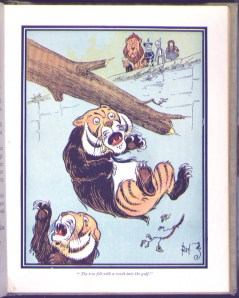
C&I were actually also a bit troubled by the scene where the ruthless animal-killer the Tin Woodman sends the two fierce Kalidahs to their deaths at the bottom of a ravine.   Iris brought it up suddenly the next day, that although the story said they were mean & scary, in the illustration, they “looked nice” as they were falling:

kalidahs

Perhaps the “twin”-ness of the Kalidahs, so much like Celie and Iris or Pot Luck and Daisy, hit close to home.

Here a cool Library of Congress online exhibit on Baum, Denslow & Oz.