
Very weird… James Franco discusses Carl Wilson’s Celine Dion book on the Oscars red carpet — by way of making excuses for why he does not watch escapist/bad t.v. but intends to do so soon. Here’s my earlier link to the book.
Franco is doing an MFA poetry program, so I knew he was probably more thoughtful/ better read than the typical young H’wood star…
Category: movies
Ian Curtis/ Kurt Cobain
Watched the Anton Corbijn biopic of Ian Curtis (Joy Division’s singer who committed suicide in 1980 at age 23), Control. Enjoyed it a lot. The musical performances, all recorded by the actors, are pretty uncannily good and Sam Riley is a dead ringer for Curtis. If they toured as the Unknown Pleasures, a Joy Division cover band, I’d definitely go.
I had one thought about the parallel between Curtis and Kurt Cobain, probably a comparison drawn a million times before. There are various links (beyond the fame and suicide), i.e. they both suffered from medical problems: Curtis’s epilepsy, the treatment of which was pretty hit or miss at that point, and Cobain’s chronic stomach problems, both of which contributed to abuse/misuse of prescription drugs. But the movie left me with the sense that for Curtis as for Cobain, sudden fame led to a psychological crisis having to do with communication and self-expression.
I get the sense that for both men music was tied up in a fantasy of total transparency and connection with a listener/interlocutor. They both had trouble communicating with real people, lovers and friends, but had an amazing power to speak to people through music. It seems likely that for both men the desperation that preceded the suicide was tied up in part with a feeling that they now had a huge audience hanging on their every word that did not in fact understand them in the least.
Many of Joy Division and Nirvana’s signature songs are about the desire to be understood and the failure to communicate. “When the people listen to you, don’t you know it means a lot?” (“Novelty”); “Walk in silence, Don’t turn away, in silence…. Don’t walk away” (“Atmosphere”); “He’s the one who likes all our pretty songs/ And he likes to sing along…/ But he knows not what it means/ Knows not what it means” (Nirvana, “In Bloom”).
Watching both men sing, you feel that part of their genius lay in a special talent for taking the basic technology of the microphone and recording technology and infusing it with a sense of complete intimacy. They are whispering or screaming in your ear. Control begins with a 17 year old Curtis lying on his bed listening to a David Bowie album; for kids like Cobain or Curtis, there is no voice they listen to more intently than the pop singer’s.
So my thought is that for Curtis and Cobain, this kind of mediated intimacy meant so much that when they became the star, Bowie (important for both of them), the voice that is in your ear as you fall asleep, it was hard to handle the crushing realization that this could feel false, not in fact linked to any true communication or insight, just showbiz.
Of course they both suffered from serious depression as well, so maybe this is all just unwarranted pop (literally) psychology.
Seeing “The Tale of Despereaux” with Celie

Sarah took Iris to see the animated movie “The Tale of Despereaux” a few days ago. Celie thought that it would be too scary and decided not to go, and then bitterly regretted the decision an hour later. So, she and I went yesterday.
It’s a pretty cute and a beautifully animated movie. It was a bit dark and complex for Celie, through whose eyes I was seeing it almost literally as she was sitting on my lap for most of it. But she liked some of it.
It’s partly about a crisis of masculinity and fatherhood. Despereaux is an unusual mouse because he is too small, has huge ears, and is totally fearless. He’s failing out of school because he can’t learn how to “cower” properly like the other mouse kids. His father basically turns him into the authorities and allows them to sentence him to banishment to the world underground, where he’ll presumably be killed by the Morlock-like rats who live there. (This was pretty heavy for Celie.)
There are at least two other failed fathers. There’s the dungeon guard who, we learn, gave away his “princess” infant daughter, an act he terribly regrets (I have to admit I didn’t completely get why he had to do this — I guess he signed her away into service, as when we meet her, she has become the servant/maid for the actual Princess). And then there’s the King, who after the death of the Queen, lapses into a life-denying, nihilistic depression. The theme of the movie is best captured, I thought, by the scene where the spunky, fearless Despereaux is frantically trying to get the King’s attention in order to warn him that his daughter the Princess is about to be killed by the rats… but the King can’t hear/ignores him and drops one single tear, which crashes down on Despereux’s head. Frozen, ineffectual, destructive male passivity/depression/cowardice leads to the “giving away”/neglect/destruction of the child. In the end Despereaux, through the reading of old tales of chivalry, revives lost values of bravery and honor, saves the community, and teaches mice that there’s more to life than cowering.
Afterwards I asked Celie if she is brave. “Well, sometimes… when I want to be. Other times, the scare comes into my body,” she replied.
New Moonraking Feature
What I’m listening to/watching/reading
1/12/09
First episode of the new season of Damages on FX, with Glenn Close, Ted Danson and now William Hurt. Wednesday nights. We watched the first season on DVD — it’s great; very over the top with countless double-crosses, like some overheated old noir. The NY Times review complained that the new season feels like a slight let-down, and maybe so, a bit, but it’s still fun.
Man on Wire. Great documentary about French highwire-walker Philippe Petit’s attempt, with the help of a gang of co-conspirators, to cross the Twin Towers on a wire in August 1974. It takes the form of a thriller or heist movie, moving forward, minute by minute, through the events of that day, and also stepping away to fill in the backstory. The mood is often sweetly elegiac, which I think has a lot to do with a sense of lost innocence surrounding the World Trade Center in the 1970s, and a time when 5 guys with (almost literally) tons of equipment could sneak past the guards, shoot a string from one tower to the other with a bow and arrow, have one of them walk back and forth, and end up being celebrated as plucky heroes. You have to figure today the police would shoot to kill…
1/4/09
Watched The Man in the Gray Flannel Suit with Gregory Peck. It surprised me in several respects. One was how much Mad Man seems to reference/rip it off. There are so many parallels, so much so that I wonder if it was a bit of an in-joke among the Man Man people to slip in allusions (like the scene where he has to pick his wife up at the police station). Was also surprised by how much it’s a war movie — there are these strangely extended flashback scenes from WW2 that go on and on.
Reading Maximum City: Bombay Lost and Found by Suketo Mehta. It’s been on my shelf for a year or two and then the Mumbai bombings (and an Op-Ed Mehta published in the Times) got me to pick it up finally.
1/1/09
Henning Mankell’s The Pyramid.
12/15/08
The new short film by Blu: an ambiguous animation painted on public walls in Buenos Aires and Baden. Really amazing!
Attack (TNR article by Adam Kirsch) and counter-attack (comments section) on Slavoj Zizek.
12/13/08
12/11/08
Battlestar Galactica first season.
12/10/08
Pingwings, Pogles’ Wood, Noggin the Nog, Ivor the Engine, The Clangers and Bagpuss on Youtube.
12/8/08
Erik Davis’s Led Zeppelin IV (33 1/3; Continuum). Very smart and funny obsessive excavation of Led Zep’s occult roots. For some reason the single historical detail that most surprised me here, though, amidst all the analysis of the band’s debt to Aleister Crowley, etc., was the revelation that “before forming Led Zeppelin and playing with the Yardbirds, [Jimmy] Page spent three years as a session player, playing on an estimated 50 to 90% of all the records made in England between 1963 and 1965, including early hits by the Who and the Kinks”(48). WTF?? Very bizarre. I had no idea.
12/7/08
The Mekons’ Fear and Whiskey (Sin Records, 1985). An old favorite of mine that I’m thinking of trying to write something about, so have returned to. British art-school punks fall into American roots music (Hank Williams, Ernest Tubb, etc) as a conceptual wormhole out of Thatcherite England.
This is the only really old Mekons video I dug up on Youtube: “Where Were You?” on New Year’s Eve 1980, opening for the Gang of Four. ”When I was waiting in a bar, where were you?/ When I was buying you a drink, where were you? When I was crying at home in bed, where were you?…/I want to talk to you all night, do you like me?/ I want to find out about your life, do you like me?/ Could you ever be my wife, do you love me?”
Taraf de Haidouks, Musique Des Tziganes De Roumanie. The live Band of Gypsies is also great. Wild, sad, take-no-prisoners party music that I’m sure the Mekons would enjoy. They’re Romanian Roma musicians — appear in the film Gypsy Caravan which I haven’t seen. (You can get all of these on emusic.)
Art or Not? t.v. show on Ovation. See my post.
Profile of Naomi Klein in The New Yorker. Sarah is a big fan of The Shock Doctrine — I think I am going to read it over the holidays.
Anthony Trollope’s The Last Chronicle of Barset.
Care Bears dvd from public library. Celie and Iris were SO excited about this DVD. We spent the drive home discussing metaphysical puzzles raised by the show e.g. “I wonder how they get up on those rainbows?” (I refrained from giving the correct answer: the poorly-paid animator in Thailand drew them up there.) I could not bring myself to watch more than a couple minutes of this tripe.
R.I.P. Rudy Ray Moore
R.I.P. Rudy Ray Moore.
“I’m the one that had the elephants roosting in trees and all the ants in BVDs.”
Eye of the Tiger/ Blog hiatus
A highlight of Persepolis (which is really good)
Actually, the clip is funnier in the context of the movie, where it signals her emergence from a deep post-breakup depression. Fun Wikipedia fact: “In 1984, singer/comedian “Weird Al” Yankovic wrote & recorded a parody of Eye of the Tiger called: The Rye or the Kaiser (Theme From Rocky XIII).” I’ll have to check that one out. Love Weird Al.
A note to my literally dozens of regular blog readers: I am soon traveling to a place without DSL connection (in Maine), so the blog will probably be on semi-hiatus for July.
Julian Schnabel’s The Diving Bell and the Butterfly
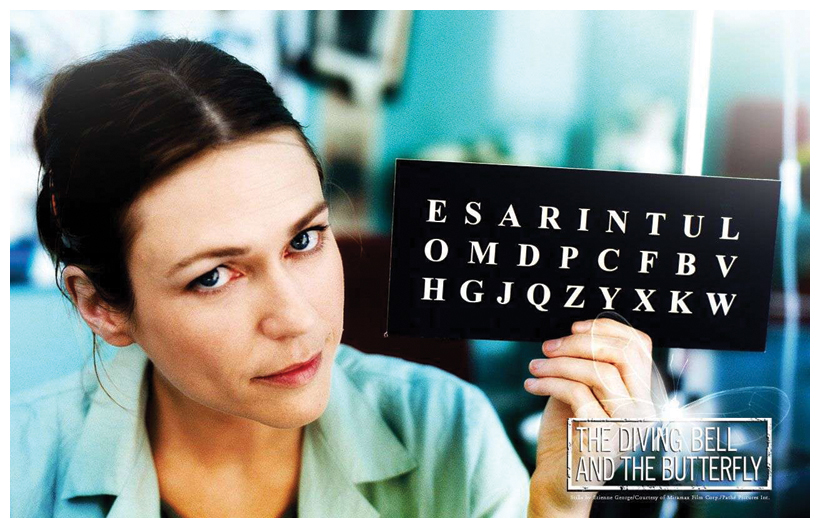
Julian Schnabel’s The Diving Bell and the Butterfly is a really cool and innovative movie. Its primary filmic P.O.V. is that of the protagonist, Jean-Do, who is paralyzed from head to toe such that he cannot express himself in any way other than blinking. So, the camera represents his perspective, and we see what he sees — doctors, nurses, physical therapists, friends, wife, children and mistress all peering at his unresponsive face. That’s about 2/3 of the movie; it also includes more usual scenes from his life before his paralysis. It’s a very beautiful movie, “painterly,” maybe, filled with gorgeous, dreamy scenes of cliffs falling into the sea, light and ocean; it makes you realize how impoverished and conventional most cinematography is.
My one little observation about the movie otherwise is that it would be a great film to show as accompaniment for German media theorist Freidrich Kittler’s Discourse Networks 1800-1900. It’s an alphabetized movie all about the acquisition of the alphabet and language as a deeply eroticized process. Quite a lot of it consists simply of shots of Jean-Do’s speech therapist (pictured above) reciting the alphabet over and over again. Jean-Do blinks once for ‘yes’, meaning in this context, “that letter.” Two blinks means no. (And by the way, I realized that that Los Campesinos! song “Sweet Dreams Sweet Cheeks,” with its line “one blink for yes, two blinks for no,” is a reference to this movie/book). Eventually they get a word, a sentence, and so on. He gradually writes his memoir, on which the movie is based.
There’s one interestingly awkward effect of the French/English language difference: we get these scenes where he is trying to spell, say, “death.” So, it’s MORTE, but the subtitles represent this as “D, E, A, T, H,” because the tension in the scene requires us to play hangman and slowly guess what word is he trying to say. It’s disconcerting to hear her say “M”? and have it translated as “D?”
Schnabel admits in a DVD commentary that the movie recalls Fellini’s 8 1/2 in its depiction of the protagonist surrounded by a kind of (unattainable) fantasy harem of women, his various lovers and the therapists. The movie is a rapturous male fantasy about infantile language acquisition, in a position of absolute helplessness, from “the Mother’s Mouth.” Jean-Do can’t move, can’t touch, can only sink deeply into the process of spelling/writing by listening to beautiful women recite the alphabet, staring at their mouths and lips as they wait for his single blink of response. All eroticism has to be projected into this single action and relationship.
Todd Haynes “I’m Not There”
 Finally saw Todd Haynes’ I’m Not There. I’m a fan of Haynes’, but the movie struck me as really smart and interesting, wonderfully apt in its treatment of Dylan’s identities, but somewhat maddening as a viewing experience. One problem, maybe, is that the postmodern identity-scrambling sometimes simply underlines the basic bio-pic problem: that is, since the actors portraying Dylan are continually changing (and many of them make little effort at verisimilitude), you’re constantly re-confronted with the artificiality and falsity of filmed biography. Of course that’s the point, but the effect is sometimes just clunky and silly. Sarah commented that certain scenes recalled A Mighty Wind, the Christopher Guest mockumentary about the 60s folk music scene: e.g. the Joan Baez character reminiscing.
The movie is always tossing out funny, clever, and memorable details: one I loved, for example, was Dylan clowning around with the Beatles, who appear as manic Teletubbies (played by a quartet of Frenchmen, it seems). It only lasts for about 5 seconds, but is hilarious and perfect. As everyone pointed out, Cate Blanchett is brilliant. Heath Ledger was melancholy to watch. David Cross is amusingly absurd as Ginsburg. I hated Richard Gere and ended up fast-forwarding through some of the late Billy the Kid scenes he’s in. I kind of wish the whole movie had been Blanchett — would’ve been more conventional but more effective, maybe.
Final verdict: not as good as the Dylan memoir. The movie didn’t do too well, did it? You pretty much need to know a lot about Dylan to appreciate it. E.g. why is there a tarantula crawling — that’s a reference to his book of poems; he was a big fan of the wrestler Gorgeous George; there’s a lot of that.
Just listened to a bit of Haynes’ commentary over the last 5 minutes or so — quite eloquent, I’m almost tempted to go back to hear more of it. He ends by saying “I’m just so glad I got to make a movie that ends with ‘Sad-Eyed Lady of the Lowlands'” and there is something to that — it’s great just to have an excuse to listen to these songs in a new context. (Once in sophomore year of high school I spent much of an evening listening to that song — which was an entire album side — over and over. I was a romantic little soul.)
I’m really glad I finally saw Dylan live this year. The university basketball stadium wasn’t exactly the ideal setting, but I loved him and the country-western-Mariachi band he has going these days.
The David Hadju book Positively Fourth Street is great btw and gives a funny, less-reverent than the norm depiction of Dylan (who comes across as a complete jerk, at least some of the time)
Iron Man
 Iron Man was fun. Iron Man is a robot, HAL, 3CPO & R2D2, and especially, I thought, Gort from The Day the Earth Stood Still; he’s a cyborg, part machine part man (and a techie friend of various other pet/helper robots); he’s a golem (I wonder if the Jewish golem tradition ties in any covert way into the film’s surprisingly retrograde anti-Arab depictions — though of course the movie makes efforts to protect itself from this accusation: these are just the evil WARLORD Arabs, not the good family-minded ones). He’s a self-guided weapon: there’s something amusingly retro in the idea that a supercharged suit for an individual could be a crucial military tool in 21st century geopolitics (the Terrence Howard character comments at one point about how the instincts and intelligence of a human pilot will never be beaten by robotic intelligence — yeah, right.) And most explicitly, he is the Tin Man from The Wizard of Oz trying to get/find his heart.

Robert Downey Jr. was an inspired choice, of course. I thought Gwynth was charming as Pepper Potts although the gender dynamics are as pathetically pre-feminist as in most such movies; or even more so, as she is an indeterminate secretary/butler/girlfriend.
Some fun musical choices: Black Sabbath’s “Iron Man” blasts out over the final credits in a satisfying way. And early on Tony Starks is grooving to Suicidal Tendencies’ “Institutionalized” while he tinkers with one of his gadgets. Hope those guys got a fat royalty check out of it.
Btw, A.O. Scott observed that Jeff Bridges’ character confirms the Law of the Bald Villain; Bridges also clarifies that anyone who rides a Segway in popular culture (unlike our friend Susan, who looks really cool in on her Segway and is definitely good) must be evil.
Previews were almost entirely superhero. I have to admit, the new Hulk with Edward Norton looked pretty good, a bit of Jason Bourne to him.
Pets in ‘The Savages’
 I was pretty sure I’d like The Savages — Laura Linney as a depressed playwright/temp, Philip Seymour Hoffman as a thwarted, dysfunctional prof endlessly working on a book about Brecht, sibling rivalry, wounded narcissism, what’s not to like? But I liked it even more than I expected. (Maybe I just like movies about Buffalo — I loved Buffalo 66). One bit I especially liked (warning, spoiler ahead) was when Wendy (the Laura Linney character) tells her brother that she’s been awarded a Guggenheim to work on her play. We believe it too (we see her open the letter and gasp) although it seems a bit unlikely; eventually we learn that it was actually a FEMA grant that she applied for on the basis of losing her temp job after 9/11. This says so much so economically about her and their brother-sister relationship: she feels intellectually and creatively unrewarded, and not fully respected by him; she yearns for recognition, praise, support; and it’s fitting, given her sense of being generally traumatized by life, that the grant she does get would not be from the Guggenhein Foundation but the Federal Emergency Management Agency.
There are interesting things going on about animals and pets throughout. When Wendy is having bad sex with her married lover, she looks over at his sweet golden lab (I think) and kind of reaches out to its paw, with the obvious implication that she feels a more genuine connection with the dog than with its owner. She eventually dumps the guy because he neglects and almost kills her plant, and she’s always concerned about her cat Genghis, whom she drags around in a pet carrier. At one point the brother is awakened by a midnight phone call; we assume it’s about their father in the nursing home, but it turns out that it’s the cat that is the problem — Genghis has escaped in their father’s room. In other words, the filmmaker (Tamara Jenkins) plays a little with our sense of who can appropriately fill the position of “object of care.” The father is the primary such object but the role is also filled by a dog, cat, and plant.
The movie ends with a nice touch. The married boyfriend returns to Wendy to try to make up with a bouquet of flowers (after the plant episode). She asks where Marly (his dog) is and he explains that she’s going to be put to sleep tomorrow: her hips are shot, she can’t move around and is horribly depressed, there is an operation they could do but it’s complicated (and presumably expensive). “She’s just old,” he says. With sympathy — the point is not that he’s awful to his dog — but it’s a reminder of the expendibility of every creature: we are all, we’re reminded, in a process of decay, our bodies are falling apart (see the photo of the Seymour Hoffman character above in a neck brace), we’re all a bit like Marly, and look what has to happen to her, “put to sleep” (like the cat, she’s a proxy for the father.) The scene ends with Wendy asking “can I just ask you one favor?” and then it cuts to a year later when her play is being performed. We think, “did she ask him to help her produce her play?”– and then we see her jogging with Marly trotting behind in some kind of elaborate dog wheelchair contraption. She has adopted Marly, the old dog, and offered her the unconditional love and care she never got and always craved from her father, and that she could not herself give him. The impossible wish of the movie has been that the father, or maybe anyone, could get better, not be sick, not decay and fall humiliatingly apart; in these final scenes, Marly gets to fulfill this wish that has been otherwise denied.
 Ivan Kreilkamp