Love me Numb: Frank Ocean

Potential album of the year is Frank Ocean’s Nostalgia, ULTRA –a free download.  This guy (nee Christopher Breaux) has some relation to the Odd Future hip-hop collective and was/is signed to Def Jam until he got fed up and released this album/mixtape himself.  It’s a very eccentric R&B album that veers in and out of wildly disparate styles —  one that sounds like Prince here (“Nature Feels”), gorgeous psychedelia tune there (“Strawberry Swing” –actually a cover of a Coldplay original(!)), etc.  Frank Ocean himself characterizes the album as “Death Metal” and “Bluegrass” — “Bluegrass is swag. Bluegrass is all the way swag” — and also compares it to Stanley Kubrick’s Eyes Wide Shut, “some visionary shit.”  To be honest I am not 100% sure how much of the music is his own since some/a lot (?) of it is him rapping over other peoples’ songs, including an amazing riff about a failed teenage marriage over the Eagles’ “Hotel California” called “American Wedding” (“it’s just an American wedding/ they don’t mean too much/ they don’t last enough”…”don’t take this hard/ but maybe we should get an annulment/ before this goes way too far”).  This isn’t just any teenage bride, either: right before the ceremony she turns in her final high school term paper, “a thesis on Islamic virgin brides and arranged marriage/ hijabs and polygamist husbands.”

Frank Ocean has a gorgeous, smooth R&B voice and has written songs for artists like John Legend and Justin Bieber (!) & part of what’s truly weird about this album is the way its formal eccentricity is combined with exceedingly high-gloss mainstream production values and high-level music chops.  What most blows me away, though, are the album’s incredibly smart, weird, sometimes devastating lyrics.

“Swim Good,” which seems to be a suicide song, features our protagonist driving around L.A. in a black suit, “roaming around like I’m ready for a funeral.”   “That’s a pretty big trunk on my Lincoln Town Car, ain’t it?” he asks.  “Big enough to take these broken hearts and put ’em in it./  Now I’m driving round on the boulevard, trunk bleeding.”  The cops stop him, but for some reason they never seem to notice all the blood from his broken hearts bleeding out from the back of the car.   “I’m about to drive in the ocean/ I’m a try to swim from something bigger than me.  Kick off my shoes, and swim good, and swim good.”   Death at sea for “Frank Ocean.”

Or the sublime “There Will Be Tears.”  “My granddaddy was a player, pretty boy in a pair of gators, the only dad I’d ever know, but pretty soon he’d be gone too.”  “Hide my face hide my face/ Can’t let em see me crying/ ’cause these boys didn’t have no fathers neither/ And they weren’t crying./ My friend said it wasn’t so bad/ You can’t miss what you ain’t had.”  And then the refrain, more or less: “Well I can” — miss what you ain’t had, that is — “I’m sad, and there will be tears.”  This in an amazing aching falsetto: “There may be smiles, but a few/ And when those tears have run out/ You will be numb and blue.”

Several of the songs fade out into an alarm clock beeping; the whole thing is, maybe, a concept album about nostalgia, emotional numbness, and dreaming on L.A. freeways. And I haven’t even mentioned the ominously throbbing hit, “Novacane,” about dating a girl in dental school whose effect on him recalls a certain drug: “But girl I can’t feel my face, what are we smokin’ anyway?/  Fuck me good, fuck me long, fuck me numb/ Love me none, love me none, numb, numb, numb, numb.”

Amazing record!  Who IS this soulful genius??

Los Zafiros

from http://www.acappellanews.com/archive/001759.html

I recently fell in love with Los Zafiros (the Sapphires).  I heard a couple tracks on WFHB recently and downloaded their collection Bossa Cubano from emusic.  The group’s former musical director Manuel Galbán, who was later a founding member of the Buena Vista Social Club, died on July 7 (2011), which must be why I heard the set on the radio.

I don’t know if I’d ever heard of this amazing group.  They formed in Havana in 1961, inspired by American doo-wop (the Platters) but also incorporating various more local Cuban & Latin American influences (bolero, bossa nova, samba).

This is one of their trippier numbers, that effect obviously underlined by this video:

The vocal harmonies are unearthly, especially Ignacio Elejalde’s eerie falsetto, as in “Bossa Cubana,” the title track of their collection, which gets into some kind of strange Tom Ze territory with its vocal sound effects (is that a crow?) and captivatingly stuttering rhythms.  Or the train sounds and crazily-rapid patter in “La Caminadora.”  Amazing stuff that I prefer over any of the classic U.S. doo-wop.  My favorites, though, are the haunting torch songs like “Cancion de Orfeo.”  I’m surprised that the music hasn’t been done to death in movie soundtracks.

There’s a documentary I want to see about the group, Los Zafiros: Music from the Edge of Time. This from the film’s website explains that they led troubled, fast rock and roll lives and (most of them) died young:

When the opportunity presented itself in 1965 to tour abroad with a group of Cuban performers known as The Grand Music Hall of Cuba, Los Zafiros were ready. They appeared in Eastern Bloc cities such as Moscow, Warsaw and East Berlin, though it was in Paris, at the legendary Olympia Theatre, that the five young men from Cuba really made their mark. While their international following continued to grow, escalating political tensions prevented them from gaining recognition in the United States. Los Zafiros returned to Cuba at the peak of their success, though problems had already begun to appear between the members.

As the popularity of the group increased, Galbán’s role expanded well beyond the music. A firm hand was needed to guide the talents and temperaments of these passionate young men. A fight between Kike and Chino one night at the Oasis Hotel completely destroyed a hotel room. Stories of their misbehavior became almost as much a part of their appeal as the incredible sounds they produced. Going without food or sleep for days at a time, Kike, Ignacio and El Chino often hit the bars as soon their doors were opened. They were killing themselves and there was nothing anybody could do about it.

With hit records rolling out of Havana’s EGREM Studios, the growing excesses of Los Zafiros’ were forgiven though not completely forgotten. Foreign promoters, afraid of the group’s increasingly disruptive reputation, eventually began canceling many overseas tours.

Within Cuba, their notorious activities and the changing musical tastes caused the quintet to drift out of political and professional favor. Frustrated by the unprofessional conditions and declining interest in the band among Cuban fans and international promoters, Galbán left the group in 1972. After his departure, the remaining members tried singing with an orchestra and made a few recordings but the results were not as before.

Los Zafiros spiraled downward until officially disbanding in the mid-70’s. Ignacio died in 1981 at 37 from complications of several heart attacks. Kike died at the same age in 1982 from cirrhosis of the liver. El Chino, beset by severe vision, speech and drinking problems, lived alone back in Cayo Hueso until his death on August 8, 1995 at age 56.

Dana Spiotta’s *Stone Arabia*: a musical tree falling in the woods

The one other novel I read in the midst of my Classic Doorstops was Dana Spiotta’s new Stone Arabia (link to Amazon where it’s for sale for less than $14).  This was also my first Kindle book purchase of over $1.99 or so.  I have to say that the whole Kindle (on iPad) experience was pretty great.  There I was up in Maine — the libraries did not even have the novel in yet, and in one minute I had it downloaded for $12.99.  Sarah keeps telling people that I “clutched the iPad to my breast like an infant” the entire time in Maine which I think is a gross overstatement, but it’s true that I do love my enchanted/ing tablet.  Reading in bed can be mesmerizing… no book light… the words hang in space, luminous and abstract.  Flip, flip, flip with your finger like Merlin or the Wicked Witch navigating a magic crystal.

I enjoyed this novel but don’t think it’s as strong as her great previous one, Eat the Document, which was based loosely on the life of Cathy Wilkerson, I believe, the former Weather Underground radical who changed her identity and lived ‘underground’ for a decade after playing a role in the accidental explosion of her father’s Manhattan townhouse.  Eat the Document is one of my favorite novels of recent years… Stone Arabia is well worth reading, especially if you’re a pop music fan, but felt to me slightly schematic or high-concept (movie-ready) by comparison.  The narrator is a woman, Nicole, whose older brother Nik almost made it as a rock and roll star, but (kind of along the lines of the Ben Stiller character in Greenberg?) missed out on success due to some combination of intransigence, eccentricity, and refusal to compromise.   Nicole narrates the novel, but big chunks of it constitute Nik’s “self-curation,” in the form of an obsessive project of semi-fantastic memoir, telling in great detail the counterfactual story of his major success and decline as an internationally famous pop star, including elaborately fabulated documents such as record reviews, fan mail, etc.  He also records cd after cd of his increasingly strange music, which he distributes in tiny, fully-packaged editions to a small circle of family members.  [btw, Great Jones Street (1973) by Spiotta’s mentor Don DiLillo, about reclusive, Dylan-esque rock legend Bucky Wunderlick and the theft of his unreleased recordings, hangs over this one.  The title of Spiotta’s last, Eat the Document, is appropriated from a Dylan tour documentary, fwiw.]

In this sense Stone Arabia reminded me a little bit of Jonathan Lethem’s The Fortress of Solitude, with the similar structure of a narrator describing a close family member’s eccentric, non-circulating project of self-memorialization or curation.  Or I suppose it’s a bit different in that in Lethem’s novel the father is simply working on a never-ending private artwork (an avant-garde film)… but there’s a similar feel in the relationship and the way the novel contains and represents a displaced self-memorialization.  Towards the end the self-curation takes a final turn of the screw when Denise’s daughter, Nik’s niece, begins a documentary film about Nik and his projects.  The novel is thinking through very of-the-moment questions about the meanings of our self-documentation, the degree to which celebrity has become normalized as a life path for ordinary people (Youtube stars, etc), and the psychological/social effects of viewing one’s own life as a “project” or a mediated story.  When self-documentation ends, can life or identity continue?  The threat of suicide-via-data-erasure (or cessation) hangs over the narrative (with almost P.K. Dick overtones at times).

Spiotta obviously knows and understands pop music, underground celebrity, the contemporary mythologies of semi-popular culture, from the inside, and so the portrayal of Nik is really compelling.  He’s a fictional cousin to real-life “lost” figures of underground music along the lines of, I don’t know, R. Stevie Moore, Skip Spence, Scott Walker?  Especially since the 1980s, we’ve been drawn to the narrative of unknown post-punk/rock legends who emerge and reveal a fully-realized body of work that was recorded but kept secret or totally ignored. It took a few decades of rock and roll history to allow sufficient sedimentation of the historical record such that giants could be “discovered,” preserved in amber from some previous strata.  Rehabilitation projects, reclaiming the marginalized, almost a World-Music-ization of Western pop, finding the primitive genius out in in the wilds.  With bands like Pavement and Guided by Voices, this became an increasingly conventional means, even, of launching oneself as a band or musician “out of nowhere” — generating the effect of “who are these guys?  Who made these strange artifacts?  Who plucked then from obscurity?”  Nik intentionally withdraws and chooses to perform as a pop music star in a private world of non-circulation, yet with a fully-articulated story of public significance, turning himself into a musical tree falling in the woods.

Stone Arabia has received rapturous reviews — “Evocative, mysterious, incongruously poetic…gritty, intelligent, mordant, and deeply sad,” NYTBR — and I think they’re are at least partly deserved… But in the end I agree more with the review in New York Magazine that praises the novel highly but complains that Denise can feel somewhat “generic…  a packhorse for all the familiar baggage of modern life;” we’re always looking through her to get to her mysterious brother’s more interesting, and only partly accessible, consciousness.

Still, if you like rock and roll/pop music fiction, this is a good one; not as great as A Visit from the Goon Squad, IMO, but in some ways a worthy pair to Egan’s novel from last year.

Vampire Weekend, Lil Jon, the Dalai Lama, & the Oxford Comma: a fuller consideration


You have probably by now heard all about this week’s dust-up, kerfuffle, brouhaha, call it what you will, about the Oxford Comma:

By Associated Press, Published: June 30

LONDON — A report that Oxford University had changed its comma rule left some punctuation obsessives alarmed, annoyed, and distraught. Passions subsided as the university said the news was imprecise, incomplete and misleading.Catch the difference between the two previous sentences? An “Oxford comma” was used before “and” in the first sentence, but is absent in the second, in accordance with the style used by The Associated Press.
Guides to correct style differ and the issue became heated on Twitter after reports of the Oxford comma’s demise.
But have no fear, comma-philes: the Oxford comma lives.
Oxford University Press, birthplace of the Oxford comma, said Thursday that there has been no change in its century-old style, and jumped into the Twittersphere to confirm that it still follows the standard set out in “New Hart’s Rules.”…
The kerfuffle at least answered the musical question posed by indie band Vampire Weekend: “Who gives a —- about an Oxford comma?”

This must have been one of those occasions where a million people at once (myself among them) thought it would be at least mildly clever and apt to reference the Vampire Weekend song (“Oxford Comma”).  I wonder if it shot to the top of the iTunes download charts this week.

I had never paid close attention to the lyrics to the song.  First of all, although by some standards I could probably count as a “punctuation obsessive,” as this A.P. piece rudely puts it (I prefer “comma-phile”), I’ll admit didn’t precisely know the definition of an Oxford comma.  But I took the concept to stand for snobby/fussy/elite punctiliousness among the educated/preppy classes… a perfect objective correlative for Vampire Weekend, as they style themselves as auto-ethnographers of that world.

Here are the full lyrics:

Who gives a fuck about an Oxford comma?/ I’ve seen those English dramas too/ They’re cruel/ So if there’s any other way/ To spell the word/ It’s fine with me, with me

Why would you speak to me that way/ Especially when I always said that I/ Haven’t got the words for you/ All your diction dripping with disdain/ Through the pain/ I always tell the truth

Who gives a fuck about an Oxford climber?/ I climbed to Dharamsala too/ I met the highest lama/ His accent sounded fine/ To me, to me

Check your handbook/It’s no trick/ Take the chapstick/ Put it on your lips/ Crack a smile/ Adjust my tie/ Know your boyfriend, unlike other guys

Why would you lie about how much coal you have?/ Why would you lie about something dumb like that?/ Why would you lie about anything at all?/ First the window, then it’s to the wall/ Lil’ Jon, he always tells the truth

First the window, then it’s through the wall/ Why would you tape my conversations?/ Show your paintings/ At the United Nations/ Lil’ Jon, he always tells the truth

“Oxford comma” turns into “Oxford climber;” punctiliousness about obscure grammar rules associated with social climbing and Anglophile snobbishness.

Wiki tells us that:

on January 28, 2008, Michael Hogan of Vanity Fair interviewed Ezra Koenig regarding the title of the song and its relevance to the song’s meaning. Koenig said he first encountered the Oxford comma (an optional comma before conjunctions at the end of a list) after learning of a Columbia University Facebook group called Students for the Preservation of the Oxford Comma. The idea for the song came several months later while Koenig was sitting at a piano in his parents’ house. He began “writing the song and the first thing that came out was ‘Who gives a fuck about an Oxford comma?'” He stated that the song “is more about not giving a fuck than about Oxford commas.”

Someone here explicates the line “Why would you lie about how much coal you have?:

Lying about how much coal you have can easily be done through the omission of an oxford comma.

An oxford comma is the comma right before the and in a series.

I have 100 pounds of iron, 50 pounds of steel, and coal.
I have 100 pounds of iron, 50 pounds of steel and coal.

In the first example, the amount of coal is not specified, while in the second example there are clearly 50 pounds of coal. By omitting the oxford comma, you can let people think that you have 50 pounds of coal, even if you do not, as the oxford comma is often viewed as optional.

But why would you lie about how much coal you have? why would you lie about something dumb like that?

What worries me a bit about this analysis, however, is that when I Googled “Oxford comma, steel, coal” in a few variants, I kept getting references to Vampire Weekend and none to the steel/coal sentence as a classic one used to explain the grammar rule in Britain.  Perhaps I needed to go further down the Google pages, though.

Reading through old comments on the song’s entry on songmeanings.net, one oft-debated crux relates to the references to “Lil Jon” (the rapper) — or is it the former Australian Prime Minister?

The Australian Prime Minister, John Howard, was know as both Honest John and Little John. He very vocally supported Bush’s War On Terror, even going so far as to make a speech at the United Nations.

Possibly there could be an allusion there, but probably not, because “First the window, then it’s to the wall/ Lil Jon, he always tells the truth” is a citation of these Lil Jon lyrics from his huge (but crude, NSFW, sorry) hit, “Get Low:”

Get low, Get low, Get Low, Get Low
To the window, to the wall,
To the sweat drip down my balls

To all skeet skeet skeet skeet goddamn
To all skeet skeet skeet skeet goddamn [? or something]

So as someone commented (sorry I’ve lost this reference already), the line “To the window, to the wall, to the sweat drip down my balls” does not need an Oxford comma because “Lil’ Jon, he always tells the truth,” that is, unpretentious, crude American speech conveys its meaning very effectively.  It doesn’t really matter whether or not there is a comma after “to the walls” (although I actually am not sure what “meaning” that line conveys, but perhaps that’s the point, that meaning per se often matters less than rhythm, rhyme, and feeling).

Another crux relates to “I climbed to Dharamsala too/I met the highest lama/ His accent sounded fine/ To me, to me.”  Liddiloop explains that “Dharamsala is a village in Northern India which has been, since the early 1960s, the capital-in-exile for Tibetan refugees fleeing persecution in Chinese-occupied Tibet, and yes, the Dalai Lama lives there, and is the ‘highest Lama’ referred to in the song. He is known for his idiosyncratic english which is far from fluent, but loved by many – so i reckon the singer is pointing out that you don’t need to be word perfect in order to get meaning across…”

So the speaker links Dalai Lama and Lil Jon as speakers of improper, non-standard “weird English” that is preferable to the fussily grammar-obsessed language of the snotty interlocutor, presumably the singer’s English (or maybe Anglophile, just back from a year abroad?) girlfriend whose “diction drip[s] with disdain.”

Other cruxes: the “coal” — is this simply a reference to the sentence about steel and coal commonly used to illustrate the Oxford comma, or (also) a figure for wealth, possibly diamonds?  The chapstick: suggesting that the girlfriend is almost OCD in her fussy obsessiveness and concern with appearances?

Thinking about this has given me a fuller appreciation for the wit, density, and allusiveness of Vampire Weekend’s lyrics, and of the complexity and cleverness of their self-positioning in reference to prestige codes.  Also codes and implications of nationality and foreign travel, e.g. Oxbridge vs. Nepal vs the United Nations, different kinds of cosmopolitanism and the knowledge or wisdom it can but will not necessarily bring.  (One subtext: Vampire Weekend are often criticized or mocked for being too Ivy League, too “white,” pretentiously cosmopolitan in the way they draw on Afropop, etc.  So you can see why they might want to ally themselves with Lil Jon here — but as ever, they are smart and self-aware about that desire to achieve authenticity, too.)

Skeet skeet skeet goddamn! (Or is that skeet, skeet, skeet goddamn?)

Basic or Bad?: Gucci Gucci Louis Louis Fendi Fendi Prada

  • My head has been spinning trying to track the Kreayshawn, nee Natassia Zolot, phenomenon this week.  Her video “Gucci Gucci” was uploaded to Youtube about two weeks ago, and since then she has signed a reportedly million dollar deal with Columbia and been subjected to a spiraling cascade of insta-punditry, hype, backlash. I fully expect to see a Hitler/Downfall meme shortly involving Kreayshawn.
  • I don’t think anything since “Combination Pizza Hut and Taco Bell” has given me the same “what is this?” feeling as “Gucci Gucci.”  There’s almost a Catfish or Exit Through the Gift Shop quality, e.g. is this either (a) “real”? (b) “fake”? (c) some kind of deeper game messing with our notions of either?  Is “das racist”??  The Das Racist guys are neither “white” nor African-American, which smooths the edge of the issue a bit, but a Ms. Natassia Zolot rapping about smoking blunts has nowhere to hide.
  • The ear-worm “Gucci Gucci Louis Louis Fendi Fendi Prada/ Basic bitches wear that shit so I don’t even bother” balances on a razor-thin boundary between “selling”/”not selling.”   It’s a lot like “I’m at the Pizza Hut, I’m at the Taco Bell,” in fact.  It’s anti-consumerism, it’s consumerism, it’s the combination consumerism anti-consumerism.  Well, it is anti- — you wouldn’t want to be one of those basic bitches, would you? — but Keashawn also gets to say “Gucci Louis Fendi Prada” a million times and stand in front of a Fendi store….
  • …while wearing the most outlandishly fabulous outfits, e.g. pink Minnie Mouse ears, huge dark accountant glasses (that’s her buddy actually, Lil Debbie, I believe — named after the snack cake?), giant square gold earrings that are sometimes linked by a chain to a nose-ring, tattoos up and down the arms, the big Native American icon medallion.  And, in the “Bumpin Bumpin” video (which “Gucci Gucci” samples, adding to the sense of having fallen into a strange self-referential rabbithole), a comparatively demure yet still garish Fred Flinstone jacket with “FRED” down the arms in big letters.  This meme is worth it if only for the fashion!
  • She’s “a self-described occasional lesbian” and will in fact steal your girlfriend: “I’m colder than the fridge and the freezer/ I’m snatching all your bitches at my leisure.”
  • She’s a cat lover: “I’m rolling up your catnip and shitting in your litter.”  She apparently also enjoys riding elephants (see “Bumpin Bumpin” here again).
  • This is kind of freaky… a friend just emailed a link to a 6-year old Natassia singing with her mom’s garage-rock band the Trashwomen in 1995.
  • The backlash, while understandable given the million dollar contract combined the goofing-around-on-Youtube quality of the project (I can’t say it doesn’t slightly bother me that Natassia earned more on Wednesday than I may in my lifetime), can seem censorious, scolding, and to me, wrong-headed.  So she’s not a “good rapper”?  Isn’t that like saying the Sex Pistols couldn’t play their instruments?  Time will tell, but this girl definitely has style and an attitude.  She’s a director and film student too.  And I can’t stop singing to myself: Gucci Gucci Louis Louis Fendi Fendi Prada…

The darker side of Burl Ives

A guest post from Moonraking reader & friend Jen F. (first guest post ever!):

So, Z. and I have recently gotten into listening to a CD of Burl Ives singing “Little White Duck” and other kids’ songs that we got at the library. I had these two Burl Ives records as a child that I loved. Most of all, I remember they had these strange old minor-key folk songs full of mumbled nonsense phrases that I found very haunting and fascinating when I was little. One of these songs, “Buckeye Jim,” later turned up on an Elizabeth Mitchell CD. But most of them weren’t on the Little White Duck CD, so I decided to look for more Burl Ives on Amazon. It turns out the records I had were never released as CDs, but one of them, The Lollipop Tree, could be had in good shape (and a decent price) from a used LP dealer, so I ordered one. It’s definitely exactly the one I had. As J. commented, “Who knows, maybe it IS yours!” So Z. and I sat down to listen to these weird old songs (and also the title track, “Lollipop Tree,” which he had already gotten to know from a YouTube video; it’s much more cheery). As soon as I heard them, I immediately remembered them, though they’d been quite hazy in my mind. As a kid, though, I barely registered any of the actual lyrics. The one I remembered most was “Tam Pierce.” This turns out to be a story about a guy who lends his horse to a bunch of friends and never gets it back, and then you find out the horse is dead. The strange part, though, is that every verse has a list of the “friends” in question that Burl kind of mutters in this incantatory way: “Bill Brewer, Jan Stewer, Peter Gurney, Peter Davey, Daniel Whiddon, Harry Hawk…” This was the part that seemed most compellingly creepy to me as a kid. Even better, though, was “Wee Cooper o’ Fife,” which has this delightful nonsense refrain: “There was a wee cooper who lived in fife/ Nickety, nockety, noo, noo, noo/ And he has gotten a gentle wife/ Hey Willie Wallacky, hey John Dougall/ Alane quo’ rushety, roo, roo, roo.”

Well, as a kid I never really listened to the actual story in this one either, and it turns out the deal is the wife thinks because she’s of a higher class she doesn’t need to do any housework, so the cooper beats her into submission! Great song for a kids’ record! I was rather appalled, esp. since Z. always wants to know every word a song is saying. Maybe I’ll try to skip this one when we play it… (Here’s a complete transcription of the lyrics.)

Even stranger, though, is that it turns out the schoolchildren in Hitchcock’s The Birds sing an American version of this song (with different lyrics–no wife-beating) right before they get attacked by our feathered friends. Finally, to cap it all off, at the end of side 1 Burl sings a song called “Lavender Cowboy,” which is about a cowboy who wants to be like the other “he-men” but “only has two hairs on his chest”!!

Burl Ives! Who knew??

“My mind is like a switchboard:” Poly Styrene R.I.P.

I was sad to hear of the death from breast cancer yesterday of Marianne Joan Elliot-Said, a.k.a. Poly Styrene, at the age of 53. Nitsuh Abebe has a nice piece about Styrene (and her death) on the New York Magazine blog.

Styrene was the singer for X-Ray Spex, whose 1978 album Germ-Free Adolescents I discovered at age 14 or so (so, 1985ish 1983ish) from Robert Christgau’s Rock Albums of the 1970s book.  It was and has always been one of my favorite punk-era albums and, really, favorite albums.

Poly Styrene was one of the truly great punk singers/ personalities.  I have to steal this fabulous photo from the Abebe piece I link to above:

She was British-Somali.  She wore braces.  She shaved her head.  She freaked out Johnny Rotten by talking about hallucinations.  She wrote lyrics like this:

My mind is like a plastic bag/ That corresponds to all those ads/ It sucks up all the rubbish/ That is fed in through by ear/I eat Kleenex for breakfast/ And use soft hygienic Weetabix/ To dry my tears/My mind is like a switchboard/ With crossed and tangled lines/ Contented with confusion… My dreams I daren’t remember…/ I’ve dreamt that I was the ruler of the sea/ The ruler of the universe/ The ruler of the supermarket/ And even fatalistic me.

Or like this: “Oh bondage up yours/ Oh bondage no more/ Oh bondage up yours/ Oh bondage no more.”

Germ-Free Adolescents, like some of the greatest other punk albums, was obviously heavily influenced by reggae’s Biblical apocalyptic fatalism and vision of a world in end days.
She wore clothing made out of what looked to be shower curtains, left-over army salvage, and anything in very bright plastics.  And cardigans and colorful gloves and strange hats.  She gave punk rock color (fashion & race), wit, a female perspective.
She was a poseur.  She liked to make people stare.  She was a feminist.  (And later, a Hare Krishna!) She made female stereotypes seem absurd.

You could say she was the female Johnny Rotten but perhaps the female David Johanson of the New York Dolls in 1975 or so is more accurate.

Her voice was an ungodly caterwaul that influenced a thousand riot grrls.
Here is Poly Styene and X-Ray Spex performing their first single, “Oh Bondage Up Yours!”  And “Identity“.  And “The Day the World Turned Day-Glo.”  And here’s a 1978 interview.  And another one in which she discusses how she chose her name while brushing her teeth: “I chose the name Poly Styrene ‘cuz it’s a lightweight disposable product.  Plastic, disposable…”
X-Ray Spex was one of the first emphatically post-modern bands, creating their music and image out of consumer society, plastic, identity crisis, credit cards, apocalypse, hygeine, suicide, television, in a spirit of outrage and critique as well as hilarity, creative appropriation, and fun.  “I was playing with words and ideas. Having a laugh about everything, sending it up.
I really feel sad about her death.

Budos Band & Charles Bradley rectify the situation

Some of the Daptone Records gang came to town on Friday.

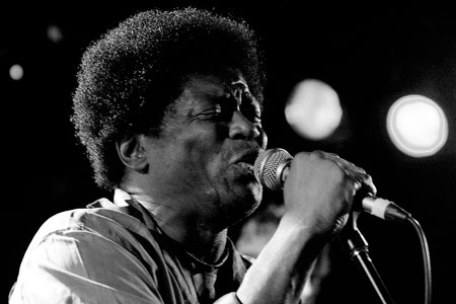
I had not heard of Charley Bradley, and so was happy to learn when we arrived that he was another Daptone recording artist who’d be singing with members of the Budos Band.

He was great!  A very affecting performance.  Bradley was born in Brooklyn in 1948 and saw James Brown at the Apollo in 1962.  “Brown’s energy formed a lasting impression on Charles. He went home and immediately began practicing microphone tricks with a broom attached to a string, imitating the Godfather’s every move.”  He first put together a band in Bar Harbor, Maine (!)– but all his bandmates were drafted for Vietnam, and he ending up finding “work as a chef in Wassaic, New York at a hospital for the mentally ill” and working as a cook for years while playing music on the side.

“Charles finally found an audience when he began making appearances in local Brooklyn clubs performing his James Brown routines under the alter ego “Black Velvet”” and he was discovered by Daptones Records at a Black Velvet performance at Bushwick.

It makes sense that Bradley is/was a professional JB imitator, as his voice is a dead ringer for the King of Soul’s, minus a lot of the vocal/melodic range; it’s a blunt instrument, but on stage he combines it to entertaining effect with JBesque moves, mostly performed fairly slowly and deliberately; he still does some of those “microphone tricks.”  Bradley’s a stocky guy, not too tall, in his early 60s and not unusually spry for someone of that age, dressed last night in very shiny and loose suit pants.  The crowd gave him a lot of love and he kept saying “I love you too!” and touching his heart and gesturing out to us all.

Here he is (at SXSW this year) performing “Heartaches and Pain,” about the murder of his brother.  Bradley starts singing about 2 minutes in.  The guy can really wail, and he exudes emotion. There’s something potentially awkward in this 60-something year-old African-American soul singer who’s been somewhat battered by life, “discovered” and brought on tour for a 95% white hipster college-town audience, but in practice it all felt very sincere and authentic.  The soul was real!

The Budos Band are an interesting group — an all-instrumental band with 10 or so people on stage, lots of horns and percussion, playing music that sounds straight out of 1972 or so, a heavy Afro-Cuban groove with a particular debt to Fela Kuti and other Afrobeat music of the 1970s.  It’s great dance music, and in person was a bit harder-hitting and decadent-feeling than I’d expected.  The music is so retro (& in eminently good/hip taste) that I thought they might have a slightly music-nerd/curatorial vibe, but they were sloshing down the Jameson’s (one of the percussionists kept sharing his bottle with two drunk girls w/ pigtails in front) and the front man (well, the guy who spoke to the audience) was prone to make comments like “so if you don’t have a copy of the Cobra [meaning Budos Band III] in your fuckin’ hands, now’s your chance to rectify that motherfuckin’ situation.”

In appearance, every member of the band could be placed on a Venn diagram chart somewhere between these poles: Al Pacino as Serpico; Zack Galifianakis; Hasidic student.  Scraggly beards up the wazoo.  The guy in the middle of this photo dropping dirt from his hands roamed the stage wielding his bass to charismatic and somewhat intimidating effect.  Here’s a video from 2010 (although they looked less hairy then).

It was fun to be at a rock show with so much dancing.  A maybe 50-ish woman next to us was rocking out in a major way.  We had to leave early for the sitter, but I bet they played for quite a while.  They’d be great for the Lotus Festival.

Heathens: Belief & Believing in the Drive-by Truckers

I finally saw the Drive-by Truckers live at the Bluebird a couple nights ago.   Great show! In a usefully thorough recent overview piece, Robert Christgau dubs them “the most productive good band on the planet” since 1998.  It’s not as catchy as “the only band that matters” or something like that, but there is something about the DBT’s that calls for that kind of measured exuberance.  I think it may be partly a matter of genre.  I’m tempted to call them the best/ most consistently good “rock” band of the past decade or so (all of their albums are good and there are really no crappy songs; Xgau considers Brighter Than Creation’s Dark clearly their best, but they tend to blend together for me on my ipod), but what is “rock” these days?  For my own archival purposes on iTunes, “rock” basically is only older pre-punk music.  I have the DBT’s under “Americana,” an admittedly stupid genre category that serves an organizational purpose in capturing a particular slice of a Venn diagram between country and “alternative” w/ people like Gillian Welch, Frazey Ford, etc.  They live in the contemporary world, musically — they’re not throwbacks or classicists, and in a way, their Southern Rock Opera is to Lynyrd Skynyrd what the Dirty Projectors’ Rise Above is to the Black Flag original — a rethinking and appropriation that recognizes the musical past as a set of codes to play with and re-deploy. But they also stick to a country/soul/ rock approach to pre-punk structured song-craft, and work within pre-existing forms in a mode of acceptance that is technically “conservative,” that makes “rock” seem like the best catch-all category for them.  (That is, they lack that attitude, pretty basic to all post-punk or “alternative” rock, of needing to defy tradition and signal emphatically that they are something very much other than what you might hear on a classic rock station.)

They went on around 10:20.  I had just come back from a conference so was beat and left early, and heard the next day that they ended up playing until 1:00.   For a while I felt slightly confused by the crowd at the Bluebird.  It wasn’t a hipster crowd at all, but also didn’t quite seem like the roots/country/Americana Bloomington audience.  It finally hit me that there seemed to be a bunch of jam-band fans in the room — white guys with dreads, a number of Widespread Panic t-shirts.  I don’t fully understand the jam-band world, but the DBT are a great live band and they get a bit loosely stretched-out on the guitar solos — they really shred — so I guess I can see why a Dead and Phish fan might get into it.

A few of my favorite DBT songs–

“Dead, Drunk and Naked” (Southern Rock Opera). When I was a young boy I sniffed a lot of glue/Mom sent me to rehab, they told me what to do/ We didn’t have much money; the lord picked up the tab/ They made me write him love songs, sitting in my room./ Now I just drink whiskey and drive around my friends./ Get a haircut, get a job, maybe born again/ And if you’re living badly, we’ll tell you how to live/ Dead, drunk, and naked.”  This probably has their single catchiest/ most irresistible guitar riff. (“The Day John Henry Died” too, maybe.)

“Heathens” (Decoration Day).  A gently strumming one w/ pedal steel and plangent fiddle. The lyrics to this one absolutely kill me: “Something about the wrinkle in your forehead tells me there’s a fit about to get thrown / If we get the van out of the ditch before morning ain’t nobody got to know what I done/ And I never hear a single word you say when you tell me not to have my fun / It’s the same old shit that I ain’t gonna take off anyone./ And I don’t need to be forgiven by them people in the neighborhood/ When we first hooked up, you looked me in the eye/ And said Pa, we just ain’t no good/ We were heathens in their eyes at the time, I guess I am just a heathen still/ And I never have repented from the wrongs that they say I have done/ I done what I feel.” Patterson Hood describes this as one of a “divorce trilogy” of songs on the album, also including the very sad “Something’s Gotta Give:” “Something’s got to give, got to give pretty soon/ Or else we’re gonna hate each other/ And that would be the saddest thing I ever seen.”

So many of their songs are about religion, ministers, churches, god (the new album’s title track, “Go-Go Boots,” is about a minister who has his wife murdered: “He was a pillar and his alibi was sturdy/ It only took a little bit of cash and the deed was done”).   Whether or not there’s actual “belief,” even if they are “heathens,” they live in a world saturated with religion.  Even their early album title, Pizza Deliverance — they can’t stop making jokes about it; I guess growing up in Alabama does that to you.  “Heathens” is (like most of their songs) about class as well as religion: “Pa, we just ain’t no good” — growing up feeling like you’re not worth that much or don’t matter. (The deep South as a geographical ghetto of the U.S.; the DBT’s first album was called Gangstabilly.)  Patterson Hood has at least a touch of ministerial charisma at the mike, too, testifying with outstretched arms.

“I Do Believe” on the new one is interesting to consider in relation to belief.  It’s a super-catchy, poppy one, and one of those devastating lyrics, really moving, about Hood’s memories from childhood of his mother: “I do believe I do believe, I know that you would never leave me/ And when you slipped the earthly binds you still live in my mind/ And when I’m gone, again I’ll find/ My way back into your kitchen/ And see you standing there in the window’s shine.” So it’s not about belief as “faith” exactly, but belief that he can still picture or imagine his mother: “I do believe I saw you standing there/ Sunlight in your hair/ Reflecting in your eyes/ I was only five years old.”  So, maybe it’s belief in something supernatural or spiritually transcendent, or maybe it’s just an expression, i.e. “I do believe I can still picture you.”  But as often happens in their songs, some sense of “faith” or “belief” accompanies the song in a way that’s hard to pin down precisely.  Maybe it’s that see yourself as a “heathen” is to accept a religious worldview in a way that few non-country (or gospel) bands/singers today do.  They’re not exactly still writing the Lord love songs in their bedrooms — well, or maybe they are, the songs just got a lot more complicated and ambivalent. [Reader AS reminded me of another line that captures this dynamic well, from Hood’s “The Righteous Path:” “I don’t know God, but I fear his wrath/I’m trying to keep focused on the righteous path.”]

They played “Box of Spiders” on Sunday, that’s a great and weird one: “My great-grandmother’s about ninety-seven/ And she is sure when she gets to heaven,/ Old St. Peter’s gonna throw his arms around her and say/ ‘I’ve waited so long for us to meet’.”  Gran Gran seems to be losing it, and the song ends:”Too mean to die. Too mean to die. Too mean.”  It’s dedicated to Gran Gran.

[p.s.  I realize I’ve only written about Hood’s songs, but Mike Cooley has tons of great ones as well…]

They are so good!  As I’m writing this I’m poking around and remembering absolutely amazing songs I had forgotten (e.g. “One of These Days” from Pizza Deliverance). Go see them!

Antidisestablishmentarianism, you prick

A friend and Moonraking reader asked my advice about the nuances of British Victorian Antidisestablishmentarianism (that is, the “conservative” position of those who opposed the drive to disestablish the Church of England, e.g. to render it no longer the official state Church).  I didn’t have a very precise answer, but when I checked Wikipedia I was amused by these examples from popular song:

The word is often referenced in English-speaking popular culture on account of its unusual length of 28 letters and 11 syllables. It is one of the longest words in the Oxford English Dictionary.[2] It is commonly believed to be the one of the longest words in English, excluding coined and technical terms not found in major dictionaries.[2] A slightly longer but less commonly accepted variant of the word can be found in the Duke Ellington song “You’re Just an Old Antidisestablishmentarianismist”. Also, in an Eminem song “Almost Famous”, he raps “get off my antidisestablishmentarianism, you prick.[3]

I would not have guessed Eminem had a particular interest in Victorian theology, but it never pays to underestimate him.