Todd Snider, Tree huggin’ lazy-ass hippie

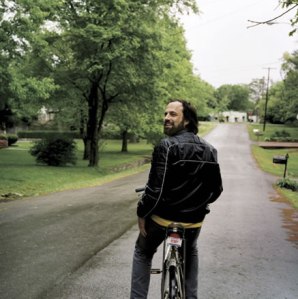
Todd Snider seems to come to town every year around spring break for two nights of shows, and I’ve always missed him, but finally caught him last night.  Snider is in his early 40s and has been playing for almost 20 years; is from Portland Oregon originally, started his career in Austin as a devotee of Jerry Jeff Walker, Kris Kristofferson, Bill Joe Shaver, and John Prine, and is based in Nashville these days.  I have two of his albums, both really great, The Devil You Know and East Nashville Skyline (the latter a Dylan joke of course).

We (Sarah and Judith and I) couldn’t quite figure out who the audience was.  It was probably the most enthusiastic and loving crowd I’ve experienced in long while — it seemed as if everyone but us knew most of the lyrics.  There was a lot of singing along, shouting requests, and behavior like randomly standing up on a chair for a couple minutes in appreciation of a favorite song.  Definitely not a college crowd (maybe he comes during spring break on purpose?), maybe libertarian, pot-smoking country music fans?

Probably the most obvious comparisons to Snider would be John Prine and Steve Earle (with a bit of Arlo Guthrie and James McMurtry).  His songs are funny/witty with shaggy-dog elements and a populist/political edge, a few of them about stoned/drunken misbehavior ending up in the holding tank.  He ambled on stage in bare feet, baggy jeans and preppy sweater and a crushed felt hat.  Came on a bit like a street busker, inviting requests, chatting a lot.

This song seems like his theme — everyone sings along:

“Conservative Christian, right wing Republican, straight, white, American male.
Gay bashin’, black fearin’, poor fightin’, tree killin’, regional leaders of the South
Frat housin’, keg tappin’, shirt tuckin’, back slappin’ haters of hippies like me.
Tree huggin’, peace lovin’, pot smokin’, porn watchin’ lazyass hippies like me.
Tree huggin’, love makin’, pro choicen, gay weddin’, widespread diggin’ hippies like me.
Skin color-blinded, conspiracy-minded, protestors of corporate greed,
We who have nothing and most likely will ‘till we all wind up locked up in jails
By conservative Christian, right wing Republican, straight, white, American males.”

Here’s an interview — I was charmed by Snider’s explanation of his approach to his finances:

I have to admit that I’m pretty blind to all the money and everything.  I’ve always given mine to this guy named Chuck.  I went to the Jerry Lee Lewis school of music business.  You can have my publishing  for a bong hit and a ride back.  Which some people may think makes me poorer than I should be…. A guy with a guitar doesn’t need a boat.  What rich guy in his right mind, doesn’t want some drunk scamp with an acoustic guitar on his boat? …I got into music by giving up on that part of the world, and promised myself I’d keep it that way.  I knew when I was 19 that I wanted to forget about money forever.

Here’s a video of Snider in a Nashville record store playing “You Got Away With It” a.k.a. “the Tale of two Fraternity Brothers”:
Genius of Mark Gormley

Have recently discovered the amazing and certainly not gormless Pensacola, Florida sensation Mark Gormley, of the haunting falsetto, jutting hip stance, inexplicable video animation and mise en scene, and trademark pleated jeans, golf shirts (what does he have in the pocket?), and upper chest band-aid. Here’s a useful overview of the career that notes Gormley’s “ability to superimpose himself onto any image of his choosing” and his “resemblance to a computer composite of every sex offender in the national registry.” Somehow the effect is of the voice and mind of a brooding, mid-1970s Dewey Bunnell-esque singer-songwriter in the body of a recently laid off Circuit City salesman.

Ian Curtis/ Kurt Cobain

Watched the Anton Corbijn biopic of Ian Curtis (Joy Division’s singer who committed suicide in 1980 at age 23), Control.  Enjoyed it a lot.  The musical performances, all recorded by the actors, are pretty uncannily good and Sam Riley is a dead ringer for Curtis.  If they toured as the Unknown Pleasures, a Joy Division cover band, I’d definitely go.

I had one thought about the parallel between Curtis and Kurt Cobain, probably a comparison drawn a million times before.  There are various links (beyond the fame and suicide), i.e. they both suffered from medical problems: Curtis’s epilepsy, the treatment of which was pretty hit or miss at that point, and Cobain’s chronic stomach problems, both of which contributed to abuse/misuse of prescription drugs.  But the movie left me with the sense that for Curtis as for Cobain, sudden fame led to a psychological crisis having to do with communication and self-expression.

I get the sense that for both men music was tied up in a fantasy of total transparency and connection with a listener/interlocutor.  They both had trouble communicating with real people, lovers and friends, but had an amazing power to speak to people through music.  It seems likely that for both men the desperation that preceded the suicide was tied up in part with a feeling that they now had a huge audience hanging on their every word that did not in fact understand them in the least.

Many of Joy Division and Nirvana’s signature songs are about the desire to be understood and the failure to communicate.  “When the people listen to you, don’t you know it means a lot?” (“Novelty”); “Walk in silence, Don’t turn away, in silence…. Don’t walk away” (“Atmosphere”); “He’s the one who likes all our pretty songs/ And he likes to sing along…/ But he knows not what it means/ Knows not what it means” (Nirvana, “In Bloom”).

Watching both men sing, you feel that part of their genius lay in a special talent for taking the basic technology of the microphone and recording technology and infusing it with a sense of complete intimacy.  They are whispering or screaming in your ear.  Control begins with a 17 year old Curtis lying on his bed listening to a David Bowie album; for kids like Cobain or Curtis, there is no voice they listen to more intently than the pop singer’s.

So my thought is that for Curtis and Cobain, this kind of mediated intimacy meant so much that when they became the star, Bowie (important for both of them), the voice that is in your ear as you fall asleep, it was hard to handle the crushing realization that this could feel false, not in fact linked to any true communication or insight, just showbiz.

Of course they both suffered from serious depression as well, so maybe this is all just unwarranted pop (literally) psychology.

Lux Interior R.I.P.

Lux Interior (born Erick Lee Purkhiser), who formed the “psychobilly” combo the Cramps with his wife Poison Ivy in 1973, is dead at age 62.

I didn’t know that he grew up on Akron, OH. Were the Cramps at all part of the whole 70s Akron scene (with Devo, the Bizarros, Rubber City Rebels), or did they split for California and NYC too soon to participate?

I stole this clip from the 33 1/3 books blog: mesmerizing footage of the Cramps performing “The Way I Walk” at the Napa State Mental Hospital in 1978.

“Somebody told me you people are crazy, but I’m not so sure about that.  You seem to be all right to me.”

The lyrics seem appropriate to the audience (and their approach to dancing to a rock song): “The way I walk is just the way I walk/ The way I talk is just the way i talk/ The way I smile is just the way I smile.”  Lots of great moments; I love the guy with the tie pretending to sing into an imaginary mike.

Neko Case “People Got a Lotta Nerve”

Neko Case is offering a free download of the first single, “People Got a Lotta Nerve,” from her new album (Middle Cyclone, due out March 3), and her record label is donating $5 to Best Friends Animal Society for every blog that re-posts it.  So, I am doing so: you can download the song here.  Here’s the explanation of the deal.  I love Neko Case, can’t get enough of her spooky, haunting voice.
The song features an elephant in a zoo, an Orca in a tank, and maybe a man-eating tiger? It’s about carnivorous animals and the way human beings try to control them and contain their instinctive violence.  “I’m a man-eater, but still you’re surprised when I eat you…. It will end again in bullets fired.”  Makes me think of Rilke’s “The Panther” and John Berger’s “Why Look at Animals.”  Also of the tiger that an archaeologist friend of ours had in her lab for her students to dissect; it had escaped from its owner at a highway rest stop in Illinois, and was shot to death by state troopers (and then made its way to the lab).
I like the song a lot, but hope Neko can live with the inevitable Hall & Oates references.

My Father, My Attack Dog

200511_032

David Berman of the Silver Jews (Pavement-associated indie rock group, basically just Berman) has announced his retirement from music and followed the announcement up with this remarkable anguished confession:


My Father, My Attack Dog
Now that the Joos are over I can tell you my gravest secret. Worse than suicide, worse than crack addiction:

My father.

You might be surprised to know he is famous, for terrible reasons.

My father is a despicable man. My father is a sort of human molestor.

An exploiter. A scoundrel. A world historical motherfucking son of a bitch. (sorry grandma)

You can read about him here.

www.bermanexposed.org

My life is so wierd. It’s allegorical to the nth. …

A couple of years ago I demanded he stop his work. Close down his company or I would sever our relationship.

He refused. He has just gotten worse. More evil. More powerful. We’ve been “estranged” for over three years.

Even as a child I disliked him. We were opposites. I wanted to read. He wanted to play games.

He is a union buster.

When I got out of college I joined the Teamsters (the guards were union organized at the Whitney).

I went off to hide in art and academia.

I fled through this art portal for twenty years. In the mean time my Dad started a very very bad company called Berman and Company.

He props up fast food/soda/factory farming/childhood obesity and diabetes/drunk driving/secondhand smoke.

He attacks animal lovers, ecologists, civil action attorneys, scientists, dieticians, doctors, teachers.

His clients include everyone from the makers of Agent Orange to the Tanning Salon Owners of America.

He helped ensure the minimum wage did not move a penny from 1997-2007!

The worst part for me as a writer is what he does with the english language.

Though vicious he is a doltish thinker

It goes on in this vein.  Pretty heavy stuff.  I find this whole family saga to be sociologically fascinating.  It’s basic Pierre Bourdieu that the offspring of the very wealthy often “trade in” the accumulated economic capital for cultural capital in the form of art/culture/education.  (A classic instance of the paradigm: I attended a private progressive high school founded by one of the sons of the founder of Merrill Lynch, whose other son was the poet James Merrill.).  The transaction whereby money is turned into culture, one kind of capital exchanged for another, often seems to serve an implicitly expiatory function as worked through generationally.  The accumulation of extreme wealth is frequently “not a pretty thing when you look into it too much,” and so one purpose of “culture” is to serve as in effect a money-laundering operation. (Not to say that’s all it is.)

So, you have David Berman, son of the union-busting lobbyist Richard Berman, working as a museum guard after college, and then going on to “hide in art” by creating eccentric, underground music, wracked with guilt about the sins of his father and perhaps about the money that made it easier for him to pursue such a life (? I don’t know, for all I know he refused to take any money from his dad, but at the least he probably didn’t have any student loans!).

I don’t intend this as criticism of Berman in the least, I’m just struck by the vividness of the way this story captures that basic logic in its most Oedipally tormented form.  I hope he’s not giving up on the Silver Jews because he feels that his art is inevitably tainted; something to work out with the therapist…

Here’s the Silver Jews’ wikipedia page.

Fated to Pretend

g11mgmt

New Pazz and Jop Village Voice rock critics’ poll.  I contributed to this for years and was always thrilled when the editors chose a couple of my elaborately-wrought witticisms/quips for inclusion in the commentary section.  The only one I remember is something I wrote about Pavement “giving the Badfinger to the rock and roll singer,” which they used as the caption for a photo of Pavement; this made my week/year, nerd that I was.

It makes me a touch melancholy how little the Pazz and Jop poll now seems to matter.  Before blogs, it was one of the only occasions (the only?) for pop music critics to crack wise, make jokes, and spin out ambitious theories apart from the strictures of a record review or band profile.  Now Robert Christgau’s over at MSN.com, and at best, it’s just another concatenation of online opinion.

So anyway, my big discovery so far from the poll (which is still useful as a guide to the year’s music) is MGMT, whose name I’d seen but had not paid any attention to.  They’re two former Wesleyan undergrads who make a kind of psychedelic electronic pop; their song “Time to Pretend” (#4 on the singles poll), extravagantly produced by a guy from the Flaming Lips, is beyond brilliant and catchy.  Youtube won’t let me embed the video for some reason so here’s the link.  Gets my vote for best/catchiest “single” of the year along with “Paper Planes” (btw can I say how ripped off I felt when I realized that the song does not actually appear anywhere in Pineapple Express, not even in the closing credits?  Whoever had the idea to use “Paper Planes” in the trailer made that movie.)

I also just finished reading Barney Hoskins’ history of pop music in L.A., Waiting for the Sun, and “Time to Pretend” resonates with the book for me as a delirious narrative of dropping out, jettisoning the straight life for good, and disappearing into an abyss of drugs, money, models, and rock and roll:

This is our decision, to live fast and die young.
We’ve got the vision, now let’s have some fun.
Yeah, it’s overwhelming, but what else can we do.
Get jobs in offices, and wake up for the morning commute?

Forget about our mothers and our friends
We’re fated to pretend
To pretend
We’re fated to pretend
To pretend

I’ll miss the playgrounds and the animals and digging up worms
I’ll miss the comfort of my mother and the weight of the world
I’ll miss my sister, miss my father, miss my dog and my home
Yeah, I’ll miss the boredom and the freedom and the time spent alone.

There’s really nothing, nothing we can do
Love must be forgotten, life can always start up anew.
The models will have children, we’ll get a divorce
We’ll find some more models, everything must run it’s course.

We’ll choke on our vomit and that will be the end
We were fated to pretend
To pretend
We’re fated to pretend
To pretend

It could be the confession of any of the lost narcissists of California pop whose stories Hoskins tells, fantasists “fated to pretend,” some geniuses, some just poseurs or hangers-on (some both, needless to say), making up their identities, doing way too much coke, marrying and divorcing models; for the less fortunate ones, an eventual ignominious death by mishap, for the luckier, eventual rehabilitation with memoir a la David Crosby.  Hoskins really allows one to see Darby Crash, Arthur Lee, and Tim Buckley (for example) as part of the same continuum of doomed/self-destructive L.A. singers.  (On rock and roll deaths, see this site.)

Anyway, the song is an irresistible “amuse bouche” as Charles Aaron put it, filled with outlandish musical flourishes and unearned grandeur.  “Kids” is also great.

Love is All “Last Choice”

Love is All are a punky Swedish pop band led by Josephine Olausson, who has a somewhat Bjork-like presence and warbling singing voice.  Amazon tells me that people who buy their second album A Hundred Things Keep Me Up At Night also buy Los Campesinos!, so I guess I’m predictable in my affinity for Western European hyper/catchy punk-pop with clever lyrics.

“Wishing Well” is a total rip-off of the Clean’s great “Tally Ho,” in a good way (that manic Farfisa riff).  See below for a video of them performing it live.

The other most memorable ones are “Sea Sick,” about a terrible cruise ship experience – would be a good soundtrack to David Foster Wallace’s “A Supposedly Fun Thing I’ll Never Do Again” — and probably my favorite, “Last Choice.”   In this one Olausson tells the story about eventually going home with “her last choice” at a party, someone she “vaguely knows”: “I’m not about to be left alone/ I’m sitting on the sofa on my own…/ He’s not my type and I’m not his but I’m sure he’s all right/ I’m not your kind and you’re not mine but for tonight you’ll have to do!”  For a song about a meaningless one-night stand, it’s weirdly touching and “inappropriately upbeat,” and somehow reminds me of that Christmas novelty song by the Waitresses (“Christmas Wrapping”).  (What is it that makes it seem Christmasy?  Is that a glockenspiel?)  There’s definitely a 1980s New Wave/post-punk feeling generally (saxophones, for example).

Carl Wilson’s Let’s Talk About Love: A Journey to the End of Taste

letstalkaboutlove

I read this a while ago but forgot to blog about it.  Strongly recommend this instant classic, one of the smartest books on modern pop music I know.  (What else would I include in that list?  Books like Michael Azerrad’s Our Band Could be Your Life, Fred Goodman’s The Mansion on the Hill, Robert Christgau’s review collections, Jon Savage’s England’s Dreaming, Greil Marcus’s Lipstick Traces, Jeff Chang’s Can’t Stop Won’t Stop, Rob Sheffield’s Love is a Mix Tape, Bob Dylan’s Chronicles Vol. 1…probably forgetting a lot…)  Wilson’s book is part of the 33 1/3 series of books published by Continuum each dedicated to one pop album, in this case, Céline Dion’s 1997 Let’s Talk about Love. The series was a great idea for many reasons, among them the fact that the books are small & cute with an attractive uniform design — they in fact look kind of like miniature LPs on the shelf.  61 books have been published in the series so far, but Wilson’s is sui generis among them (as suggested by the fact that his is the only one granted a subtitle to date — oops, just noticed the U2 book has one too).

You certainly don’t need to care about Céline Dion to enjoy the book.  Or be Canadian, although the Toronto-raised Wilson is fascinating on Dion’s roots in French-Canadian Quebecois chanson/showbiz traditions.  Wilson takes Dion, one of the top-selling pop singers of our era, now in possession of her own schmaltzy Vegas show, as a test case for the practices, politics, and poetics of taste in popular music & culture.  For Wilson, Dion’s records somewhat resemble Russian conceptual artists Komar and Melamid’s “Peoples’ Choice” Most Wanted Paintings.  Crafted according to the specifications of a poll, the paintings contain landscapes, water, the color blue, soft curves, and representational images of people and wild animals, etc.  Dion’s music is arguably the Peoples’ Choice of pop, a statistically irrefutable embodiment of broad popular taste.  So is it awful or great?

Wilson, a right-thinking hipster with “good taste,” had always hated Dion’s music, but had become suspicious of his own aversion; the book is his exploration of what it means to hate or to love Céline Dion, or any kind of music — with particular attention to subcultures, embarrassment, sentimentality, class, canons, kitsch, and shame.  Wilson lays out the ideas of Pierre Bourdieu on taste and distinction in several lucid pages (the book would work fabulously in an undergrad course on cultural theory), and he’s well-informed in theories of aesthetics generally, but he’s a working pop music journalist with a snappy, funny style, and the book is a completely fun and brilliant read.

He’s especially insightful on the meanings of “sentimentality” in today’s pop culture:

Punk, metal, even social-justice rock such as U2 or Rage Against the Machine, with their emphatic slogans of individuality and independence, are as much “inspirational” or “motivational” music as Céline’s, but for different subcultural groups.  They are just as one-sided and unsubtle.  Morally you could fairly ask what is more laudable about excess in the name of rage and resentment than immoderation in thrall to love and connection.  The likely answer would be that Céline is conformist, quiescent, unsubversive.  “Subversion” today is sentimentality’s inverse: it is nearly always a term of approval.

Here’s a collection of press, reviews, interviews of/on the bookNew York Magazine named it one of the ten best books of the year, quite a feat for a little paperback that costs $8.76 on Amazon. Here’s Alex Ross on the book.

My Will Oldham profile

will-oldham-bonnie

Here’s my Will Oldham profile.  (Here’s the New Yorkers).

Will Oldham opened the door of his Louisville ranch house, which would have been the perfect size for an upwardly-mobile young family had it not been filled with overflowing boxes of pink tank tops and multi-colored Crocs.

He punched me quickly in the face, muttering ambiguously, “I don’t like press… but I did really love that Pulitzer Prize-winning 2001 Ken Auletta profile of Ted Turner, which is the only reason I’m talking to you today.”

Chewing thoughtfully on marijuana-infused bubble gum, Oldham explained to me that he just wants to be recognized as a hip-hop superstar like his peers Li’l Wayne, R. Kelly and L’il Mama.  “I don’t understand why some listeners consider me to be contrived or affectedly backwoods,” he commented while absent-mindedly pulling old Gypsy good-luck charms, horse-shoe nails, baby mice, and fragments of burlap sacks from his bristling beard. He explained that his name changes every week according to a passphrase system “in order to keep the focus on the music.”  During our interview, his name changed to L’il Viceroy Archduke; when I accidentally addressed him as Mr. Oldham, he punched me in the face again, shouting furiously, “it’s all about the music, man!”

The brash hip-hop superstar, stripping down to nothing but a plaid flannel shirt,  a new pair of 4-color Cayman Crocs, and a pink Boston Red Sox cap, stepped into the shower. Morosely warbling the Mariah Carey smash “Fly Away (Butterfly Reprise),” he seemed to be having fun.