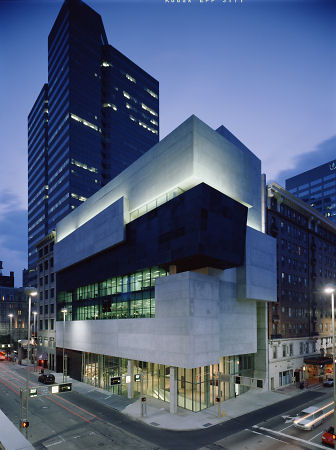
Another visit in Cincinnati was to the Contemporary Arts Center, which for a while was the only building in the U.S. designed by Pritzker-prize-winning, Rem Koolhaus-protege, Iraqi-British architect Zaha Hadid.
From wiki: “A winner of many international competitions, theoretically influential and groundbreaking, a number of Hadid’s winning designs were initially never built: notably, The Peak Club in Hong Kong (1983) and the Cardiff Bay Opera House in Wales (1994).” It’s funny to look at a (seemingly abandoned/ not up to date — only up to 1990) accounting of her early works: over and over, “Not Realized.” Here is a good, albeit somewhat skeptical, analysis of the Cincinnati museum. I like the building, although it is showy and I agree with the critique that “we are often forced to acknowledge the building at times when perhaps we should be admiring the work presented inside the building instead.” Although maybe that is not such a problem really.
(I just remembered an amusing bit in Bruce Wagner’s good novel Memorial — the protagonist is a semi-successful bitter architect who is always mentally fulminating about various international art and architecture stars including, obsessively, “fucking Zaha Hadid.”)
Right now the whole experience is very 21st-century and postmodern (or late 20th-century anyway) since the building is full of a show about the history of music videos. I actually thought it held up pretty well — although most of the videos are things you could easily pull up on Youtube, they did make sense as a curated collection, and the experience of watching them on large screens with headphones in this context was often pretty engaging. No question of course that music videos have been a major occasion for groundbreaking aesthetic experiment over the past 30 years. A lot of Bjork… there was one whole little room based around her amazing video for “Wanderlust” featuring these somewhat Snuffleupagus-like felt yak creatures. Also several Kanye West videos (“Can’t Tell Me Nothing” lip-synched by Zack Galifianakis and Bonnie Prince Billy in the sidekick/Flava Flav role = great; the “Runaway” video featuring an apparent Victoria’s Secret model in painted-on feathers in the Man Who Fell to Earth angel role = crap), early David Bowie, LCD Soundsystem, several Michel Gondry videos, Missy Elliot and Hype Williams’s fantastic “The Rain,” all kinds of other stuff.
There was a huge, noisy school group there (once they left, we were almost the only ones in the whole place) and the guards kept shutting off certain screens in order to protect the sensibilities of the little brats. There was one little room specifically dedicated to “Controversial” videos which featured little peepholes you had to peer through — quite irritating actually as, ironically, you had to kneel to see them if you were over 5′ 5″ tall. These mostly weren’t too exciting — the one I’d never seen that made an impression was the rather creepily erotic and fascinating video for a song called “Twin Flames” by the Klaxons.
We made a little Spring Break visit to Cincinnati this week, and one highlight was the show of Nick Cave “soundsuits” at the Cincinnati Museum of Art. This is not the Australian musician Nick Cave of the Bad Seeds but the African-American, Missouri-born artist. (At first I thought, geez, if you have the same name as an iconic/famous musician, wouldn’t you use Nicholas or something professionally? But it turns out the poor guy is only two years younger than the Australian Nick Cave.)
The soundsuits are body suits made of fur and (sometimes human) hair and decorated with buttons and various other appendages, tassels, sequins, feathers, and patterns. They’re really beautiful, often funny & joyful, sometimes a bit scary, sometimes in the form of bears or other totemic animals. In some ways they’re very simple — as much textile art, fashion and costuming as high-concept art; obviously influenced by drag outfits and probably New Orleans Indian Mardi Gras costumes, not to mention actual Native American or other indigenous shaman or ritual clothing. One room was screening a video of the artist (and others?) dressed in the suits, dancing and generating the sounds and noise that they are designed to make when moving. But in fact they worked very well as more static sculptural displays.
Part of what was neat about seeing them was the clever way they’d been integrated into the museum. The Cincinnati Art Museum is a big, old-school, traditional 19th-century art museum with a pretty impressive collection of Old Master-type work from the last few centuries. They scattered the soundsuits throughout the entire collection such that you follow blue arrows on the ground from room to room to come upon them integrated with the permanent collection. They often seemed to be playing off the Japanese ceramics or 18th-century French painting or whatever it was in that room; although I never felt sure how intentionally or expressly the juxtapositions had been been planned, it often felt as if there were subtle parallels or echoes at play.
The girls really loved them too, and would gasp and exclaim when we came upon a new one. It was definitely art an 8-year-old girl could relate to, all about the transformative power of costumes and dressing up.
Here’s a video interview of the artist with some of the suits:
I just discovered (via this neat online comic by Lewis) this excellent song about artistic self-doubt. Singer-songwriter Jeffrey Lewis tells the story of the time he thinks he saw Will Oldham on the subway in Brooklyn.
I kinda thought I was gonna grow up to do stuff that would benefit humanity
But it’s getting harder to tell if this artist’s life is even benefitting me
Cause I was gonna waste some time and money today to remaster some dumb old album
And on the L train in the morning, I was totally sure I saw Will Oldham,
He was wearin’ the same big sunglasses he had on stage at the Bowery Ballroom
And since I was feeling in need of answers I just went right up and asked him, I said,
Will Bonnie Prince, Palace or whatever ‘What do you think about it?
Is it worth being an artist or an indie-rock star, or are you better off without it?’
Cause I mean maybe the world would be better if we were all just uncreative drones,
No dead child, hood dreams to haunt us, a decent job, a decent home,
And if we have some extra time we could do real things to promote peace,
Become scientists or history teachers or un-corrupt police at least,
‘Come on Will, you gotta tell me!!’ I grabbed and shook him by the arm…
As the shaggy-dog song continues, Jeffrey Lewis’s own self-doubt about his own identity as an artist, with Will Oldham in the role of the successful, envy-producing artist, spirals outward such that Lewis starts to imagine Oldham himself feeling inadequate next to Dylan; and then in turn Dylan “wishing he was as good as Ginsberg or Camus;” and “Camus probably wished he was Milton too or whatever”…
I was starring into his sunglasses and I was really freakin’ out i was like,
Steamboat Willie Bonnie Prince of all this shit, you’re like the king of a certain genre
But even you must want to quit like if you hear a record by Bob Dylan or Neil Young or whatever
You must start thinkin’ ‘People like me, but i won’t be that good ever’
And I’m sure the thing is probably Dylan himself too stayed up some nights
Wishing he was as good as Ginsberg or Camus
And he was like ‘Dude, I’m such a faker, I’m just a clown who entertains
and these fools who pay for my crap, they just have pathetic punny brains
and Camus probably wished he was Milton too or whatever, you know what i’m sayin’?!’
Every week I read through the “One Page Magazine” in the NYT Sunday Magazine and have the same reaction. Really? It’s come to this?
The Meh List
By Greg Veis
Not Hot, Not Not, Just Meh.
1. Rob Schneider (except in “The Waterboy”)
2. “Best of” albums
3. Chocolate-covered cherries
4. Having a Gmail photo
5. “Ladies drink free”
6. Newt, post-candidacy
7. “The Firm”
A while ago I read this absolute rave review in the NYTBR of a European mystery thriller called Sorry (by Zoran Drvenkar). I’m partial to Nordic/European crime fiction, and this sort-of postmodern German thriller sounded right up my alley, albeit a bit gross: “Stunning… If you, my own reader, have made it this far, waded through the moral questions and the postmodern tricks of perspective and chronology, then you’ve earned the right to hear the best news: “Sorry” thrills, and it thrills immaculately.”
I read the whole thing and disliked it. This was a case where I truly was saying to myself, “Ok, wait, which person is this nailed to the wall? And who is seeing the corpse?” Too many bodies nailed to the wall, I literally could not keep track. The grotesque violence is disgusting, yes, and/but, more importantly, the theme and images of the serial killer who sculpts bodies like a conceptual artist feels rote, over-familiar, a tired trope akin to a wizard in a robe, a superhero, a damsel in distress.
I just went through this again with Jo Nesbo’s The Snowman. I actually was enjoying the novel quite a bit for the first half or so. A bit like Henning Mankell, Nesbo is very good at sketching memorable characters among the various detectives, and pulling you into their personal and work lives. At a certain point, though, the Silence of the Lambs mechanics start to dominate: yes, once again we have an insane serial killer here who expresses his pathology through creatively-sculpting the bodies of those he murders. (How often does this really happen?) In this case, he stages them as snowmen, and/or builds little snowman avatars peering in their windows. It all has something to do with a primal scene; the snowman is, I guess, the killer himself, emotionally frozen, watching the trauma.
Bleah! I regretted reading both of these (though The Snowman actually was enjoyable in some ways).
Also just read Raven Black, “Book One of the Shetland Island Quartet,” by Ann Cleeves. This is in a less gruesome, cozier English-mystery tradition. It has elements of a locked-room mystery in that it all takes place in a very small town on the Shetland Islands in Scotland. The isolated, gorgeous, windswept, insular community, layered with longstanding grudges and suspicions and alliances, is very well evoked. I have to say that ultimately I was not crazy about the way the mystery was resolved… I won’t say more, but I thought the conclusion was a slight let-down. A good read, however.
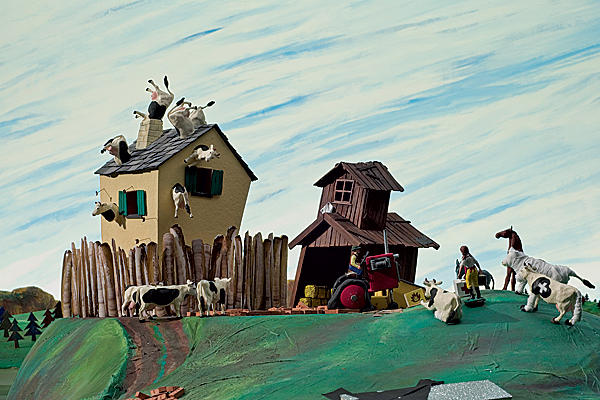
Things that happen in the animated stop-action film A Town Called Panic, featuring lurching plastic toys prone to voluble shouting in French, available streaming on Netflix:
For Horse’s birthday party, a little temporary bar is set up in the basement and everyone drinks too much. Afterwards the policeman’s wife comments, “I should’ve charged more for beers.” I have never seen so much drunkenness in a kids’ animated movie! This must have been part of what prompted one dissatisfied Netflix commentator to opine, “This is presented as a children’s movie but it is not. Maybe in France children are exposed to such language and debauchery but not in my house.” Another review: “This should have been called, ‘A Town Called Hypertension.’ It was like being yelled at non-stop by an angry, coke-snorting Frenchman.” Not coke, though: just lots and lots of coffee. At one point Policeman devours a piece of toast several times his size spread with Nutella and then actually smashes through the coffee mug in his passionate enthusiasm.
Cowboy and Indian go online to order 50 bricks to build a barbecue for Horse’s birthday, but the key sticks and they accidentally order 50 million bricks. To hide them, they stack them in a huge cube on Horse’s house, which collapses that night.
Horse sets Cowboy (which he pronounces “Cowboy” in his old-French-man accent) and Indian to rebuilding the house, but when they wake up, their walls are missing. It turns out they are stolen every night by sea monkey creatures (with plastic flippers) that emerge from the pond. The thieves carry down the wall into an undersea world where they construct their own home. It takes a while to figure this out, however.
Oh, I should stop, there is too much. Eventually Horse, Cowboy and Indian, along with one of the sea-monkey thieves, Gerard, fall to the core of the earth where their cellphone falls into the lava… And then end up on the North Pole, where they discover some brilliant and possibly evil (?) scientists who live inside a giant robot penguin they’ve created, passing their time manipulating the penguin robot to form huge snowballs which they throw hundred of miles at targets chosen for fun. Eventually our heroes escape by planting themselves into one of these snowballs, which they have aimed back at the bucolic French village where they live (and where Horse is late for his music lessons taught by the sexy lady horse). But, Gerard the sea monkey has re-directed the penguin, so when they are all tossed through the air, they land in the middle of the sea…
In sum, this is a truly demented movie and very fun… we all loved it. As another Netflix commentator observed, “The characters act just as if we are watching children playing with them, wild imagination and all. You have absolutely no idea of where this is going, what is going to happen next. The events only make sense in the framework of some kids playing.” This is true– the storyline can only be rationalized as some kind of extrapolation from a crazy kids’ game.
The closest parallel would be the early Aardman Entertainment Wallace & Gromit shorts, yet those are models of sober, careful, traditionally crafted plot development by comparison. (Of course there’s a certain parallel with the Toy Story franchise, too.)
The Frenchness of it all is wonderful, too. The drinking, coffee, the “ohh la las!” and “ah no!”s, Nutella, the charming village in which people get drunk, argue, take music lessons, and bicker about their walls, gardens, and ponds.
Activity for an MLK day holiday afternoon (no service component here…).
Materials mostly gathered on walk to park:
sticks
milkweed (or something) fluff
seeds
berries
acorns
one round box
Tools: saw, hot glue gun.
And here is the finished product, so far, the house of two fairy children and their pet mouse Rollo (made from an acorn, with felt ears and tail, unfortunately not pictured).
I especially like the seed-pod chandelier, the little canoe-like fluff beds, the leaf rugs, the table, the bowls of seeds…
Another strange young (post-Black/ post-identitarian?) California (post-?) rapper (formerly K. Dot) self-releasing gorgeous, smart music. Great song– check out the pretty piano chords and synth throb.
Has anyone in Ethnic Studies grappled with this one? “Racism is still alive” — what exactly is he saying about that statement? Is he saying it’s wrong? Presumably not, maybe just that he’s sick of hearing it, or thinks it’s a banal/boring thing to say. Or that race/ethnicity doesn’t have much to do with the music he makes and why he loves it; or that he feels bullied when he’s told that his music must express his racial identity above all (“everybody lied to y’all, and you believed it”).
“I mosh pit”: I guess he likes punk — reminds me of Canadian rapper K’Naan’s “If Rap Gets Jealous” (“I’d rather do a stage dive”).
Wizard!
Now I don’t give a fuck if you
Black, White, Asian, Hispanic, Goddammit
That don’t mean shit to me
Fuck your ethnicity
Fire burning inside my eyes
This the music that saved my life
Y’all be calling it hip-hop
I be calling it hypnotize
Yeah, hypnotize
Trapped my body but freed my mind
What the fuck is you fighting for?
Ain’t nobody gonna win that war
My details be retail
Matter of fact, don’t mistake me
For no fucking rapper
They sit backstage and hide
Behind the fucking cameras
I mosh pit
Had a microphone and I tossed it
Had a brain, then I lost it
I’m out of my mind, so don’t
You mind how much the cost is
Penny for my thoughts
Everybody, please hold up your wallets
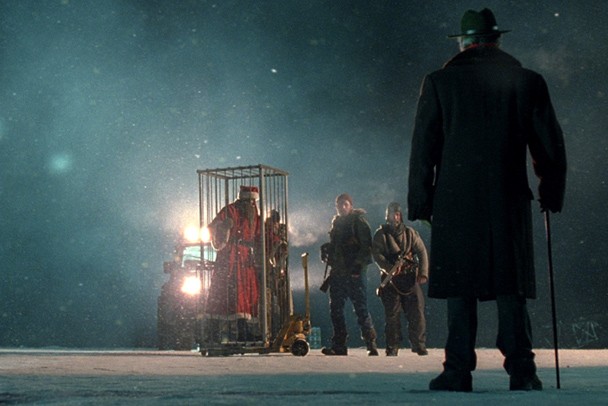
I had been looking forward for quite some time to seeing this strange-sounding Finnish film, Rare Exports: A Christmas Tale, a sort of Finnish Santa Claus horror movie. Very high-concept: evil Santa (one-upping Bad Santa). Brief synopsis from Wikipedia:
The film focuses on a group of local reindeer herders whose Christmas is disturbed by excavations on the mountain. A scientist has ordered a team of workers to dig open what he calls “the largest burial mound in the world”. An explosive used by the team uncovers what is referred to as a “sacred grave”. However, the occupant of the grave is still alive. Soon, the reindeer important to the local people are mysteriously killed, and children and supplies begin to disappear from the town. It emerges that the occupant is the source of the original Santa Claus myth; a supernatural being who, rather than rewarding good children, punishes the naughty. One family, however, manages to catch the culprit in a trap, and plans to sell it to the scientist to cover the losses caused by his excavation.
The movie reminded us in various ways of the great Trollhunter (here’s my earlier commentary on that one): a smart & scrappy low-budget Nordic independent film that draws on indigenous mythology & folklore in clever ways to make a fresh kind of American-style action/horror genre film. Rare Exports is not quite as thoroughly excellent as Trollhunter, IMO, and is a bit more of an extended high-concept joke. “Evil Santa Claus as Finnish legend” is a good enough joke to sustain the movie, though.
I read the film as being an allegory about Finnish/ Nordic cultural production and “exports” in a global cultural marketplace. It begins with young Pietari and his friend Juuso peeking through a fence at a group of Americans conducting an high-tech anthropological dig with explosives. There’s an evil-seeming group leader with a strange pseudo-American accent whose manner suggests that there’s something nefarious going on. Meanwhile we learn that Pietari lives alone with his angry single father Rauno — the mother has died — and that the family subsists on reindeer herding and hunting. First, a vast herd of reindeer is found slaughtered, apparently by wolves, but what kind of wolves would kill so many deer indiscriminately and leave the corpses untouched? Next, the town’s children (including Juuso) start disappearing.
Pietari, who has a bedroom filled with books about Finnish folklore, has a better understanding than anyone else in the town of the old legends of an evil, terrifying Santa Claus figure who was buried in the ice by Laplanders thousands of years ago. The rapacious Americans have hatched a plan to dig up Santa for profit– but where did Santa go?
So, we have a closed-off, local, indigenous Nordic community scraping by on traditional pastimes, particularly hunting reindeer. In a globalized 21st century run by multinational corporate types like the Americans, this is not sustainable (not much of a market for reindeer, which is local and Finnish in ways that don’t translate or “export” well). The American crew plans to swoop in and steal local Finnish culture (in the form of Santa Claus) to monetize it for an international market. But a scrappy, abandoned Finnish boy and his angry father save the day by using their wits and strength and understanding of local traditions to seize control of their own native culture for themselves, thereby gaining economic self-sufficiency and healing the wound left by the absent/dead mother (= an original older form of local culture, pre-globalization).
This is a spoiler: In the movie’s surprise ending, son and dad and a friend package Santa (sort of) and his elves and literally ship them off to a global audience that is eager for examples of authentic local culture. This seems a pretty direct allegory of the film itself. The rapacious Americans represent global/Americanized popular culture, which strip-mines the world’s heritage and profits from it. But resistance is possible for those who can combine techniques, forms and methods from that 21st-century global pop culture (e.g. Hollywood-style horror/suspense genre film tropes) with authentic, rooted local materials (e.g. the Finnish folklore that goes into the film). So when Pietari and his dad are boxing up the elves for export, they represent the filmmakers themselves, Pietari embodying a new generation of Finns who can break free of old assumptions of what constitutes tradition (i.e. his father’s previous belief that hunting reindeer is the only way to make a living) and find savvy ways to market their heritage in forms palatable to the new global world. (Of course the critique would be that in this process, the putatively authentic culture gets homogenized, rendered bland: no more truly scary Santa Claus.) A clever horror film proves a more sustaining way to put food on the table than reindeer meat. And these local reindeer-hunters transform themselves into savvy global marketers, a bit like the kinds of entrepreneurs who figure out new ways to export local/native crafts or artwork for the 10,000 Villages kind of marketplace.
You could think about the excellent 2008 Swedish vampire film Let the Right One In as an example of this dynamic, too.
I also have to cite this amusing Netflix review by an aggrieved defender of Santa, Christmas, and Christ:
Horrible film. Whoever created this film sure has a beef with Santa Claus. … Santa Clause and his elves are depicted as creepy, skinny, buck naked, evil beings. Hmmm, Santa Claus historically is part of the celebration of CHRISTmas and if Santa Claus is evil then….. Poor Santa gets a double whammy, first he’s evil and at the end of the film, he’s massed produced (a market commodity) on an assembly line and “programmed” by the boy who makes these Santas into droid-like Santas. If you don’t BELIEVE in CHRISTmas or Santa and want to strip your child of the pleasure, magic and joy of Santa and the hope, joy and love that CHRISTmas brings to the world, here’s your film.
Actually this reminds me that Trollhunter had an interesting anti-Christian theme to it (the trolls despise Christians; of course one could possibly interpret this as pro-Christian, defining them as martyrs, but I don’t really think it plays that way in the film).
Here’s the original 2003 short film that was the first version of Rare Exports– more sheer comedy/satire:
Another English-professor blog I always check is Moonraking, a series of ruminations on popular music, concerts, books, movies, and anything else Prof. Moonraking is thinking about. These posts combine erudition with rock-critic brio. Be warned: following his links can eat up your day. But it will be a day well spent.
Thanks Lisa, I appreciate it! This inspired me to update my moribund Blogroll by adding Sister Arts to it…





 Ivan Kreilkamp