*A Wrinkle in Time* as Cold War fiction

[The cover art of the original Farrar, Straus & Giroux edition]

We recently got through Madeleine L’Engle’s  A Wrinkle in Time, her weird & great 1962 children’s book about 12 year-old Meg Murry, her precocious/genius 5-y.o. brother Charles Murry, and their travel through a time-space continuum to rescue their missing scientist father, who has been taken prisoner by a malign intelligence known only as IT upon the planet Camazotz.  (When I read this, Celie and Iris kept correcting my pronunciation of “Camazotz,” which I assume means they decided they way Sarah said it was correct.)*

[*By the way: we’d gone through a period of several months of not doing much reading out loud.  C&I are always in the middle of a book and so they often seemed happiest just to go to bed and do their own reading.  But I’ve been making an effort to bring back the family reading-out-loud as part of the mix.]

It turned out that I did not remember this novel very well.  I remembered Meg and her little brother Charles Murry, and I kind of remembered the three strange benevolent female Abbott and Costello-named seer/witch/ angel/beings who visit to help them — Mrs. Whatsit, Mrs. Which, and Mrs. Who — but not much beyond that.

I was struck by how much of a Cold War novel this is.  Camozotz is Stalinist or Stasi, beyond the Iron Curtain, overseen by the “CENTRAL Central Intelligence Agency” and its literally all-knowing central intelligence, IT.  A friend commented to me that one of her strongest memories from the novel is of the town in Camazotz in which in front of every front door stands a boy bouncing a rubber ball at exactly the same time & in the same rhythm:

In front of all the houses children were playing.  Some were skipping rope, some were bouncing balls.  Meg felt vaguely that something was wrong with their play….

“Look!” Charles Wallace said suddenly.  “They’re skipping and bouncing in rhythm!  Everyone’s doing it at exactly the same moment.”

This was so.  As the skipping rope hit the pavement, so did the ball.  As the rope curved over the head of the jumping child, the child with the ball caught the ball.  Down came the ropes.  Down came the balls.  Over and over again.  Up.  Down.  All in rhythm.  All identical.  Like the houses.  Like the paths.  Like the flowers.

They see a boy who is bouncing a ball irregularly, out of rhythm — his terrified mother runs out and pulls him inside.  Everyone lives in terror of the oversight of CENTRAL Central Intelligence and IT, which goes beyond Stasi methods in being able to read the thoughts and consciousness of all citizens of Camazotz, who possess “no lives of [their] own, with everything all planned and done” for them.  Meg’s brainwashed brother explains to her: “Why do you think we have these wars at home?  Why do you think people get confused and unhappy?  Because they all live their own, separate, individual lives.  I’ve been trying to explain to you in the simplest possibly way that on Camazotz individuals have been done away with… that’s why everybody’s so happy and efficient.”

In Meg’s final showdown with IT over the mind of her mentally enslaved brother, who now mouths Camozotzian platitudes, she engages in an ideological showdown with this cruel “living brain” on a dais, “a brain that pulsed and quivered, that seized and commanded.”  At one point the nationalistic Cold War allegory seems especially clear when Meg, as a method to resist IT’s mind-control, recites from the Declaration of Independence: “We hold these truths to self-evident!  That all men are created equal,” etc.  But in the end L’Engle emphasizes American virtues or principles less than Christian ones (L’Engle was a serious Episcopalian), as the power of love (more than freedom, say) is what allows Meg to defeat IT and wrest her brother away from ITS power.

The novel is strongly feminist in a way that I think made an impression of me as a kid.  Meg’s mother is as talented and dedicated a scientist as the missing father, and the kids often have to get their own snacks together in the afternoon because the mother is in the middle of an experiment in her home laboratory.  And when Meg finally reaches her father and frees him, she is cruelly disappointed that he can’t make everything OK.  One of the takeaways of the novel’s conclusion is that Meg must learn to solve her own problems; as she says to her father, “I wanted you to do it all for me…. I was scared, and didn’t want to have to do anything myself.” When they land back home on earth he’s lost his glasses and is kind of stumbling around, far from the heroic father Meg had fantasized.

Now onto A Wind at the Door

“Singing religious songs and getting the words wrong”: Withered Hand

The other record I’ve been crazy about lately is Good News by Withered Hand, a.k.a. a father of two from Edinburgh with a Moldy Peaches poster on his wall named Dan Willson.  It’s pretty easy to describe the album: it sounds a whole lot like early If You’re Feeling Sinister-period Belle & Sebastian; his voice can sound like Dean Wareham’s, and on some of the songs the slightly hanging-back drumming style makes me think of Galaxie 500’s Damon Krukowski.* [* just noticed that Good News was produced by Kramer, the guy who did the early Galaxie 500 records!  So maybe that drum thing is his signature.]

The Belle & Sebastian analogy isn’t just a matter of sound, either — if Willson’s not actually a former choirboy, he’s definitely hung up on a guilty Catholic Edinburgh childhood.

Anyway: amazing, beautiful, hilarious songs!  Maybe the best lyrics are on the hymnal “Religious Songs,” an acoustic version of which you can see Willson performing on his own Edinburgh rooftop in the video below.

Really, this is a seriously incredible song.  It starts out with a lapsed-Catholic’s confusion over the ritual of the sacrament and turns into pained memories of something short of a relationship: “Remember you thought I was gay?/ I beat myself off when I sleep on your futon/ Walk in the rain with my second-hand suit on.” He still feels guilty for not singing religious songs anymore and is half-ripping off Dylan in any case (“Knocking on Heaven’s Door” counts as a religious song, I guess?).

I don’t really know what I should do
Like should I be passing this bread along to you
And I don’t really know what the wine was for
Like if this was Jesus’ blood wouldn’t there be more?
I’m knocking on Kevin’s front door
I’m singing religious songs and getting the words wrong
My hair’s getting too long, this congregation
And they’re saying, how does he really expect to be happy
when he listens to death metal bands?
La, la la la, la la la, la la la la la

If there’s manna from heaven then you’re disinclined to share
You stole my heart and I stole your underwear
You said “religion is bullshit it’s all about metaphor”
Well if I need a fence to sit on
I’ll sit on yours dreaming of Babylon’s whores

I knew you so long I ran out of cool things to say
I still bump into friends that we both had yesterday
When they ask me how I am I I lie, say I’m doing fine
Still manage to tell me you’re on an easy lake holiday well that’s OK [?]
Remember you thought I was gay?
I beat myself off when I sleep on your futon
Walk in the rain with my second-hand suit on
I walk in the rain and I’m thinking, if I happen to die tonight in my sleep
I’ll have come and not blood on my hands
La, la la la, la la la, la la la la la

“New Dawn” is peppier, sounds more like… what was that Scottish band, I can’t remember now, the Lighthouse Keepers?  Who am I thinking of?*  “I saw you at the Embassy/ We were both crippled socially/…We wrote ‘Pavement’ on our shoes…. We paid our respects, we wrote ‘Confusion is Sex,’ and on your shoulder-bag I wrote ‘the Silver Jews.'”  “I Am Nothing” is another fave: “I tried to see the world in your eyes/ I’m insignificant, that’s my size/ In the greater scheme of things I am nothing.”  [*I was trying to think of the Wedding Present who are actually from Leeds.]

Love this record.  Get this guy in a studio with Frank Ocean and see what happens!

Love me Numb: Frank Ocean

Potential album of the year is Frank Ocean’s Nostalgia, ULTRA –a free download.  This guy (nee Christopher Breaux) has some relation to the Odd Future hip-hop collective and was/is signed to Def Jam until he got fed up and released this album/mixtape himself.  It’s a very eccentric R&B album that veers in and out of wildly disparate styles —  one that sounds like Prince here (“Nature Feels”), gorgeous psychedelia tune there (“Strawberry Swing” –actually a cover of a Coldplay original(!)), etc.  Frank Ocean himself characterizes the album as “Death Metal” and “Bluegrass” — “Bluegrass is swag. Bluegrass is all the way swag” — and also compares it to Stanley Kubrick’s Eyes Wide Shut, “some visionary shit.”  To be honest I am not 100% sure how much of the music is his own since some/a lot (?) of it is him rapping over other peoples’ songs, including an amazing riff about a failed teenage marriage over the Eagles’ “Hotel California” called “American Wedding” (“it’s just an American wedding/ they don’t mean too much/ they don’t last enough”…”don’t take this hard/ but maybe we should get an annulment/ before this goes way too far”).  This isn’t just any teenage bride, either: right before the ceremony she turns in her final high school term paper, “a thesis on Islamic virgin brides and arranged marriage/ hijabs and polygamist husbands.”

Frank Ocean has a gorgeous, smooth R&B voice and has written songs for artists like John Legend and Justin Bieber (!) & part of what’s truly weird about this album is the way its formal eccentricity is combined with exceedingly high-gloss mainstream production values and high-level music chops.  What most blows me away, though, are the album’s incredibly smart, weird, sometimes devastating lyrics.

“Swim Good,” which seems to be a suicide song, features our protagonist driving around L.A. in a black suit, “roaming around like I’m ready for a funeral.”   “That’s a pretty big trunk on my Lincoln Town Car, ain’t it?” he asks.  “Big enough to take these broken hearts and put ’em in it./  Now I’m driving round on the boulevard, trunk bleeding.”  The cops stop him, but for some reason they never seem to notice all the blood from his broken hearts bleeding out from the back of the car.   “I’m about to drive in the ocean/ I’m a try to swim from something bigger than me.  Kick off my shoes, and swim good, and swim good.”   Death at sea for “Frank Ocean.”

Or the sublime “There Will Be Tears.”  “My granddaddy was a player, pretty boy in a pair of gators, the only dad I’d ever know, but pretty soon he’d be gone too.”  “Hide my face hide my face/ Can’t let em see me crying/ ’cause these boys didn’t have no fathers neither/ And they weren’t crying./ My friend said it wasn’t so bad/ You can’t miss what you ain’t had.”  And then the refrain, more or less: “Well I can” — miss what you ain’t had, that is — “I’m sad, and there will be tears.”  This in an amazing aching falsetto: “There may be smiles, but a few/ And when those tears have run out/ You will be numb and blue.”

Several of the songs fade out into an alarm clock beeping; the whole thing is, maybe, a concept album about nostalgia, emotional numbness, and dreaming on L.A. freeways. And I haven’t even mentioned the ominously throbbing hit, “Novacane,” about dating a girl in dental school whose effect on him recalls a certain drug: “But girl I can’t feel my face, what are we smokin’ anyway?/  Fuck me good, fuck me long, fuck me numb/ Love me none, love me none, numb, numb, numb, numb.”

Amazing record!  Who IS this soulful genius??

Fee Fi Fo Fum: *Trollhunter*

I’ve been waiting for Trollhunter, and it is as fun as I hoped.

The movie begins by explaining that DVDs containing 283 minutes of mysterious footage turned up in the mail (at a newspaper or t.v. station?  I forget).  What follows is that footage.  [e.g. the structure is just like The Blair Witch Project, a mock-doc based on supposedly found video.]

Three student journalists in Norway are looking into a story about bear poachers.  They start tracking a possible poacher, Hans, who drives around in a camper with strange dents and gashes in its side.  He rebuffs their efforts to question him on camera.  They follow him into the woods, where they hear strange howls and roars; he emerges out of the forest, screaming “Trolllllll! Run!”  They turn tail to flee (camera bouncing around) from a frightening three-headed troll standing 20 feet or so high, which Hans eventually kills with an industrial-strength flashlight (strong light either turns trolls to stone or, if they’re younger, makes them explode).

Turns out Hans works for an X-Files-esque government agency dedicated to the management and concealment of Norway’s considerable troll problem.  Hans is called whenever a troll is causing trouble or wandering too close to humans.   He’s disillusioned about the whole enterprise, partly, it seems, for ethical reasons: at one point he broods about the time he had to slaughter a whole community of trolls, including pregnant females and young ones not yet able to walk: “it was a massacre…”  But he’s also pissed off that he gets no overtime or night pay, and he’s sick of his boss, a hypocritical bureaucrat.  So he allows the student crew to tag along with him.

The movie is really funny about the bureaucratic apparatus of the secret troll-management program.  For every troll Hans kills, he has to fill out and file a Slayed Troll Form, which features, sort of like a car-accident report, outlines of a troll body that Hans needs to annotate based on cause and means of death.

Hans remains a slightly mysterious, brooding character of unplumbed depths.  The interior of his camper features rather lovely ink drawings of trolls made by Hans which seem to go beyond anything necessary for sheerly practical purposes.  By the film’s climax, he begins to seem like an Ahab, obsessively pursuing an implacable force of nature; or perhaps a more relevant comparison would be the Roy Scheider character in Jaws.  He’s very good at his job, perhaps in part because even as he characterizes trolls as stupid and cruel predators — “I once saw a troll trying to eat its own tail; it kept snapping at it through its legs until it fell over and rolled down the hill” — he also maintains some degree of sympathy for these ancient creatures, who are so out of place in a modern Norway.

The movie is very witty in the way it draws on and updates old Norwegian folk lore about trolls.  No Christian should participate in a troll-hunt, as trolls go absolutely crazy for the smell of the blood of a Christian man.  At one point Hans carries a bucket sloshing over with “a Christian man’s blood” as bait for a troll who is parked under a bridge in classic Billy Goat Gruff fairy-tale fashion.  (I guess the government supplies Hans with as much of the blood as he needs.)  Hans has outfitted himself in a full-body metal outfit which makes him look like the Tin Man in preparation for getting mauled by the creature: “God I’m sick of this job” he mutters.

Trollhunter, whose CGI special effects are really excellent, and I presume made on a tiny budget, made me think of the great Swedish vampire movie Let the Right One In: a smart independent Nordic film more influenced by Spielberg than Bergman. Of course part of what makes this one so excellent is the way it develops this American-blockbuster influence in an indigenous cultural context.  The trolls are closely modeled on illustrations from 18th-century Norwegian books (the director commented on a DVD extra feature).  And everything is shot on location in absolutely gorgeous Norwegian forests and coastal areas.

I’m sure the somewhat-disappointing U.S. remake will follow in good time (actually I never saw Let Me In, I guess it’s supposed to be pretty good).  If that does happen, I wonder what the filmmakers will do with the trolls’ instinctive hatred of Christians — there would seem potential for something interesting there in an American context.  But of course a lot would be lost if the film were set outside Norway.

Perhaps inevitably, the phrase “No trolls were harmed during the making of this film” scrolls at the end.  The joke reminds us of the film’s insistence that the trolls are really just animals.  They ultimately seem rather sad in their stupidity, rage, smelliness (they emit deadly farts) and obsolescence.

Los Zafiros

from http://www.acappellanews.com/archive/001759.html

I recently fell in love with Los Zafiros (the Sapphires).  I heard a couple tracks on WFHB recently and downloaded their collection Bossa Cubano from emusic.  The group’s former musical director Manuel Galbán, who was later a founding member of the Buena Vista Social Club, died on July 7 (2011), which must be why I heard the set on the radio.

I don’t know if I’d ever heard of this amazing group.  They formed in Havana in 1961, inspired by American doo-wop (the Platters) but also incorporating various more local Cuban & Latin American influences (bolero, bossa nova, samba).

This is one of their trippier numbers, that effect obviously underlined by this video:

The vocal harmonies are unearthly, especially Ignacio Elejalde’s eerie falsetto, as in “Bossa Cubana,” the title track of their collection, which gets into some kind of strange Tom Ze territory with its vocal sound effects (is that a crow?) and captivatingly stuttering rhythms.  Or the train sounds and crazily-rapid patter in “La Caminadora.”  Amazing stuff that I prefer over any of the classic U.S. doo-wop.  My favorites, though, are the haunting torch songs like “Cancion de Orfeo.”  I’m surprised that the music hasn’t been done to death in movie soundtracks.

There’s a documentary I want to see about the group, Los Zafiros: Music from the Edge of Time. This from the film’s website explains that they led troubled, fast rock and roll lives and (most of them) died young:

When the opportunity presented itself in 1965 to tour abroad with a group of Cuban performers known as The Grand Music Hall of Cuba, Los Zafiros were ready. They appeared in Eastern Bloc cities such as Moscow, Warsaw and East Berlin, though it was in Paris, at the legendary Olympia Theatre, that the five young men from Cuba really made their mark. While their international following continued to grow, escalating political tensions prevented them from gaining recognition in the United States. Los Zafiros returned to Cuba at the peak of their success, though problems had already begun to appear between the members.

As the popularity of the group increased, Galbán’s role expanded well beyond the music. A firm hand was needed to guide the talents and temperaments of these passionate young men. A fight between Kike and Chino one night at the Oasis Hotel completely destroyed a hotel room. Stories of their misbehavior became almost as much a part of their appeal as the incredible sounds they produced. Going without food or sleep for days at a time, Kike, Ignacio and El Chino often hit the bars as soon their doors were opened. They were killing themselves and there was nothing anybody could do about it.

With hit records rolling out of Havana’s EGREM Studios, the growing excesses of Los Zafiros’ were forgiven though not completely forgotten. Foreign promoters, afraid of the group’s increasingly disruptive reputation, eventually began canceling many overseas tours.

Within Cuba, their notorious activities and the changing musical tastes caused the quintet to drift out of political and professional favor. Frustrated by the unprofessional conditions and declining interest in the band among Cuban fans and international promoters, Galbán left the group in 1972. After his departure, the remaining members tried singing with an orchestra and made a few recordings but the results were not as before.

Los Zafiros spiraled downward until officially disbanding in the mid-70’s. Ignacio died in 1981 at 37 from complications of several heart attacks. Kike died at the same age in 1982 from cirrhosis of the liver. El Chino, beset by severe vision, speech and drinking problems, lived alone back in Cayo Hueso until his death on August 8, 1995 at age 56.

*Louie* and experimental sitcom form

I’ve become sort of obsessed with Louie, the sitcom starring comedian Louis C.K.  Someone I know who’s in the comedy biz raved about him a while ago which finally prompted me to check out the show (which is on FX — I think the second season is currently going?  I have it set to “record all” so I’ve been watching a lot of shows from earlier this year, I think.  Season one is on DVD.)

It’s pretty brilliant!  Probably the best new comedy show I’ve seen since Curb Your Enthusiasm, with which it has some things in common.  The structure is basically like Seinfeld: Louis C.K. is playing some version of himself, a (now) recently-divorced father of two girls, 5 & 9, and a somewhat successful standup comic, although the t.v. Louie is somewhat less successful than the real Louis.  Every episode includes some of the Louie’s (or is it Louis’s?) standup routine, which usually relates in some way to what it going on in the show… although it doesn’t always.  In fact part of what I find striking about the show is its embrace of discontinuity, loose ends, and incoherence.  Sometimes there’s just an element of sloppy production, but it also seems intentional, part of an purposefully loose-ended aesthetic strategy.  Louie himself is a a schlub, overweight, balding, with money issues since the divorce, lonely and depressed.  42 years old (maybe that’s one element in my bonding with the show; the show is about what it feels like to be 42 in various ways… from a certain perspective anyway).  He has an expressively dour face which often falls into a look of suppressed desperation.  Louie’s experiences as a (divorced) father play a major role, and the show is hilarious and unusually honest/realistic about parenting & kids.  (Someone told me that his kids remind her a bit of our daughters, which I can kind of see!)

So, there’s some Seinfeld, some Curb Your Enthusiasm (often wince-inducing, feels improvised), and some influence from Taxi or other 1970s shows.  Louie has a blue collar vibe, presents himself as a regular, beaten-down NYC guy (although he grew up in Boston, Newton specifically).  In the opening credits, which show Louie lumbering up the stairs from the subway, eating a slice of pizza and then heading into the basement comedy club, the lettering is very retro 1970s, a lot like Taxi specifically I think; I heard Louis C.K. on Fresh Air mention his admiration for The French Connection so perhaps there’s a more general 1970s media influence.

The show’s theme song, playing as Louie eats his pizza etc., is a new version of that early 1970s song (about an inter-racial relationship, interestingly) “Brother Louie:” “Louie Louie Louie Loo-ee, Louie Louie Louie Loo-ayy, Louie Louie Louie Loo-ee, Louie you’re going to cry,” although cry is changed to “die” in this version.  Super grim.  Gee, you can really see why the producers would think that would be an irresistibly catchy theme.

The show has occasionally made me laugh until I had tears in my eyes… Although lately I’ve been laughing out loud less often, more often admiring it and sometimes being rather amazed at the very dark, sad, or ambiguous places it goes.

The best example of that (the dark places) might be an episode I just saw.  The show begins with Louie’s routine; as he heads backstage he finds what appears to be an old friend he has not seen for years.  This guy is also a comic, someone who started out with Louie when they were in their early 20s.  It becomes clear the guy is pretty depressed and not doing that well.  He explains that he’s on the way to Maine for a gig in Bangor and just stopped to try to say hello to Louie, whom he convinces to drive around with him.  First they go to a liquor store, where the friend buys a big bottle of vodka which he starts drinking in the store.  When the guy at the counter tells him not to do that, the friend rails against him with racist insults (“curry jockey” or something — the guy’s South Indian).  Louie is disturbed, but gets back in the car.

They end up hanging out in a parking lot in Brooklyn drinking vodka.  The guy is bitter, sarcastic and obviously jealous of Louie’s success.  Louie obtusely does not get it for a while, but finally the penny drops that when his friend talks about “stopping,” “ending it,” he is not talking about his career in standup, but his life: the plan is to do the final show in Bangor and then take some deadly pills a doctor prescribed to him for some reason.

Louie is stunned, but tries to argue with him; his friend cuts him off, mocking him for his big life-affirming speech.  Then he relents and says more kindly, “I just wanted to say goodbye.”  Finally Louie says something like, “OK.  I guess there’s not much I can tell you.  I found reasons to keep living, I can’t find those for you.  I really hope you don’t kill yourself.  I need to go, I have to take my kids to school tomorrow morning.”  They embrace, and Louie heads towards the subway.

End of episode!!!!!   This one did not really have a single laugh in it (well, maybe a few very uncomfortable ones).  Pretty radical.  Oh, I forgot one key element: a few times the show cuts to a black-and-white flashback featuring two actors portraying Louie and the guy twenty years ago.  It’s very stylized, almost in a 1940s movie mode or something — like we’re seeing the gangster and the priest when they were kids, before their lives diverged, or something — and these younger actors don’t look much at all like the two guys.  As far as I could tell, there is no subsequent reference to the suicidal buddy (although I may be watching all out of order so maybe I did miss something).

Ever since Seinfeld it’s been axiomatic that a smart sitcom must at all costs avoid the “very special episode” trap: the occasional “serious” episode that aims to tug the heartstrings.  This has been a good discipline for many shows, but I think Louie shows how much is left out if a comedy can’t also try to tackle more emotionally powerful material as we’d expect a novel or movie to do.

Another strange episode, this one also very funny.  In the hall at the elementary school, another parent, a mother, asks Louie if he would be willing to sign on to a petition to protest a new flat-screen t.v. that’s going to replace the message board at the school entrance.  This woman thinks it sounds “propagandistic” in aim.  Louie admits he has not thought about it and does not really have an opinion, which the woman characterizes as a sellout position.  She starts to leave, but then returns and asks if Louie might be interested in going out some time.  Before he can say much, she cuts him off and explains that she has no interest whatsoever in a relationship, she just hasn’t had sex for a very long time, “and you seem safe and discreet.”  He agrees to come over that night.

Once he arrives (and finds her in a dowdy nightgown), she asks if he brought condoms.  When he shows them to her, she makes a face and instructs him to go to the deli downstairs to different non-Latex ones, along with some Monistat (or something for some vaginal ailment) and blueberries.  She hands him a twenty dollar bill and when he says he can cover it, she says “oh no, I’m not going down that road!” and forces the twenty into his hands. (The actress is hilarious.)  He buys the condoms and the medicine and has to go to another store for the blueberries.

Once in bed, all she wants to do is to have him spank her; he hesitantly does so, which prompts her to start crying and calling out, “daddy, daddy, I’m sorry, I’m sorry, I’ve been so bad.”  The episode ends at the kitchen table where the woman repeatedly takes a little mouthful of whipped cream from the canister and then a small spoonful of blueberries, while Louie looks on in stunned silence.  She says to him, “so, have you begun thinking about middle schools yet?”

End of episode.  Really more like a Mary Gaitskill story than a sitcom.

Although Louis’s standup mode is on the crude and direct side, there’s something very artful and even experimental about the show, which seems interested in playing with the (under-explored) possibilities for innovation within the rigid sitcom form [as our friend Josh observed, I should have credited him].

Ideas and Idealessness in *Rise of the Planet of the Apes*

I happened across these comments (by Vadim Rizov in GreenCine, via Jim Emerson’s Sun Times commentary) about the seeming paucity of allegorical meanings in Rise of the Planet of the Apes (especially considering how metaphorically laden the franchise has been in the past, particularly in reference to race):

“Rise” decides it doesn’t really need resonance or grown-up subtext. It has something better: digitally rendered monkeys that can move really fast. When the chimps make a run for the woods, they move at velociraptor speed. The ’60s and ’70s didn’t have such technology and relied on profundity, but “Rise” doesn’t need ideas…. Steve warns Will not to get too emotionally involved in his research since investors want results, not feelings. The metaphor applies to the movie—it’s mostly mechanical, honed on results rather than motivations—but it makes for good craft, and the chases rule.

I thought this was a good point that made me think of Neal Gabler’s thinkpiece in yesterday’s NYT Sunday Review (is that what they’re calling it now?), “The Elusive Big Idea,” in which he argues that “in effect, we are living in an increasingly post-idea world — a world in which big, thought-provoking ideas that can’t instantly be monetized are of so little intrinsic value that fewer people are generating them and fewer outlets are disseminating them, the Internet notwithstanding. Bold ideas are almost passé.”

I think there are some problems in Gabler’s claims… For example, “To paraphrase the famous dictum, often attributed to Yogi Berra, that you can’t think and hit at the same time, you can’t think and tweet at the same time either, not because it is impossible to multitask but because tweeting, which is largely a burst of either brief, unsupported opinions or brief descriptions of your own prosaic activities, is a form of distraction or anti-thinking.”  Thought cannot occur in fragments, in small bursts or pieces?  Tell that to Nietzsche or Oscar Wilde.  Thought cannot occur socially, manifested less in individual geniuses than in social networks?  Tell that to… I dunno, Addison and Steele.

But, I don’t think Gabler is entirely wrong that our culture today is less interested than it used to be in “ideas that can’t instantly be monetized” or instantiated in some technological form (or that Twitter has its limits as a vehicle for powerful or fully-articulated ideas!).  In that sense, I agree with Rizov’s reading of Rise of the Planet of the Apes, which abandons allegory or deep/”hidden” meaning for kinetic motion and technological spectacle and illusion.

The movie can be understood more positively in this sense through the lens of something like Sontag’s “Against Interpretation.”  It’s beside the point to plumb its depths for “meaning” or allegory.  One should instead meet it on its own terms via immersion in the flow and kineticism of its spectacle.  I was dazzled and entranced by the movements of the apes: hurling themselves through the air, confined in indoor spaces and then, in their freedom, unconstrained & released, turning San Francisco into a Parkour environment for flying, swinging, spinning, ricocheting.  The scene where the driver and the jogger stop at the strange sight of rustling trees and falling leaves on a suburban street, and then turn their gazes upwards to see the shadowy apes traversing the city above the treeline, is extraordinary.  At some level the apes have to be figures for the camera itself, released into three-dimensional exploits unimaginable before the rise of contemporary action film technologies, allowing human vision to transcend ordinary, ground-bound limitations.

The film arguably does enact a “meaning” which can be described as a fulfillment of a belief in ape species-being flourishing in kinetic movement and activity.  The trajectory of the movie is from confinement, and subordination to human control, to a unchecked flow of pack or tribe bodily expressiveness through movement, from tree to tree, structure to structure, and more broadly away from city towards the forest.  “Evolution becomes Revolution” (the film’s tagline), linear movement becomes the “monkeying around” of spinning, rotating bodily performance.  So when Rizov comments that “the chases rule,” he’s being a bit too dismissive, IMO, of the “deeper” (though that’s not really the right term) meaning of the chases, which enact and display the movie’s primary values in jaw-dropping ways.  And in this sense this is definitely a Planet of the Apes movie for our moment.

That said, the human acting [by this I mean by human beings portraying human beings; Andy Serkis as Caesar is fantastic] was really lousy!  James Franco called to mind his wooden Oscar-host performance (very little movement kinetic or otherwise).

*Cedar Rapids,* Eliot Coleman, and the Midwestern greenhouse dream

[image: http://www.urbanfarmonline.com/urban-gardening/backyard-gardening/small-scale-greenhouse.aspx%5D

We watched the El Helms movie Cedar Rapids: Ed Helms is Tim Lippe, a modest, upstanding, nerdy small-town Iowa insurance salesman who is sent to a conference in the glittering fleshpots of Cedar Rapids, IA, which functions (often wittily) in the movie as a very tame/toned-down version of Las Vegas in The Hangover.  “Sometimes a girl just needs to go somewhere where she can be someone else,” a character comments; what happens in Cedar Rapids stays in Cedar Rapids.  It’s not bad… Helms and his roommate, similarly modest/upstanding/pious salesman Isiah Whitlock Jr., are both very amusing in their shocked disapproval of the wild goings-on (swearing, drinking shots, swimming in the hotel pool after hours) at the conference, embodied in their other crass roommate played by a good John C. Reilly.  There’s a funny running meta-joke about Isiah Whitlock’s nerdy (African-American) character, who is “a fan of the HBO series The Wire” and at one point puts on his best ghetto Omar imitation for purposes of intimidation; Whitlock played corrupt State Senator Clay Davis in The Wire.

Ultimately I’d categorize this as one of those movies that if you stumbled upon, you’d be pleasantly surprised; not exactly a must-see, though.  Sadly these days that probably makes it one of only a small handful of decent recent Hollywood comedies?  Sarah made a good point that the movie would make more sense if the characters were teenagers, and that it’s probably (a la Hot Tub Time Machine) intended for 40-somethings with fond memories of 1980s teen movies; I immediately could see the whole thing taking place at a senior class trip or some such.

Anyway… we were both amused when the Anne Heche character asks Helms to tell her about his dreams and fantasies, and he starts explaining his desire to build a small backyard season-extending greenhouse.  “A greenhouse?  Come on…” she says, meaning, “I want to hear about major life fantasies, not little DIY backyard projects,” but Helms says, “no, really, it can be quite affordable if you build it yourself.”

This was funny to us and hit a bit close to home because Sarah has been obsessed with this very possibility even since our friend Judith offered us her quite-awesome built-in greenhouse which she does not use.  Of course, the question is whether it would be remotely practical to move the fragile, glass-filled thing the 7 blocks to our yard, but Sarah has been scheming about it and dreaming of December fresh lettuce and greens.

I’m reading & enjoying that Melissa Coleman memoir about her upbringing on her father Eliot Coleman’s famous Maine organic Four Seasons Farm (which we visited last month; Sarah even managed to schmooze with Coleman himself a bit), THIS LIFE IS IN YOUR HANDS: One Dream, Sixty Acres, and a Family Undone… Elliot Coleman was an innovator in popularizing organic farming techniques that allow for vegetables throughout the winter– greenhouses and root cellars playing a key role.  Sarah would also like a root cellar of course.

In a way, that a character in this kind of Hollywood comedy would be dreaming about a backyard greenhouse can be understood as a sign of how far the influence of Eliot Coleman and his ilk has spread in the U.S., far beyond the counterculture.  Next all Tim Lippe needs are some chickens.

Dana Spiotta’s *Stone Arabia*: a musical tree falling in the woods

The one other novel I read in the midst of my Classic Doorstops was Dana Spiotta’s new Stone Arabia (link to Amazon where it’s for sale for less than $14).  This was also my first Kindle book purchase of over $1.99 or so.  I have to say that the whole Kindle (on iPad) experience was pretty great.  There I was up in Maine — the libraries did not even have the novel in yet, and in one minute I had it downloaded for $12.99.  Sarah keeps telling people that I “clutched the iPad to my breast like an infant” the entire time in Maine which I think is a gross overstatement, but it’s true that I do love my enchanted/ing tablet.  Reading in bed can be mesmerizing… no book light… the words hang in space, luminous and abstract.  Flip, flip, flip with your finger like Merlin or the Wicked Witch navigating a magic crystal.

I enjoyed this novel but don’t think it’s as strong as her great previous one, Eat the Document, which was based loosely on the life of Cathy Wilkerson, I believe, the former Weather Underground radical who changed her identity and lived ‘underground’ for a decade after playing a role in the accidental explosion of her father’s Manhattan townhouse.  Eat the Document is one of my favorite novels of recent years… Stone Arabia is well worth reading, especially if you’re a pop music fan, but felt to me slightly schematic or high-concept (movie-ready) by comparison.  The narrator is a woman, Nicole, whose older brother Nik almost made it as a rock and roll star, but (kind of along the lines of the Ben Stiller character in Greenberg?) missed out on success due to some combination of intransigence, eccentricity, and refusal to compromise.   Nicole narrates the novel, but big chunks of it constitute Nik’s “self-curation,” in the form of an obsessive project of semi-fantastic memoir, telling in great detail the counterfactual story of his major success and decline as an internationally famous pop star, including elaborately fabulated documents such as record reviews, fan mail, etc.  He also records cd after cd of his increasingly strange music, which he distributes in tiny, fully-packaged editions to a small circle of family members.  [btw, Great Jones Street (1973) by Spiotta’s mentor Don DiLillo, about reclusive, Dylan-esque rock legend Bucky Wunderlick and the theft of his unreleased recordings, hangs over this one.  The title of Spiotta’s last, Eat the Document, is appropriated from a Dylan tour documentary, fwiw.]

In this sense Stone Arabia reminded me a little bit of Jonathan Lethem’s The Fortress of Solitude, with the similar structure of a narrator describing a close family member’s eccentric, non-circulating project of self-memorialization or curation.  Or I suppose it’s a bit different in that in Lethem’s novel the father is simply working on a never-ending private artwork (an avant-garde film)… but there’s a similar feel in the relationship and the way the novel contains and represents a displaced self-memorialization.  Towards the end the self-curation takes a final turn of the screw when Denise’s daughter, Nik’s niece, begins a documentary film about Nik and his projects.  The novel is thinking through very of-the-moment questions about the meanings of our self-documentation, the degree to which celebrity has become normalized as a life path for ordinary people (Youtube stars, etc), and the psychological/social effects of viewing one’s own life as a “project” or a mediated story.  When self-documentation ends, can life or identity continue?  The threat of suicide-via-data-erasure (or cessation) hangs over the narrative (with almost P.K. Dick overtones at times).

Spiotta obviously knows and understands pop music, underground celebrity, the contemporary mythologies of semi-popular culture, from the inside, and so the portrayal of Nik is really compelling.  He’s a fictional cousin to real-life “lost” figures of underground music along the lines of, I don’t know, R. Stevie Moore, Skip Spence, Scott Walker?  Especially since the 1980s, we’ve been drawn to the narrative of unknown post-punk/rock legends who emerge and reveal a fully-realized body of work that was recorded but kept secret or totally ignored. It took a few decades of rock and roll history to allow sufficient sedimentation of the historical record such that giants could be “discovered,” preserved in amber from some previous strata.  Rehabilitation projects, reclaiming the marginalized, almost a World-Music-ization of Western pop, finding the primitive genius out in in the wilds.  With bands like Pavement and Guided by Voices, this became an increasingly conventional means, even, of launching oneself as a band or musician “out of nowhere” — generating the effect of “who are these guys?  Who made these strange artifacts?  Who plucked then from obscurity?”  Nik intentionally withdraws and chooses to perform as a pop music star in a private world of non-circulation, yet with a fully-articulated story of public significance, turning himself into a musical tree falling in the woods.

Stone Arabia has received rapturous reviews — “Evocative, mysterious, incongruously poetic…gritty, intelligent, mordant, and deeply sad,” NYTBR — and I think they’re are at least partly deserved… But in the end I agree more with the review in New York Magazine that praises the novel highly but complains that Denise can feel somewhat “generic…  a packhorse for all the familiar baggage of modern life;” we’re always looking through her to get to her mysterious brother’s more interesting, and only partly accessible, consciousness.

Still, if you like rock and roll/pop music fiction, this is a good one; not as great as A Visit from the Goon Squad, IMO, but in some ways a worthy pair to Egan’s novel from last year.

Excruciating & Tragic Dentistry of Buddenbrooks

I had two wisdom teeth removed on June 3.  Dentists had been telling me to do so for at least 15 years, maybe longer.  I’m not sure how my current dentist convinced me; I think in part because he was pretty lowkey about it, and didn’t seem to be pressuring me.  Anyway, I made the appointment and had it done.  The few days immediately afterwards were not as bad as I feared.  The pain, managed with Vicodin for a few days and then a lot of ibuprophren, was very bearable.  I went to my office to do some work on the Monday after the Friday appointment and felt ok.  However — the (bearable & manageable) pain did not go away.  It turned out that I had the disturbingly-named Dry Socket.  I ended up going back 4 times or so for Dry Socket treatment, which consists very simply in sticking some intense clove oil, and clove oil-soaked gauze, in the back of your mouth.  It tastes absolutely terrible, like you’ve just swallowed some kind of potpourri spice ball, and numbs everything for a while.

So I kept going back… finally the dentist himself met with me… They were worried about infection, but the wounds were healing fine.  In they end they told me that at my age, early 40s, it’s not so unusual to have a long reaction time as the teeth readjust themselves.  I kept taking 9-12 ibuprophren a day, which is what I needed to go about my business (it still hurt, too), and it was seeming like quite a long time to be keeping up that rate of the medication, I was getting a little worried about the ol’ liver — and then finally in late July it just stopped hurting, all of a sudden.  I’ve had occasional twinges since then, but only enough to make me feel relieved that the real pain is over with.

Kids, get your wisdom teeth out before you’re 30!!

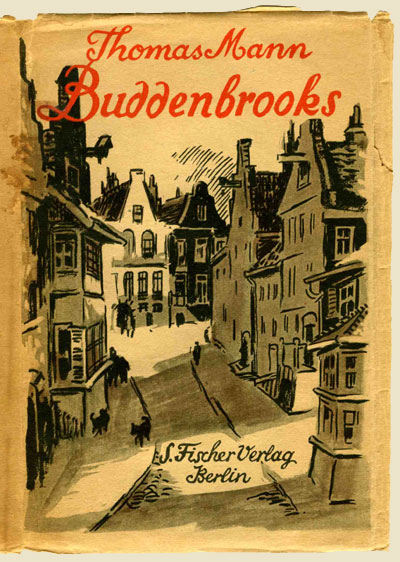
Anyway, as I was enduring this in July, I was reading Thomas Mann’s Buddenbrooks.  I kind of have a tradition of trying to read at least one door-stopper classic work of fiction, preferably one not directly related to ‘work,’ when we’re in Maine.  I absolutely loved Buddenbrooks; I’d read The Magic Mountain a few summers ago, and I think that’s more original, weirder and probably greater, but BB (published 1900) would be a good candidate for the Last Great Nineteenth-Century Novel, one of those (like Conrad’s, James’, a few others) that seem to have one foot in the realist novel, one just starting to move towards new approaches (although BB is pretty heavily realist).  It’s mindblowing to me that Mann published in at age 26 — amazing.

Anyway, in some ways Buddenbrooks turned out to be exactly the wrong choice for me this summer because it contains so many hair-raising descriptions of painful dentistry.  It’s practically a Big Book of German Smiles.  And without giving anything away, this is a novel that demonstrates very vividly how dangerous 19th-c dentistry could be for a patient.

The young boy Hanno, whom I presume is based on Mann himself, has teeth which

had been a source of trouble and the cause of many painful episodes… His teeth, which were as beautiful and white as his mother’s, were unusually soft and brittle; they came in all wrong, crowding each other.   And because these complications had to be corrected, little Johann was forced early on to make the acquaintance of a terrible man: Herr Brecht, the dentist…

The man’s very name reminded Hanno of the horrible sound his jaw made when, after all the pulling, twisting, and prying, the roots of a tooth were wrenched out.  The mere mention of that name would jolt his heart with the same fear he felt whenever he had to sit cowering in an armchair in Herr Brecht’s waiting room…

Hanno would sit there in a limp cold sweat, unable to protest, unable to run away — in a state no different from that of a felon facing execution — and with enormous eyes he would watch Herr Brecht approach, his forceps held against his sleeve, and he could see the little beads of sweat on the dentist’s brow and that his mouth, too, was twisted in pain.  And when the ghastly procedure was over — and Hanno would spit blood in the blue bowl on his side and then sit up pale and trembling, with tears in his eyes and his face contorted with pain — Herr Brecht would have to sit down somewhere to dry his brow and drink a little water.

(Part of what’s amazing and excruciating here is the way Herr Brecht suffers along with Honno…)

Here’s another scene in which Hanno’s father Thomas Buddenbrook sits in Herr Brecht’s chair:

Thomas Buddenbrook grasped the velvet armrests firmly with both hands.  He barely felt the forceps take hold of the tooth, but then he heard a crunching sound in his mouth and felt a growing pressure in his head…. It took three or four seconds.  Herr Brecht quivered with the exertion, and Thomas Buddenbrook could feel the tremor pass through his whole body;  he was pulled up out of his chair a little and heard a soft squeak coming from somewhere deep in his dentist’s throat.  Suddenly there was a violent jerk, a jolt — it felt as if his neck had been broken — and one short loud crack… [H]ot pain raged in his inflamed and maltreated jaw; and he felt quite clearly that this was not what had been intended, that this was not the solution to his problem, but simply a premature catastrophe that had only made matters worse.

Ow!  I can read it a bit more dispassionately now, but I was really squirming and clutching my jaw when I first read it a few weeks ago.  Of course modern life is crap in many ways, but I feet deep gratitude to live in the post-anesthesia era.  They knocked me out for the wisdom teeth, I did not feel a thing.

Then, I finished Buddenbrooks earlier than I thought I would, and decided to move on to Classic Bookstop #2, Anna Karenina, which I read in high school, I think, but not the Pevear/ Volokhonsky translation I’ve been curious about.

There’s certainly not as much dentistry in this, but there is this interesting passage when Anna Karenina’s husband finally learns definitively that Anna has been unfaithful to him:

He felt like a man who has had a long-aching tooth pulled out.  After the terrible pain and the sensation of something huge, bigger than his head, being drawn from his jaw, the patient, still not believing his good fortune, suddenly feels that what has poisoned his life and absorbed all his attention for so long exists no more, and that he can again live, think and be interested in something other than his tooth… The pain had been strange and terrible, but now it was gone; he felt that he could again live and think about something other than his wife.

Perhaps Tolstoy had had better luck with dental care than Mann.

It’s a somewhat chilling image.  You can sympathize with him to whatever degree the tooth in the metaphor is the affair, but the tooth also seems to be Anna herself, whom Alexei proves very ready to discard as something poisonous and tainted.

There are probably some (likely boring) dissertations out there on such topics…