Konrad Lorenz, Selma Lagerlof, & Nazi chickens

I recently read through (meaning skimming parts of it) an interesting book, Patterns of Behavior: Konrad Lorenz, Nico Tinbergen, and the Founding of Ethology (Chicago), by Richard Burkhardt, Jr., about how the study of animal behavior emerged from its former place as a sub-category of natural history to become a full-fledged science in the twentieth century.

With apologies for going straight to the most sensationalist aspects of the book, Lorenz’s accommodation to the Nazi regime, and the Nazis’ promotion of his work, was a bit shocking for me to discover (as someone with vague pleasant memories of reading King Solomon’s Ring in high school).  Lorenz was (for a time) a Nazi, notwithstanding his supporters’ attempts to cover this up or whitewash it after the war.  In a major 1938 speech in Bayreuth, he

proposed that the degeneration of instinctive behavior patterns in domesticated ducks and geese corresponded to the cultural and genetic degeneration of civilized man…. The danger to the race, he warned, lay in the undesirable types that proliferated under the conditions of civilization.  Summoning up an image with which the Nazis were obsessed, the naturalist who only a few days before had applied for the membership in the Nazi party likened degenerate members of society to cancerous cells in an organism: ‘Nothing is more important for the health of an entire people than the elimination of invirent types, which, with the most dangerous and extreme virulence, threaten the penetrate the body of a people like the cells of a malignant tumor.’

Lorenz’s arguments found favor with an important Nazi psychologist, Erich Jaensch, who drew on Lorenz’ basic claims in order to compare “the pecking styles and other characteristics of northern vs. southern races of chickens.”

[Jaensch] concluded that the differences between northern and southern races of chickens paralleled the differences between northern European and southern European races of humans.  Northern chickens pecked steadily and accurately while southern chickens pecked rapidly but impulsively and inaccurately.  This mirrored, he claimed, the calm, measured, and tenacious behavior of northern, Germanic types as compared with the restless, lively, and flexible behaviors of Mediterranean types.

Wow.

Ethology did begin to improve in the post-National Socialism 1950s.

One non-Nazi-related detail that also caught my attention was that Lorenz credited his childhood love for animals, in part, to

Selma Lagerlof’s classic children’s book The Wonderful Adventures of Nils, which was read to him when he was about six.   Nils is the story of a boy who is magically changed into the size of an elf and flies off on the back of a barnyard gander with a flock of wild geese.  By Lorenz’s account, the story led him to want to become a wild goose himself or, failing that, at least to have one…. In Lagerlof’s classic, wild geese are identified as clearly superior to their barnyard cousins.  Thus, beginning with the bedtime stories of his childhood, Lorenz was taught that wild animals are stronger and more admirable than their domestic relatives are.  This idea would feature significantly in his thinking for the rest of his life.

Because my daughters must learn of the superiority of the hearty wild Swedish goose to its emasculated domesticated cousin For some reason I felt compelled to get hold of a copy of Nils, which we read to the girls.  It’s a pretty great book, although at a certain point it kind of devolves into a Swedish travelogue in which Nils learns about each region of the country as he flies around on the back of his goose friend.  It’s an anti-cruelty book, among other things; Nils gets turned into an elf because of his mistreatment of farm animals, and he has to go through his adventures to learn a new comradeship with his feathered and furred friends.
Funerals and Bis Poles

I hadn’t been to one in several years, but this week I went to funerals on Friday and Saturday nights: Friday night here in town, a colleague who was murdered, Saturday night in NYC, a relative, younger than me, who died suddenly.  It was very weird to be in that funeral space, literally and psychologically, twice in two nights.  (Sorry to my friends whom I didn’t have a chance to see in NYC — it was a quick and sudden trip.)

On Sunday morning I was up and had two hours before a family brunch on the upper East Side, and since I noticed that the Met opened at 9:30, I headed over there.  I didn’t have an urge to see modern art, but headed first to the Ancient Greek and Rome wing and the the sarcophagi, or “flesh eaters,” the name referring to the limestone that was thought to dissolve the flesh of the corpses laid within it.  In the mood I was in, all of the artifacts seemed death-obsessed, and I was thinking about how so much human creativity is dedicated to memorializing, commemorating, representing, and in these cases, even literally storing or housing the dead.

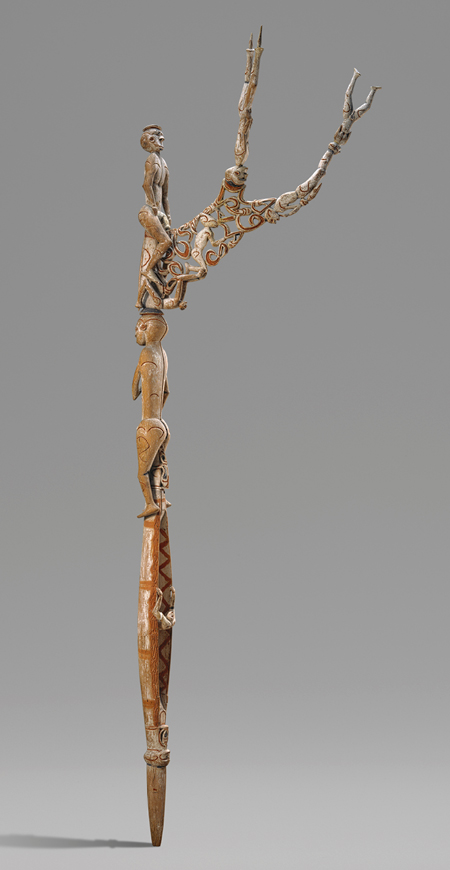
I wandered into the new wing of arts of Oceana, e.g.. the Pacific Islands.  I was floored by a lot of the art on display here, particular these Ancestor (Bis) Poles and canoes.

This is one of at least 6 or 7 displayed in a row.

The Asmat honored their dead with feasts and rituals, which both commemorated the deceased and reminded the living to avenge their deaths. The towering Asmat “bis” poles were made for these funeral feasts. The basic form of the bis is an openwork pole incorporating several ancestor figures and a winglike projection that represents the pole’s phallus.

In Asmat belief, no death was accidental. Each death was always caused by an enemy, either through headhunting raids or sorcery. Death created an imbalance in society, which the living had to correct by taking an enemy head. When a village had suffered a number of deaths, it would hold a bis ceremony, which consisted of a series of feasts held over several months. A number of bis poles were carved for the ceremony and displayed in front of the men’s house, where they formed the center of a mock battle between men and women. The poles were kept until a successful headhunt had been carried out and the balance restored. After a final feast, the Asmat abandoned the bis poles in the sago palm groves from which they obtained their primary food. As the poles decayed, their fertile supernatural power seeped into the earth and fertilized the sago trees.

I found these spectacular, deeply strange in form, intention, ideology, and belief system, and with a vertiginous sense of near-flight in the jutting of the inverted figures on top so boldly out into space.  There are the familiar ironies of these ritual objects, the entire raison d’etre of which depended on their instrumental use, ephemerality, and eventual decaying in the sago tree groves, lavishly displayed in the museum as art objects.  And the ideas about death, revenge, vital powers, aesthetic expression — all struck me as thrillingly alien.

The bis poles are upside-down sago trees — the phallic projection is created out of the roots of the trees.  A pole is a natural object taken from nature, aesthetically reshaped, inverted and placed back in the grove of trees once again to decay.  “Inversion” seems one of the primary gestures of these artworks: upside down men and trees, sticking up in displays of force.

They seem to be something like death clocks?  Until the death is avenged, they stand as a monument and a reminder of the revenge that must follow.  Once that occurs, they’re returned to the forest.

I’m not saying I think we should adopt the custom, but as funereal artifacts, the sarcophagi and bis poles seem more aesthetically and spiritually satisfying than the rites and objects we tend to come up with.  I was charged with making an ipod playlist to broadcast after the ceremony, which can’t exactly match up to the Bis Poles when it comes to ritual closure (although Marion Williams singing “I’ll Fly Away” and John Coltrane’s “Naima” are nothing to sneeze at for sorrow and grandeur, either).

At one of these funerals, a close friend of the deceased had made 1000 multi-colored paper origami cranes, which were displayed on the stage as people spoke: that was lovely, and did seem to tap into some vein of pre-modern death ritual.

Maybe what I find appealing, in theory if not in practice, is the idea that every death is caused by an enemy: someone to blame definitively, and something to do about it; no accidental deaths.

Posted in art

Big Star Revisited

Big Star was one of the handful of bands who most shaped my musical tastes at the crucial age of 14-18 or so.  Radio City and Sister Lovers/ Big Star Third are icons of my personal aesthetics (I never loved #1 Record as much), but ironically I haven’t had either of them on MP3, other than some tracks included on an Alex Chilton cd collection.  So Keep Your Eye on the Sky, the Big Star box set, which is full of demos, alternate tracks and some early live recordings, was a really cool birthday gift (thanks Jake).  Getting it also inspired me to pick up the Continuum 33 1/3 book on Radio City.

Carrie Brownstein has a nice little blog post in that Best Music Writing of 2009 book about the diminishment of “mystery and the mysterious” in pop music today.  Big Star is a perfect example of this.  As everyone comments, being a fan of the band in the 1970s usually involved stumbling upon one of their albums — maybe Radio City, with its William Eggleston photo of a bare light bulb on the cover — in a dollar bin or something, being blown away by how amazing the music was, and having no idea who these people were.  Peter Buck of R.E.M. is quoted in the box set liner notes:

No one I knew had ever seen them play.  I think I’d read that one of the guys had been in the Box Tops — which made no sense either.  Information was scarce.  So these records they’d put out, they were simply artifacts.  It was like seeing the heads of Easter Island or the Great Pyramids or something.  You didn’t know what they were or how they’d gotten there.

By the time I got into Big Star in 1984 or so they were a lot better known, but even so, you couldn’t Google them, there was so Wikipedia page, so you ended up relying a lot on the little Robert Christgau capsule reviews or the Rolling Stone Record Guide entry and the like.  Going through the box set and this book now offers a surplus of information and photographs that once and for all eliminates that numinous haze, born of a paucity of information, that used to surround the band — but at this point, that’s perfectly OK with me, as they deserve all-time-great historical status, with all the archival trappings.

Bruce Eaton’s 33 1/3 book is quite good.  It’s austere in its formalist focus on “the music itself” — Eaton starts out explaining that because of all the gossip, rumor and falsehoods surrounding the Big Star and Alex Chilton stories, he’s going to focus pretty exclusively on the actual process by which the band formed and made Radio City.  This involves a fair amount of to me, somewhat boring technical chitchat about production choices, recording and mixing, etc., but on the other hand, I did feel I got a better understanding of what was musically/technically special about the band and the importance of the producer John Fry.  I also suspect there may have been a strategic element here, as Eaton makes clear that Chilton has expressed zero interest, in recent years, in talking with any journalists, and it sounds as if Chilton agreed to participate on the condition that the interviews would be almost exclusively about the music and recording.

A few tidbits/insights I gleaned from the book:

  • Chilton grew up with a sometimes jazz musician father and was heavily immersed in Memphis/Stax R&B (Wilson Pickett, the Staple Singers, etc).  The Anglophiliac, British Invasion sound of Big Star was almost entirely a product of Chris Bell’s obsessions, and Chilton seems always to have viewed the band as a vehicle for this particular, very “white” approach to music which he saw as only a small part of what he himself was about.  Actually it’s kind of hilarious in Eaton’s book how much Chilton repudiates Big Star and Radio City, their masterpiece, in particular; he says he thinks “Back of a Car” (which he did not write) is the album’s “only good song” and that he thinks his lyrics on the album as a whole are terrible.  (Although this struck me as heresy, if you actually look up the lyrics to “O My Soul” or something you realize that they are pretty flimsy; it’s a great example of how little lyrics matter except in their musical context.)
  • Big Star opened for Badfinger in Boston in March 1974, one of their few performances ever outside Memphis; their instruments were stolen and they had to play with gear borrowed from Billy Squier (! — yes, of later “The Stroke” fame!) of local band Sidewinder.
  • Notwithstanding the point about Chilton’s partial disaffection from the “whiteness” of Big Star’s approach, Chilton himself says that he copped certain musical structures and ideas on Radio City from Bach and other Baroque music… which actually kind of makes sense.
  • During and after Big Star, Chilton was in a semi-/unofficial pickup studio band called the Dolby Fuckers.  Surprised no one’s ever borrowed that name.
  • Of course everyone knows that Big Star was a “critics’ band.”  But the book makes clear that Radio City never would’ve been recorded (after Chris Bell’s departure from the band) if it hadn’t been for the somewhat bizarre event called the Rock Writers Convention in Memphis in May 1973.  All surviving members of the band attest that the good response they got to their performance at the convention convinced them that they actually could have an audience.  Considering that the very idea of a rock critic was a fairly recent invention at the time, Big Star may have been in some respects the first band who recorded specifically for rock critics and with their tastes in mind.  (I was also surprised to learn that Chilton knew Richard Meltzer and other rock writers from his sojourn in NYC in 1970.)
  • Eaton makes some good points about the difference between Big Star and other “power pop” bands of the era sometimes associated with them (like the Raspberries or Badfinger).  While the latter were classicists trying to work entirely within pre-established musical structures, Big Star (after #1 Record especially) was always about taking and reproducing those kinds of pop structures but messing with them, disintegrating them, removing the ground beneath them.  This then builds to an extreme on Big Star Third which is still unparalleled as a woozy, druggy, depressive, achingly gorgeous collection of songs.

One more thought: I was fascinated to hear the Flying Burrito Brothers cover (“Hot Burrito #2”) in the live set on the box set.  Chilton seems to have more than a few things in common with Gram Parsons as a musically omnivorous, addictive, louche son of privilege (well, relative privilege in Chilton’s case) with an ambivalent relationship to pop music in what was becoming the New South.

I saw Alex Chilton in 1985 at the Rat in Boston.  I was 16 and had the most ridiculous fake I.D.  I was desperate to get in and was thrilled that I did.  If I recall correctly he played stuff from Feudalist Tarts and various R&B covers and then a few Big Star songs like “September Gurls” which made me very happy.  I think I ended up walking all the way back home to Cambridge from Kenmore Square at 2 a.m. or whatever.

The box set contains an amazing collection of photos.  My favorite is one of Chilton at age 20 in the Chelsea Hotel in NYC with long hair, tie-dyed tank top (!) and scruffy facial hair holding a copy of the Byrds’ Untitled.

This photo above is from the back of Radio City: Jody Stephens, Andy Hummel and Chilton — in the original T.G.I. Friday’s in Memphis!

Pleasure reading (late 2009/holidays)

Got around to reading Philip Roth’s 2004 counterfactual The Plot Against America which I found compelling and kind of scary.  It’s a re-imagining of American history in which Republican candidate Charles Lindbergh defeats F.D.R in 1940 on an anti-war, anti-semitic, covertly pro-German (or at least pro-accommodationist) platform.  What makes it really get under your skin is that Roth seems to be drawing heavily on his own Newark childhood, so it reads not as science fiction or fantasy but as a creepily plausible rethinking of both U.S. and his own family history if the country had taken a drastically different turn in the late 1930s.  So, for example, the depiction of his brother who embraces the new Lindbergh regime seems charged with real and intense family memories and conflicts.  The novel also feels obviously of its 2004 Bush administration moment in its detailed thinking through of how a truly fascist U.S. might play out.

Recently read both The Girl with the Dragon Tattoo and the sequel The Girl Who Played with Fire by Stieg Larsson, a Swedish journalist who, to what must have been the deep frustration of the international publishing world, had actually died at age 50 in 2004 prior to the publication of any of his novels.  The third of the trilogy is due out in the States soon.  These are interesting blockbusters.  They’re pulpy and have some of the limitations of most blockbuster fiction: the characters can be cartoonish, the plots implausible, sensationalist and heavily dependent on techno-thriller conventions of various sorts.  (For example, a whole lot of both novels involves descriptions of computer hacking.)  But, they’re total page-turners, really hard to put down and a lot of fun (I gave Sarah the second one at Xmas and over the last few days we were reading it simultaneously, with me picking it up when she put it down; we each had our own bookmark).  I guess I felt the second one was inferior and in the end closer to that techno-thriller cliche than the first, which is more thoughtful and interestingly broody about Swedish politics, patriarchy, and misogyny.  Has there ever been an international blockbuster series of novels whose major theme is male violence against women?  The Swedish title of the first one is Men Who Hate Women and the hero, Lisbeth Salander, is a female avenger against male sadists and abusers.  Salander is in some ways too Hollywood-ready, kind of Laura Croft-like in some ways, but she’s also a great heroine in her weird combination of Sherlock Holmes (she’s Asbergers-y, a genius/savant with a photographic memory), Jason Bourne or the Fugitive, and Batman or something.  The novels also reminded me a bit of a recent favorite of mine, the Danish thriller The Exception by Christian Jungersen of a couple years ago; they share a left-wing, anti-racist Scandinavian perspective on problems of contemporary globalism such as sex trafficking, war crimes, and the like.

One more thing: one of my favorite things about the novels and about Salander is that she’s a kind of superhero version of Pippi Longstocking: uses “V. Kulla” as a fake name on her doorbell at one point for example (cp. Pippi’s Villa Villakulla).

Read two Patricia Highsmith novels while in Cambridge for the holidays, inspired by reviews of the new Highsmith biography which make her sound like a very weird and fascinating character (did you know she worked as a writer for superhero comic books, for example?).  One of her most famous, Strangers on a Train, and a more obscure one, The Blunderer.  Similar plots and characters: “men who hate women,” actually, or men who want to get rid of their wives. Strangers on a Train is a brilliant “double” novel and a novel of homosexual panic — it would’ve fit perfectly into Eve Sedgwick’s Between Men.

Best Music Writing 2009, this year guest edited by Greil Marcus.  I threw this into an Amazon order as a stocking stuffer for myself.  Someone gave me the 2007 volume, which I loved, and I haven’t missed one since (ok, that only makes 3).  I’m a longtime fan (and erstwhile practitioner) of rock/pop music criticism, which can feel like a dying mainstream art.  But these collections inspire confidence that there’s loads of brilliant, imaginative and funny writing out there about pop music, albeit sometimes in hard to find places.  The books tend to collect a really diverse mixture of artist profiles from Rolling Stone or The New Yorker with pieces from little magazines and quasi-unpublished bits from blogs and whatnot.  A few favorites from this one:

  • Vanessa Grigoriadis “The Tragedy of Britney Spears” — a long investigative piece from Rolling Stone, itself a voyeuristic peek at this train-wreck of a career but also a thoughtful analysis of Spears’ downwardly spiraling dependency on celebrity/paparazzi culture (she is now romantically involved with a paparazzi she met on one of her daily chases).  Reads a bit like a Bruce Wagner novel.
  • John Jeremiah Sullivan, “Unknown Bards: the blues becomes transparent to itself.”  Reflections on John Fahey and other collectors and aficionados of early 20th-century blues recordings.  Really smart and interesting on the paradoxes and ironies attendant on old white men obsessing over old records made by Southern black men.  Also an argument for blues as great, transcendent art.
  • James Parker, “Unauthorized!  Axl Rose, Albert Goldman, and the renegade art of rock biography.”  Hilarious overview of the disreputable genre of the “unauthorized” rock biography, including analysis of several biographies of “persistent, near-magical malignancy.”
  • A nice short piece by Jonathan Lethem about the nature/meaning of rock vocals in “post-Elvis, post-Sam Cooke, post-Ray Charles popular music” in which he makes a case that “the singer in rock, soul and pop has to be doing something ineffable that pulls against any given context.”  I actually found this argument surprisingly original and persuasive.
  • An investigative piece by Josh Eells about “the eyeliner wars,” e.g. the harrassment and persecution of “emos” (androgynous fans of Dashboard Confessional and My Chemical Romance) in contemporary Mexico.  Reminded me of a good piece from the anthology of a year or two ago about the surprisingly enormous cult of Morrissey in Mexico.
  • Paul Ford’s “Six-word reviews of 763 SXSW Mp3s.”  Just what it sounds like: 763 reviews of 6 words or less (tweets, in effect) of bands performing at the South by Southwest conference, a reducto ad absurdum of the Blender-style capsule review genre.  In the introduction Greil Marcus aptly describes this feat of reviewing and of dismissal as “heroic, or demonic” and as a performance that implicitly dismisses “music and criticism at the same time.”  Maybe you’d have to have put some time in a music reviewer to fully appreciate this one.

Live-blogging IU women’s basketball vs. Florida State

Tuesday.  Girls come home all excited about a visit to their school from Sasha, a player on the IU women’s basketball team.  Aka “Big Sash.”  There was a special promotion going on in which each kid was sent home with an adult ticket for the game on Thursday night (kids are free anyway I think).  Mom was going to be busy at the studio helping set up the holiday show, but I agreed to take them.

Thursday, 5 pm.  Last minute work on Go IU/ Go Sasha flags taped onto chopsticks:

I guess that’s Big Sash at the bottom right.  The rainbows, hearts and butterfly really push the go-team spirit to the next level, I think.

6:30.  In the parking lot, we see Calley and her dad and Olivia and her mom.  Joyful, hopping-up-and-down excited group hugs.  It has been a whole three hours since the kids have seen one another.

6:35.  In the arena!  Game has started, you can see all the kids from school at one end with their red t-shirts on!  Big Sash is on the court!

6:40.  For the next 2 hours it’s like some hopped-up 5-8 year-old cocktail party with continual changing of seats, conferrals about snacks, walking up and down the stadium stairs, new groupings of kids, weird games involving cheers, waving signs and a pom-pom someone brought.  The parents exchange occasional amused chit-chat over the din and try to prevent things from getting too inappropriate or dangerous.  The kids pay only fleeting attention to the actual game.

For much of the game we’re down in the 3rd row or so with the cheerleaders right in front of us.  The role of cheerleader normally seems so gendered, a performance of exaggerated femininity in structural, Manichean opposition to the exaggerated masculinity of the male jocks on the court.  But here it’s two very different models of female identity, bodies, behavior, gesture, etc., which seems to destabilize or call into question the original opposition.  (For ex. the center on Florida State must be 6’5″ and built to bust through any pick.)  I was rooting for C&I to be more impressed by the players.

7:30 At halftime all kids are invited to come on court and form two masses through which the players run through, high-fiving (if you can call it that at 3 1/2 feet from the ground).  Pandemonium as 100-odd 5-8 year-olds rush the court.  It’s a slightly dangerous situation when they all return in a thundering herd, rushing right through the IU team’s layup drills.

7:45 Iris finally makes it onto the Jumbotron!  C&I and their friends end up getting filmed a couple times doing their little cheers and dances.

8:00  Celie cajoles one of the cheerleaders to throw her a t-shirt!  Size extra-large men’s.

8:30  It’s a close game for much of it, but finally ends with Florida State winning by 8.  (One silver lining: Big Sash got a double-double with ten rebounds.)  I drag the girls out.  They have a despondent manner which initially I think is just fatigue, but then they start saying: “I can’t believe IU lost!”  Sobbing, a little bit.

“Why did they have to lose?”

I offer various sententious commentary about the nature of sports, winning and losing, etc.  They basically ignore me.

“I HATE Florida State!”

“I feel so bad for Sasha, I really wanted her to win!”

And, poignantly: “It’s OUR FAULT!  We were playing with Faith and Gabe and we didn’t cheer hard enough!”  When I try to deny this: “No, daddy!  Cheering really helps you play better!”  It’s pathetic, but I also have to stifle a chuckle from the front seat.

This continues until they’re in bed.  They seemed truly astonished and appalled that IU, notwithstanding the whole crowd rooting for them, had lost.

The sting of defeat seemed to have faded a bit by the next morning.  But I’m still not sure they possess the emotional armor to handle team spectator sports.

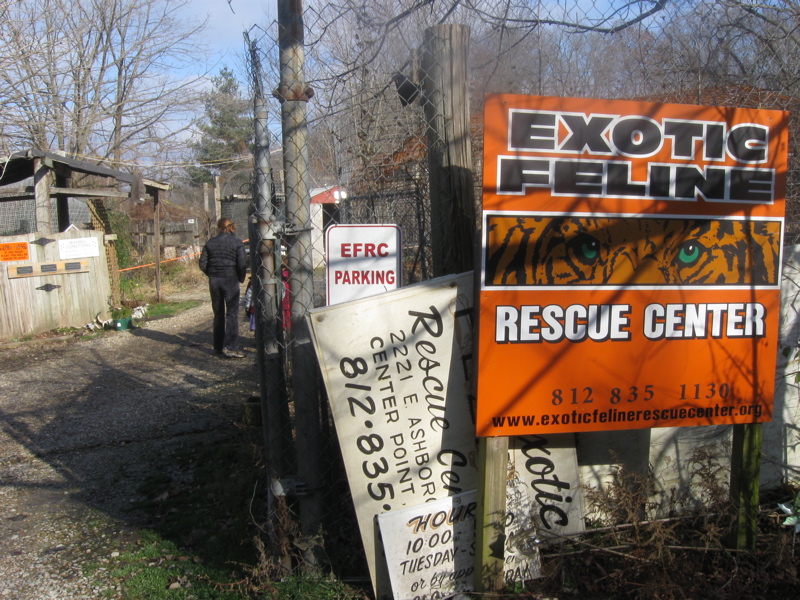
Exotic Feline Rescue Center

We finally visited the Exotic Feline Rescue Center after 8 years in Southern Indiana, an excellent post-Thanksgiving day trip.

It’s a couple miles off 46 East on the way to Terre Haute.  The entrance has a vague resemblance to an autobody parts store or some such.  You pay your entrance fee, and one of the volunteers/employees explains the rules/guidelines (if you touch a cat you will be asked to leave; if a cat turns its rear end towards you, it may be planning to spray you; move quickly to the side) and takes you on a tour.

It’s an amazing place!  They have about 200 big cats.  A lot of tigers, some lions, and also leopards, bobcats, servals, cougars, and ocelots.  Most of them were rescued from abusive/neglectful situations: breeders, pet owners in over their heads, drug dealers, other shady characters who like the idea of having a lion in their backyard.  They do not breed animals and they don’t place them elsewhere; it’s a permanent retirement home.  They say that for every animal they can adopt, they have to turn down about 40.

The animals definitely seemed to pay special attention to the girls and another young boy with our group.

The animals tended to be fairly interested and would come up to check us out.  You’re not supposed to come within an arm’s reach of the cages, which at some points means you kind of have to squeeze through a relatively narrow passageway with giant cats sitting or pacing on either side.  It all seems very well run, but on the other hand, it’s just normal fences and padlocks between you and the animals, no high-tech zoo moats or walls.  At one point Iris got scared and didn’t want to come into one area; she eventually braved it by riding on my shoulders.

A few minutes into our tour the lions started roaring back and forth, a very eerie sound.  We saw one of the big lions chewing on a leg of some sort — the lady said that local farmers will often donate a cow or horse that dies.  The center goes through 3000 pounds of meat a day.

They’re definitely doing good work here.  Sad to think of so many of these creatures kept as pets.  There are no national laws governing exotic pet ownership so it’s a state by state patchwork; in Indiana (surprisingly) it’s fairly stringently regulated but in Ohio there are virtually no rules, anyone can buy a tiger cub, stick it in the back of the pickup truck and take it home.

This was a cute guy rubbing his head against the fence.

As we were leaving we noticed a little tabby cat walking around the entrance area.  She looked ridiculously tiny.  I guess she must know to stay out of the cages.

Curb Your Enthusiasm, shark, jump?

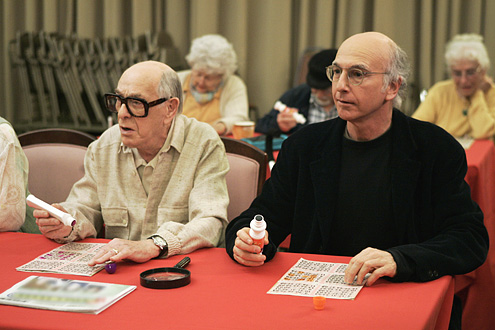
For a while this season I felt that Curb Your Enthusiasm had jumped the shark.  (No huge spoilers here, btw.) Or probably that’s the wrong phrase in its suggestion of a Rubicon-crossing into sudden badness; more a sinking into repetitive tics and self-indulgence of some of the show’s worst qualities.  Is it possible that every episode this season involved someone trying to get money out of Larry, especially in the form of a tip?  It happened so frequently that you have to assume there was self-awareness about it, but really, could I care less about how hard it is for LD to have every waiter and coffee guy expecting a $20 tip from him at every moment? And the drive for edginess/envelope-pushing in regards to race and disability was often painful.  Although I did like the running joke about Larry’s baldness as an identity category.

In the end though I did find the Seinfeld reenactment/reunion to be somewhat irresistible and fun.  It was great just to see Larry and Jerry riffing on random stuff together.  And as a viewer, I felt a bit as Cheryl apparently did: it had gotten tedious to witness Larry always moping around as a bored rich man at loose ends; it was invigorating to see him actually at work trying to produce something, and to have the purposeful action that creates Curb Your Enthusiasm itself seep into the plot of the show.  That is, there was always a (initially productive) tension in Curb in that its main topic is Larry’s dilemma after he’s made his fame and fortune with Seinfeld; what should he do now?  Of course what he actually did was create a smaller, semi-improvised premium-cable show, but we could never see that in the show itself, which ended up spinning off endless and often redundant riffs on the minutiae of Larry’s aimless, spoiled existence and his Honeymooners- esque fights with neighbors and associates, etc.

So, there was a kind of satisfying formal logic to the way this season wound up in Larry “putting on a show” once again.  (Echoing the Producers plot of a couple seasons ago.)  And also perhaps to the way he finally backs away, once again, from a life of purposeful action and employment.  Although I don’t agree with those who found Larry performing as George Constanza sublime; Larry’s “bad acting” is just too… bad, I think.

I don’t think Cheryl made the right call at the end, though.

p.s.  For those who know me well, the reason I watched the show as it screened was that I got a fortuitously timed three free months of HBO.

Where the Wild Things Are as family therapy

where-the-wild-things-are

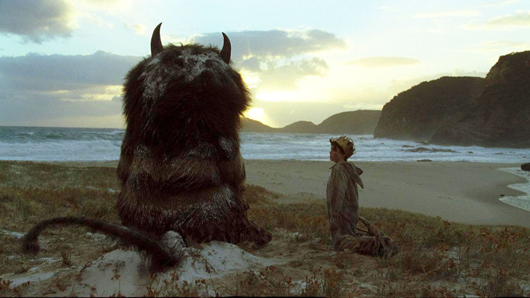
Spike Jonze’s Where the Wild Things Are is kind of like a long, whacked-out family therapy session.  Maurice Sendak has commented that the monsters in the book are all based on his Polish-Jewish aunts and uncles back in 1930s Brooklyn.  Homage seems to be paid in the Wild Things’ names in the movie: Judith, Ira, Carol — they sound like they could be those aunts and uncles.  (It’s funny that the most Jewish-seeming one, Ira, is voiced by Forrest Whittaker.)  But I wouldn’t be surprised (just guessing here) if Jonze based a lot of the movie on memories of his own parents’ divorce and family-therapy sessions.  Many of the antics on the island feel like different forms of play-acting and role-playing in that context as Max works out his rage against his mother, his fears and anxieties, loneliness, with these other equally-troubled characters.

One memorable scene occurs when Max is on the run from Carol, the Tony Soprano-voiced character who seems an avatar of Max himself in his uncontrolled rages.  Carol feels betrayed by the revelation that Max may not in fact be “the king” (i.e. the good parent, the one who makes everything OK — could be the absent father, but the mother is much more important in the movie and book).  Max encounters K.W. (whom Carol loves and feels rejected by), who seems to be the sister-figure monster.   She urgently instructs Max to hide from Carol in her mouth.  He hesitates at first and then, as Carol approaches, down the hatch: he slides into her mouth and into her gullet (where he finds a raccoon foraging).   Once Carol leaves, he climbs back out in a slimy birth scene.  Pretty amazing!

Sarah commented that the movie has a lot of John Cassavetes in it and that it can be a bit hard to take in the painfully intimate and claustrophobic, dysfunctional behaviors of the monsters.  “K.W. may be psychotic, with her owls” (that she believes to be great sages), Sarah observed, Carol flies into dangerous bipolar rages, Judith is, as everyone comments, an endless “downer,” manipulative and passive-aggressive, Douglas (the goat one) is very depressed and self-undermining.  Also (still channeling Sarah here) you have to have a pretty high tolerance for wet plush animal fur, which is the defining and sometimes oppressive texture of the movie.

It has occasionally arch/cute moments in that Dave Eggers way, too, but I thought it was pretty great overall.  Great on childhood creativity and imagination — loved Carol’s elaborate sculptural mountain world into which, if you place your head in just the right spot, a fully-developed three-dimensional scene with moving figures on a river surrounds you. This struck me as one of those manifestations you sometimes see in Jonze’s movies (Michel Gondry too; and maybe Wes Anderson?) of a desire for film to be a handmade craft/art project, something tactile and a bit like a child’s fantasy world.

I’m glad the movie has done well, as it would be nice to see more 100 million dollar movies like this one.

p.s.  If we’d tried to bring C&I to this one, we would’ve been out of the theater in 15 minutes.  It’s quite scary, I wouldn’t bring any kid younger than maybe 8.

Ballet, rainbows, magic, fairies, and jewelry

Sometimes it feels like we’re continually being hit up for money via the girls’ kindergarten.  What I don’t like about it is the sense that the school or the PTA are using the kids for fund-raising — invoking the nag factor to get us to pony up.  If they wrote directly asking if we could pay a certain amount per month to pay for extras the school can’t otherwise afford, we’d have no problem with that.  But the reading marathon, the contests, the Scholastic book orders (of which I presume the school gets a cut) get tiring.  Especially at this age when my daughters, at least, really do not understand money at all.  Or odds or probabilities.  We had several complete meltdowns around the Reading Marathon because they were convinced that they were going to get to ride in a limo (the final top prize for one student in the school).

So anyway, we weren’t prepared for the Scholastic Books order.  The girls came home with pieces of paper on which their librarian (I think) had written the titles and prices for three books each in which C&I had expressed interest.  These would cost a total of almost $50 and they somehow presumed it was a done deal that we’d be buying all of them.  Screaming, crying meltdown over this.  Finally we compromised and got one book each and one more to share.

I also am not too impressed with the books’ general level of literary quality.  I don’t think it’s a promising sign about a book’s merits when it comes with a cheap dollar-store style necklace included (that’s why they wanted the book, of course).  Actually to be fair, when I actually went to the sale with them set up in the library, they did seem to have good books mixed in with the necklace/book hybrids my daughters unfortunately gravitated towards.  Showing a 6-year old girl a book with jewelry included is not really playing fair.  Normally we’re pretty good at telling them that they can’t buy something, but somehow all the peer/school pressure involved here made it very difficult to manage.  Maybe part of what was galling about this was that Grandma Suzy had just shown up with a few bags of wonderful/classic children’s lit from the 1950s-70s, next to which these looked especially tawdry.

This is the book/necklace title.  Ballet, rainbows, magic, fairies, and jewelry, a potent brew:

9780545106153_xlg

Torture Porn Lit

Heartsick-Chelsea-Cain-unabridged-compact-discs-Audio-Renaissance

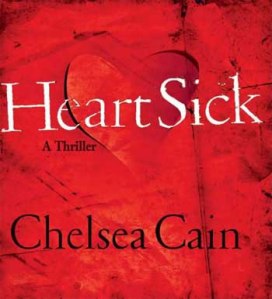
Just read Heartsick by Chelsea Cain which I picked up looking for something else because, I think, Amazon named it the top thriller of 2007.

I didn’t altogether enjoy it — it seemed derivative (of Silence of the Lambs, although it does have the wit tacitly to acknowledge the debt when the psycho killer mockingly refers to the journalist as Clarice) and very, very gross.  It is gripping and well done in some ways — I wanted to read to the end to find out what would happen — but I was struck by the sheer bloody sadism of it.

It reminded me of a silly argument my brother and I had a while ago about the ethics and politics of so-called “torture porn” film, namely the Eli Roth Hostel movies.  It was silly because I think at that point neither of us had seen the movies… so if anything, I’d have to say he won the argument b/c it’s difficult to take a moral stance of condemnation about something you haven’t seen.   Although part of my point was, I refused to give in to the logic that because this on-the-face-of-it objectionable cultural object has become notorious, “you must see it yourself” to decide.  On the other hand, it’s hard to argue the position from ignorance.

Anyway, what I didn’t like about Heartsick is the back story involving the protagonist detective’s ten-day-long ordeal being slowly and lovingly tortured by the psycho serial killer he’d been investigating.  It actually works pretty well as back story to explain his particular trauma and what’s at stake for him in current case… but annoyingly, the novel is interwoven with day by day chronological accounts of that week and a half.  It’s really hard to take — painstaking description of what it’s like to drink drain cleaner, anyone? — and just seemed sadistic/self-indulgent in a mode of “can you top this” grossness.

I was mulling over the cultural meanings of ‘torture porn’ and thought of several possible explanations/causes for why this has trend emerged so clearly in the last decade or so.

  • Most obviously: sheer oneupsmanship in a modernist logic of greater and greater, purportedly more and more “daring,” transgressions.  This was basically the point I was making to Jake: within Modernist art of the early and mid 20th century, various forms of transgression, obscenity, and more and more realistic depiction of sex and violence became closely linked with artistic expression and a cultural vanguard.  One could think of this as the “First Amendment theory” of modernist transgression, in that to be “censored” or deplored becomes an almost necessary sign of artistic expression and integrity.  The thing is, though, that this dynamic has become tired and predictable when every gangsta rapper and thriller novelist or director participates in the same game.  Sorry, Eminem and Marilyn Manson, you are not James Joyce or Picasso bravely defying the philistines with your cds and DVDs sold at Walmart to every wanna-be radical tweener in America.  (Or for that matter Tarantino: I think he’s at his worst when he falls into this mode; most of the more interesting aspects of his movies have little to do with pushing the transgression envelope.)   And in this case, Chelsea Cain’s novel being that much grosser and more explicit than The Silence of the Lambs does not make it more daring.  Given that you can find stuff on the internet with a few keystrokes that would’ve made Henry Miller or James Joyce blush, that whole logic, which relies on certain dynamics of scarcity and concealment, is basically moot.  These days really radical, daring art is more likely to avoid this whole game of transgression entirely.
  • post-9/11 culture, Abu Ghraib and Guantanamo.  Needless to say a lot of the obsession with torture in pop culture comes directly out of this political/cultural dynamic: e.g. the t.v. series 24.  I’d assume that Saw and Hostel are part of this too, albeit less directly.
  • One other thought, a slightly less obvious one: in this novel anyway, there seemed to be a fascination with the idea of the body as art-work, and the serial killer as a kind of conceptual artist, carving and sculpting her victims’ bodies into new shapes.  A break in the original case came when the detective Archie noticed, looking at photos of all the crime victims, that the shape of a heart had been carved into all the torsos (hard to make out amid all the gore).  The journalist protagonist dyes her hair pink which I think is meant to link to this theme.   Like Jack the Ripper, these murderers are artist/author figures who leave their “signature” to be read by the police.  So here too we could link the trend to plastic surgery and various kinds of body-based conceptual art that views the human bodily as “plastic,” malleable and part of culture not nature.

Anything else going on here?  There’s always the possibility of whole-scale moral degeneration, I forgot that one…