Battery-operated Guinea Pig Unfortunately Does Not Poop

There’s this one detail from the NY Times article “Our Love Affair With Shopping Malls is on the Rocks” that Sarah and I were laughing about because it seemed such a sadly apt emblem for the U.S. economy.

The economic crisis has caused shoppers to go into an essentials-only mode. But the mall has never trafficked in essentials. You can’t, for instance, fill a prescription at the Mall of America, because it doesn’t have a pharmacy. You can, however, buy a vanilla hazelnut fragrance candle in the shape of a miniature cooking skillet. Or a $13 baseball hat that looks as though it’s made of cheddar cheese. A store called Corda-Roy’s sells a variety of bean bags that convert into beds. Magnet Max sells a battery-operated guinea pig that runs continuously on a spinning exercise wheel.

It’s the battery-operated guinea pig that stuck in my mind as a little icon of pointless/wasteful U.S consumerism (and maybe of the U.S. consumer too).  We went on a post-Xmas expedition to the Indianapolis “Fashion Mall” a few weeks ago and I had the thought that 80% of what was on offer constituted a sort of money-laundering operation, just in the sense that it really only exists in order to have something to spend your money on.  (The heavily marked-down Christmas gifts and paraphernalia especially conveyed this impression.)

A different article in today’s Times mentions the popular iPhone application iFart: “as you can pretty much deduce from the name, it enables your $200 to $300 mobile device to emit a variety of noises simulating flatulence.”  Compared to the vanilla hazelnut fragrance candles in the shape of a miniature cooking skillet, etc., though, at least the iFart application is cheap (99 cents) and will not end up in a landfill.

By the way, speaking of guinea pigs, when we got home last night at 8:30 or so we stepped over a big garbage bag in front of our front door.  It says something about our housekeeping that no one commented on it; I assumed it was something Sarah had left there for some reason.  As soon as we got in the door, the phone rang; it was Steve across the street letting us know that the bag contained a load of guinea pig poop from their pets, which Sarah covets for our backyard compost heap.  There’s quite a lot of traffic in guinea pig poop between the two households, although unfortunately Steve will not accept the contents of Pot Luck and Daisy’s litter box in exchange.
Pot Luck Becomes a Man (sort of )

Yesterday was the long-awaited/feared day when we had to bring Pot Luck in to the vet for his operation.  There was a scissors icon drawn on the date on the calendar for the day Pot Luck would become a man… or not.  Sort of.  It’s the responsible thing to do, in any case.

I heard Celie explaining this on the phone to Grandma Suzy: “Pot Luck is gonna have his operation so Daisy can’t have a baby.”  Actually there was no real danger of this b/c Daisy already had her operation.

It’s been weird having Pot Luck away.  Daisy seemed especially affectionate and needy when I let her out of the basement (they spend the night there b/c otherwise they wake us up at 5:00 a.m).  But actually, Daisy seems to be having a good time experiencing the life of solo cat for a morning, with the girls fighting over her.

We get him at noon today I think.  I hope he won’t have lost any of his devil-may-care ways.

Bad Parenting moment #1016

Celie was trying to sing “Mary Had a Little Lamb” and couldn’t remember all the words.  I couldn’t either, so I found a couple video versions of it on Youtube.  I left for 5 minutes and came back to find C&I watching Pokemon cartoon footage of creatures hitting one another in the face to a soundtrack of Akon’s “Smack That.”  I’m sure they couldn’t make out any of the lyrics, at least (one sample: “The way she climbs up and down them poles/ Looking like one of them putty-cat dolls”).

Note to self: no unmonitored Youtube time allowed.

Mary had a little lamb its fleece was white as snow;
And everywhere that Mary went, the lamb was sure to go.
It followed her to school one day, which was against the rule;
It made the children laugh and play, to see a lamb at school.
And so the teacher turned it out, but still it lingered near,
And waited patiently about till Mary did appear.
“Why does the lamb love Mary so?” the eager children cry;
“Why, Mary loves the lamb, you know” the teacher did reply.

It’s an interesting fantasy of pure and total reciprocal love between child and animal.  What’s the answer to why the lamb loves Mary?  Just reverse the subject and object: Mary loves the lamb.  The trip to school is a ritual of maturation and development away from infancy, but the lamb remains as a disruptive “lingering” remnant of the pure animal love of babyhood.  I suppose the lamb is probably a Jesus type, too, which means the rhyme may be an allegory of the tension of spiritual faith in the rational schoolroom.

No strip-club pussy-cat dolls allowed at school, either.

By the way, the words to “Mary Had a Little Lamb” were apparently the first recorded by Edison on a tinfoil phonograph.

My Father, My Attack Dog

200511_032

David Berman of the Silver Jews (Pavement-associated indie rock group, basically just Berman) has announced his retirement from music and followed the announcement up with this remarkable anguished confession:


My Father, My Attack Dog
Now that the Joos are over I can tell you my gravest secret. Worse than suicide, worse than crack addiction:

My father.

You might be surprised to know he is famous, for terrible reasons.

My father is a despicable man. My father is a sort of human molestor.

An exploiter. A scoundrel. A world historical motherfucking son of a bitch. (sorry grandma)

You can read about him here.

www.bermanexposed.org

My life is so wierd. It’s allegorical to the nth. …

A couple of years ago I demanded he stop his work. Close down his company or I would sever our relationship.

He refused. He has just gotten worse. More evil. More powerful. We’ve been “estranged” for over three years.

Even as a child I disliked him. We were opposites. I wanted to read. He wanted to play games.

He is a union buster.

When I got out of college I joined the Teamsters (the guards were union organized at the Whitney).

I went off to hide in art and academia.

I fled through this art portal for twenty years. In the mean time my Dad started a very very bad company called Berman and Company.

He props up fast food/soda/factory farming/childhood obesity and diabetes/drunk driving/secondhand smoke.

He attacks animal lovers, ecologists, civil action attorneys, scientists, dieticians, doctors, teachers.

His clients include everyone from the makers of Agent Orange to the Tanning Salon Owners of America.

He helped ensure the minimum wage did not move a penny from 1997-2007!

The worst part for me as a writer is what he does with the english language.

Though vicious he is a doltish thinker

It goes on in this vein.  Pretty heavy stuff.  I find this whole family saga to be sociologically fascinating.  It’s basic Pierre Bourdieu that the offspring of the very wealthy often “trade in” the accumulated economic capital for cultural capital in the form of art/culture/education.  (A classic instance of the paradigm: I attended a private progressive high school founded by one of the sons of the founder of Merrill Lynch, whose other son was the poet James Merrill.).  The transaction whereby money is turned into culture, one kind of capital exchanged for another, often seems to serve an implicitly expiatory function as worked through generationally.  The accumulation of extreme wealth is frequently “not a pretty thing when you look into it too much,” and so one purpose of “culture” is to serve as in effect a money-laundering operation. (Not to say that’s all it is.)

So, you have David Berman, son of the union-busting lobbyist Richard Berman, working as a museum guard after college, and then going on to “hide in art” by creating eccentric, underground music, wracked with guilt about the sins of his father and perhaps about the money that made it easier for him to pursue such a life (? I don’t know, for all I know he refused to take any money from his dad, but at the least he probably didn’t have any student loans!).

I don’t intend this as criticism of Berman in the least, I’m just struck by the vividness of the way this story captures that basic logic in its most Oedipally tormented form.  I hope he’s not giving up on the Silver Jews because he feels that his art is inevitably tainted; something to work out with the therapist…

Here’s the Silver Jews’ wikipedia page.

Fated to Pretend

g11mgmt

New Pazz and Jop Village Voice rock critics’ poll.  I contributed to this for years and was always thrilled when the editors chose a couple of my elaborately-wrought witticisms/quips for inclusion in the commentary section.  The only one I remember is something I wrote about Pavement “giving the Badfinger to the rock and roll singer,” which they used as the caption for a photo of Pavement; this made my week/year, nerd that I was.

It makes me a touch melancholy how little the Pazz and Jop poll now seems to matter.  Before blogs, it was one of the only occasions (the only?) for pop music critics to crack wise, make jokes, and spin out ambitious theories apart from the strictures of a record review or band profile.  Now Robert Christgau’s over at MSN.com, and at best, it’s just another concatenation of online opinion.

So anyway, my big discovery so far from the poll (which is still useful as a guide to the year’s music) is MGMT, whose name I’d seen but had not paid any attention to.  They’re two former Wesleyan undergrads who make a kind of psychedelic electronic pop; their song “Time to Pretend” (#4 on the singles poll), extravagantly produced by a guy from the Flaming Lips, is beyond brilliant and catchy.  Youtube won’t let me embed the video for some reason so here’s the link.  Gets my vote for best/catchiest “single” of the year along with “Paper Planes” (btw can I say how ripped off I felt when I realized that the song does not actually appear anywhere in Pineapple Express, not even in the closing credits?  Whoever had the idea to use “Paper Planes” in the trailer made that movie.)

I also just finished reading Barney Hoskins’ history of pop music in L.A., Waiting for the Sun, and “Time to Pretend” resonates with the book for me as a delirious narrative of dropping out, jettisoning the straight life for good, and disappearing into an abyss of drugs, money, models, and rock and roll:

This is our decision, to live fast and die young.
We’ve got the vision, now let’s have some fun.
Yeah, it’s overwhelming, but what else can we do.
Get jobs in offices, and wake up for the morning commute?

Forget about our mothers and our friends
We’re fated to pretend
To pretend
We’re fated to pretend
To pretend

I’ll miss the playgrounds and the animals and digging up worms
I’ll miss the comfort of my mother and the weight of the world
I’ll miss my sister, miss my father, miss my dog and my home
Yeah, I’ll miss the boredom and the freedom and the time spent alone.

There’s really nothing, nothing we can do
Love must be forgotten, life can always start up anew.
The models will have children, we’ll get a divorce
We’ll find some more models, everything must run it’s course.

We’ll choke on our vomit and that will be the end
We were fated to pretend
To pretend
We’re fated to pretend
To pretend

It could be the confession of any of the lost narcissists of California pop whose stories Hoskins tells, fantasists “fated to pretend,” some geniuses, some just poseurs or hangers-on (some both, needless to say), making up their identities, doing way too much coke, marrying and divorcing models; for the less fortunate ones, an eventual ignominious death by mishap, for the luckier, eventual rehabilitation with memoir a la David Crosby.  Hoskins really allows one to see Darby Crash, Arthur Lee, and Tim Buckley (for example) as part of the same continuum of doomed/self-destructive L.A. singers.  (On rock and roll deaths, see this site.)

Anyway, the song is an irresistible “amuse bouche” as Charles Aaron put it, filled with outlandish musical flourishes and unearned grandeur.  “Kids” is also great.

More Animal Slaughter in the Wizard of Oz

oz12-05

Just had to write again about the amazing emphasis on animal slaughter in The Wizard of Oz.  It’s practically like Tintin in the Congo (in which the jungle animal body count increases steadily throughout).

Here are a few scenes from the climactic Chapter 12, “The Search for the Wicked Witch,” as she sends out waves of her minion creatures to attack Dorothy & co.

First wolves:

He seized his axe, which he had made very sharp, and as the leader of the wolves came on the Tin Woodman swung his arm and chopped the wolf’s head from its body, so that it immediately died. As soon as he could raise his axe another wolf came up, and he also fell under the sharp edge of the Tin Woodman’s weapon. There were forty wolves, and forty times a wolf was killed, so that at last they all lay dead in a heap before the Woodman.

Then he put down his axe and sat beside the Scarecrow, who said, “It was a good fight, friend.”

Now crows, giving the Scarecrow a chance to show his stuff:

The King Crow flew at the Scarecrow, who caught it by the head and twisted its neck until it died. And then another crow flew at him, and the Scarecrow twisted its neck also. There were forty crows, and forty times the Scarecrow twisted a neck, until at last all were lying dead beside him. Then he called to his companions to rise, and again they went upon their journey.

And how about some insects?

The bees came and found no one but the Woodman to sting, so they flew at him and broke off all their stings against the tin, without hurting the Woodman at all. And as bees cannot live when their stings are broken that was the end of the black bees, and they lay scattered thick about the Woodman, like little heaps of fine coal.

Finally, the Witch sends off a herd of buffalo, which Dorothy herself dispatches, shooting each one through the eye with a long-barreled rifle.  (Just kidding.)

It all has a distinct Manifest Destiny, conquest-of-the-Western-wilderness feel to it.

Killing a Cat to Save a Mouse in the Wizard of Oz

ww-denslow-illustration-1

We’ve been reading the girls The Wizard of Oz.  They are entranced by it, especially in this neat Dover reprint that includes all of the original gorgeous W.W. Denslow illustrations and plates (many of the pages of text are printed over/under illustrations, which creates a dazzling effect).

You probably know some of the disturbing/controversial facts about L. Frank Baum, such as his belief that Native American should be absolutely exterminated.  This from an 1890 newspaper editorial:

The Whites, by law of conquest, by justice of civilization, are masters of the American continent, and the best safety of the frontier settlements will be secured by the total annihilation of the few remaining Indians. Why not annihilation? Their glory has fled, their spirit broken, their manhood effaced; better that they die than live the miserable wretches that they are. History would forget these latter despicable beings…

Yikes!  Of course, as I read the novel, my lit-crit gears are continually turning to try to think about what kind of “natives” the Munchkins are supposed to be, whether Oz is some kind of native sovereign, how his power in the city-state of the Emerald City relates to the Witches’ authority over the regional territories, whether the various colors in Oz (yellow, green, blue) are intended to represent an alternative racial system, etc. etc.  I spare Celie and Iris these speculations, however.

It’s a very weird book, much more so than the movie.

I just wanted to make one point here about a hilariously/disturbingly strange moment regarding animal welfare.  I’ll quote from chapter nine:

The Tin Woodman was about to reply when he heard a low growl, and turning his head (which worked beautifully on hinges) he saw a strange beast come bounding over the grass toward them. It was, indeed, a great yellow Wildcat, and the Woodman thought it must be chasing something, for its ears were lying close to its head and its mouth was wide open, showing two rows of ugly teeth, while its red eyes glowed like balls of fire. As it came nearer the Tin Woodman saw that running before the beast was a little gray field mouse, and although he had no heart he knew it was wrong for the Wildcat to try to kill such a pretty, harmless creature.

Ok, that sound reasonable, so the Tin Woodman is going to grab the mouse, or stop the cat from chasing it, right?

Actually, he takes a somewhat more aggressive approach:

So the Woodman raised his axe, and as the Wildcat ran by he gave it a quick blow that cut the beast’s head clean off from its body, and it rolled over at his feet in two pieces.

Well, I guess that seems fair.  Maybe he does have a heart, after all!

Wonder why they didn’t include that scene in the movie.

I remember being amazed to learn from Mike Davis’s Ecology of Fear: Los Angeles and the Imagination of Disaster that in the early twentieth century, environmentalist groups like the Sierra Club took the position that predator animals like mountain lions were inherently malign & should be destroyed.  Hey, after all, they kill all those sweet bunnies and mice, right?

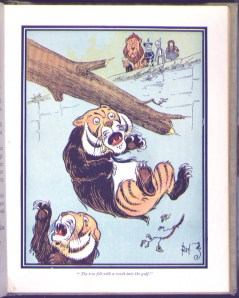
C&I were actually also a bit troubled by the scene where the ruthless animal-killer the Tin Woodman sends the two fierce Kalidahs to their deaths at the bottom of a ravine.   Iris brought it up suddenly the next day, that although the story said they were mean & scary, in the illustration, they “looked nice” as they were falling:

kalidahs

Perhaps the “twin”-ness of the Kalidahs, so much like Celie and Iris or Pot Luck and Daisy, hit close to home.

Here a cool Library of Congress online exhibit on Baum, Denslow & Oz.

Love is All “Last Choice”

Love is All are a punky Swedish pop band led by Josephine Olausson, who has a somewhat Bjork-like presence and warbling singing voice.  Amazon tells me that people who buy their second album A Hundred Things Keep Me Up At Night also buy Los Campesinos!, so I guess I’m predictable in my affinity for Western European hyper/catchy punk-pop with clever lyrics.

“Wishing Well” is a total rip-off of the Clean’s great “Tally Ho,” in a good way (that manic Farfisa riff).  See below for a video of them performing it live.

The other most memorable ones are “Sea Sick,” about a terrible cruise ship experience – would be a good soundtrack to David Foster Wallace’s “A Supposedly Fun Thing I’ll Never Do Again” — and probably my favorite, “Last Choice.”   In this one Olausson tells the story about eventually going home with “her last choice” at a party, someone she “vaguely knows”: “I’m not about to be left alone/ I’m sitting on the sofa on my own…/ He’s not my type and I’m not his but I’m sure he’s all right/ I’m not your kind and you’re not mine but for tonight you’ll have to do!”  For a song about a meaningless one-night stand, it’s weirdly touching and “inappropriately upbeat,” and somehow reminds me of that Christmas novelty song by the Waitresses (“Christmas Wrapping”).  (What is it that makes it seem Christmasy?  Is that a glockenspiel?)  There’s definitely a 1980s New Wave/post-punk feeling generally (saxophones, for example).

Seeing “The Tale of Despereaux” with Celie

tale-of-despereaux-tsrimg

Sarah took Iris to see the animated movie “The Tale of Despereaux” a few days ago.  Celie thought that it would be too scary and decided not to go, and then bitterly regretted the decision an hour later.  So, she and I went yesterday.

It’s a pretty cute and a beautifully animated movie.  It was a bit dark and complex for Celie, through whose eyes I was seeing it almost literally as she was sitting on my lap for most of it.  But she liked some of it.

It’s partly about a crisis of masculinity and fatherhood.  Despereaux is an unusual mouse because he is too small, has huge ears, and is totally fearless.  He’s failing out of school because he can’t learn how to “cower” properly like the other mouse kids.  His father basically turns him into the authorities and allows them to sentence him to banishment to the world underground, where he’ll presumably be killed by the Morlock-like rats who live there.  (This was pretty heavy for Celie.)

There are at least two other failed fathers.  There’s the dungeon guard who, we learn, gave away his “princess” infant daughter, an act he terribly regrets (I have to admit I didn’t completely get why he had to do this — I guess he signed her away into service, as when we meet her, she has become the servant/maid for the actual Princess).  And then there’s the King, who after the death of the Queen, lapses into a life-denying, nihilistic depression.   The theme of the movie is best captured, I thought, by the scene where the spunky, fearless Despereaux is frantically trying to get the King’s attention in order to warn him that his daughter the Princess is about to be killed by the rats… but the King can’t hear/ignores him and drops one single tear, which crashes down on Despereux’s head.   Frozen, ineffectual, destructive male passivity/depression/cowardice leads to the “giving away”/neglect/destruction of the child.  In the end Despereaux, through the reading of old tales of chivalry, revives lost values of bravery and honor, saves the community, and teaches mice that there’s more to life than cowering.

Afterwards I asked Celie if she is brave.  “Well, sometimes… when I want to be.  Other times, the scare comes into my body,” she replied.