Jamie Quatro & George Meredith: Hiding the Skeleton

15712681

Jamie Quatro’s I Want to Show You More seems like the 2013 version of Ben Lerner’s hilarious & super-smart 2011 Leaving the Atocha Stationa first-book fiction breakout on a small press (Lerner’s was published by the really indie Coffee House press; Quarto’s is on Grove, so maybe not exactly the same thing) that gets rave reviews from James Wood in the New Yorker, the NY Times, and cascading ripples of underdog-new-author-loving accolades from that point on.

Quatro’s stories are really good.  They’re all set in the town of Lookout Mountain on the Georgia-Tennessee border, which on first blush sounds like a too-picturesque invented setting but turns out to be where Quatro actually lives.  (Her husband seems to be a business professor at the (Presbyterian) Covenant College in Lookout Mt.)

The one that seems to have received the most attention is “Decomposition: A Primer for Promiscuous Housewives.” This is a disconcertingly realist-allegorical account of a married woman’s adultery in which, following her confession to her husband and breaking off of the affair, her lover’s slowly decaying corpse manifests in the marital bed.  She zips up the body in a sleeping bag and hides it in an old playpen in the basement, disguised under piles of junk.  Finally she brings her husband down to look at the hidden corpse, which starts to scream at her and call her a whore.

My theory is that Quatro (who started but did not finish the PhD program in English at Princeton, specializing in British Romantic poetry) is drawing on George Meredith’s great 1862 sonnet sequence “Modern Love,” especially its famous section 2 in which the miserable, adulterous couple play “hiding the skeleton” in their performance of a happy marriage:

AT dinner she is hostess, I am host.

Went the feast ever cheerfuller? She keeps

The topic over intellectual deeps

In buoyancy afloat. They see no ghost.

With sparkling surface-eyes we ply the ball:

It is in truth a most contagious game;

HIDING THE SKELETON shall be its name.

Such play as this the devils might appall!

But here ’s the greater wonder; in that we,

Enamor’d of our acting and our wits,

Admire each other like true hypocrites.

Warm-lighted glances, Love’s Ephemeræ,

Shoot gayly o’er the dishes and the wine.

We waken envy of our happy lot.

Fast, sweet, and golden, shows our marriage-knot.

Dear guests, you now have seen Love’s corpse-light shine!

There’s a new Yale UP edition of the poem (and a bunch of other Meredith poetry) reviewed (somewhat nastily to its editors) by Helen Vendler in a recent New Republic.

I Want to Show You More has various enjoyable & surprising things about it, including that it is (a) immersed in matters of religion; not only are many of its characters church-goers but several stories (like “the Anointing” and “Demolition”) are centrally about faith in different ways and (b) it’s unusually filthy/pervy by prestigious-short-story standards. In “Decomposition,” for example, one manifestation of the adulterous woman’s ill ease (with her lover in the basement) is that she “grow[s] desperate, watch[es] Asian breast massage how-to videos on YouTube with links to girl-on-girl porn.”  I wonder what the folks at Covenant College think of all this.

*Any relation to Suzi Quatro a.k.a. “Pinky” Tuscadero on Happy Days?  Weirdly conceivable but probably too good to be true.

Our love is alive, and so we begin

Foolishly laying our hearts on the table

Stumblin’ in

Our love is a flame, burning within

Now and then firelight will catch us

Stumblin’ in

Stumblin’ in

Stumblin’ in

I actually always thought it was “our love is a lie”… which I thought was kind of hard-hitting for that kind of song.

The pop song’s question: Why??

When I did a college radio show many moons ago, I always felt that the “theme show” was a bit cheesy, over-obvious, and often a cop-out. There were always a lot of bad and/or obvious theme shows, anyway. A set of songs all about colors… or girls’ names… or with goodbye or hello in the title. You get the idea.

But this morning I’ve been opening my mind to the potential of the Theme Show by listening to Meghan McKee’s WFMU show Underwater Theme Park, which I believe follows a different theme every week.

This week’s theme is Why? Songs about why, asking why, beginning with why.  Some of the songs that I have been listening to while grading papers:

Benny Goodman and His Orchestra featuring Peggy Lee- Why Don’t You Do Right?

Jack Wyatt and the Bayou Boys- Why Did You Let Me Love You?

Johnny Cash- Why Is a Fire Engine Red?

Hank Williams- Why Should We Try Anymore?

Wayne Hancock- Why Don’t You Leave Me Alone?

Reverend Horton Heat- Generation Why

The Bartlebees- Why?

Weezer- Why Bother ?

The White Stripes- Why Can’t You Be Nicer To Me?

Slick Rick- Why, Why, Why

KRS-One- Why?

Blakroc -Why Can’t I Forget Him

Ladytron- The Reason Why

Bronski Beat- Why?

As the playlist develops, it poses a meta-question about the essential role of the question in the pop song.  The pop song as question, questioning, “Questioningly” (like the Ramones song – “aren’t you someone that I used to know/ And weren’t we lovers a long time ago?”). The pop song addresses us, begs and pleads like James Brown, grabs our shirt and demands an answer.  But we don’t need to answer or respond in any way, we can just listen.

Kitty’s *D.A.I.S.Y. Rage*: Getting drowsy, Bena-Benadryl, y’all

Kitty-DAISY-Rage-e1358974522517

I love Kitty [*but not in a creepy way].  Formerly Kitty Pryde, which I guess she had to change for copyright reasons (it’s a comic book character)– too bad, as plain Kitty is more generic.  Her free- download D.A.I.S.Y. Rage (which you can get here — throw her a few bucks when you do!– it’s on a pay what you like basis) surprised me, made me laugh, and felt like it was expressing a fresh perspective more than anything since Frank Ocean’s Nostalgia, Ultra (although I guess that one didn’t make me laugh so much).

Melissa Leon observed, “To a degree, you can’t blame the confused and angry hip-hop diehards who shunned her as soon as they saw her last year. Who’s really sure, right away, what to make of a red-headed, teenage white girl who lives in suburban Daytona Beach, Fla., works at a Claire’s, has a huge crush on both the major Justins (Bieber and Timberlake, natch), and calls herself a rapper?” Noted. Although you could also just say “because she’s an assertive teenage girl with a big mouth.”  (Truth be told, she faintly resembles Alyson Hannigan.)

She slurs, giggles, talks over the beat, mumbles, vocal fries, texts “Fuck Men!” to her buddies, internal- and half-rhymes, and tells her mom she loves her like the Florida suburban teenager in her room that she is.  The music is woozy-hypnotic, a buzzed-former-Disney-Princess soundscape with loops of toy piano and harp.  You kind of picture this 17 year-old in her bedroom, surrounded by stuff she was into when she was 12 and hasn’t had the energy to clear away.

Exhibit A as to her brilliance, she does a homage to the Wu-Tang Clan’s “”C.R.E.A.M.” (“Cash Rules Everything Around Me”) called “R.R.E.A.M” that follows the syntagmatic chain of associations from the song title to allergy/rash cream in order to rap about the hives, rashes, and propensity for blushing that she suffers from as a fair-headed red-head.  I mean, how completely brilliant!

I sctratch the bumps my skin /Stress Rash Rules Everything Around Me (RREAM) Getting drowsy, Bena-Benadryl, y’all /Rash Rules Everything Around Me/ Getting drowsy, Bena-Benadryl, y’all I’m blushing while I’m running the show/ I don’t wanna pose cuz I don’t want ’em to see/ The anxiety rash I’m hiding under my sleeves /It looks weak, to get all red and itchy when I’m barely upset/ but it’s bad enough to make em call a medic

She also admits to stuffing her face and not being super-thin (“I’m kinda like a pelican, cuz my mouth/ Is way bigger than my belly and/ I like to keep some feathers on my skeleton”), and expresses her ambivalence about annoying cool boys: “I know you wanna prove your dominance, and you want all my klonopin/ You talk about the devil cuz you’re so black metal.”

Her idea of a threat: “I piss all on your bike, I like to see your fixie rust.” Watch out, hipster boys.

So great!!! She will be a star.  Or should be.  I swear it on my freckles.

Richard Hell: Cold, angry days on the houseboat

tumblr_me9yrynXC41rifi7wo1_500

I had Richard Hell and the Voidoids’ Blank Generation and Destiny Street in high school and although those were never albums I listened to from start to end a whole lot, I’ve always really loved a few of Hell’s songs: e.g. “Time” (“Only time can write a song that’s really really real”), “Love Comes in Spurts,” “Kid With the Replaceable Head,” and “Blank Generation.”  He was a bit of a punk-rock Zelig: a founding member of the great Television before his high school buddy Tom Verlaine kicked him out; briefly in Johnny Thunders’ Heartbreakers after the breakup of the New York Dolls; slept with Nancy Spungeon for a while before she got involved with Sid Vicious; opened for the Clash with the Voidoids in Britain in 1977.  That year Time dubbed him “the demon-eyed New Yorker who could become the Mick Jagger of punk” (it didn’t quite work out that way). I don’t think I had really known this, but Hell’s memoir (I Dreamed I was a Very Clean Tramp) makes a convincing case that when Malcolm McLaren spent a while hanging around NYC in 1974-5, he admired Hell’s style — his good looks in torn leather jacket, the safety pins, spiky hair, aggressively graphic hand-printed text on t-shirts, a Situationist-influenced collage aesthetic — and that when he couldn’t recruit Hell to form his own band, McLaren just appropriated the look and gave it to the Sex Pistols. (Hell admits to spending some time feeling frustrated about his unacknowledged role as the originator of punk’s signature style, but seems Zen about it now.)

Robert Christgau claims that with the memoir Hell equals or exceeds Patti Smith’s achievement in the National Book Award-winning Just Kids.  I definitely disagree; overall I found I Dreamed I Was a Very Clean Tramp hit or miss. It has some great stories to tell, but eventually it devolves into a dispiriting narrative of heroin addiction, reflexive promiscuity, and missed opportunities– somewhat redeemed by the awareness that Hell eventually got clean and turned into an apparently healthy person.

Some examples:

Our record company was another source of disgust and disappointment.

Later, as the monotony and discomfort of the tour became more and more horrible, the great [Clash friend/ roadie] Roadent introduced me to his antidote for ennui — self-inflicted cigarette burns.  It worked and I still have the cherished memory on my left forearm.

Jake did a creative thing for us in London by renting a houseboat on the Thames, off Cheyne Walk, for the band to live in.  But it turned out not to be a good idea to cram us all into a tight space.  By the end of the first three days I was junk-sick and irritable… My hopelessness grew… It got labyrinthetically self-repellant… The entire… tour was just a stretched-out version of those first few cold, angry, nauseated days on the houseboat.

Some friend or editor also really should have gotten Hell to ease off on of the punk-groupie sex stories, which also get monotonous and depressing. He indulges too much in plain old objectification of the array of women who pass through his various fleabag Lower East Side bedrooms. “Although he’s self-deprecating about it of course,” Christgau writes (unfortunately), “Hell was New York punk’s great ladies’ man.”  Sabel Starr is one example of his conquests.  “Sabel was fifteen (Johnny [Thunders] was nineteen) when they met and she was already notorious as an L.A. groupie.  Word was she’d slept with Iggie Pop was she was thirteen… She always had the cheeriest healthy smile.  The smile was real — happy and friendly.  Everything about her was real.  She was heroic.  At least from the point of view of a musician she liked.  She truly lived for fun and joy, and the thing that was the most joyous of all to her was to make a meaningful rock musician happy.  That was her mission, the way someone else might join the Peace Corps.  Instead of digging wells and planting crops and offering medical care, she provided pretty and entertaining companionship, astute and sincere encouragement, favorite drugs, and magnificent blow jobs…. She was a soulful, sane, self-aware sweetheart of a committed groupie.”

Eww. As he comments at one point, while on coke his “brain and cock were one”… and he was high most of the time in the late 70s and early-mid 80s.

Hell is a pretty smart guy, one of the better-read and more intellectual of the punk generation (he always saw himself as a writer/artist who happened to decide to make music for a while), and there are some good/fun things about the book… he knew everyone in those days, and it’s fascinating to see the emergence of punk from the perspectives of one of its conceptual architects.

He observes interestingly at one point that “the British punk culture also seemed strangely asexual.  There were some classic teenage sexpectations among stray members of bands, but for the most part the relations between the boys and the girls seemed infantile, like prepubescent.  People kidded and cuddled and might even share beds, but it seemed to be in bad form to regard one another as sexual prospects.”  The book brought out the prude in me: I kept thinking, “stop doing drugs and chasing groupies, focus on your opportunities.”  Punk saw itself as an alternative to the excesses of 1970s rock and roll culture, but people like Hell got caught up in an arty downtown version of those same excesses, to the point of sleeping with the very same groupies.  Although he definitely gets the problem of drug addiction, it doesn’t seem to occur to him that there might have been something valuable in a (relative) prudishness and “asexuality” in the London scene, which may have helped to prevent punk from reverting into just a new form of rock and roll.  (Just read this Bookforum review which comments of Hell, “he’s a scumbag with an intimate, articulate understanding of scumbag psychology.”)

The “clean”/chaste vs dirty/ “tramp[y]” [vis. the book’s title] dichotomy may also relate to Hell’s complicated feelings towards Tom Verlaine, who is the closest this book comes to the Robert Mapplethorpe of Smith’s Kids — e.g. the roommate/ best buddy/ co-conspirator from the early days.  Hell still seems to feel rejected by and angry at Verlaine to some degree, perhaps in part because of Verlaine’s aloof, un-rock-and-roll fastidiousness: he didn’t do drugs, didn’t hang out much, and you don’t hear a lot about his girlfriends.  I guess he just dedicated all his energy to making genius music… (Although to be fair, Verlaine does sound as if he could be a pain in the neck, a bit of a control-freak J. Mascis type, with Hell as the bewildered/rejected Lou Barlow).

But then, I was always much more of a bookish Verlaine than a bad-boy Hell type (sans any musical talent), personally.

*Amour* and *I Married You for Happiness*

Amour

Coincidentally (I think) I happened to be reading Lily Tuck’s novel I Married You For Happiness when I saw Michael Haneke’s Amour at the IU Cinema– both of which are about an elderly, long-married spouse’s response to the death of his/her partner.  You probably know about Amour.  The donnée of Tuck’s novel is a bit different; at its onset, the narrator Nina is at the bedside of her husband, who after going upstairs to take a quick nap, has died suddenly; the novel plays out in that night, as she stays by his corpse, thinking back over memories from their marriage.  As its title suggests, I Married You For Happiness is less about the death than about the marriage, and I found it to be a moving and engaging portrait of a not-untroubled long-term relationship as it spools out over decades.  They meet at a cafe in Paris where she is reading an avant-garde French novel by Natalie Saurraute (which hints at Tuck’s aesthetic program). Theirs is a C.P. Snow two-cultures kind of marriage, she a painter, he a mathematician, and one of its concerns is the way two people with different ways of thinking, kinds of mind, and perspectives can form a life together.  In this it reminded me of Virginia Woolf’s portrait of a somewhat incompatible yin/yang marriage in the Ramsays:

Whenever she "thought of his work" she always saw clearly before 
her a large kitchen table. It was Andrew's doing. She asked him 
what his father's books were about. "Subject and object and the 
nature of reality," Andrew had said. And when she said Heavens, 
she had no notion what that meant. "Think of a kitchen table then," 
he told her, "when you're not there."

So now she always saw, when she thought of Mr. Ramsay's work, 
a scrubbed kitchen table.

Nina is a bit Mrs Ramsay-like in her bemused attitude to her abstractly-thinking husband’s worldview.  Although in other ways she, as an artist, more resembles Mrs. Ramsay’s protege Lily, the painter (Lily Tuck/ Lily Briscoe?).

I am a longtime Haneke fan (I’ve seen most of his films, I think — my favorite is probably Caché; I can never bring myself to watch either version of Funny Games), and I found Amour brilliant and/but hard to watch in some respects.  I read one review that asserted that it is “not a depressing movie” and in fact that it would be a good choice for a couple to go see on Valentine’s Day.  It’s true that it’s a notably realist and unsentimental depiction of long-term commitment– one that considers what the phrase “’till death do us part” might really mean in practice.  Not sure I’d really recommend it for date night, though.  One friend saw it at a different showing at the IU Cinema during which she reports various audience members were crying, one woman doing so throughout the entire film and, at one climactic moment (you can probably guess which if you’ve seen it), shouting out loudly “no!”  My friend says she actually kind of wished she’d seen it on DVD at home, as the emotion in the audience was a bit overpowering.

George Saunders’ & Sam Lipsyte’s Disrespected Worlds of Fantasy

dungeons-dragons-400ds0702

My spring break pleasure reading, partly on a round-trip plane ride, consisted of two new collections of stories by authors I’ve read for a while, George Saunders’ Tenth of December and Sam Lipsyte’s The Fun Parts. It was interesting to read them in succession; you could construct a Venn Diagram in which they both overlap with parts of Donald Barthelme, Mark Leyner (although I admit I only thought of him because I just read Lipsyte’s admiring interview with him in the new Paris Review), Louis C.K. and/or other standup comics, Saunders’ one-time Syracuse colleague David Foster Wallace and maybe Kurt Vonnegut. What may be most distinctive about them, at least considered together, is the fundamental role of humor in their fiction — they almost continually crack jokes even in pretty serious and/or grim narratives, in a way that feels kind of post-David Letterman and contemporary to me.

It’s a slightly unfair comparison to Lipsyte because Tenth of December is probably the best book of an artist for whom the short story is his central and basically only art form, whereas Lipsyte’s The Fun Parts is more of an occasional collection and doesn’t, IMO, show him at his strongest compared to, for example, his last full-length novel The Ask which I believe I wrote about here a few years ago… Yes, I began that posting by observing that it will “probably long remain the funniest and best novel filed under this Library of Congress Cataloging-in-Publication data: 1.  College administrators– Fiction.  2.  College benefactors — Fiction.  3.  Education fund raising — Fiction.”

Saunders’ book is fantastic. I guess my favorite is the amazing “The Semplica-Girl Diaries” which he discusses on the New Yorker fiction blog here. Saunders in his winningly unpretentious way comments that ‘If the only thing the story did was say, ‘Hey, it’s really wrong to hang up living women in your backyards, you capitalist-pig oppressors,’ that wasn’t going to be enough. We kind of know that already. It had to be about that plus something else.” This story would work really well on a syllabus in a course focused on depictions of immigrant labor or related topics.

Lipsyte is a master of that contemporary mode of cringing-embarrassment-and-shame, with a focus on the grotesque and abject body, that’s most familiar from t.v. shows like Louie C.K., Curb Your Enthusiasm, and Girls. And Maria Bamford’s stand-up comedy and her show. He’s hilarious and brilliant, but I found the stories a bit brutal and cudgeling when read all in a row.  They contain some pretty disgusting and/or emotionally lacerating moments, e.g. the story with the dad who taunts his son to goad him to take a swing at him: “Don’t be such a damn pansy!  I’m leaving your dying hag of a mother!” Maybe my favorite was the one about early-teenage Dungeons & Dragons players, which stood out for me as having more of a Saunders-like sympathy and emotional depth than some of the others.

That story’s D&D theme also reminded me of the final story in Saunders’s collection, “Tenth of December” itself, which starts in the consciousness of an odd kid who seems to have developed his own cosmology involving creatures called Nethers that vaguely bring to mind some of the creatures in A Wrinkle in Time:

They were Netherworlders.  Or Nethers.  They had a strange bond with him.  Sometimes for whole days he would just nurse their wounds.  Occasionally, for a joke, he would shoot one in the butt as it fled.  Who henceforth would limp for the rest of its days. Which could be as long as an additional nine million years.

That’s a characteristic Saunders thought, that this weird kid spends days, in his fantasy life, nursing the wounds of aggressive invented creatures whom he also humiliatingly injures for laughs, and with whom he has a “strange bond.”

It makes sense that both Saunders and Lipsyte would be interested in eccentric, childish, disrespected realms of fantasy and role-playing. Both authors return repeatedly to self-contained invented worlds and subcultures, lacking good aesthetics or high-cultural credibility, that provide opportunities for grandiose self-dramatizing on the part of losers and marginal types of all kinds. Amusement and theme parks seem often to serve this role for Saunders. This preoccupation seems fitting for an era in which literary fiction has vastly less cultural influence than, say, console or smartphone video games. There’s a resigned albeit slightly embarrassed sense on the part of both authors that they are working in a genre that has lost status in a major way and that cannot really even compete with the cheesiest of non-literate games. And of course part of their success is that they fully recognize this in the way a lot of authors trying to plug away at realist fiction do not.  (Maybe Jennifer Egan’s work has some of this too.)

I point this out as a former somewhat-dedicated D&D player circa 6th-7th grade…

Diane Arbus, Adventurer

Camera-obscura-...-Diane--007I read the Patricia Bosworth biography of Diane Arbus, originally published in 1984, only a little over a decade after her death, but reissued and, I believe, the basis for the 2006 film Fur: an Imaginary Portrait of Diane Arbus, which stars a horribly mis-cast Nicole Kidman (!!) and which looks awful.

The biography is not perfect — somehow I felt the truth of who Arbus was, what she felt and thought, remained to some degree elusive or hidden from Bosworth and the reader — but I found it very gripping.

I had never known that Arbus was born Diane Nemerov and was the sister of famous poet (twice poet laureate, winner of Pulitzer, National Book Award, and Bollinger prizes) Howard Nemerov!  Quite the talented-sibling duo.  Howard is quoted late in the book saying that Diane once commented to him, “You know, I’m going to be remembered for being Howard Nemerov’s sisrer;” “how ironic and untrue,” he observed to Bosworth. (Although I think Nemerov’s own fame emerged more fully after the book was first published.)  They were cosseted children of privilege, of immigrant Jewish parents, in a rarefied Upper West Side Manhattan world, their father a wealthy founder of the Russek’s department store on Fifth Avenue (Diane grew up to hate shopping for clothes); attended the elite Fieldston prep school where they were both recognized as very talented.  Yet oddly, Diane and Howard’s parents gave them very little if any money as adults, and both of them had to scrape and scheme to support themselves in their early adulthood.

I was thinking about some other famous later 20th-c American poets whose fathers were very wealthy industrialists or financiers. James Merrill, son of Charles Merrill, co-founder of Merrill-Lynch; Louise Glück, daughter of the inventor of the X-Acto knife.  I went to a private high school in Boston founded by another son of Charles Merrill, and I always found it funny to think that the Merrill money alternately funded a school and a poetry career.  Economic capital –> Aesthetic/cultural capital.

Diane married Allan Arbus as a teenager and they became a successful fashion-photography duo in the 1940s and 1950s.  People comment that the two of them were often in a corner consulting about a shot, whispering conspiratorially.  There’s an amazing reproduction of an image from a 1947 feature article in Glamour on “case histories of seven married couples who are collaborating on joint careers in the arts, the sciences, and business” that shows a prim-looking Diane in a long dark dress feeding their young daughter Doon.  They both eventually became disenchanted by the fashion world– after their divorce, Allan eventually became a successful actor, starring as Maj. Sidney Freedman on M.A.S.H. (!- this actually does not come up in the biography).

One limitation of the book is that it does not reproduce a single Arbus photograph.  I know them pretty well, but if you didn’t, you’d definitely want to read the biography with one of her collections in hand.  I am going to try to get hold of the 2003 catalogue Diane Arbus Revelations because I really only know the famous images from the 1972 Aperture monograph.

Even after reading the biography, I can’t quite decide what I think about the question of the degree to which the ways her photography sensationalizes and (cruelly?) exoticizes its subjects.  One of her mentors, Marvin Israel, says:

A photograph for Diane was an event.  It could be argued that for Diane the most valuable thing wasn’t the photograph (the result), it was the experience, the event… Once she became an adventurer — because Diana really was an adventurer — she went places no one else [no photographer] had ever gone to.  [Those] places were scary… But once [she] became an adventurer [she was] geared to adventure and she sought out adventure and her life was based on that… the photograph was like her trophy– it was what she received as an award for her adventure.

It would be difficult to defend the work on purely aesthetic grounds.  She was “adventuring,” pushing herself to enter into forbidden, strange, exotic zones– that sense of symbolic boundary-crossing was fundamental to the images. And a critique can certainly be fairly made of the ways different kinds of social marginality (e.g. ethnic, economic, disability-based) get conflated into what can seem like one big category of the non-normative. On the other hand, she was no slumming tourist, dropping in to get the photo and then going back to her upper-middle-class world.  She returned again and again, obsessively, to many of her subjects.  The famous photo of the “Jewish giant” with his parents came out of over years of visiting and photographing him: “from 1962 to 1970 she kept returning to the Carmels’ cramped apartment until she finally captured the image she wanted.”  And she became a regular at the Coney Island sideshows and Hubert’s Freak Museum, far beyond what could have been needed to get the photos, and got to know many of the performers very well (“the living skeleton, the embalmed whale, the ventriloquist with his two-headed cat”) and considered some of them friends.

Later, in the 1960s after her divorce, this “adventuring” transitioned into sexual adventures, sometimes of a pretty seamy variety:

Sex was the quickest, most primitive way to begin connecting with another human being, and the raunchier and grosser the person or environment, the more intense the experience, and this enlarged her life… She… described in a particularly detached way how one night she’d had sex in the back of a Greyhound bus (“If you sit on the inside back seat of a Greyhound bus, it means you’re sexually available.” [ed. note: good to know!)  No introductions were made, not a word was spoken, and after this swift, mute encounter in the dark, she got off on the next stop and waited on the highway for an hour or so until another bus came along which would bring her back to New York. … It was almost as if she was determined to explore with her body and her mind every nightmare, every fantasy, she might have repressed deep into her subconscious…. Crookson listened as she told him of picking up a Puerto Rican boy on Third Avenue “because he was so beautiful.”… At this point Crookson interrupted to ask her if she hadn’t ever faced actual danger as a result of such recklessness.  Yes, she answered, but she’d always been “thrilled” to take risks to “test” herself- and besides, nothing bad had ever happened to her and for some strange reasons she was positive it never would…. [W]hen her camera was with her she always felt in control….. It seemed as if merging with her subjects… was a way of giving herself to them after they revealed themselves to her camera.

Many comment that Arbus carried her often-bulky cameras and other equipment in front of her like a shield– even when she photographed at orgies (these images have apparently never surfaced).  I was surprised that there is not a single reference to her ever getting mugged or having her camera stolen, given all the stories about her wandering about Central Park in the middle of the night or the like.

To me probably the most haunting images are the late ones taken at the institution for mentally-disabled patients in Vineland, New Jersey:

diane_arbus_untitled

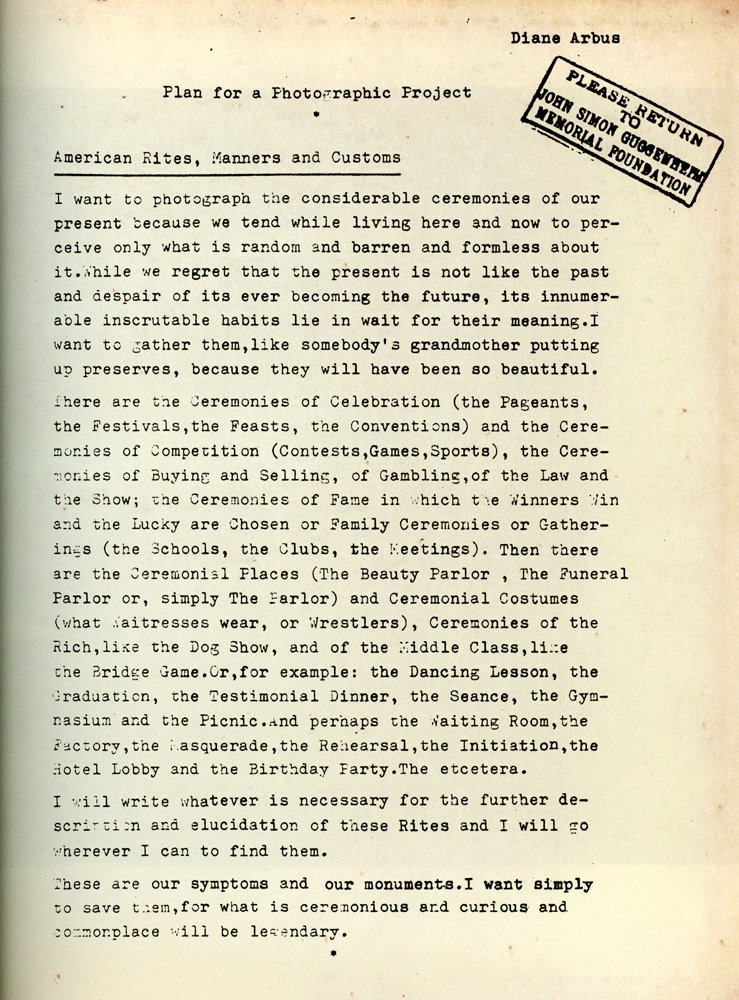
Arbus’s Guggenheim proposal (she won it): “While we regret that the present is not like the past and despair of its ever becoming the future,  its innumerable inscrutable habits lie in wait for their meaning.”

Iris DeMent: Learning How Not To Pray

singthedeltapromopic2_20120626_155354

Iris DeMent at the Buskirk-Chumley in Bloomington on Friday night…  A great show.  I’d seen her at the Bluebird a number of years ago, and I remember guessing that she was depressed; she didn’t seem all that happy about performing that time, in any case.  (And later I did read references to some kind of extended depression, or something, that she suffered.)  She seemed much happier about being on stage this time, actually having fun, joking around and teasing the audience quite a bit (she made fun of us for all stopping clapping in perfect simultaneity).  She alternated between guitar and gospelly grand piano.  As one-time Moonraking contributor JF (who went to the show with me) commented, the difference between her singing and speaking voice is surprising and almost bizarre.  Her singing voice (still) has a girlish purity and a choked quaver that reminds me a bit of a female Jimmie Dale Gilmore; but when she speaks, she turns into this earthy, funny, kind of gravel-voiced lady from Paragould, Arkansas.  I liked the lines from one song, something like, “Mama was always tellin’ her truth, now it’s my time” — e.g. “now I’m becoming an old lady [not really– she is about 52] who is going to say whatever I like and not worry too much about it.”

A lot of her songs reflect on the experience of someone raised in a fundamentalist faith who has lost that belief. She’s said about her upbringing,

“It was full gospel-fundamentalist, I guess you’d call it. There was hell and there was heaven, and the in-between was just kind of preparation to get to the better place. [In] everyday life, your primary focus was staying out of the bottom side of the afterlife. I have zero regrets about having been brought up that way — in fact, I can’t even put into words how grateful I am for it. There were some useless things and some, I suppose, somewhat damaging things that I got from it. But … there was a sincerity in there, as well, and a really good message that came through about what’s going on underneath the waters of life. My parents just gave me a gift I can’t even put a figure on.”

In “The Night I Learned How Not to Pray,” about the death of her younger brother (I have no idea if this really happened or not*): “That was the night I learned how not to pray/ ’cause God does what God wants to anyway/ And I never did tell my mother, I kept it from my sisters and all my brothers/ That was the night I learned how not to pray.”  Or one of her best-known songs, “Let the Mystery Be:” “Some say once you’re gone you’re gone forever, and some say you’re gonna come back./ Some say you rest in the arms of the Saviour if in sinful ways you lack./ Some say that they’re comin’ back in a garden, bunch of carrots and little sweet peas./ I think I’ll just let the mystery be.”

From the same interview:

“My mom, who sang straight up until the day she died, told me one day: ‘You know, Iris, singing is praying and praying is singing. There ain’t no difference.’ So I think, even though I’ve left the church and moved away from a lot of the things that didn’t do me any good, I continued to pray — and that is singing for me. That’s as close as I get to praying.”

Infamous Angel, My Life, and The Way I Should (the latter the one that pissed off Nashville) are still probably my favorites, but 2012’s Singing the Delta, her first album in years, is also great.  Merle Haggard, who became a kind of mentor, apparently called her the greatest singer he’d ever heard. It was a treat to see her live again.  (The band was really good, too, including local fave Jason Wilber, who is also in John Prine’s band.)

Here’s an old video of her singing “Let the Mystery Be”:

*Here’s a recent interview with Greg Kot in which DeMent explains that the brother’s death comes from a story told to her by a friend; she also discusses her period of depression.

You are Radiant like Sunlight: L. Ron Hubbard and Scientology

L._Ron_Hubbard_in_1950-1024x731L. Ron Hubbard in 1950

I’m reading Lawrence Wright’s Going Clear: Scientology: Hollywood, & the Prison of Belief, from which I keep having to read excerpts out loud for being so bat-shit crazy even within the frame of my expectations about Scientology and L. Ron Hubbard.

The basic story so far: young man with a flair for self-dramatizing/lying joins the Navy in WW2 and is discharged; at this point a massive gap develops between Hubbard’s own accounts of his experiences in the war (filled with heroism and derring-do) and all extant navy records of his undistinguished or worse record.  He develops a promising career as a science fiction writer and becomes part of a boho sci-fi scene including the likes of Robert Heinlein, who becomes a close buddy.  Joins a cultish commune in Pasadena called the Agape Lodge, “a branch of the Ordo Templi Orientis, a secret fraternal organization dedicated to witchcraft and sexual ‘magick,’ based on the writing of… Aleister Crowley.”  Hubbard’s estranged son later comments that when Crowley died in 1947, “That’s when Dad decided that he would take over the mantle of the Beast and that is the seed and beginning of Dianetics and Scientology… It was his goal to be the most powerful being in the universe.”

Under anasthesia at the dentist, Hubbard has a vision that he believes reveals the secrets of existence to him.  He writes a self-help book based on said vision, Dianetics: the Modern Science of Mental Health, which becomes a surprise best-seller and makes him wealthy.  When the Dianetics trend passes, however, Hubbard is broke again, and subsequently re-invents Dianetics as not simply a kind of self-help, power of positive thinking alternative to mainstream psychiatry, but instead a full-fledged religion with Hubbard at its center as a charismatic leader.  This is when things start getting really weird and dark.

A few favorite passages so far.  This is from “a list of personal goals and compliments [Hubbard] pays himself, but… also a portrait of the superman he wishes to be,” written in the late 1940s before the publication of Dianetics.

You are radiant like sunlight.

You can read music.

You are a magnificent writer who has thrilled millions.

Ability to drop into a trance state at will…

You did a fine job in the Navy.  No one there is now ‘out to get you.’

You are psychic.

You do not masturbate.  [This follows an earlier affirmation: “Masturbation does not injure or make insane.  Your parents were in error.  Everyone masturbates.”  Btw, one Crowleyian ritual at the Agape Lodge involved “‘invocation of wand with material basis on talisman’ – in other words, masturbating on a piece of parchment.'”]

You do not know anger.  Your patience in infinite.

Snakes are not dangerous to you.  There are no snakes in the bottom of your bed.

Later, in the heady “Sea Org” era, when Scientology’s leaders had not yet found a stable home base and were located on a ship at sea:

Hubbard began recalling many of his own various existences… He claimed to have been a contemporary of Machiavelli’s, and he was still upset that the author of The Prince stole his line ‘The end justifies the means.’ He said he had been a marshal of Joan of Arc and Tamburlaine’s wife.  He told stories of driving a race car in the alien Marcab civilization millions of years before.  He came to believe that in some of his past lives on this planet, he had buried treasure in various locations, so he launched an expedition to unearth his ancient hoards.  He called it the Mission of Time.  He selected a small crew… Because he wanted to keep the mission secret, he had two long rafts fashioned, which could be rowed ashore under cover of darkness and pulled up on the beach near where he imagined his ancient treasure was buried….

The missionaries found some old bricks they thought might have been the ruins of a castle beside the watchtower.  The metal detectors found nothing.  Hubbard decided to come along the next day to inspect the site himself.  “Yes, yes, this is the place!” he said excitedly.  He explained the absence of treasure by saying that it must have been hidden in a portion of the ruined castle that had fallen into the sea.  [The expedition] next stopped in Calabria, on the toe of Italy, where Hubbard had buried gold in his days as a tax collector in the Roman Empire.  None was found, however.

It is an unbelievable story, and I have not even gotten to Tom Cruise and John Travolta yet. The book makes you realize that Paul Thomas Anderson’s The Master massively underplayed the craziness– it represents Scientology as resembling in origins a deranged instantiation of an H.P. Lovecraft fiction or something along those lines.

Remember: You are radiant like sunlight. You are a magnificent writer who has thrilled millions. You are psychic. You do not masturbate.

p.s. The Amazon reviews of the book, some written by former Scientologists, are fascinating.  Also see Kim Masters’ “Why the Media is No Longer Afraid of Scientology.”

Maria Bamford Driven Crazy By Bullshit

[with apologies to Elayne Boosler]

maria-bamford1

I’m totally pissed I missed Maria Bamford when she performed in Bloomington a year or so ago (I didn’t know about her then).  Like Louis C.K., she offers a standup comedy of abjection & anxiety, with a quality of pleading loneliness and reaching out for connection.  Part of the tension of the routines is in the sense conveyed of someone who feels locked up into him/herself, trying to communicate, and simultaneously undercutting and commenting on those efforts.  Both Bamford and LCK have a similar kind of trademark apprehensive/amazed/horrified look, and an almost-cringing physical quality– a sense of someone used to getting beaten up by life.

Bamford’s supposed current Match.com personals ad: “I can wear the same outfit for five days straight!  Or, I can crouch in the shower and make myself real small.”

I think I first heard about her in this fascinating piece in Slate,Stand-up Comedy and Mental Illness: A Conversation with Maria Bamford,” in which she discusses her history of mental illness and how she incorporates it into her comedy.

Bamford: People get really irritated by mental illness. “Just fucking get it together! Suck it up, man!” I had a breakdown, and a spiritual friend came to visit me in the psych ward. And they said, “You need to get out of here. Because this is the story you’re telling yourself. You know, Patch Adams has this great work-group camp where you can learn how to really celebrate life.”

It’s something people are so powerless over, and so often they want to make it your fault. It’s nobody’s fault. I started thinking of suicide when I was 10 years old—I can’t believe that that’s somebody’s fault. Like, “Oh, you’re just an attention getter.” Mental illness isn’t seen as an illness, it’s seen as a choice.

Slate: Or a weakness.

Bamford: Yeah. I have a joke about how people don’t talk about mental illness the way they do other regular illnesses. “Well, apparently Jeff has cancer. Uh, I have cancer. We all have cancer. You go to chemotherapy you get it taken care of, am I right? You get back to work.” Or: “I was dating this chick, and three months in, she tells me that she wears glasses, and she’s been wearing contact lenses all this time. She needs help seeing. I was like, listen, I’m not into all that Western medicine shit. If you want to see, then work at it. Figure out how not to be so myopic. You know?”

Slate: Right. And then people who suffer from mental illness feel ashamed, making it even harder for them to talk about it with other people—where if you had a “regular” illness, people would speak much more openly about it.

Bamford: Yeah, it’d be like, “Let’s pink-ribbon it up!”

Slate: By talking about these things in your act, you’re countering some of the silence that otherwise clouds them. Is that something you’re conscious of as you work on your material?

Bamford: Well, a lot of it is selfish, I think. If I talk about it, then maybe somebody will talk about it to me. I don’t know if there’s as much much nobility in it as I would hope…I feel super insecure and embarrassed and ashamed about mental health issues. That’s why I want to talk about it. There’s sort of a hostility even, where you go, “I’m just gonna say what I am and then see if you can’t handle it.”

Bamford has this brilliant new special called The Special Special Special that’s available for download or streaming for $4.99.  Here’s her website for more details.  It’s a standup routine she performs in her own home to an audience of two, her parents, sitting there on the couch.  (Plus a guy playing keyboards.)  She has to stop at one point to give her pug his eye drops, and to get some cookies from the oven for the audience. Imitations of her mother are almost as much a part of Bamford’s routines as they are in Margaret Cho’s.  So seeing Bamford imitate her mother and father, to them and only them, generates a special kind of excruciating discomfort.  Although in a way, maybe that’s not quite true, because the affection you sense between Bamford and her parents comes through clearly, and they also seem to find the stand-up pretty hilarious.  It is awkward, though.  And sometimes it gets to a place beyond mere awkwardness, such as when she discusses her suicidal episodes and desire to die.

But if you don’t know her, you might as well start by checking out some of the episodes of the 20-part 2009 web series The Maria Bamford Show.  I’m not sure to what degree this is factual (it seems obviously based on reality), but Bamford sets up the scene in the little pseudo-theme-song she sing-songs in the first episode:

I was a marginally successful comedy living in Los Angeles for fourteen years… But I never got my own sitcom and then my boyfriend turned out to bisexual… And then I forgot to pay my insurance premiums so I couldn’t afford my medication for OCD, depression, anxiety… So I started driving cross-country in a blond wig and bathing suit looking for ‘angels’ with a drug dealer named ‘Lips’…  My parents found me on a sidewalk selling clock radios in Detroit… And they said, hey why don’t you come live with us in Duluth, Minnesota so you can get your medications kind of stabilized… and they took me back to their house where I’m living in the attic with my 11-year old pug Blossom… It’s the Maria Bamford Show!

The addictive show, which consists of 20 3-6 minute episodes, chronicles the various embarrassments and humiliations of living in Duluth with her parents and encountering old friends and enemies as an apparently-failed would-be showbiz comedian.  It becomes difficult to draw the line between the necessarily or accidentally low-budget, awkward, or even bad/ low-quality, and the intentionally so.  Blossom the pug is a great presence; there’s one fantasy-horror (Holloween?) episode where Blossom kills and, if I recall correctly, eats Bamford.  A lot of formal experimentation playing around with the limitations of the cheapo DIY production and the larger conceit of Bamford licking her wounds, back in Minnesota from L.A. and finally producing the pseudo-homemade star vehicle sitcom she would never be allowed to do in reality.  (But maybe now she can??) She’s kind of the anti-, abject Marlo Thomas or Mary Tyler Moore.

Ideally you’d watch the episodes in order, but if you want to try another one, I really like this Mother’s Day special in which Maria’s (actual) mother tries out for the role of her mother (and tries to convince Maria that she might want to become a lesbian).  It ends with this little encomium: “Mom?  Thanks for letting me do less-than-accurate and highly-embellished portrayals of you for the internet and on television and in movies, if they’d let me… Happy mother’s day!”

Check her out!  I love this woman. Shell out the $5 for her special, it’s great and she deserves it (and she definitely needs to keep those insurance premiums paid, too).