More Animal Slaughter in the Wizard of Oz

oz12-05

Just had to write again about the amazing emphasis on animal slaughter in The Wizard of Oz.  It’s practically like Tintin in the Congo (in which the jungle animal body count increases steadily throughout).

Here are a few scenes from the climactic Chapter 12, “The Search for the Wicked Witch,” as she sends out waves of her minion creatures to attack Dorothy & co.

First wolves:

He seized his axe, which he had made very sharp, and as the leader of the wolves came on the Tin Woodman swung his arm and chopped the wolf’s head from its body, so that it immediately died. As soon as he could raise his axe another wolf came up, and he also fell under the sharp edge of the Tin Woodman’s weapon. There were forty wolves, and forty times a wolf was killed, so that at last they all lay dead in a heap before the Woodman.

Then he put down his axe and sat beside the Scarecrow, who said, “It was a good fight, friend.”

Now crows, giving the Scarecrow a chance to show his stuff:

The King Crow flew at the Scarecrow, who caught it by the head and twisted its neck until it died. And then another crow flew at him, and the Scarecrow twisted its neck also. There were forty crows, and forty times the Scarecrow twisted a neck, until at last all were lying dead beside him. Then he called to his companions to rise, and again they went upon their journey.

And how about some insects?

The bees came and found no one but the Woodman to sting, so they flew at him and broke off all their stings against the tin, without hurting the Woodman at all. And as bees cannot live when their stings are broken that was the end of the black bees, and they lay scattered thick about the Woodman, like little heaps of fine coal.

Finally, the Witch sends off a herd of buffalo, which Dorothy herself dispatches, shooting each one through the eye with a long-barreled rifle.  (Just kidding.)

It all has a distinct Manifest Destiny, conquest-of-the-Western-wilderness feel to it.

Killing a Cat to Save a Mouse in the Wizard of Oz

ww-denslow-illustration-1

We’ve been reading the girls The Wizard of Oz.  They are entranced by it, especially in this neat Dover reprint that includes all of the original gorgeous W.W. Denslow illustrations and plates (many of the pages of text are printed over/under illustrations, which creates a dazzling effect).

You probably know some of the disturbing/controversial facts about L. Frank Baum, such as his belief that Native American should be absolutely exterminated.  This from an 1890 newspaper editorial:

The Whites, by law of conquest, by justice of civilization, are masters of the American continent, and the best safety of the frontier settlements will be secured by the total annihilation of the few remaining Indians. Why not annihilation? Their glory has fled, their spirit broken, their manhood effaced; better that they die than live the miserable wretches that they are. History would forget these latter despicable beings…

Yikes!  Of course, as I read the novel, my lit-crit gears are continually turning to try to think about what kind of “natives” the Munchkins are supposed to be, whether Oz is some kind of native sovereign, how his power in the city-state of the Emerald City relates to the Witches’ authority over the regional territories, whether the various colors in Oz (yellow, green, blue) are intended to represent an alternative racial system, etc. etc.  I spare Celie and Iris these speculations, however.

It’s a very weird book, much more so than the movie.

I just wanted to make one point here about a hilariously/disturbingly strange moment regarding animal welfare.  I’ll quote from chapter nine:

The Tin Woodman was about to reply when he heard a low growl, and turning his head (which worked beautifully on hinges) he saw a strange beast come bounding over the grass toward them. It was, indeed, a great yellow Wildcat, and the Woodman thought it must be chasing something, for its ears were lying close to its head and its mouth was wide open, showing two rows of ugly teeth, while its red eyes glowed like balls of fire. As it came nearer the Tin Woodman saw that running before the beast was a little gray field mouse, and although he had no heart he knew it was wrong for the Wildcat to try to kill such a pretty, harmless creature.

Ok, that sound reasonable, so the Tin Woodman is going to grab the mouse, or stop the cat from chasing it, right?

Actually, he takes a somewhat more aggressive approach:

So the Woodman raised his axe, and as the Wildcat ran by he gave it a quick blow that cut the beast’s head clean off from its body, and it rolled over at his feet in two pieces.

Well, I guess that seems fair.  Maybe he does have a heart, after all!

Wonder why they didn’t include that scene in the movie.

I remember being amazed to learn from Mike Davis’s Ecology of Fear: Los Angeles and the Imagination of Disaster that in the early twentieth century, environmentalist groups like the Sierra Club took the position that predator animals like mountain lions were inherently malign & should be destroyed.  Hey, after all, they kill all those sweet bunnies and mice, right?

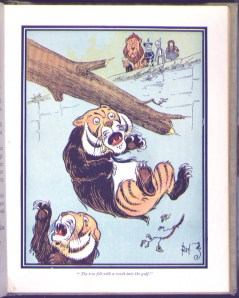
C&I were actually also a bit troubled by the scene where the ruthless animal-killer the Tin Woodman sends the two fierce Kalidahs to their deaths at the bottom of a ravine.   Iris brought it up suddenly the next day, that although the story said they were mean & scary, in the illustration, they “looked nice” as they were falling:

kalidahs

Perhaps the “twin”-ness of the Kalidahs, so much like Celie and Iris or Pot Luck and Daisy, hit close to home.

Here a cool Library of Congress online exhibit on Baum, Denslow & Oz.

Carl Wilson’s Let’s Talk About Love: A Journey to the End of Taste

letstalkaboutlove

I read this a while ago but forgot to blog about it.  Strongly recommend this instant classic, one of the smartest books on modern pop music I know.  (What else would I include in that list?  Books like Michael Azerrad’s Our Band Could be Your Life, Fred Goodman’s The Mansion on the Hill, Robert Christgau’s review collections, Jon Savage’s England’s Dreaming, Greil Marcus’s Lipstick Traces, Jeff Chang’s Can’t Stop Won’t Stop, Rob Sheffield’s Love is a Mix Tape, Bob Dylan’s Chronicles Vol. 1…probably forgetting a lot…)  Wilson’s book is part of the 33 1/3 series of books published by Continuum each dedicated to one pop album, in this case, Céline Dion’s 1997 Let’s Talk about Love. The series was a great idea for many reasons, among them the fact that the books are small & cute with an attractive uniform design — they in fact look kind of like miniature LPs on the shelf.  61 books have been published in the series so far, but Wilson’s is sui generis among them (as suggested by the fact that his is the only one granted a subtitle to date — oops, just noticed the U2 book has one too).

You certainly don’t need to care about Céline Dion to enjoy the book.  Or be Canadian, although the Toronto-raised Wilson is fascinating on Dion’s roots in French-Canadian Quebecois chanson/showbiz traditions.  Wilson takes Dion, one of the top-selling pop singers of our era, now in possession of her own schmaltzy Vegas show, as a test case for the practices, politics, and poetics of taste in popular music & culture.  For Wilson, Dion’s records somewhat resemble Russian conceptual artists Komar and Melamid’s “Peoples’ Choice” Most Wanted Paintings.  Crafted according to the specifications of a poll, the paintings contain landscapes, water, the color blue, soft curves, and representational images of people and wild animals, etc.  Dion’s music is arguably the Peoples’ Choice of pop, a statistically irrefutable embodiment of broad popular taste.  So is it awful or great?

Wilson, a right-thinking hipster with “good taste,” had always hated Dion’s music, but had become suspicious of his own aversion; the book is his exploration of what it means to hate or to love Céline Dion, or any kind of music — with particular attention to subcultures, embarrassment, sentimentality, class, canons, kitsch, and shame.  Wilson lays out the ideas of Pierre Bourdieu on taste and distinction in several lucid pages (the book would work fabulously in an undergrad course on cultural theory), and he’s well-informed in theories of aesthetics generally, but he’s a working pop music journalist with a snappy, funny style, and the book is a completely fun and brilliant read.

He’s especially insightful on the meanings of “sentimentality” in today’s pop culture:

Punk, metal, even social-justice rock such as U2 or Rage Against the Machine, with their emphatic slogans of individuality and independence, are as much “inspirational” or “motivational” music as Céline’s, but for different subcultural groups.  They are just as one-sided and unsubtle.  Morally you could fairly ask what is more laudable about excess in the name of rage and resentment than immoderation in thrall to love and connection.  The likely answer would be that Céline is conformist, quiescent, unsubversive.  “Subversion” today is sentimentality’s inverse: it is nearly always a term of approval.

Here’s a collection of press, reviews, interviews of/on the bookNew York Magazine named it one of the ten best books of the year, quite a feat for a little paperback that costs $8.76 on Amazon. Here’s Alex Ross on the book.

Henning Mankell’s The Pyramid: Novels about the Swedish Anxiety

300h

Henning Mankell’s The Pyramid.  I’m a huge Henning Mankell fan, have probably read at least ten of his novels, all of the Kurt Wallender mysteries, I think, and even a Linda Wallender one (his daughter).  I discovered Mankell 6 or 7 years ago — I’d never gotten so into a thriller series, and I haven’t quite found anything else as addictive, although Mankell has opened me up to the genre generally.  A lot of what’s so distinctly great about the series has to do with the modern Swedish setting, social and natural.  I’m surprised no one has made a movie (perhaps starring Stellen Starsgard as Wallender), it would be great on film — the icy, cold, stark Swedish landscapes; the moody, mordant people; the eruptions of shocking violence.  Wallender is a really appealing detective, always brooding about his failed marriage, his difficult relationship with his daughter & father, sweating, drinking endless pots of coffee and too much booze too; he’s funny and has a real moral center, continually questioning the state of Swedish society which seems to him to be falling apart.  Many of the books are more or less explicitly about the changes Sweden has undergone in the the last decade or two — the fraying of the welfare net, the stresses of immigration, a shift to a more heterogeneous society and a new sense of embeddedness in a globally linked world.  Maybe that’s what makes the mysteries work so well, the sense of Sweden as this strangely homogenous, stable, harmonious society, filled with a lot of stalwart folks in isolated homes in the woods, that has finally started to transform in disruptive ways allegorized in crimes.  The series contains some starkly memorable images, like the young girl who sets herself on fire in the middle of a field (from Sidetracked).

Firewall, which takes place in 1990, is the first Wallender mystery, so would be a good place to start, but this volume would be as well: it’s a kind of prequel, written later but including several stories and one novella covering the earlier phases in Wallender’s career as a policeman in the 1970s and 80s. The five stories all have characteristic Mankell plots, all containing some epistemological mystery often hinting at a political/social subtext, but they get resolved much more quickly.  The longest story (a novella, really), “The Pyramid,” is excellent on Mankell’s eccentric father, who spends his days painting variations of the same landscape, sometimes featuring a single wood grouse.

In his introduction Mankell lays out the political/social subtext, explaining that after completing the series, he recognized the subtitle it should have had: “Novels about the Swedish Anxiety”:

The books have always been variations on a single theme: ‘What is happening to the Swedish welfare state in the 1990s?  How will democracy survive if the foundations of the welfare state is no longer intact?  Is the price of Swedish democracy today too high and no longer worth paying?”

I remember reading a Mankell novel off and on, can’t remember which one, sitting in the hospital room with Sarah during her 12-hour labor delivering Celie and Iris.

New Moonraking Feature

What I’m listening to/watching/reading

1/12/09

First episode of the new season of Damages on FX, with Glenn Close, Ted Danson and now William Hurt.  Wednesday nights.  We watched the first season on DVD — it’s great; very over the top with countless double-crosses, like some overheated old noir.  The NY Times review complained that the new season feels like a slight let-down, and maybe so, a bit, but it’s still fun.

Man on Wire.  Great documentary about French highwire-walker Philippe Petit’s attempt, with the help of a gang of co-conspirators, to cross the Twin Towers on a wire in August 1974.  It takes the form of a thriller or heist movie, moving forward, minute by minute, through the events of that day, and also stepping away to fill in the backstory.  The mood is often sweetly elegiac, which I think has a lot to do with a sense of lost innocence surrounding the World Trade Center in the 1970s, and a time when 5 guys with (almost literally) tons of equipment could sneak past the guards, shoot a string from one tower to the other with a bow and arrow, have one of them walk back and forth, and end up being celebrated as plucky heroes.  You have to figure today the police would shoot to kill…

1/4/09

Watched The Man in the Gray Flannel Suit with Gregory Peck.  It surprised me in several respects.  One was how much Mad Man seems to reference/rip it off.  There are so many parallels, so much so that I wonder if it was a bit of an in-joke among the Man Man people to slip in allusions (like the scene where he has to pick his wife up at the police station).  Was also surprised by how much it’s a war movie — there are these strangely extended flashback scenes from WW2 that go on and on.

Reading Maximum City: Bombay Lost and Found by Suketo Mehta.   It’s been on my shelf for a year or two and then the Mumbai bombings (and an Op-Ed Mehta published in the Times) got me to pick it up finally.

1/1/09

Henning Mankell’s The Pyramid.

12/15/08

The new short film by Blu: an ambiguous animation painted on public walls in Buenos Aires and Baden.  Really amazing!

Attack (TNR article by Adam Kirsch) and counter-attack (comments section) on Slavoj Zizek.

12/13/08

Meaningful-core bands.

12/11/08

Battlestar Galactica first season.

12/10/08

Pingwings, Pogles’ Wood, Noggin the Nog, Ivor the Engine, The Clangers and Bagpuss on Youtube.

12/8/08

Erik Davis’s Led Zeppelin IV (33 1/3; Continuum).  Very smart and funny obsessive excavation of Led Zep’s occult roots.  For some reason the single historical detail that most surprised me here, though, amidst all the analysis of the band’s debt to Aleister Crowley, etc., was the revelation that “before forming Led Zeppelin and playing with the Yardbirds, [Jimmy] Page spent three years as a session player, playing on an estimated 50 to 90% of all the records made in England between 1963 and 1965, including early hits by the Who and the Kinks”(48).  WTF??   Very bizarre.  I had no idea.

12/7/08

The Mekons’ Fear and Whiskey (Sin Records, 1985).  An old favorite of mine that I’m thinking of trying to write something about, so have returned to.  British art-school punks fall into American roots music (Hank Williams, Ernest Tubb, etc) as a conceptual wormhole out of Thatcherite England.

This is the only really old Mekons video I dug up on Youtube: “Where Were You?” on New Year’s Eve 1980, opening for the Gang of Four. ”When I was waiting in a bar, where were you?/ When I was buying you a drink, where were you? When I was crying at home in bed, where were you?…/I want to talk to you all night, do you like me?/ I want to find out about your life, do you like me?/ Could you ever be my wife, do you love me?”

Taraf de Haidouks,   Musique Des Tziganes De Roumanie.  The live Band of Gypsies is also great.  Wild, sad, take-no-prisoners party music that I’m sure the Mekons would enjoy.  They’re Romanian Roma musicians — appear in the film Gypsy Caravan which I haven’t seen.  (You can get all of these on emusic.)

Art or Not? t.v. show on Ovation.  See my post.

Profile of Naomi Klein in The New Yorker.  Sarah is a big fan of The Shock Doctrine — I think I am going to read it over the holidays.

Anthony Trollope’s The Last Chronicle of Barset.

Care Bears dvd from public library.  Celie and Iris were SO excited about this DVD.  We spent the drive home discussing metaphysical puzzles raised by the show e.g. “I wonder how they get up on those rainbows?”  (I refrained from giving the correct answer: the poorly-paid animator in Thailand drew them up there.)  I could not bring myself to watch more than a couple minutes of this tripe.

Mortimer Adler’s Syntopicon

This photo cracks me up:

campbell-500
It’s from this NY Times book review:

In “A Great Idea at the Time,” Alex Beam presents Hutchins and Adler as a double act: Hutchins the tall, suave one with a gift for leadership; Adler “a troll next to the godlike Hutchins,” with a talent for putting students to sleep. Making the acquaintance of Hutchins through his works was, to Beam, “like falling in love.” By contrast, “to be reading Mortimer Adler’s two autobiographies and watching his endless, self-promotional television appearances was a nightmare from which I am still struggling to awake.” As an appendix to the Great Books, Adler insisted on compiling a two-volume index of essential ideas, the easily misspelled Syntopicon. A photograph in “A Great Idea at the Time” shows Adler surrounded by filing-cabinet drawers, each packed with index cards pertaining to a separate “idea”: Aristocracy, Chance, Cause, Form, Induction, Language, Life and so on. The cards registered the expression of those ideas — Adler arrived at the figure of 102 — in the Great Books of the Western World.

Ah, the Great Books and the Great Ideas.  I like the Great Books myself, some of them anyway, and have a residual respect for freshmen core curricula (I did a program of that sort myself), but the photo could not be more perfect as a representation of self-satisfied mid-20th-century academic pomposity.

The review also cites Joseph Epstein as commenting that Adler “did not suffer subtlety gladly.”

I just saw an interesting presentation on Digital Humanities and text tagging, and Adler’s cards struck me as a early manifestation of a similar urge; you have to figure this guy would’ve killed to be able to create a searchable/mappable online database of the 102 Great Ideas.

Here’s a funny clip from a t.v. interview with Adler explaining how he can read 10 books in one day — if by “read,” you mean “inspect them” and “put them on [your] bookshelf for future reference”:

Australian Slang

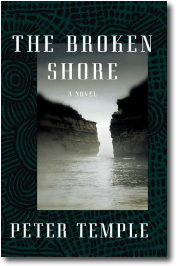
brokentemple

Am almost done with this Australian mystery novel, The Broken Shore by Peter Temple.  It’s very good although to tell the truth, I’ve sometimes had trouble following the plot because of the Australian slang/jargon.  There’s a whole Glossary at the end which is helpful.  Here are some good items:

Quickpick: A lottery ticket that spares the buyer the task of choosing numbers by randomly allocating them.  Anything chosen without much thought or care.  Also a term for someone, not necessarily a prostitute, picked up for sex.

Pommy:  Someone from England.  The English are often known as Pommy bastards.  This has been known to be said affectionately.  The term derives from “pomegranate” as rhyming slang for “immigrant.”

Bludger: Once, a man living off a prostitute’s earnings; now applied to anyone who shirks work, duty or obligation.  A dole bludger is someone who would rather live on unemployment benefits than take a job.

I tried out one of the book’s pieces of slang, not one of the ones about prostitutes, on our Australian friend Catherine, and she immediately recognized it: spaggy bol, “Spaghetti bolognese.  Also called spag bol.  Italian immigrants to Australia were once called spags.

Last Days of David Foster Wallace

Excerpt from Rolling Stone article: The Lost Years & Last Days of David Foster Wallace.

Last night I had some time to kill and went to Borders, ended up reading this whole long article about D.F. Wallace.  It’s very sad — he’d suffered from chronic depression, including hospitalizations, since high school or so.  The suicide itself was far from a surprise; it had followed an earlier attempt, and he was in terrible terrible shape in the final months, trying to adjust to a new medication regime.

This is from a short story he published in an Amherst College literary magazine as an undergraduate:

You are the sickness yourself…. You realize all this…when you look at the black hole and it’s wearing your face. That’s when the Bad Thing just absolutely eats you up, or rather when you just eat yourself up. When you kill yourself. All this business about people committing suicide when they’re “severely depressed;” we say, “Holy cow, we must do something to stop them from killing themselves!” That’s wrong. Because all these people have, you see, by this time already killed themselves, where it really counts…. When they “commit suicide,” they’re just being orderly.

When I heard about his death, aside from sadness, I had a strong feeling of disappointment and of having been cheated of what he would have written in the future.  But this article suggests that his depression was so overwhelming that it was not clear he would have ever been able to emerge from it well enough to write another novel.  (Although perhaps he just never received the proper treatment and it could have been different.)

On a more light-hearted note, the most amusing detail in the article (not in this excerpt) is that he went through an Alanis Morissette obsession in the early 90s (I think) during which he had a huge poster of her on his wall.  This succeeded long Melanie Griffith and (get this) Margaret Thatcher obsessions.

Here’s a NY Times article about a recent service held for Wallace.

Alan Greenspan/ Thomas Gradgrind

Sorry for all the Dickens-related posts, but this amazing scene of Alan Greenspan admitting the failure of his free-market ideology reminds me of Thomas Gradgrind’s anguished confession to his daughter Louisa, whose life he has destroyed with his inhumane utilitarian philosophy:

“I have proved my — my system to myself, and I have rigidly administered it; and I must bear the responsibility of its failures.  I only entreat you to believe, my favorite child, that I have meant to do right.”

Here’s the Ayn Rand acolyte Greenspan admitting to Congress that his ideology didn’t really turn out so well:

Published: October 23, 2008

Facing a firing line of questions from Washington lawmakers, Alan Greenspan, the former Federal Reserve chairman once considered the infallible maestro of the financial system, admitted on Thursday that he “made a mistake” in trusting that free markets could regulate themselves without government oversight….

“I made a mistake in presuming that the self-interests of organizations, specifically banks and others, were such as that they were best capable of protecting their own shareholders and their equity in the firms,” Mr. Greenspan said.

Referring to his free-market ideology, Mr. Greenspan added: “I have found a flaw. I don’t know how significant or permanent it is. But I have been very distressed by that fact.”

Mr. Waxman pressed the former Fed chair to clarify his words. “In other words, you found that your view of the world, your ideology, was not right, it was not working,” Mr. Waxman said.

“Absolutely, precisely,” Mr. Greenspan replied. “You know, that’s precisely the reason I was shocked, because I have been going for 40 years or more with very considerable evidence that it was working exceptionally well.”

English Professors as Therapists

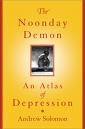
I loved this, from Andrew Solomon’s The Noonday Demon: An Atlas of Depression:

In an important study done in 1979, researchers demonstrated that any form of therapy could be effective if certain criteria were met: that both the therapist and the patient were acting in good faith; that the client believed that the therapist understood the technique; and that the client liked and respected the therapist; and that the therapist had an ability to form understanding relationships.  The experiments chose English professors with this quality of human understanding and found that, on average, the English professors were able to help their patients as much as the professional therapists.

This leaves me with several questions.  Why English professors?  Is this choice intended to be some kind of extreme example that goes to show that any sensitive person, in any random profession, might be able to do as much good as a trained therapist?  (As in, even an English professor.)  Or were English professors presumed to be relatively intuitive and emotionally sensitive to begin with?  I suppose probably the latter, although I wonder if that assumption would be as likely to be made today; in 1979, before the theory and culture wars, the profession may have seemed seemed more “sympathetic” in some respects that it does today.  (See, for example, movies like Smart People.)

Were self-nominations accepted for English professors possessing these “qualities of human understanding”?  Imagining therapy at the hands of certain English profs I’ve known over the years would be a somewhat scary thought.  But much as we dislike it when students try to turn class discussion into group therapy, I kind of like the implication that there could be some hidden therapeutic benefit in our talking cure (not that this is the point of the experiment).

Anyway, Solomon’s book is excellent and quite moving and eye-opening in its descriptions of the devastating effects of chronic/major depression.  It made me feel sad about David Foster Wallace, who apparently had suffered from very serious depression for years prior to his recent suicide.  (Btw, I feel retrospective guilt about my reaction to his very bleak story “The Depressed Person,” which I took to be somewhat cruel in its depiction of a woman whose depression is overwhelming and tedious to her acquaintances; for some reason it did not occur to me that it might be based on his personal experience as a “depressed person.”)