Julie and Julia as indictment of 21st century life

I finally got around to watching Julie and Julia.  Thought it was a strangely bifurcated movie.  Meryl Streep was fabulous, Stanley Tucci excellent too, and the whole Julia Child narrative very enjoyable overall.  Amy Adams on the other hand was irritating and off-putting, the character Julie a narcissistic whiner, her husband deeply unappealing.  Was this part of the movie filmed by a different director?

The movie felt to me like a bitter satire on the glib hollowness of contemporary life.

According to the movie, Julia and her husband’s 1950s expatriate experience is characterized by great beauty and charm, human connection, leisurely, unpretentious daily life, pleasure in friends and lovers, laughter, commitment to craft & cultural tradition, rewarding hard work.  And, at a meta-level, by fantastic acting and fine film-making: Paris looks wonderful, Julia Child’s marriage is loving and playful, and Streep a total delight.

21st century Queens/NYC, on the other hand, is sort of a nightmare — of fake friends, narcissism, empty careers, soul-crushing architecture, and irritating, mannered acting.  The Julie character has her contrived obsession with Julia Child, which feels mirrored or multiplied by Amy Adams’ over-perky portrayal of the character.  I just found it depressing.  It’s a totally unfair comparison, of course, apples and oranges: on the one hand, a major figure of 20th century American and international life; on the other, this self-involved would-be writer in Queens trying to promote her blog.

It feels so… sad, is if this is the choice (not that we have a choice):

Vibrant creativity, pleasure, friendship, beauty and sensual delight, immersion in complex and sustaining cultural traditions, passionate work performed for its own sake, and brilliant originality (Julia/ mid-century) vs.

Blogging and self-promotion — life lived as a PR stunt — in an apartment above a pizzeria in Queens (Julie/ contemporary life).  Julie can be read as a figure for post-9/11 NYC and America: surrounded by reminders of the trauma (she works for the city taking calls from 9/11 victims) and doing anything she can to forget, to sublimate or repress, to withdraw into manic private activities and little projects of self-making.  (At the risk of being humorless about it, there’s something off-putting about the way Julie completely tunes out the voices of the 9/11 victims in order to submerge herself completely in her foodie-Francophile fantasy.)

I liked that the movie admitted that Julia Child herself hated Julie’s blog.  This felt surprisingly honest because it works against the broader parallel the movie tries to put in place — with Julie getting her book contract for her blog (ludicrously) posited as equivalent to Julia’s publication of Mastering the Art of French Cooking.  I wonder if this was contractual — if Julia or her people would only allow the film to go forward with this proviso of Julia’s disapproval?

The meaning of a “book” seems so different in the two contexts.  For both Julia and Julie, the book contract is a personal fulfillment, a career goal, and a vindication.  For Julia, though, the book is a summing up of an extended immersion into rich cultural traditions; an expression of her own love of food and French culture; a pedagogical tool to teach others to learn the same pleasures.  For Julie, the book is a media event — the key moment is when she gets a write-up by Amanda Hesser in the Dining section of the New York Times and the agents start calling.

From “Julia” to “Julie“: the supplemental “e” trivializes, empties out substance, so food becomes the plaything of “foodies.”

Maybe the movie is actually deeply clever and sly?   All this is intentional, and the movie is itself about the ways culture and creativity have now been reduced to shameless plagiarism of the past and narcissistic PR projects in personal branding.

p.s.  Sarah once sat next to Julia Child at a hair salon in Cambridge; Julia complimented her hair.

p.p.s.  Since I’m (partially) knocking Nora Ephron’s movie, I’ll also mention that I thought her recent Girl with the Dragon Tattoo parody in the New Yorker was hilarious.

p.p.s. Thinking more about it, I’m probably too hard on Amy Adams above; she probably did about as well as she could with this material & character.


Toy Story 3: nightmare of emotional socialism

I took the girls to see Toy Story 3 on a hot and humid July 4 afternoon.

It’s incredibly clever and good.  I was fascinated by the way it seems to play out a conflict between what could be described as emotional capitalism and emotional socialism.  Andy is going off to college and is consigning his old toys to the attic — unless he’s persuaded by his mother to donate them to the local Sunnyside Daycare.   Although Woody is suspicious, the other toys view Sunnyside as a utopian solution to their dilemma.  For a toy attached to a single human child, obsolescence is all but guaranteed.  The child ages and casts the toys aside: if they’re lucky, to be saved for the child’s own children a generation later; more likely, tossed out.  It’s the old Velveteen Rabbit problem, exacerbated in an age of cheap Chinese plastic toys.  (That’s the most unrealistic part of the Toy Story films, that Woody & Buzz and friends would survive for 10-15 years.)

At Sunnyside, as the reigning, avuncular patriarch Lots-o’-Huggin’ Bear (who “smells like strawberries”) explains, toys escape the remorseless cycle of child aging and emotional withdrawal from the world of play: as we can see from the class photos on the wall, when one group of children ages, another replaces them.  It’s presented as a kind of socialism of love and play: the toys enjoy no primary human bond, but are played with by a cycling collective of children.  Kind of a toy kibbutz.  Love is free, easily passed on from individual to individual.  (And the toys are always donated, not purchased.)  Woody seems like a stubborn, old-fashioned individualist capitalist holdout, insisting to his comrades that “we have an owner, his name is Andy, remember?”  But the other toys refuse to go back to Andy’s attic (to wait patiently and perhaps hopelessly for the possibility of Andy eventually passing them on to his own children).

It turns out that Sunnyside is actually no utopia but a prison-camp Gulag nightmare, and Lots-o’-Huggin’ Bear not a wise and loving elder but “Lotso,” a cynical and cruel (and, as we learn, emotionally traumatized) despot.  At this point the movie turns into a creepy Manchurian Toy narrative filled with Cold War anti-communist tropes (overlapping with prison-movie conventions).

Perhaps the most chilling image is the initially adorable, ultimately frightening baby infant doll, who toddles around cooing as Lotso’s golem-like enforcer.  We eventually learn that the bear and doll were abandoned at a rest stop by their own first owner, Daisy.  Lotso was always Daisy’s most “special” toy; when they somehow make it back to Daisy’s house after an Incredible Journey-like odyssey, and Lotso sees through the window that he’s been replaced by another bear of the same model, he can’t accept his own displacement, and allows the experience to turn him into a brutal cynic who no longer believes in any primary human-toy affectual bond.

Part of what’s so powerful about the movie is the way it traffics in a primal fear of loss of love.  Lots-o’-Huggin’ Bear, denied affection, transforms into the cruel prison boss Lotso.  The toys’ experience of displacement and denied love is given disturbing overtones of sexless, loveless marriages.  They gaze with longing at their child who no longer will look at them, love them, touch them.  The movie begins with the toys engaging in “one last plan” to somehow induce Andy to pick them up and play with them the way he once did: pathetically, the only way they can think to do this is to steal his cell phone, to which Andy has transferred all his attention.  All of the toys begin to seem like abandoned spouses, yearning for contact.  The (almost inevitable) nightmare of abandonment or loss of love is literalized in being treated as “trash” or junk (in a landfill), denied any personhood or value by the former partner/parent/love object.  (This part recalls Wall-E a bit, although the environmental themes aren’t emphasized; the trashing of toys always feel highly individualized and metaphorical, not really about the disposal of plastic.)

In this depressed, emotionally desperate state, the toys give in easily to the illusory promise of Sunnyside, a total institution promising escape from the transience of human emotions — but where in fact, real love and affection have been transformed into a noisy, frightening ritual of impersonal abuse.  Sunnyside feels a bit like a Soviet orphanage.  The movie can be read as shockingly prejudicial about institutional childcare.  It suggests that “real,” peaceful, quiet emotions can only be found in a single family and a private home, experienced with an individual child; in the institutional setting of Sunnyside, children sweep in and out of the playroom on a rigid clock schedule, descending into a howling mass of screaming tots who can only abuse and destroy their toys.  I found a bit disturbing the film’s implication that the individual child’s ownership of a toy can be the only model for authentic love; the toys are finally redeemed by being not “donated” to the daycare center but given (a transaction between individuals, involving no institution) to a single child.  (To be fair, the horror of the Sunnyside playroom is explained by the fact that Lotso has consigned the protagonists to the age-inappropriate three-year-old room.  Also, Sunnyside is redeemed in the end and transformed from a prison camp into a fun daycamp run by counselors Ken and Barbie, but this felt tacked-on to me, and none of the toy protagonists stay there.)

Anyway, it’s all brilliant and hilariously witty.  Perhaps my favorite routine involves Buzz the astronaut accidentally being thrown into “Spanish mode,” which involves a lot of hip-shaking flamenco dancing, smoldering glances at Cowgirl Jessie, and dual-cheek kisses of greeting.

The sexless marriage theme is given a comic echo is the Barbie and Ken relationship; they make a big romantic-lovebird show, but they’re obviously happiest when trying on outfits together (with changing room) and putting on big group dance parties.  The “well-groomed” Ken’s homosexuality is fairly subtly joked about, although the film pushes the envelope a bit (hilariously I thought) at the end when we realize that a very girly, heart- and curlicue-filled note in purple ink was actually written not by Barbie but Ken.

p.s.  The girls liked it too; Iris said her favorite part was the disco-dance scene at the end.  Celie dismissed my reading of the film as “facile cultural-studies-by-numbers” (just kidding…).

Aldous Snow

I’ll go out on a limb and declare that Aldous Snow may be the best cinematic comic character of the past few years.  He’s by far the high point of Forgetting Sarah Marshall (which is much better than I expected generally — saw it on t.v. recently) and is hilarious throughout the Aldous Snow vehicle Get Him to the Greek.

[photo removed b/c I think too many people were coming here from Google Image search]

(Is there a technical term for this kind of narrative spin-off, when a secondary character in one narrative becomes the protagonist of a subsequent one?  Anyway, to truly understand Get Him to the Greek in all its nuances you might need to see Forgetting Sarah Marshall, although I suppose it’s not absolutely necessary.  There’s a funny reference to the previous movie in GHTTG when Snow catches a clip of Sarah Marshall, who’s a t.v. actress, and a light bulb goes off: “I think I shagged her once!” or some such.)

I haven’t paid too much attention to Russell Brand, the comedian who plays Snow… and maybe if I had I’d be slightly less amused by his alter ego?  Dunno.  Anyway, Brand is absolutely spot-on as a hypersexual, fatuous yet sort of brilliant, degenerate, spoiled, louche, drug-gobbling, Cockney Jim Morrison knock-off.  His insinuating eyebrow expressions alone are worth the ticket to Get Him to the Greek.

It’s a performance worth considering in the line of modern British comedy greats from John Cleese through Jennifer Saunders and Ricky Gervais.  In fact, when Brand/Snow is a bit irritated or peeved about something, whiny, he can remind me a lot of those three, although the effect is very different in the body/persona of a rock and roll sex god. (See the letter U. clip below — either Cleese, Saunders or Gervais would’ve killed this one too.)

While I’m on the topic: Get Him to the Greek is pretty gross and frat-boy/ potty-humor filled, but its gender politics are actually not so bad.   Elisabeth Moss (aka Peggy Olson in Mad Men) is good in the seemingly thankless role of the fiance whose dull embrace Jonah Hill must flee to set the movie’s plot into motion.  You assume he’ll end up dumping her for someone flashier.  But (SPOILER ALERT) in the end he actually moves with her to Seattle so she can take up her medical residency there; he’s absolutely the trailing spouse and ultimately he’s happy to move to accommodate her career.  (Of course he gets everything he wants in any case, but I was sort of impressed by the way this unrolled.)  Despite less gross-out sexual humor in FSM it’s probably worse on gender at least if you judge by the climactic scene where Jason Segal’s character declares Sarah Marshall to be “the devil”(!) — she becomes a kind of fantasy figure of the vilified terrible ex-girlfriend.

Here’s Brand in an audition tape from Forgetting Sarah Marshall:

And here’s Aldous becoming infuriated while filming an episode about the letter U. for a children’s t.v. show (he thinks the puppeteer’s “not committing to this”):

Recent movies: Bird & Magic, Redford and Dunaway, etc.

Our t.v. died a month or so ago — just stopped working.  Sarah’s dad had bought it for us at Best Buy for $500 in 2002 or so.  It was a 27″ and/but seemed huge — very bulky and room-dominating.  After some research on the Consumer Reports site I bought this 32″ flatscreen for $380 — it showed up in the mail, a lithe rectangle weighing maybe 20% of what our last one did, and basically just needed to be plugged in.

See?  Things may seem pretty messed up in the world, but at least t.v.s have improved.  We can watch the oil plume in brilliantly H.D. flat-screen detail.

Some of the movies we’ve watched recently:

Three Days of the Condor.  We’ve been using Netflix on-demand a bit lately.  Sarah wanted to see some sort of fun/ not too challenging thriller (no subtitles) and this is what we came up with.  She’d seen it years ago but it turned out literally only remembered the romance scenes between Redford and Faye Dunaway in her apartment — which have a somewhat creepy Stockholm Syndrome enjoying-your-abduction element, by the way.  (Redford carjacks Dunaway and makes her take him to her Brooklyn apartment, ties her up, and they sleep together shortly thereafter).  As the plot developed it started feeling more predictable, but I really enjoyed the first half, especially the depiction of 1975 NYC.  The movie has a funny Bovaryism theme with Redford as a C.I.A operative analyzing mystery novels, in a phony publishing-house front, for clues of international espionage.

The movie ends in front of the New York Times building with Redford telling the baddie that he’s given the whole story to the Times and so it should be in the next day’s paper.  The basic faith in the power of the mainstream press as a force for transparency and reform felt very foreign.

Mulholland Drive. I watched this a while ago but just had to mention how much it blew me away.  I’d seen it back when it came out but did not altogether remember how strange, scary, and amazing it is.  It topped some best of the decade lists — somewhat telling, maybe, that the most critically acclaimed film of the 21st century started out as a rejected t.v. network pilot.  (After the pilot was turned down, Lynch went back and added a second hour, which turns the movie into a kind of Mobius strip, folding back on itself.)

The Borrowers.  Am reading the Borrowers series to the girls (we’re into The Borrowers Afield now).  I’m trying to work out an argument that it’s an allegory of the mid-20th-century British welfare state.  Fascinating on class, with this miniature family of working-class Cockney types living in the floorboards of the grand house.  Anyway, I picked up the 1973 American t.v. version, a Hallmark Hall of Fame t.v. special, at the library.  I just watched a bit of this with the girls while reading the paper, but it seemed kind of creepy/spooky to me — the music reminded me of Rosemary’s Baby.

Very excited to learn, btw, that a Studio Ghibli anime version of the Borrowers is due out later this year!!

Step-Brothers.  Part of the Judd Apatow empire (he produced), with Will Ferrell and John C. Reilly as the 40 year old children of newlyweds Richard Jenkins and Mary Steenburgen (both excellent).  This movie is surprisingly funny, possibly underrated.  It’s kind of one-joke but a good joke: Ferrell and Reilly both act exactly like 4th grade boys; you get the feeling they did some real research for these roles.  A sequel to the 40-Year-old Virgin in spirit — more male arrested development.  (Btw, I just checked and Steenburgen is 56 years old, which makes her kind of a stretch as a 40 y.o. Will Ferrell’s mother.)

Magic & Bird: A Courtship of Rivals (HBO).  Loved this!  I was an avid Celtics fan in the 80s — went to a couple games every year in the years when the Celtics never, ever lost at home.  Bird was a poor working-class kid living next to the railroad tracks in a small nowhere town in Southern Indiana.  I’d forgotten that he actually enrolled at I.U. — left after a month or two, alienated and freaked out — went back home to French Lick to work in a grocery store.  His dad committed suicide soon after.  Larry obviously was/is a pretty weird individual.  Very private, prickly and socially awkward, the Hick from French Lick for real, unbelievably gifted and competitive.  Magic grew up in Lansing MI — incredible smile and charisma, a star from a young age.  He radiates happiness & pleasure in life whereas Bird seems to be trying to hold everything at arms’ length away from him.  When they met for the NCAA finals, Magic tried to seek him out to say hello and Bird totally snubbed him, refused to shake his hand.  “I probably did snub him,” Bird says now.  “I’m not into that lovey-dovey stuff.  I was there to win” (something like that).

The movie makes a good case that they became doppelgangers, rivals and enemies and eventually friends.   Bird says that the day he heard about Magic’ H.I.V. diagnosis was the worst day since his father’s suicide.  There’s an eerie shot of Bird playing the next day — he does a behind-the-back pass that the movie suggests was a secret homage to Magic.

The racial politics of the rivalry are complex and sad.  Bird does seem genuinely race-blind.  But as a Celtics player in racist Boston and the Great White Hope of the NBA trying to attract white fans, he’s enlisted in a racial drama not of his own making.  Cedric Maxwell comments of black basketball fans in Boston who’d root for L.A. — it was very hard to be a black Celtics fan in those days.

Bird mowed his own suburban Boston lawn every weekend: fans showed up to watch (he ignores them).  He eventually messes up his back installing his mother’s driveway in Indiana and suffers through in the final years of his career in agony.  Now he’s President of Basketball Operations for the Indiana Pacers and an NBA elder statesmen; I kind of enjoyed the recent ad in which he steals LeBron and Dwight Howard’s hamburgers and they have no idea who he is (extending the longtime meme of Bird as a white star in a black man’s game).  [*btw how can professional athletes live with themselves for promoting McDonalds???]

It’s been nice to see Magic’s halftime commentary during the NBA playoffs this month — good to see his enormous smile and that he seems to be doing well.

We Live in Public. Interesting documentary about a semi-forgotten internet pioneer of the 1990s, Josh Harris, who became a symbol of the excesses of the tech bubble of the era.  His hubris culminated in a couple of different Truman Show-esque experiments in living under total surveillance — first with dozens of volunteers in a giant loft in NYC, then just with his girlfriend.  He eventually loses everything and more or less disappears.  I found him to be a very creepy guy and was somewhat under-impressed by his supposed prescient innovations (as Sarah commented, what’s here that Philip K. Dick didn’t come up with years ago?) but it’s an compelling movie.

Food Inc. Finally got around to watching this last night (again, Netflix on demand).  Excellent doc.  Very well done, turns the rise of industrial food into a kind of thriller/horror movie with scary music.  Most infuriating part involves Monsanto’s copyrighted soybeans.  The beans are copyrighted intellectual property of Monsanto; our corrupt government, entirely in the pocket of Big Food, allows the transnational behemoth to behave like Disney with Mickey Mouse — no farmer is too small to be sued for doing what farmers have done for thousands of years with their crops.  If you are still in the habit of eating industrial meat regularly, watch this movie (although it does not rely much on total gross-out images of slaughterhouses and the like; it’s more about building a sustained argument).  [Btw this 2009 NYT article about “pink slime” in hamburger meat is what convinced me to never, ever eat another McDonald’s burger.]

Avatar vs the Hurt Locker

We watched the DVD of the Hurt Locker last night and I think it gave me nightmares. Or at least, I found myself awake at 5:30 a.m. and had some images from it running through my head, especially the moment when the well-meaning army doctor gets exploded to bits.  I could easily see myself as that guy.

Last week I guess it was a bit of a surprise when Kathryn Bigelow’s The Hurt Locker beat out her ex-husband James Cameron’s Avatar for best picture award from the Directors Guild of America.  Perhaps many others have made this point, but I noticed some strong similarities between the two movies.  Both feature a bad-ass working-class white guy protagonist, who in a wartime situation is the one chosen to enter into enemy territory on a kind of reconnaissance mission — Avatar‘s Jake Sully to ‘go native’ among the Na’vi on the planet Pandora in order to figure out how to persuade them to relocate, The Hurt Locker‘s William James to go into Baghdad’s most dangerous neighborhoods to defuse Improvised Explosive Devices.

One major difference could be summed up as the two movies’ implicit attitude towards the mediation of warfare.  In  Avatar, the mission is entirely technologically mediated: paraplegic Jake Sully enters his avatar suit, takes control of a 9-foot tall native body, and virtually enters an alien world.  I thought Caleb Crain’s critique was pretty accurate, although it didn’t bother me as much as it did him:

The audacity of Cameron’s movie is to make believe that the artificial world of computer-generated graphics offers a truer realm of nature than our own. The compromised, damaged world we live in—the one with wars, wounds, and price-benefit calculations—can and should be abandoned.

That is, the movie completely endorses the ‘avatar’ effect of abandoning one’s reality for a mediation. As Crain points out, the movie tempts you with the promise, which is partially enacted by the experience of watching the movie itself, of giving up on our damaged world and succumbing entirely to the virtual, imaginary, still-pure fantasy of Pandora.

What struck me about The Hurt Locker is that it can be read as an overt critique of just this kind of embrace of the mediation and virtualization of warfare (and perhaps of experience more generally).  When James shows up as the new head of the bomb dispersal team, we’ve already seen the team in action with their previous leader, who was killed in an operation gone wrong.  As part of what appears to have been standard procedure, they first approached a potential bomb via a little robot on wheels; some of the first images of the film are in fact broadcast from the camera of that robot, zooming along the Baghdad street like a strange little child’s toy.  The robot approaches the bomb, checks it out, and does much of the work of defusing it before the human being has to take over at the end.

The bomb disposal team could thus be seen as part of the logic of the U.S.’s deployment of Predator drones to commit targeted assassinations, as elements of a form of warfare that is systematically mediated in order to ensure that as many of the most dangerous and vulnerable actions as possible are performed virtually, without putting U.S. soldiers in harm’s way. Bigelow implies that the entire war strategy is continuous with the X-Box video games she shows the soldiers playing at one point. Not that the soldiers aren’t in fact in continual grave danger, but that the logic of the war is to employ virtual strategies whenever feasible.  By beginning the movie from the bomb-robot P.O.V., Bigelow even links our own experience of the film with this kind of mediation: we, like the soldiers, are watching the robot’s film as it (not we) approach the bomb.

When Jeremy Renner’s William James joins the squad, his disconcerting innovation is to do away almost entirely with the layers of mediation separating him from the bomb.  He ditches the robot, takes his helmet and even suit off whenever possible, and just heads straight to the bomb, where he sets to dismantling it with his pliers like some garage hobbyist tinkering with a faulty motor.  It’s virtually suicidal — “you know what they call them, suicide bombers,” he comments at one point, underlining his own tendency to mimic and put himself literally in the same space as the Iraqi insurgency.  What it is to be “suicidal” is to shed the virtual armor and to put your own body at risk.

The movie makes clear that James’ approach is both heroic and completely self-destructive, and compromised by an obviously compulsive search for an adrenaline rush.  But Bigelow also depicts James, with ambivalent admiration, as offering a wholescale rejection of the U.S. army’s mediation of combat.  He’s the precise opposite of Avatar’s Jake Sully, who becomes a hero precisely by embracing his own virtualization.

Whether this has anything at all to do with Bigelow’s divorce from Cameron, I have no idea!  But the (relatively) low-budget Hurt Locker can definitely be read as an implicit rebuke to Cameron’s mega-budget fantasia.  (Which, by the way, I did also enjoy; even if it’s ideologically creepy, it is an amazing spectacle).

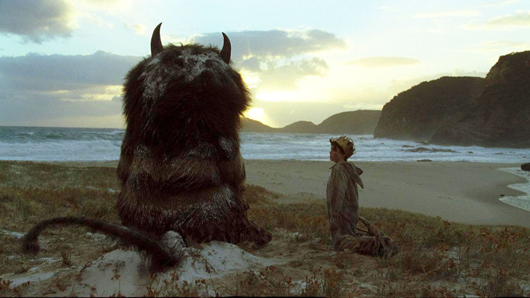
Where the Wild Things Are as family therapy

where-the-wild-things-are

Spike Jonze’s Where the Wild Things Are is kind of like a long, whacked-out family therapy session.  Maurice Sendak has commented that the monsters in the book are all based on his Polish-Jewish aunts and uncles back in 1930s Brooklyn.  Homage seems to be paid in the Wild Things’ names in the movie: Judith, Ira, Carol — they sound like they could be those aunts and uncles.  (It’s funny that the most Jewish-seeming one, Ira, is voiced by Forrest Whittaker.)  But I wouldn’t be surprised (just guessing here) if Jonze based a lot of the movie on memories of his own parents’ divorce and family-therapy sessions.  Many of the antics on the island feel like different forms of play-acting and role-playing in that context as Max works out his rage against his mother, his fears and anxieties, loneliness, with these other equally-troubled characters.

One memorable scene occurs when Max is on the run from Carol, the Tony Soprano-voiced character who seems an avatar of Max himself in his uncontrolled rages.  Carol feels betrayed by the revelation that Max may not in fact be “the king” (i.e. the good parent, the one who makes everything OK — could be the absent father, but the mother is much more important in the movie and book).  Max encounters K.W. (whom Carol loves and feels rejected by), who seems to be the sister-figure monster.   She urgently instructs Max to hide from Carol in her mouth.  He hesitates at first and then, as Carol approaches, down the hatch: he slides into her mouth and into her gullet (where he finds a raccoon foraging).   Once Carol leaves, he climbs back out in a slimy birth scene.  Pretty amazing!

Sarah commented that the movie has a lot of John Cassavetes in it and that it can be a bit hard to take in the painfully intimate and claustrophobic, dysfunctional behaviors of the monsters.  “K.W. may be psychotic, with her owls” (that she believes to be great sages), Sarah observed, Carol flies into dangerous bipolar rages, Judith is, as everyone comments, an endless “downer,” manipulative and passive-aggressive, Douglas (the goat one) is very depressed and self-undermining.  Also (still channeling Sarah here) you have to have a pretty high tolerance for wet plush animal fur, which is the defining and sometimes oppressive texture of the movie.

It has occasionally arch/cute moments in that Dave Eggers way, too, but I thought it was pretty great overall.  Great on childhood creativity and imagination — loved Carol’s elaborate sculptural mountain world into which, if you place your head in just the right spot, a fully-developed three-dimensional scene with moving figures on a river surrounds you. This struck me as one of those manifestations you sometimes see in Jonze’s movies (Michel Gondry too; and maybe Wes Anderson?) of a desire for film to be a handmade craft/art project, something tactile and a bit like a child’s fantasy world.

I’m glad the movie has done well, as it would be nice to see more 100 million dollar movies like this one.

p.s.  If we’d tried to bring C&I to this one, we would’ve been out of the theater in 15 minutes.  It’s quite scary, I wouldn’t bring any kid younger than maybe 8.

Torture Porn Lit

Heartsick-Chelsea-Cain-unabridged-compact-discs-Audio-Renaissance

Just read Heartsick by Chelsea Cain which I picked up looking for something else because, I think, Amazon named it the top thriller of 2007.

I didn’t altogether enjoy it — it seemed derivative (of Silence of the Lambs, although it does have the wit tacitly to acknowledge the debt when the psycho killer mockingly refers to the journalist as Clarice) and very, very gross.  It is gripping and well done in some ways — I wanted to read to the end to find out what would happen — but I was struck by the sheer bloody sadism of it.

It reminded me of a silly argument my brother and I had a while ago about the ethics and politics of so-called “torture porn” film, namely the Eli Roth Hostel movies.  It was silly because I think at that point neither of us had seen the movies… so if anything, I’d have to say he won the argument b/c it’s difficult to take a moral stance of condemnation about something you haven’t seen.   Although part of my point was, I refused to give in to the logic that because this on-the-face-of-it objectionable cultural object has become notorious, “you must see it yourself” to decide.  On the other hand, it’s hard to argue the position from ignorance.

Anyway, what I didn’t like about Heartsick is the back story involving the protagonist detective’s ten-day-long ordeal being slowly and lovingly tortured by the psycho serial killer he’d been investigating.  It actually works pretty well as back story to explain his particular trauma and what’s at stake for him in current case… but annoyingly, the novel is interwoven with day by day chronological accounts of that week and a half.  It’s really hard to take — painstaking description of what it’s like to drink drain cleaner, anyone? — and just seemed sadistic/self-indulgent in a mode of “can you top this” grossness.

I was mulling over the cultural meanings of ‘torture porn’ and thought of several possible explanations/causes for why this has trend emerged so clearly in the last decade or so.

  • Most obviously: sheer oneupsmanship in a modernist logic of greater and greater, purportedly more and more “daring,” transgressions.  This was basically the point I was making to Jake: within Modernist art of the early and mid 20th century, various forms of transgression, obscenity, and more and more realistic depiction of sex and violence became closely linked with artistic expression and a cultural vanguard.  One could think of this as the “First Amendment theory” of modernist transgression, in that to be “censored” or deplored becomes an almost necessary sign of artistic expression and integrity.  The thing is, though, that this dynamic has become tired and predictable when every gangsta rapper and thriller novelist or director participates in the same game.  Sorry, Eminem and Marilyn Manson, you are not James Joyce or Picasso bravely defying the philistines with your cds and DVDs sold at Walmart to every wanna-be radical tweener in America.  (Or for that matter Tarantino: I think he’s at his worst when he falls into this mode; most of the more interesting aspects of his movies have little to do with pushing the transgression envelope.)   And in this case, Chelsea Cain’s novel being that much grosser and more explicit than The Silence of the Lambs does not make it more daring.  Given that you can find stuff on the internet with a few keystrokes that would’ve made Henry Miller or James Joyce blush, that whole logic, which relies on certain dynamics of scarcity and concealment, is basically moot.  These days really radical, daring art is more likely to avoid this whole game of transgression entirely.
  • post-9/11 culture, Abu Ghraib and Guantanamo.  Needless to say a lot of the obsession with torture in pop culture comes directly out of this political/cultural dynamic: e.g. the t.v. series 24.  I’d assume that Saw and Hostel are part of this too, albeit less directly.
  • One other thought, a slightly less obvious one: in this novel anyway, there seemed to be a fascination with the idea of the body as art-work, and the serial killer as a kind of conceptual artist, carving and sculpting her victims’ bodies into new shapes.  A break in the original case came when the detective Archie noticed, looking at photos of all the crime victims, that the shape of a heart had been carved into all the torsos (hard to make out amid all the gore).  The journalist protagonist dyes her hair pink which I think is meant to link to this theme.   Like Jack the Ripper, these murderers are artist/author figures who leave their “signature” to be read by the police.  So here too we could link the trend to plastic surgery and various kinds of body-based conceptual art that views the human bodily as “plastic,” malleable and part of culture not nature.

Anything else going on here?  There’s always the possibility of whole-scale moral degeneration, I forgot that one…

Netflix/ Movie Roundup

I can No Longer Hear the Guitar. One of those movies that was on the Netflix queue but now I can’t remember exactly what led me to it.  It’s a 1991 Phillipe Garrell movie based on his ten-year affair with Nico (the German model/ original Velvet Underground singer).  What was disconcerting is that the Nico character, Marianne, is about the exact opposite of an icy Nordic beauty; she seemed so implausible as Nico that for much of the movie Sarah was convinced I’d gotten confused.  Also, notably, the film features no guitar or any music except for a few (admittedly somewhat Velvet Underground-sounding) brief snippets.  We found this slow and the characters gloomily pretentious.  Maybe it is a bad sign when a Heidegger quotation is uttered in the first ten minutes of a film?  Even so I did find it somewhat moving by the end.

Silk Stockings.  Fred Astaire and Cyd Charisse.  And Peter Lorre.  Charisse is the beautiful Soviet functionary who has come to Paris to demand the return of a Russian composer working on a musical.  Astaire is the film’s director.  Lorre is one of the three bumbling Soviets who’d previously failed in the mission.  Charisse has a big lingerie/silk stockings routine that Sarah thinks was referenced in ads for stockings she recalls from the 1970s.  Astaire and Charisse were fresh from The Band Wagon, one of the most famous musicals.  (Though Astaire looking a bit long in the tooth by now (1957).)  Hokey plot but lots of great/memorable song & dance numbers.

Waltz with Bashir. Amazing movie!  An animated documentary, perhaps the first of its kind?  Actually I bet they got the idea from Richard Linklater’s Waking Life, but whereas that movie is a kind of a woolly philosophical/stoner daydream, Waltz with Bashir is an intense dive into repressed personal and national memories.  (I.e. it uses the form to much more pointed ends.)   imdb plot summary: “An Israeli film director interviews fellow veterans of the 1982 invasion of Lebanon to reconstruct his own memories of his term of service in that conflict.”   Probably the scene I’ll remember the most is the opening, a nightmare of a pack of 28 terrifying dogs on the hunt; we learn that it’s the recurring dream of a man who, as an Israeli soldier in Lebanon, followed orders to shoot dead every dog that barked as they entered a small town, all 28 of them.  Made me think of Hitchcock’s Spellbound — the form of the film is almost like analysis.

Ball of Fire.  1941 Howard Hawks/ Billy Wilder movie.  Gary Cooper = stuffy Princeton English prof researching American slang.  Barbara Stanwyck = nightclub performer and gangster moll.  Cooper sees her as an ideal source for new slang, and she needs to go undercover anyway.  Screwball antics ensue.  Drags on a bit, but a lot of it is as great as Some like it Hot or the like.  A must for stuffy English profs.  Fantastic 1940s slang.  Worth seeing too just for the weird/great Gene Krupa matchbox drum solo.

Baby Doll.  “Written by Tennessee Williams, this 1956 black comedy tells the story of cotton gin owner Archie (Karl Malden) and his sexy teenage wife (Carroll Baker), who won’t consummate the marriage until she turns 20. When Archie battles a rival (Eli Wallach, in a BAFTA-winning performance), he could lose his business — and his beloved child bride” (Netflix).    Entertaining overheated Tennessee Williams.  Was denounced by the Catholic Legion of Decency and pulled from theaters in 1956.  Eli Wallach is supposed to be Sicilian but also has a bit of a nefarious Mexican gangster vibe– I guess it’s all-purpose ethnic otherness.  His scenes with Caroll Baker are pretty hot.  She comments that for years she was freaked out by people on the street calling her Baby Doll.

Ghost Town.  Recent flop romantic comedy that suggested that Ricky Gervais can’t open a big-budget movie as the lead.  Or, let’s be fair, maybe this just wasn’t the right one.  He plays a misanthrope dentist and is pretty funny at his most rude and hateful, inevitably less so as he is redeemed and finds love.  The movie is going for a kind of old-fashioned Hollywood romatic ghost comedy effect, a la Topper or the like.   Greg Kennear is good as the head ghost, a charming asshole lawyer.  Tea Leoni does her best as the love interest (she’s a paleontologist at the Museum of Natural History, a nod to Bringing up Baby I suppose) but doesn’t have much to work with.

Careful by Gay Maddin.  “In the remote Alpine village of Tolzbad at the turn of the century, people talk quietly and restrain their movements lest avalanches come and kill them…All this is shot in the style of an early German sound film, complete with intertitles, deliberately crackly soundtrack and ‘hand-tinted’ colour effects.”  Guy Maddin is brilliant and hilarious but this gets a bit much after an hour or so.  Kind of like a mad film student’s senior project.  Still glad I saw it.

Year of the Dog.  2007 directorial debut of Mike White (of Chuck and Buck, Freaks and Geeks, etc).  Molly Shannon (of SNL) is a sad office worker who finds meaning through animal rescue and veganism despite the scorn and incomprehension of her relatives and coworkers.   Not everything works but I enjoyed it.   Laura Dern excellent as the Molly Shannon character’s insufferable/smug rich sister-in-law.  The politics/ stance of the movie vis a vis animal rights issues is interestingly ambiguous: it kind of tries of have it both ways, I felt, making her politics seem aberrant & motivated by personal/psychological problems, but then in the very final scene presenting those politics as heroic and admirable.

Momma’s Man.  Mikey is 30-ish, with a wife and baby, and is back from California on a business trip to NYC, where he visits with his artist parents in their Tribeca loft.  He misses his flight out and never leaves — after a few days his parents start to wonder what’s wrong, but he’s stuck, paralyzed, agoraphobic, can hardly step out of the apartment.  It’s fascinating as transformed autobiography because Mikey’s parents are payed by the director’s actual parents (!) and it’s filmed in the crazy, ramshackle, overstuffed loft on Chambers Street where he grew up.  The DVD includes a really interesting interview the director conducted with his parents after they watched the movie’s premiere.  A recent American independent movie filmed on a shoestring that’s actually interesting and unpredictable.

The “Romanian abortion movie”

I finally watched “the Romanian abortion movie,” Cristian Mungiu’s 4 Months, 3 Weeks and 2 Days.  This was the film that won the Cannes Palme D’Or in 2007 and, along with The Death of Mr. Lazarescu (by a different director), has been heralded as a standard-bearer of a Romanian new wave of cinema.

I’ve had both movies in my Netflix queue for quite a while.  I really wanted to see them both, but somehow, it can be hard to find the right Saturday evening for the harrowing tale of a college girl’s illegal abortion in Communist Romania under Ceausescu, or the harrowing tale of the grim final hours of a dying old man in Communist Romania who is dragged in an ambulance from hospital to hospital, each turning him away.  And Sarah kind of has her eye on me in terms of getting ultra-grim fare for our movie nights.  There’s an implicit household rule in place saying that for every movie to which adjectives like “harrowing,” “unflinching,” or “uncompromising” would be likely to be applied (or phrases like “dark journey into…”), there should be one better described as “entertaining,” “fun,” or the like.  (OK, maybe I push it to a two to one or so ratio.  There just aren’t enough “fun,” light movies that are any good.)

I finally found the right moment for the illegal late-term abortion (in a society in which abortion is punished by jail sentence) movie: while Sarah is out of town.

It turns out to be a really great movie.  Is completely engrossing, compelling, like a good thriller.  Admittedly slow (filmed in real time, with no music) and definitely hard to take at some moments, but  humanistic and life-affirming in the end, not in fact “depressing” (but instead energizing and inspiring) although about some very depressing experiences.  But, maybe that’s just me.  And I don’t know, if you’re someone who’s had a difficult experience with an abortion, quite possibly the movie would be too excruciating.  I’ll make one small spoiler/ disclosure by saying that (a) you do actually see the dead fetus towards the end, in an extended shot, and/but (2) the movie does not end in an entirely brutal/horrifying way.

It reminded me of Mike Leigh’s Happy-Go-Lucky in some odd ways.  The abortionist is an unforgettably awful character who reminded me slightly of the taxi driver played brilliantly by Eddie Marsan in Leigh’s film, although the tonality is very different.  And the dinner party scene with the boyfriend’s parents is memorably terrible in a Mike Leigh kind of way (as Roger Ebert pointed out), as Otilia endures her boyfriend’s parents’ friends’ self-congratulatory palaver while she waits to return to her friend, who could be bleeding to death alone in her hotel room.  (The parents and their friends are professionals who have given into and accepted Ceausescu’s regime, and profited from it.  They patronize Otilia because her father was a common soldier.)

Also, both movies (this one and Happy-Go-Lucky) are very much about female friendship and loyalty, and more specifically, the young adult female friendship of roommates: both about the relationships of two women in their 20s who’ve lived together for years to the point where they feel almost like sisters.  Part of what’s moving about the movie is Otilia’s unquestioning, unwavering willingness to do whatever it takes (and it takes a lot) to help her friend.

And then there are the obvious Vera Drake analogies.  I wonder if any smart-aleck theater curator has ever organized a triple “abortion movie” showing of 4 Months, 3 Weeks and 2 Days, Vera Drake and Juno. Could be fun.

The film magazine Cineaste points out that one of Ceausescu’s

most notorious fiats—Decree 770 issued in 1966—outlawed abortion and proceeded to reward mothers of multiple children with medals and lavish praise for their efforts to build a populous socialist bulwark. Unlike campaigns against abortion in the West, Ceausescu’s imposition of mandatory motherhood (at least for women under forty-five) had nothing to do with religious or moral doctrines. It was instead aligned to what the Romanian author Norman Manea terms “the state ownership of human beings”—the obliteration of the private realm enforced by an intractable bureaucracy.

To get a bit academic about it, you could also think of the relevance of Georgio Agamben’s concept of “bare life” to the movie: the concept of a political order in which the definition of what counts as “life and the living” is determined and controlled by the state, and certain forms of life are defined as purely biological, living but symbolically cast out of the political realm.  To mount my hobbyhorse briefly, I’ll also point out that the movie does small but interesting things with domestic animals that seem to function as images of “bare,” orphaned, or absolutely vulnerable/exposed life: the goldfish in the opening scene, the kittens found abandoned in the boiler room, the roaming dogs.

Really, you should see it!  Pop up a bowl of popcorn and settle in.

Movie Roundup: Gran Torino, Frozen River, Coraline, Happy-Go-Lucky

We went to see Clint Eastwood’s Gran Torino and rented Frozen River (the indie movie for which Melissa Leo got a surprise nomination for Best Actress) soon after. Both are Obama-moment films, I thought, with a narrative drive towards an ethnically-diverse/ multi-racial family, and a repudiation of old-style (racist) whiteness or white Americanness.  In both, that white American identity is shown to be limited or obsolete and is redeemed only by a reaching-out to others.  Gran Torino is entertaining; as everyone has said it’s a sort of ironic rewriting of the old Eastwood Dirty Harry script revolving around Eastwood’s character Walt’s discovery that he has less in common with his own spoiled suburban grandchildren that with the striving Hmong immigrant kids who’ve moved into his neighborhood.  What we found disconcerting were the belly laughs in the theater that greeted all of Walt’s racist tirades in the first half of the movie; people seemed just a little too delighted by these… Frozen River is more of a gripping thriller than I’d expected and Melissa Leo is really great… you’re there with her the whole time in her desperate quest to come up with the $1500 to make the final payment on the Double-Wide trailer she wants for her two sons.

Two movies that kind of blew me away: Coraline and Happy-Go-Lucky.  I’m pissed b/c the theater had to use the 3D technology for the Jonas Brothers movie (!) and now they seem to have put Coraline back on 3D, but I missed it.  I thought it was one of the greatest animated movies ever.  Obviously influenced by avant-garde handmade animation by the Svankmajers and others; in fact it made me think of the Svankmajers’ version of Alice in Wonderland which I once showed to a freshman class who found it scary and creepy.  “Mothers don’t eat their children, do they?”: it’s a very frightening fairy tale (also very funny) that draws on Alice, surrealist art, and psychoanalytic nightmare imagery (buttons sewn into eyes, a mother who become a wire spider) among other sources.  I found it visually gorgeous and transporting — am very glad I saw it in a theater.

And Mike Leigh’s Happy-Go-Lucky.  I am a devoted Mike Leigh fan.  Have probably seen at least a dozen of his movies and love or like a lot just about all of them, with the possible exception of Bleak Moments which I remember as just being too purely and bleaky minimalist and depressing.  Watching the dvd commentary interviews reminded me of how unique Leigh’s methods are.  The actors explained how Leigh talked them through the entire life stories of their characters, from birth on, before they knew anything about the plot of the movie.  So by the time they got to the actual story and the beginning of the filming, they knew their character to the bones and could simply improvise in character.  All of this occurs behind the scenes and sets up a method in which you feel the characters as deep, three-dimensional and as possessing histories and personalities that go way beyond what you seen or hear on screen.

The movie feels a bit like some kind of experiment in representing “goodness” and happiness in narrative, which is tricky to do.  Poppy has her problems but she’s basically just fundamentally happy and a very loving/generous/warm-hearted person.  Such a character could easily be cloying or boring as a protagonist in a movie without all that much of a plot, but I found it riveting and entertaining.  In the scenes where’s she’s getting to know the potential boyfriend, you almost expected him to turn out to have something terribly wrong with him; everything seemed to be going too well; there was almost something experimental in not introducing any twists to that first impression.

It has two main metaphorical/symbolic lines of imagery.  First and most simply, transportation: the movie begins with Poppy’s bike getting stolen, it revolves around her weekly auto driving lessons, and ends with she and her friend Zoe rowing aimlessly in a lake.  The other more interesting imagery source has to do with education and teaching.  Poppy is a school teacher, she’s taking her driving lessons (from an embittered, slightly psychotic instructor), she goes to a Flamenco dancing class, and in all these situations the movie thinks/talks about what it means to teach effectively, to give up on a student or to refuse to do so, to learn, and so on.