Dreaming about Kim Gordon

I picked up Goodbye Twentieth Century: A Biography of Sonic Youth (by David Browne) at my mother in law’s house (have no idea whatsoever what it was doing there).  I enjoyed it and it sent me off on an ongoing Spotify tour of Sonic Youth’s music from the past 10-15 years that I ignored or gave short shrift to at the time (e.g. I’m enjoying A Thousand Leaves).

Here are a few things I learned or found edifying:

  • Reading the book and going back to some of the music, I was struck by how very Catholic Thurston Moore’s songs are.  No wonder he loved Madonna!  There’s the great “(I Got a) Catholic Block,” of course: “I got a Catholic block/ Inside my head/… Guess I’m out of luck.”  But so many others.  “She said Jesus had a twin who knew nothing about sin/ She was laughing like crazy at the trouble I’m in.”  Have any Religious-Studies types gotten on this?
  • I guess I always realized that the band’s name was inspired by Big Youth, but I don’t think I ever thought about their serious debt to reggae & dub.  “The deep, undulating rhythms of reggae and dub had infiltrated the downtown music scene.  Moore was so invested in the genre he’d begun taking subway trips to a warehouse in Queens that specialized in reggae LPs, and he told Gordon to practice at home by playing along with the bass lines on a Black Uhuru album.”  This actually makes perfect sense as a way to think about the claustrophobic sound & rhythms of their early music: No Wave meets Lee Perry.
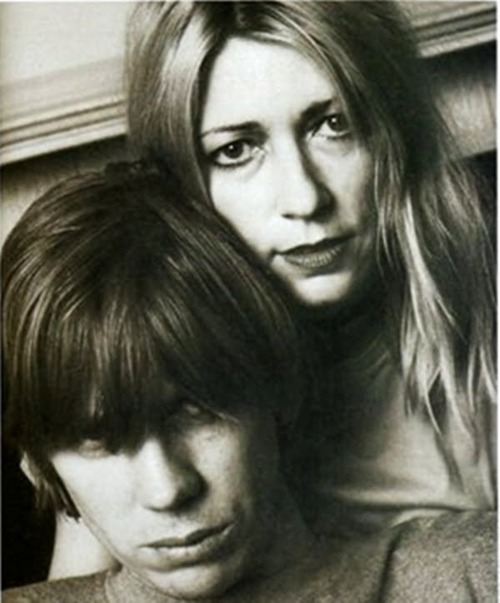
  • This was a favorite moment of mine:  “Phil Morrison, the up-and-coming filmmaker who’d directed the “Titanium Expose” video, starting having dreams in which [Kim] Gordon would suddenly appear, casting a judgmental eye on whatever he was doing.  Talking with friends, he discovered he wasn’t alone. “Lots of people dreamed about Kim,” he says.  “That was a real phenomenon.  And it wasn’t about sex.  She was the person you’d be most concerned about whether they think you’re cool or not.”  This most perfectly encapsulated the band’s role as taste-makers, cool-hunters and -arbiters, commanding the hipster unconscious of their era. I do think some of the music absolutely stands up as some of the greatest of the era (Sister is my personal fave), but the book kind of makes the case that their greatest importance lay in their stewardship of the underground as “the imposing older siblings of the new alternative world order.”  Thurston was the ultimate record-collector boy (someone hypothesizes that they invited Jim O’Roarke to join the band primarily so Thurston would have someone to go record shopping with on tour!) and Kim the arch-cool underground art/fashion diva.
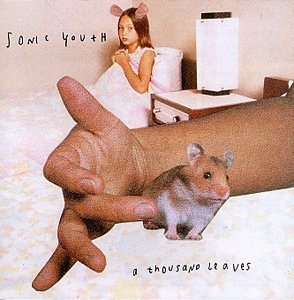
  • They had the kind of career that creates a bit of a letdown in the last third of the book.  Their big pop push with Goo and Dirty in the mid-90s never really happened, and so there’s a little disillusionment as they soldier on making new records to diminishing expectations every year or two.  That said, they’re actually really impressive as a model of a band that figured out new models for their career as they went along (e.g. Thurston’s immersion in experimental & improvised music, the band’s own SYR Records, and so on).  There are some funny lines from Geffen execs or others expressing their mild frustration or resignation about the band’s increasingly willfully anti-pop moves.  “The cover [of 1998’s A Thousand Leaves] was given over to “Hamster Girl,” a piece by L.A. artist Marnie Weber.  In keeping with Weber’s disturbing cut-and-paste montages, “Hamster Girl” juxtaposed a small rodent with a young girl… who was sporting animal horns.  ‘It was obviously not something they put together to sell a lot of records,’ recalls Farrell…”

*In the latest SY-related news, Thurston Moore has apparently just joined “black metal supergroup” Twilight.  He does keep himself busy.

On the One: RJ Smith on James Brown

I mentioned that I’d been reading RJ Smith’s The One: the Life and Music of James Brown.  You may have seen the rave review in this Sunday’s NYT Book Review by Al Sharpton (!), who I thought was an odd choice as reviewer given that he was, as the biography explains, a protege of and “like a son” to James Brown.  Sharpton did convey some of what’s great about the book, though.

RJ Smith, whose music criticism I used to read in the Village Voice way back in the 1980s, is really good at connecting Brown’s music to larger cultural and political forces and movements — shifting deftly in register from James’ signification as an international black culture hero (the account of Brown’s 1974 trip to Zaire and his meeting with Fela, sometimes called “the African James Brown,” is fascinating) all the way down to tiny details of rhythm, movement, gesture, and song.

This was a brilliant piece of lust and rhythm.  “Mother Popcorn” was not soul music; it spoke to the body, and it moved the body in ways that soul music knew not.  This was funk, possibly the moment when Brown fully moved from soul to funk — a music that didn’t even have a name yet.  It was just James Brown music.  It was the sound of the One….

Brown had a capacity for expressing different rhythms through his form.  “Every part of his body had a beat, had a rhythm going on — his feet, his head, his neck, his chest, his ass,” said Lola Love, a dancer in the show.  “And all those beats were different and were made him funky.”… However explosively or fiercely he moved, Brown telegraphs that there’s more we don’t get to see — his actions exert maximum impact with a minimum of exertion (coolness), a withholding that compels the viewer to follow the gesture through in the imagination.

Smith is not just appreciative, but near-reverent about Brown’s musical and cultural accomplishments — as Sharpton points out, the book leaves no doubt that Brown should be recognized as the single most important figure in later 20th century American music — but the book is also hilarious on the man’s frequently insane behavior.  Early in his career he nearly always packed heat, and shot up juke joints more than once, having to pay off those he’d accidentally hit.  He beat up his wives and girlfriends (not so funny).  He was grandiose but also wounded and perpetually insecure, partly due (presumably) to his upbringing in a Georgia brothel run by his aunt.  (With Richard Pryor, this makes at least two towering figures in late 20thC American popular culture who were raised in a brothel.)  He was an outrageous and sometimes cruel tyrant to the members of the band, capriciously handing out fines for the tiniest perceived infractions; one former band member calls him no less than “a black Hitler” (which seems maybe a little exaggerated).  In his final years, he regularly smoked PCP-laced marijuana while waxing self-righteous about any suggestion that he was a drug user.  There’s an implication that he thought PCP was some kind of vitamin-like health booster (he of course eventually served several years in jail.)  Most perplexingly, he was a Nixon supporter; Smith makes clear that Brown’s alliance with Nixon in the 1970s fatally tainted his previously godlike status in the African-American community.

“The One,” a mystical concept of Africanist rhythm, weaves through the biography, sometimes amusingly:

If Brown had something to share with the bassist [a teenage Bootsy Collins] after a show, most likely it was his unwavering parental disapproval.  “Son, you just ain’t on it,” he would grunt, his head sadly shaking with the bad news.  “You just ain’t on the One.”  Collins took it for a while, but then he tuned the guy out.  “As far as he was concerned, we were never on the One.”… It drove the formally trained musicians around him slightly crazy.  “It’s really — it’s a joke,” scowled Fred Wesley.  “He didn’t know what the One was to him.  To him it’s the downbeat.  But he didn’t know what it was. The emphasis of the one of the bar… his music kind of emulated that, but, as far as it being some kind of concept — I don’t think so.”

RJ Smith ultimately does suggest, though, that even if James could be a bit fuzzy on what precisely constituted the state of being on the One, he spent his career in successful pursuit of this state of rhythmic/musical/erotic grace.

JB on the good foot:

p.s.  Another great piece of writing on James Brown is this 2006 Rolling Stone article by Jonathan Lethem.

RJ Smith’s *The One*– James Brown on *the T.A.M.I. show*

I’ve been reading RJ Smith’s great The One: the Life and Music of James Brown.

Much has been made of how Brown upstaged the Rolling Stones, the show closers [on The T.A.M.I. Show].  How Mick Jagger was petrified as he watched Brown work and needed backstage consoling from Marvin Gaye — “Just go out there and do your best,” Gaye told him.  He had to tell him something.  Decades later, Keith Richards told an interviewer the biggest mistake of his life was going on The T.A.M.I. Show after Brown.

The second time he falls to his knees, we get a closeup of Brown’s face as he is being guided off the stage, the guys now intent on delivering him from this unsafe place.  Brown touches his cheek in an almost shocking way, and the crowd is shouting, “Don’t go!” along with the Flames, but what you notice is how Brown is shaking his head and muttering something.  Is he speaking in tongues?  So gone he’s lost bodily control?  He seems barking mad… He’s conducting the band from the depth of his paroxysm.

Be sure not to miss the incredible dancing on “Night Train,” too, especially the bit that begins around 8:30.  This is one of the most amazing live concert clips I’ve ever seen (I’d never seen the film…).

Lee Ranaldo @ Landlocked Music

Lee Ranaldo of Sonic Youth is touring in support of his new (& first full?) solo album, and appeared for a free performance and reading at our estimable local record/music store Landlocked Music.  The cool hook of the visit was that it was promised that Ranaldo would do a reading of a poem, ‘Bloomington Indiana Autumn’, that he’d written on his only previous visit to town, in 1990, when Sonic Youth performed at IU.

The store was full, though not a mob scene — I think you may have needed to be on Landlocked’s email list to hear about this one. Apparently a press in Louisville, White Fields Press, don’t know if it still exists, produced this broadside/poster of the Bloomington poem back in 1995, and they had signed copies for sale for $10.  Although I’m not crazy about the image of a mid-90s Ranaldo looking broody in a hoodie, I had to buy a copy.

Ranaldo, who’s gone grey in an nicely distinguished way, alternated songs from the new album, with two guys playing along with him*, and some recited poetry.  The poems maybe work best as song lyrics, by and large, although I actually enjoyed the recitations, too.  I have not listened to the album itself (which Pitchfork kind of panned, I see) but in this context the songs came across as somewhat blurred or abstract songwriter folk.  He seems like an unreconstructed Beatnik, in a way.  There was a funny bit where he reminisced about a summer when he was 16 or 17 and did a lot of drugs hanging around with friends in a parent’s backyard.

[*did not realize until now that these two guys were Alan Licht and original S. Youth Steve Shelley drummer on cardboard box!]

Since his Bloomington poem includes a reference to Sylvia Plath, I wanted to tell him about the Lilly Library afterwards — he may not realize that the major Plath holdings including all of her juvenilia and a lock of her hair are here in town– but he was chatting with a kind of line of kids afterwards so I decided not to wait.  The crowd was young, btw; a few other old-timers like me, but mostly 20-something.

In the bookstore I can barely see/ to let a few words from some page through/

All these words collide/ and jostle one another: Anne Sexton/ I open at random and find “Sylvia’s Death”/ which then bumps against biographical blurbs on Dylan, and Joni.

He said that the poem was written to his wife (then girlfriend) who is back in NYC while Ranaldo explores the college town:

The courthouse square, my head still for a moment/ The breeze scattering jewel-like leaves all at my feet/ Burnt yellow, bright yellow, mottled reds and oranges/ I press a few into my book, why?/ Have you kicked through leaves, in the city?/  Let them come up under your toe?/ Well I have, out here, while thinking of you.

Music Videos @ Contemporary Arts Center, Cincinnati

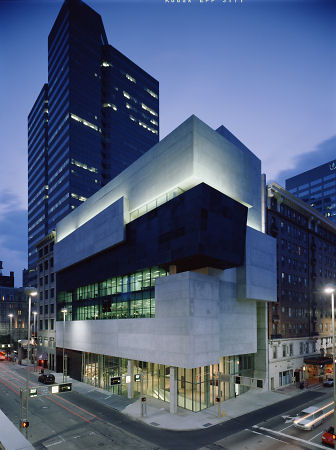
Another visit in Cincinnati was to the Contemporary Arts Center, which for a while was the only building in the U.S. designed by Pritzker-prize-winning, Rem Koolhaus-protege, Iraqi-British architect Zaha Hadid.

From wiki: “A winner of many international competitions, theoretically influential and groundbreaking, a number of Hadid’s winning designs were initially never built: notably, The Peak Club in Hong Kong (1983) and the Cardiff Bay Opera House in Wales (1994).”  It’s funny to look at a (seemingly abandoned/ not up to date — only up to 1990) accounting of her early works: over and over, “Not Realized.”  Here is a good, albeit somewhat skeptical, analysis of the Cincinnati museum.  I like the building, although it is showy and I agree with the critique that “we are often forced to acknowledge the building at times when perhaps we should be admiring the work presented inside the building instead.” Although maybe that is not such a problem really.

(I just remembered an amusing bit in Bruce Wagner’s good novel Memorial — the protagonist is a semi-successful bitter architect who is always mentally fulminating about various international art and architecture stars including, obsessively, “fucking Zaha Hadid.”)

Right now the whole experience is very 21st-century and postmodern (or late 20th-century anyway) since the building is full of a show about the history of music videos.  I actually thought it held up pretty well — although most of the videos are things you could easily pull up on Youtube, they did make sense as a curated collection, and the experience of watching them on large screens with headphones in this context was often pretty engaging.  No question of course that music videos have been a major occasion for groundbreaking aesthetic experiment over the past 30 years.  A lot of Bjork… there was one whole little room based around her amazing video for “Wanderlust” featuring these somewhat Snuffleupagus-like felt yak creatures.  Also several Kanye West videos (“Can’t Tell Me Nothing” lip-synched by Zack Galifianakis and Bonnie Prince Billy in the sidekick/Flava Flav role = great; the “Runaway” video featuring an apparent Victoria’s Secret model in painted-on feathers in the Man Who Fell to Earth angel role = crap), early David Bowie, LCD Soundsystem, several Michel Gondry videos, Missy Elliot and Hype Williams’s fantastic “The Rain,” all kinds of other stuff.

There was a huge, noisy school group there (once they left, we were almost the only ones in the whole place) and the guards kept shutting off certain screens in order to protect the sensibilities of the little brats.  There was one little room specifically dedicated to “Controversial” videos which featured little peepholes you had to peer through — quite irritating actually as, ironically, you had to kneel to see them if you were over 5′ 5″ tall.  These mostly weren’t too exciting — the one I’d never seen that made an impression was the rather creepily erotic and fascinating video for a song called “Twin Flames” by the Klaxons.

“Williamsburg Will Oldham Horror:” Camus probably wished he was Milton too or whatever

I just discovered (via this neat online comic by Lewis) this excellent song about artistic self-doubt.  Singer-songwriter Jeffrey Lewis tells the story of the time he thinks he saw Will Oldham on the subway in Brooklyn.

I kinda thought I was gonna grow up to do stuff that would benefit humanity
But it’s getting harder to tell if this artist’s life is even benefitting me
Cause I was gonna waste some time and money today to remaster some dumb old album
And on the L train in the morning, I was totally sure I saw Will Oldham,
He was wearin’ the same big sunglasses he had on stage at the Bowery Ballroom
And since I was feeling in need of answers I just went right up and asked him, I said,
Will Bonnie Prince, Palace or whatever ‘What do you think about it?
Is it worth being an artist or an indie-rock star, or are you better off without it?’
Cause I mean maybe the world would be better if we were all just uncreative drones,
No dead child, hood dreams to haunt us, a decent job, a decent home,
And if we have some extra time we could do real things to promote peace,
Become scientists or history teachers or un-corrupt police at least,
‘Come on Will, you gotta tell me!!’ I grabbed and shook him by the arm…

As the shaggy-dog song continues, Jeffrey Lewis’s own self-doubt about his own identity as an artist, with Will Oldham in the role of the successful, envy-producing artist, spirals outward such that Lewis starts to imagine Oldham himself feeling inadequate next to Dylan; and then in turn Dylan “wishing he was as good as Ginsberg or Camus;” and “Camus probably wished he was Milton too or whatever”…

I was starring into his sunglasses and I was really freakin’ out i was like,
Steamboat Willie Bonnie Prince of all this shit, you’re like the king of a certain genre
But even you must want to quit like if you hear a record by Bob Dylan or Neil Young or whatever
You must start thinkin’ ‘People like me, but i won’t be that good ever’
And I’m sure the thing is probably Dylan himself too stayed up some nights
Wishing he was as good as Ginsberg or Camus
And he was like ‘Dude, I’m such a faker, I’m just a clown who entertains
and these fools who pay for my crap, they just have pathetic punny brains
and Camus probably wished he was Milton too or whatever, you know what i’m sayin’?!’

It is tough being an artist!!

Kendrick Lamar, “F*ck Your Ethnicity”

Another strange young (post-Black/ post-identitarian?) California (post-?) rapper (formerly K. Dot) self-releasing gorgeous, smart music. Great song– check out the pretty piano chords and synth throb.

Has anyone in Ethnic Studies grappled with this one?  “Racism is still alive” — what exactly is he saying about that statement?  Is he saying it’s wrong?  Presumably not, maybe just that he’s sick of hearing it, or thinks it’s a banal/boring thing to say.  Or that race/ethnicity doesn’t have much to do with the music he makes and why he loves it; or that he feels bullied when he’s told that his music must express his racial identity above all (“everybody lied to y’all, and you believed it”).

“I mosh pit”: I guess he likes punk — reminds me of Canadian rapper K’Naan’s “If Rap Gets Jealous” (“I’d rather do a stage dive”).

Wizard!

Now I don’t give a fuck if you
Black, White, Asian, Hispanic, Goddammit
That don’t mean shit to me
Fuck your ethnicity

Fire burning inside my eyes
This the music that saved my life
Y’all be calling it hip-hop
I be calling it hypnotize
Yeah, hypnotize
Trapped my body but freed my mind
What the fuck is you fighting for?
Ain’t nobody gonna win that war
My details be retail

Matter of fact, don’t mistake me
For no fucking rapper
They sit backstage and hide
Behind the fucking cameras
I mosh pit
Had a microphone and I tossed it
Had a brain, then I lost it
I’m out of my mind, so don’t
You mind how much the cost is
Penny for my thoughts
Everybody, please hold up your wallets

Lucking out/ real bitter? James Wolcott’s memoir

As a kind of followup to the Kael bio, I also read the James Wolcott memoir,  Lucking Out: My Life Getting Down and Semi-Dirty in Seventies New York.  I somehow did not realize that Wolcott (whom I associate with Vanity Fair) began his career and was generally known for years not only as a Village Voice writer but as a sometime rock critic.  (“Somehow” because I was a devoted reader of the Voice, especially its music section, in the early & mid 1980s, not long after his time writing for it.) Walcott dropped out of Frostberg State U. in Maryland as a sophomore after he sent a piece of his to Norman Mailer, who promised to put a word in for him to a Voice editor once Wolcott graduated.  Wolcott proceeded to quit school on the spot and move to NYC and eventually, through persistence/ refusing to go away, parlayed that recommendation into a job answering phones, from where he began to do some writing.  Pretty soon, at age 19-20, he was covering the nascent punk rock scene — he published one of the first raves about Patti Smith, well before the release of Horses — and covered television as a regular beat (not to mention the band Television, along with Talking Heads and other CBGBs bands). He soon became a protege/buddy of Pauline Kael’s (he became somewhat notorious for a later Vanity Fair take-down of her followers “the Paulettes,” which was taken as apostasy and an act of betrayal –one of her other rival proteges labels him a “self-promoting asshole” or some such in her biography; he does not discuss this in the book but it came up in the Fresh Air interview); became obsessed with the New York City Ballet; and he also dedicates a section of the book to Times Square pornography in the 1970s.  He doesn’t push this too strongly but there’s an implicit thread in the book in which Wolcott charts his own experience as a fan, critic, and consumer of these different parallel art forms and media (punk rock, movies, ballet, porn), within all of which in this period the representation and expression of bodies, sexuality, physicality, gender transformed.  Wolcott is very much a critic and an observer; he refers in passing to his own sex life, for example, but greater emphasis is placed on the represented bodies and lives he wrote about.  As “semi-dirty” in the title hints, Wolcott portrays himself as a watcher, a bit prudish and reserved even in the grimiest occasions in Times Square or the Bowery or otherwhere in a NYC that was close to falling apart entirely:

It wasn’t just the criminality that kept you laser-alert, the muggings and subway-car shakedowns, it was the crazy paroxyms that punctuated the city, the sense that much of the social contract had suffered a psychotic break.  That strip of upper Broadway [where Wolcott lived] was the open-air stage for acting-out episodes from unstable patients dumped from mental health facilities, as I discovered when I had to dodge a fully-loaded garbage can flung in my direction by a middle-aged man who still had a hospital bracelet on one of his throwing arms.

By and large he managed to side-step the garbage and keep himself more or less clean (not a drinker or much of a drug user).  Wolcott is an aesthete and a literary stylist — you have to have patience for his kind of elaborate sentences to enjoy the book — and you get the sense of this style as something he developed, in part, as a protection against the threatening urban scene.  (He talks about giving up on punk rock in the late 70s when it became too much about bad politics, skinheads, vomit, and spit– you can feel a visceral distaste.)

I was just checking out the customer reviews of the book on Amazon.  One person comments:

For anyone even mildly curious about New York, movies, punk, journalism, writing, ballet, or the Times Square of the “Taxi Driver” era, this book should not be missed. Think of it as Woody Allen’s “Manhattan,” only with real intellectuals as opposed to fake ones.

Another less appreciative reader observes,

Just can’t imagine many general readers caring about office politics at the Village Voice, fringe critic Lester Bangs, punk rock at CBGSs, why ballet makes him woozy, the seamy 70s porn scene, Wolcott[‘s] relationship with movie critic Pauline Kael…

Ha!  I guess I was a perfect reader for this, as just about all of those topics interest me to some degree.  (This reader does not mention Wolcott’s discussions of Ellen Willis and Robert Christgau, a power couple in counter-cultural journalism in the early 70s; especially indelible is an account of Christgau walking around his and Willis’s tiny downtown apartment in tight red speedos.)  As an occasional writer for the Voice’s music section in the 1990s, I was fascinated by the account of earlier days at the paper, and I thought Wolcott evocatively captured the special feeling of the Voice in the days before email, when all copy had to be dropped off on paper in a physical file.  Human presence, embodied personalities, were so much more central to the operations of publishing, criticism and writing, all of which, Wolcott suggests, have now become much more “lonely.”  When I was first doing freelance writing circa 1991, this was just beginning to change and I too remember dropping by the Spin offices to leave my copy (offering opportunities for schmoozing/ gossiping) or sitting down with Voice music editor Joe Levy to line-edit my reviews (of American Music Club and the Go-Betweens — those are the first two I remember); I recall those sessions as an intensive education in journalistic writing that I expect is difficult to come by today.  (I never did meet Robert Christgau, although he was around.)  Wolcott’s example shows that counter-cultural/arts journalism in the 1970s was a place where an (exceptionally) smart lower-middle-class kid without even a college degree could get an apprenticeship and eventually transform himself into a well-known writer and intellectual.  This is no longer true — that arts weekly journalism institutional space no longer exists.  Blogs to some degree have replaced it, but serious/rigorous arts criticism as such offers much less of a career opportunity these days (to understate it).

[btw, Wolcott comes up several times as well in Will Hermes’s new book, Love Goes to Buildings on Fire: Five Years in New York That Changed Music Forever, which I’ve so far only skimmed a bit.]

There’s a funny/poignant moment when Wolcott speculates about what might have been if he had specialized and chosen a stronger focus, as a critic, on literature, rather than covering such a wide range of topics.  “I sometimes wonder what would have happened if I had found true fruition in book reviewing and taken up literary criticism as my sole vocation, putting aside childish things” (he means here primarily writing about t.v.).  Next line: “I bet I’d be real bitter now.”

Slight ambiguity there: does he mean “real bitter” as opposed to just slightly bitter?  The title of the book underlines Wolcott’s sense that he was very lucky in his lucked-into career, but does he feel lucky now?  There’s an elegiac feeling to his story of, among other things, the decline of the Voice and of arts journalism and reviewing generally (film critic J. Hoberman was apparently just laid off from the Voice as I write this, by the way, eliminating one of the last remaining great arts critics there).  I’m not sure how secure Wolcott’s present position is (he is among other things a blogger for Vanity Fair), but he obviously feels something has been lost both personally and for the intellectual scene more generally.

Of course, there are other explanations for an elegiac sense to the book, such as Wolcott’s references of the coming onslaught of AIDS in the early 1980s, at the end of his narrative.  On a more personal note, his friendship with Kael also has a bittersweet feel, at least for a reader coming to his book from the Kael biography, which explains how she cut him off following his publication of the “Paulettes” piece in Vanity Fair.  I was a bit surprised he does not address this falling out, perhaps because it is still too painful?  or possibly simply because it occurred outside the 70s time-frame of the book, although Kael is such a major mentor figure here that it feels odd not to mention it.

Jonathan Richman and the eternal “Boston”/”New York” dialectic

We caught Jonathan Richman at the tiny (capacity 100 or so?) Bishop last night.

My first “rock show” ever was Richman at a folk club in Harvard Square (am forgetting the name, long gone… oh, Jonathan Swift’s!) in probably 1983, after he released the great Jonathan Sings! which was in effect his comeback album after disappearing for a while (after the demise of the Modern Lovers) in the late 1970s.  (I learned from Wikipedia that “following the Modern Lovers’ final breakup, Richman went on sabbatical for a few years staying in Appleton, Maine and playing at a local diner in Belfast, Maine, called Barb’s Place.” In those pre-internet days, did people even realize this was happening?)

Funny to look back and realize how little time had passed since the heyday of the Modern Lovers, whose first records were not even released until 1976/7 (although they’d been recorded several years earlier).  Richman was about 32 years old in 1983.  But from my perspective, as a 14 year-old who’d recently immersed myself in the rock and roll canon via Robert Christgau among others, he felt like a legendary elder coming in from the cold.  I went to the show with my father and I think my friend Sam (is that right Sam?).

Richman slowly turned into a new kind of institution in the later 1980s and 1990s, going further and further down his particular rabbit-hole of wide-eyed, child-like, earnest folk music with a slightly delusional/out-of-it edge.  I stopped paying close attention to the recordings long ago, but I was very glad when his role as Greek-chorus troubadour in the Farrelly Brothers’ There’s Something About Mary seemed to give him a new level of mainstream visibility (and presumably a good chunk of living money).

So I was surprised that he’d play a tiny place like the Bishop… and not necessarily even sell it out (it wasn’t clear to me if he did).  Someone said he’s played in Bloomington a lot, although if this is true I somehow missed it.

Here’s a video someone made a few days ago in Ithaca.  This, I think a new, unrecorded song, was also a highlight last night.

Bohemia by Jonathan Richman at The Haunt in Ithaca, 10/24/11 from Armin Heurich on Vimeo.

My parents didn’t stand in my way when I was 16 years old… They knew I had to find, they knew I was pining, for the door to the art world… They knew that I had to find the door — to Bohemia.  I had my pretentious artwork, but my parents didn’t laugh too bad… I needed to be reined in once in a while.  But they didn’t have a hateful vibe, they didn’t demean.  In fact, I’m grateful because they didn’t… stand in my way, when I was — standin’ in Harvard Square, pretentious artwork in my hand.  The New York hipsters saw me standin’ there, and they knew this young man was looking for the door…. To Bohemia.  There I was standin’ in the square, pretentious artwork folio, but they knew I had to find the way…. To Bohemia.

I was bratty.  Bratty… but sincere.  Yes, I was bratty… But I had to know, they knew I had to go.  Pretentious Artwork Folio, it showed me the door, to Bohemia.  High school was night.  But they showed me light.  When they helped me find the door to Bohemia.  Desperate, desperate, hook or crook… I searched for Bohemia in the high school dusty art book.  Faintly, faintly, conjured I — I searched for Bohemia in the darkened Boston sky.  And once they saw that I wouldn’t back down, well they showed me the door to Bohemia.

It reprises old themes of Richman’s, going back to the Modern Lovers album.  Boston vs. New York, “Old world” vs. modernity, parents vs. rock and roll, squares vs hipsters, “straight”/”stoned,” finding a life in art and music.  Richman moved to NYC in 1969 as a teenager and slept on the floor of the Velvet Underground’s manager, determined to make it in music; he gave up and came back to old Boston, but a few years later, John Cale produced the Modern Lovers sessions.  Keith Gessen argues in a nice piece of a few years ago that “the power of The Modern Lovers is that it’s simultaneously about leaving and not leaving Boston, or about leaving it and coming back,” with “Boston” representing tradition, family, resistance to the new.

I guess one could explain Richman’s career for the last 25-odd years as a full acceptance of “Boston,” in those terms (although what he does now can’t really be explained as simple “tradition”).  He certainly didn’t play a single song from the Modern Lovers or 1970s Richman songbook last night, although presumably at least some of us would have absolutely died for a “She Cracked” or “I’m Straight” or even “Government Center” — let alone “Road Runner.”  Does he ever play that?  How odd to have written one of the THE GREATEST ROCK AND ROLL SONGS EVER, up there with “Satisfaction,” “Like a Rolling Stone,” etc. (robbed when Rolling Stone named it the #269th greatest rock song, but hey, that was still a few notches above “Born to Run”), one of the few songs covered by the Sex Pistols, and never to play it, never apparently even to consider the possibility of playing it?

That’s some strange career management.  This aspect of Richman’s career made me think of Alex Chilton.  He knows everyone’s dying for him to play “September Girls” but instead he plays “Volare” — and this is a surprisingly exact parallel, as Jonathan now sings a bunch of songs in Italian for some reason and often seems to be going for some kind of louche Italian lounge/ folksong mode.

Perhaps because last night was a Friday, he sang “I was Dancing at the Lesbian Bar,” an audience favorite, with its catchy refrain, “In the first bar things were just alright/ At this bar things were Friday night,” spun off in numerous variations: “Well at the first bar things were stop and stare/ But in this bar things were laissez faire,” “Well in the first bar, things were okay/ But in this bar things were more my way,” “In the first bar things were so controlled/ In this bar things were way way bold.”  Another version of the Boston/ New York dialectic, I suppose.

He has a somewhat manic gleam in his eyes, and certain songs get pretty close to self-help or therapy-talk.  (He also dances a little like a Hare Krishna.)  I enjoyed “When We Refuse to Suffer” last night, in which Jonathan casts his lot in with suffering, sorrow, and stink against air conditioning, air fresheners, and Prozac.

There was something quite moving about the show.  I hope that Farrelly bros. and “Road Runner” money (there must be some of that, right?  Is it on Guitar Hero or anything like that?) is funding a comfortable late middle age –the guy’s 62!  Could pass for much younger, though.

“Singing religious songs and getting the words wrong”: Withered Hand

The other record I’ve been crazy about lately is Good News by Withered Hand, a.k.a. a father of two from Edinburgh with a Moldy Peaches poster on his wall named Dan Willson.  It’s pretty easy to describe the album: it sounds a whole lot like early If You’re Feeling Sinister-period Belle & Sebastian; his voice can sound like Dean Wareham’s, and on some of the songs the slightly hanging-back drumming style makes me think of Galaxie 500’s Damon Krukowski.* [* just noticed that Good News was produced by Kramer, the guy who did the early Galaxie 500 records!  So maybe that drum thing is his signature.]

The Belle & Sebastian analogy isn’t just a matter of sound, either — if Willson’s not actually a former choirboy, he’s definitely hung up on a guilty Catholic Edinburgh childhood.

Anyway: amazing, beautiful, hilarious songs!  Maybe the best lyrics are on the hymnal “Religious Songs,” an acoustic version of which you can see Willson performing on his own Edinburgh rooftop in the video below.

Really, this is a seriously incredible song.  It starts out with a lapsed-Catholic’s confusion over the ritual of the sacrament and turns into pained memories of something short of a relationship: “Remember you thought I was gay?/ I beat myself off when I sleep on your futon/ Walk in the rain with my second-hand suit on.” He still feels guilty for not singing religious songs anymore and is half-ripping off Dylan in any case (“Knocking on Heaven’s Door” counts as a religious song, I guess?).

I don’t really know what I should do
Like should I be passing this bread along to you
And I don’t really know what the wine was for
Like if this was Jesus’ blood wouldn’t there be more?
I’m knocking on Kevin’s front door
I’m singing religious songs and getting the words wrong
My hair’s getting too long, this congregation
And they’re saying, how does he really expect to be happy
when he listens to death metal bands?
La, la la la, la la la, la la la la la

If there’s manna from heaven then you’re disinclined to share
You stole my heart and I stole your underwear
You said “religion is bullshit it’s all about metaphor”
Well if I need a fence to sit on
I’ll sit on yours dreaming of Babylon’s whores

I knew you so long I ran out of cool things to say
I still bump into friends that we both had yesterday
When they ask me how I am I I lie, say I’m doing fine
Still manage to tell me you’re on an easy lake holiday well that’s OK [?]
Remember you thought I was gay?
I beat myself off when I sleep on your futon
Walk in the rain with my second-hand suit on
I walk in the rain and I’m thinking, if I happen to die tonight in my sleep
I’ll have come and not blood on my hands
La, la la la, la la la, la la la la la

“New Dawn” is peppier, sounds more like… what was that Scottish band, I can’t remember now, the Lighthouse Keepers?  Who am I thinking of?*  “I saw you at the Embassy/ We were both crippled socially/…We wrote ‘Pavement’ on our shoes…. We paid our respects, we wrote ‘Confusion is Sex,’ and on your shoulder-bag I wrote ‘the Silver Jews.'”  “I Am Nothing” is another fave: “I tried to see the world in your eyes/ I’m insignificant, that’s my size/ In the greater scheme of things I am nothing.”  [*I was trying to think of the Wedding Present who are actually from Leeds.]

Love this record.  Get this guy in a studio with Frank Ocean and see what happens!