R.I.P Owsley Stanley/ Kid Charlemagne

Another great NYT obituary, this one for Owsley Stanley, “Artisan of Acid:”

Owsley Stanley, the prodigiously gifted applied chemist to the stars, who made LSD in quantity for the Grateful Dead, the Beatles, Jimi Hendrix, Ken Kesey and other avatars of the psychedelic ’60s, died on Sunday in a car accident in Australia. He was 76 and lived in the bush near Cairns, in the Australian state of Queensland.

Owsley Stanley, left, with Jerry Garcia of the Grateful Dead in a 1969 publicity photograph.

Mr. Stanley, the Dead’s former financial backer, pharmaceutical supplier and sound engineer, was in recent decades a reclusive, almost mythically enigmatic figure. He moved to Australia in the 1980s, as he explained in his rare interviews, so he might survive what he believed to be a coming Ice Age that would annihilate the Northern Hemisphere.

Once renowned as an artisan of acid, Mr. Stanley turned out LSD said to be purer and finer than any other. He was also among the first individuals (in many accounts, the very first) to mass-produce the drug; its resulting wide availability provided the chemical underpinnings of an era of love, music, grooviness and much else. Conservatively tallied, Mr. Stanley’s career output was more than a million doses, in some estimates more than five million.

He briefly attended the University of Virginia before enlisting in the Air Force, where he learned electronics. He later worked in Los Angeles as a broadcast engineer for radio and television stations. He also studied ballet and for a time was a professional dancer.

I am not sure if I knew of Stanley… probably I’d read references to him but they didn’t stick.  As is typical of NYT obits, this contains some amazing/weird/funny little details.  My favorite:

Mr. Stanley remained with the band off and on through the early ’70s, when, according to Rolling Stone, his habits became too much even for the Grateful Dead and they parted company. (He had insisted, among other things, that the band eat meat — nothing but meat — a dietary regimen he followed until the end of his life.)…

Mr. Stanley, who became an Australian citizen in the 1990s, was treated for throat cancer in 2004. In the Rolling Stone interview, he attributed his survival to his carnivorous diet. (A heart attack he had suffered some years earlier he ascribed to eating broccoli as a child, forced on him by his mother.)

Wow.  Of all the things mothers get blamed for, this has to be one of the most unfair.

I was fascinated to learn that Stanley is the “Kid Charlemagne” of Steely Dan’s fantastic song (which Kanye West samples on “Champion”):

Amazing lyrics: “Did you feel like Jesus/ On the hill the stuff was laced with kerosene/ But yours was kitchen clean/ Now your patrons have all left you in the red/ Your low rent friends are dead/ All those dayglow freaks who used to paint the face/ They’ve joined the human race…/Clean this mess up else we’ll all end up in jail/ Those test tubes and the scale/ Just get them all out of here/ Is there gas in the car/ Yes, there’s gas in the car/ I think the people down the hall/ Know who you are…You are still an outlaw in their eyes”

Well, chalk up a Steely Dan lyric that used to be absolutely opaque to me that now makes some sense.  Now it can be added to the ranks of great songs about drug dealers: “I’m Waiting for the Man,” “Doctor Wu”, “Pusherman”…actually can’t think of too many more offhand but I’m sure there are a lot.

Road trip radio report: Ladies love me, I’m on my Cool J

Several hours in the 1995 Corolla listening to the radio on bad speakers.

Miley Cyrus “Party in the U.S.A.” Why “in the U.S.A.”?  OK, she’s a Nashville girl arrived in L.A., feels out of place without her friends, feels like she’s wearing the wrong kind of shoes (Nashville boots not stilletos)… But then her favorite song by Jay-Z or Britney comes on and she feels good.  So the suggestion in the refrain is that pop music transcends region, makes a Nashville kid feel at home in L.A. when the song comes on?  I guess this is part of her career strategy to re-brand as a “pop” singer not “country,” to de-regionalize and nationalize her.  As Brad Paisley observes, “It ain’t hip to sing about tractors, trucks, little towns” (although that song is #26 on the charts).  Produced and written by Dr. Luke, who lives in the Hollywood Hills and was trying to picture the city from what he imagined a Nashville teenager’s P.O.V. might be.  Very catchy, but I still find the “U.S.A.” reference kind of gratuitous.

Speaking of Britney: Britney Spears, “Hold it Against Me.” “So if I said I want your body now/ Would you hold it against me?”  When she sings this couplet, I have no faith that she’s aware of any wordplay or double meaning.  She’s just saying, “would you hold your body against me.”  Something very characteristically vacuous in the delivery. “Cause you feel like paradise/ And I need a vacation tonight” — slick line!

Bruno Mars, “Just the Way You Are.” I like “Grenade” and liked Bruno Mars on the Grammys, but I find this song a bit creepy in the way it seems to define female beauty in a context of potential plastic surgery.  “When I see your face/ There’s not a thing that I would change/ Cause you’re amazing/ Just the way you are”: I read this as, “I wouldn’t do even the tiniest nip or tuck, it’s just perfect!!!!”

Chris Brown Featuring Lil Wayne & Busta Rhymes, “Look At Me Now.” This was our favorite (heard it 3 times I think), Sarah called it the Oobie-Doobie song.  Love the little Middle Eastern drone and the bubbly Theramin-esque synth.  And Busta Rhymes’ tongue-twister Oobie-Doobie rap, which for a while we thought must be technologically enhanced since it sounded impossible for a human being to produce (it starts around 1:40).  “Your girlfriend a freak like Cirque Du Soleil…. Ladies love me, I’m on my Cool J.”

Waka Waka– Shakira’s and Zangaléwa’s

I’ve listened to Shakira’s “Waka Waka (This Time for Africa)” at least 30-40 times in the past week.

Celie and Iris play it over and over and my response to it has passed through various phases.

My reaction:

  • Listens 1-5:  This song is sort of dreck.
  • 6-10: But very catchy.
  • 11-15: Now I’m really getting sick of it.
  • 16-20: Oh god, please no, not this again.
  • 21-25: [eyeing sharp instruments to gouge out my ears]
  • 26-30  Weirdly coming out the other side and starting to kind of enjoy it again.
  • 31-40  The song feels natural, inevitable, beyond judgment, part of the environment

They are doing some kind of school dance to the song tomorrow morning, so this may end soon.

The backstory to the song is kind of fascinating.  It’s basically a cover/rip-off of this absolutely great, beautiful Cameroonian song:

Wikipedia explains that

Tsamina or Zangaléwa is a 1986 hit song, originally sung by a makossa group from Cameroon called Golden Sounds who were beloved throughout the continent for the dances and costumes. The song was such a hit for Golden Sounds that they eventually changed their name to Zangaléwa, too. The song pays tribute to African skirmishers (a.k.a tirailleurs) during WW II. Most of the band members were in the Cameroonian Army themselves[1] and used make up, fake bellies, and fake butts for comic relief.  The song was used extensively in the frontlines by the Nigerian Army during the Nigerian Civil War (1967-1970). It was also popular in some Nigeria schools as a marching song in the 1970’s and 1980’s. The Nigerian Army Band, The Mercuries, based in Kaduna also did cover this song in the 1970’s on live Television appearances.  The song is still used today almost everywhere in Africa by soldiers, policemen, boy scouts, sportsmen, and their supporters, usually during training or for rallying[1]. It is also widely used in schools throughout the continent especially in Cameroon as a marching song and almost everyone in the country knows the chorus of the song by heart.

What gets fascinating is that the song is apparently — or is sometimes turned into — an anti-militaristic anthem:

The men in the group often dressed in military uniforms, wearing pith helmets and stuffing their clothes with pillows to appear like they had swollen butts from riding the train and fat stomachs from eating too much. The song, music historians say, is a criticism of black military officers who were in league with whites to oppress their own people. The rest is Cameroonian slang and jargon from the soldiers during the war.

According to Jean Paul Zé Bella, the lead singer of Golden Sounds, the chorus came from Cameroonian “sharpshooters who had created a slang for better communication between them during the Second World War”. They copied this fast pace in the first arrangements of the song. They sang the song together for freedom in Africa.

So… it kind of makes sense, a little bit, as an African World Cup anthem — with the literal opening lines, “you’re a soldier, choosing your battles,” turned into a metaphor for football.   To re-deploy it in this way, though, sung by a blonde from Columbia, scrubs it all of its cultural specificity, history, and pointed political significance.

The comments thread on Youtube is interesting; I’ll cite a few:

beautiful. so much better then shakira’s version. shakira is someone i can’t really relate to africa.. but this.. this is perfect.

This song isn’t about ‘singing good’. It’s a chant, a protest song, a empowering tune, a cheer for your cause. You want to hear this from ‘the people’, and not from a individual artist. Shakira’s song is nice, but in a stadium, you just want to scream it.

shakira didn’t do anything wrong – it’s actually even admirable. It’s just that we hate her ignorant fans – but lets get it straight – it’s not her fault who listens to her.

I dislike how Shakira lied, and said that she made up this song. However, I do think that she’s gotten the ORIGINAL song a lot of good recognition. People who actually give a crap about Africa and their culture will definitely pass by here.

Celie and Iris have stayed out of the controversy.  They just listen to Shakira’s version 24/7 and work on their dance.

Now, if only I can convince the girls to dress up for the performance “in military uniforms, wearing pith helmets and stuffing their clothes with pillows to appear like they had swollen butts from riding the train and fat stomachs from eating too much.”   If I do, I’ll be sure to get a photo…

The Flatlanders in Bloomington

We saw the Flatlanders last night: Jimmie Dale Gilmore, Butch Hancock, and Joe Ely.

The show was scheduled to begin at 7:30 and there did not seem to be an opener, so we got there at 7:45, figuring we’d still need to sit around for a while.  Apparently they’d been on for 15 minutes already.  The show proper was over by 8:50 or so, first and final encore concluded by 9ish.  Wow, that was one early show!!  I guess that’s what you get with 65-year-old (ish) musicians.  Hey, I was happy to get to bed by 10 on a school night myself…

I interviewed Jimmie Dale Gilmore for an article in 1991 when More a Legend than a Band was released.  If I understand correctly, these were sessions from the 1972 album that was never released: Wikipedia tells me that “the planned album, All American Music, was all but scrapped, being released only in a small run on 8 track tape in order to fulfill contractual obligations.”  Jimmie Dale was totally charming and fun to chat with at the time.  He looked kind of wan and greenish on stage, I hope life on the road is not wearing him down too much.   He did always have this ethereal-mystic vibe, only buttressed by the long grey ponytail these days.

I also just learned from Wikipedia that Joe Ely sings backup vocals on the Clash’s “Should I Stay or Should I Go?” — I had no idea!

I’m a bit unclear about is the respective histories and drawing power of the three solo artists. My impression is that both Ely and Hancock had bigger names in the 70s and 80s but that Jimmie Dale experienced more of a revival in the 1990s.  Is this true?  I am going to forward this to George in hopes of getting a clarification: check the comments.

Anyway, we enjoyed the show.  It was pretty Nashville, slicker and less “alt-country” than you might have thought.  Gilmore’s “Dallas” for example, which is spooky and otherworldly in the 1972 recording, was more of a lively, upbeat bluesy stomp.  They have this extra lead guitar player who cracked me up.  He looks a bit like Jon Lovitz and kind of lurked behind the three, and then occasionally when he got a solo he’d sort of creep to the forestage with an insinuating kind of movement — “here I come again!” — and a lot of shoulder shrugging.  It kept making me giggle.

An enthusiastic, but modest-sized crowd (very few below age 50 or so, and more than a few over 80, I’d guess).  I wonder if “the Flatlanders” may have lesser name recognition than the three solo artists at this point…

“You Can Never Quarantine the Past:” Pavement Redux

Reports from the Pavement reunion tour have been sending me down memory lane.   I must obnoxiously boast that I think I saw one of Pavement’s first few shows ever.  Or at least outside of Stockton?   This must have been the summer of 1989 when I was back in Cambridge after my junior year of college.

[OMG, this was 21 years ago!!!!  How can that be??  21 years prior to 1989 was 1968!!  Does that mean I’m like an oldster talking about seeing Moby Grape at the Fillmore?? And if Malkmus is in his 40s like me how come he has that full head of hair?  Can an artist entering middle age really effectively communicate the melancholy nuances of adult life without having experienced male pattern baldness?]

Sorry.  Pavement’s first e.p., Slay Tracks (1933-1969), had just come out and it was being played to death at WHRB, Harvard’s radio station where I did a summer fill-in show (not sure if it was that summer) and had various friends who DJ’d. I loved that record (and the other ones that soon followed).  To me they felt like this perfect, out-of-nowhere combination of Sonic Youth noise, Swell Maps/the Fall grime/static, and New Zealand/Flying Nun pop tuneage.   They played in the smaller back room of the Middle East in Central Square.  I remember being amazed that they were, minus the hippie freak drummer Gary Young, these wholesome, good-looking college boys.  Slay Tracks was all mystification and unexplained references — the title reminded me of the Swell Maps in its inexplicable 20th-century history timeline — and I certainly didn’t expect guys who looked like they could’ve been on the U VA soccer team or something.  (Well, fencing maybe.)

They were definitely the Vampire Weekend of their day in that respect.  College-boy sex appeal.

I saw them again around when Slanted and Enchanted came out in 1992 — I was living in NYC and saw them somewhere downtown.  Malkmus was outside and I kind of screwed up my courage and went up to say hi and that I loved the album or some such.  I awkwardly introduced myself by asking “S.M.?” and he seemed embarrassed and corrected me kindly, “Stephen.”  At that point they still identified themselves by their aliases S.M., Spiral Stairs, et al — part of the veils and obscurings of identity and meaning that were at that point beginning to lift as they became really big.

I wrote a while ago about Big Star as an example of “mystery and the mysterious” in pop music in the pre-internet age.  Before Google & Pitchfork, etc, this was such a major part of what it meant to learn about bands: information scarcity.  I actually remember getting hold of some kind of xeroxed Velvet Underground fanzine when I first got into them in 1983 or so.  With an obscure band like Big Star, there were only a few places to go for information, and a lot remained unexplained.  A band like Pavement played with this and turned it into a strip-tease.  The early records were red-herring-filled and explained almost nothing.  Maybe you’d start to get third-hand stories and reports via fanzines or elsewhere, but the particular brand of celebrity was all about a paucity of information and the imaginative investments and projections that would foster.

By the time I introduced myself to “S.M.,” Pavement was starting to give up on that whole project.  Crooked Rain really inaugurated Pavement 2.0, the college-radio favorites with the handsome, patrician lead singer whom Courtney Love dubbed the Grace Kelly of indie rock.  Pavement 2.0 had funny, witty songs that communicated well on the radio and they functioned very well in the post-grunge alterna-media environment.  Even their gestures of negation — “Smashing Pumpkins, they ain’t got no function” — were also effective moves in that game.

I know this is boringly anti-populist, but I never loved Pavement 2.0 the way I did the Pavement of 1989-1994.  Of course I do love Crooked Rain and a lot of the later stuff, but the “Range Life” Pavement, the Pavement exploring the possibilities of becoming a California pop band, bathed in sunlight, to me always lacked some of the noir shadows and epistemological sinkholes and ambiguities of the early art-punk version.   I’d take Slanted and Enchanted over Crooked Rain any day, “Loretta’s Scars” and “Perfume-V” over “Cut Your Hair” and “Range Life” in a second.

The early releases reminded me of Flying Nun records in the way they functioned as talismans, fetishes, sacral objects with a numinousness created by a dearth of reference.  “Pastor’s flock, no church” (“Perfume-V”): “Song is sacred” as Malkmus put it in “Shoot in the Singer.”  The project was to generate sacral value out of limited networks of small-circulation records, intensely original aesthetics, passionately minor fan communities, and shrouded identities. I don’t blame them in the least for becoming Pavement 2.0 — the “early” approach was no longer available; it was a smart and effective move to go the direction they did, I personally just didn’t connect quite as strongly any more, though I still always liked the music a lot and thought Malkmus was a damn fine indie Grace Kelly.*

*I realize I am not accounting for the late psychedelic turn, e.g. Terror Twilight, which was perhaps an effort to restore some version of the old mystery/distancing tactics in a new form, although I’d have to go back to that album again.

Anyone have an extra ticket to the reunion tour?

It’s So Obvious: No Age

I went out to mingle w/ the kiddies again at the No Age show at the all-ages teenage club that is, coincidentally, immediately next door to my kids’ school.

I really like No Age.  There’s a purity and directness to them, and also a kind of opacity.  The music seems simple and the influences fairly obvious — e.g. the Ramones & 1980s hardcore — but there’s something in it that remains unexplained or surprising.  I suppose it’s partly the way the sheerly assaultive noise combines with the underlying pretty melodies — it almost reminds me of My Bloody Valentine.  There’s also something intriguing in the sense of political commitment, the veganism and the veneration for the Black Flag/ SST era communitarian approach to punk (they’re named after a 1987 SST instrumental compilation featuring Black Flag and others), and yet the politics don’t translate in any direct way to the lyrics.  They seem to draw on skater culture too which comes out partly in a sense of headlong physical abandon in the performance (which you don’t get in a lot of arch/withholding contemporary indie rock).

The chorus of “Boy Void” is lifted straight from Wire, I think: “it’s so obvious, so obvious, so obvious.”  I have no idea what the song is about or what is “obvious,” unless it’s actually a song about abstraction and about the perception of abstractions (like noise, color, forms): “Why don’t you try these fields across my eye…”

All of No Age’s music is pretty “obvious” in certain ways (a few chords, a wall of noise, tunes you can hum to) but there’s a conceptual heft to the aesthetics (all the way down to the simple and memorable t-shirts: I almost broke my longstanding taboo on rock t’s, but they didn’t have the one I wanted in the right size)  (and no, it’s not that I’m too fat for the teenage/kiddie shirts, as Sarah assumed when I mentioned this; they only had extra large and I wanted large).

They know how to deploy “minimalist” effects in resonant ways; they’re involved in the L.A. art scene so my guess is that they have a well-informed historical sense for how minimalist aesthetics work.

Ed and I got there and found out they might not go on until 10:45, so we wandered up the street to get a beer at the Bishop where a band called the California Guitar Trio were playing.  Tickets were $20 but someone offered us a pair for free so we caught the last 10 minutes — kind of a virtuoso classical-guitar/jazz thing.  They ended with the William Tell Overture.  Then back to the club where No Age went on by 10:30.  They did not play any t.v. theme songs.  We left early — it was a school night and we were both tired, but they were really great.  Good vegans that they are, they gave a shout-out to Bloominfoods: praised the balsamic-vinegar brussels sprouts in the cold bar.

Also need to mention: singing drummer.  Unusual.

I guess they’re opening for Pavement at the Hollywood Bowl on September 30th — funny to play at Rhino’s to about 125 people, and the Hollywood Bowl to 17,000 (?) in the same two weeks.  New album is out — just heard a somewhat disappointed report about it, so we’ll see.

Wait, they were nominated for a Grammy?  I missed that…

Joan Jett’s fictional leather pants

Finally got around to watching The Runaways. It was all right… somewhat entertaining… directed by a music-video auteur (Floria Sigismondi, who did that apparently influential Marilyn Manson video “The Beautiful People” — which I do recall for some reason) and (so?) enlivened by random bursts of arty visual sequences that don’t really add up to much.  Kristen Stewart was in my opinion simply bad as Joan Jett.  Just felt like a miscasting.  She does her best to be the tough working-class Philadelphia chick, but she’s too delicately refined and it doesn’t come off.  Michael Shannon is entertaining, although I suspect way too benign, as the famously creepy/evil producer Kim Fowley, the Fagin/Svengali who put the band together.

I found the commentary track with Kristen Stewart, Dakota Fanning and Joan Jett very amusing.  Stewart and Fanning seem properly awed by Jett and sort of babble on school-girlishly about their various acting choices.  You have to feel for Stewart — must’ve been embarrassing to have to sit through the scenes in which she attempted to recreate Jett’s teenage years with the icon herself.  My favorite exchange (I only watched for 20 minutes or so) was when Jett complained that she never in fact wore leather pants.  Stewart had some convoluted justification about how it was important that the character always be dressed exactly the same way, to which Jett responded, in her almost Patty-or-Selma-Simpson-esque growl, “Yeah… but I could’ve always just been wearing jeans.”

Here’s the re-incarnation and the original:

An interesting fact I learned from the credits (though this is from Wikipedia):

Jett’s self-titled solo debut was released in Europe on May 17, 1980. In the US, after the album was rejected by 23 major labels,[8] Jett and Laguna released it independently on their new Blackheart Records label, which they started with Laguna’s daughter’s college savings. Laguna remembers, “We couldn’t think of anything else to do, but print up records ourselves, and that’s how Blackheart Records started.”

I presume this means that Jett was one of the first women to helm her own record label.  I’m also curious, given the enormous success of that album and the finances of the music industry in those days, whether she made a fortune from it.  She was all of 22 years old when her post-Runaways solo album came out.

Scott Pilgrim vs. Junior Brown

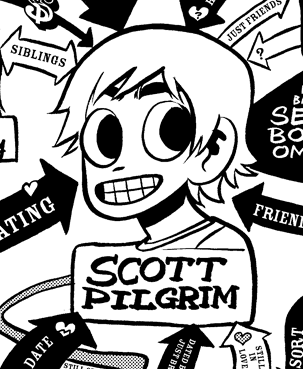
Damn it, I just wasted too much time trying to create a Venn diagram for this post.  Easy to make one but I couldn’t embed it; I give up.  The failed diagram was my attempt at a graphic representation of my unusually active Friday night, when Sarah and I and our friend Leah went to see Scott Pilgrim vs. the World and then I peeled off from the tired ladies to see Junior Brown performing downtown.

The Venn diagram represented the small overlap between the youthful “Emerging Adults” at Scott Pilgrim (one circle) and the mostly 50/60-ish Hoosier country music fans of Junior Brown (second circle).  The little sliver of overlap between the two circles may only have been only me on this particularly evening: 40ish aging hipsters/ incipient geezers.

If you don’t know, Scott Pilgrim is the film version of a graphic novel series depicting the adventures of young Toronto indie-rock 20-somethings in pseudo-Manga (e.g. Japanese comic) style.  I got the first book or two several years ago and didn’t keep buying it the series, but it’s very witty and fun.  The charm is partly in the casual way the inbred, gossipy, wise-cracking, media-saturated world of these arty hipsters blends into video-game and sci-fi tropes and events (Scott for some reason must battle to the death the seven evil exes of his new girlfriend Ramona).   Probably inevitably, the movie somewhat pumps up the Mortal Combat-esque battle scenes which end up taking over the movie a bit too much.  But it’s all very funny and well done.  One highlight was Scott’s battle with Romana’s ex who possesses the unstoppable force of Vegan power: “we’re just better than non-vegans,” he observes (or some such).  He cannot be defeated, it would seem, until Scott tricks him into accidentally drinking some coffee with half-and-half in it, at which the Vegan Police show up and haul him away.  Michael Cera was not exactly how I imagined Scott, but he was good in his own wimpy way.

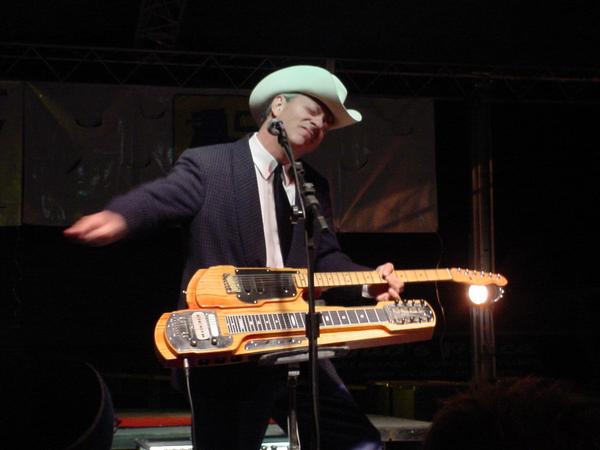
From a head-spinningly different universe is Western Swing legend Junior Brown, is actually an Indiana native (which I’d never known) who’s been an Austin fixture for years.  When we visited George in Austin in 1996 or something he took us to see Brown at his then-weekly (I think) show at some cool outdoor restaurant venue.  On Friday night he came out a bit late — someone I ran into there told me this is generally the case b/c Brown is busy smoking his famously excellent pre-show weed backstage.  He is perhaps best known for having invented what he calls his guit-steel, a two-necked guitar.  He’s a virtuoso and many of the songs — mostly country/ Western Swing, with some surf and Hawaiian steel excursions — are designed to allow him to show off his impressive skills.

Although it was a challenge to find any common ground between the world of Scott Pilgrim and Junior Brown, my ever-busy relations-seeking mind led me to imagine JB battling the Katayanagi Brothers (a Japanese synth rock duo) in one of the battles-of-the-bands from the movie.  He’s definitely stand a decent chance, especially with the power of the guit-steel’s double neck, one available to vie with each evil brother.

Recent music: Surfer Blood, Titus Andronicus, A. B. Crentsil & The Osookoo Stars

Some recent music I’ve been listening to.

Spoon Transference.  I’ve never entirely fallen for Spoon, one of those bands whose albums always struck me as at least pretty good but none of which wowed me.  The singer always seemed slightly charisma-challenged.  Or maybe for me they started to seem like a band you were supposed to be rooting for.  They were nice guys, good guys, and/thus (perhaps?) a little dull?  Anyway, I like this newest one more.  It feels very unspontaneous, a studio construction, altogether controlled and worked-over, with several really stand-out tracks.  My favorite is “Out Go the Lights,” their “All My Friends” maybe, a gorgeous, drawn-out ballad filled with spooky/beautiful studio effects.  “I Saw the Light” also very good, and “Who Makes Your Money,” a piece of thin, stuttering Chic white funk.   Somehow made me think of Steely Dan (the song title is a Steely Dan kind of question to ask).

Surfer Blood Astro Coast.  I ignored this for a while — missed them when they played in town — maybe because their name seemed so rote.  But the album’s actually excellent, a great summer album.  They do feel like a bit of a pieced-together Frankenstein apparatus of influences and resemblances.  A rougher Weezer, definitely, in the super-catchy surfy tunes; some Vampire Weekend (the vague afropop feeling in the lightness and lilt of the guitars); the Shins; the Pixies in the background.  But less obviously, I sense parallels with another young band I like a lot, No Age; in “Floating Vibes” or “Fast Jabroni” or “Anchorage,” for example, the way they ride a simple riff in a way that makes me think of 1980s SST (like early-mid Sonic Youth): punk forms (the Ramones) filtered through a more knowing, art-informed perspective (although they’re not really conceptualists like No Age or the Dirty Projectors, as far as I can tell).  Pretty much every song is really good with instantly memorable hooks you could pound your dashboard to.  Wish I’d seen them.

Finally came around to the National. I’m not sure if the new one High Violet is as good as Boxer or not but I like it despite the vague concern that it’s all getting too close to U2 or Coldplay.  My favorites are “Lemonworld”, “Vanderlyle Crybaby Geeks,” “Bloodbuzz Ohio” [I like that they’re from Cincinnati, btw] and “Conversation 16,” the latter which goes a bit over the top with the climactic zombie-movie confession, “I was afraid… I’d eat your brains — ’cause I’m evil….”  My reading of “Lemonworld:” it’s about being a poorly-paid over-educated wage slave in NYC spending the weekend in your girlfriend’s parents’ swank Hamptons or Long Island weekend home.   “So happy I was invited/ Gave me an excuse to get out of the city.” Mixed feelings and depressive affect ensue.  Part of what works about this song is the ironic relation between the song’s form and content: it’s a song about ambivalence about wealth and luxury that is itself luxuriously lush (and likely a bit guilty about it).

I’ve probably listened to those four songs at least a dozen times each.  You can sink into this album’s lush textures– a good headphones album.

Titus Andronicus A More Perfect Union. This album sounds so silly.  A New Jersey punk rocker obsessed with Springsteen, who named his band after a violent Shakespeare play, makes a concept album about the Civil War inspired by the Ken Burns documentary, featuring readings of Lincoln speeches???  But surprise, it’s great.  By the time he’s ripped off/payed homage to the Boss and Billy Bragg in the same line a couple minutes in (“I never wanted to change the world, I’m looking for a new New Jersey/ ’cause tramps like us, we were born to die”), I was sold.  It’s in another universe from the cool studio perfectionism of the National and Spoon — makes you think of various famously drunken bands (early Replacements, the Pogues), obviously very much a live band spilling over with Celtic reels, bagpipe, saxophone, singalongs.  I suspect a big Pogues influence, and likely the Civil War thing is an attempt for this New Jersey punk band to find their own comparable folkloric/ historical frame — adding gravitas and depth to what might otherwise just be hungover pissing and moaning.  E.g. when he sings “I’m worthless and I’m weak, I’m sick and and I’m scared,” it sounds like a 22 year old kid on a Sunday morning scared he may be becoming an alcoholic, but the next line, “the enemy is everywhere” lifts what could be a merely personal drama into a national-historical register.

Ultimately I think its reach exceeds its grasp a little bit — it’s not quite Rum Sodomy and the Lash, but this guy Patrick Stickles (who does sound uncannily like Conor Oberst, btw) is seriously talented.  “Gimme a Guinness, gimme a Keystone Light, gimme a kegger on a Friday night, gimme anything but another year in exile.”

This one’s a bit older, but another fave has been Tegan and Sara’s Sainthood.  Of course I love the Canadian twin-sister angle.  A few songs here I’ve listened to over and over.  “Arrow” is a great elaborated Cupid’s arrow metaphor: “I feel the breeze, feathers of an arrow; I take my aim, you feel me coming close.”   “Sentimental Song” is really smart on what it means to reject sentimentality, or sentimental art.  “You hate the tenderhearted torch song,” she sings to her lover.  “Hard-hearted — don’t worry, I’m ready for a fight;” that is, I may like corny love songs but it doesn’t mean I’m not tough.  And “Someday” is fantastic, super-catchy, needs to run over the credits of an inspiring teen movie: “I might write something I might want to say to you someday,/ Might do something I’d be proud of someday/ Mark my words, I might be something someday.” I think it’s a coming-out song.  “The Cure” another favorite: “I know the world’s not fair to you, I’ve got a cure for its crimes.”  Surely this could’ve been a big hit on MTV in 1990.  Very new wave (minus the frills), taut/tense songs that stick in your head.

Love the thought of Celie and Iris as a band — in theory if not probably in practice.  “Hi dad, yeah we just finished the show in Pensacola, we’re driving to Texas tonight.”  Never mind, not a good idea at all!!!

OK, one token non-indie rock album, A. B. Crentsil & The Osookoo Stars. I presume I downloaded this from Awesome Tapes from Africa (“Free mp3s of obscure African music”).  Really great notwithstanding the scratchy audio.   “When I was going to the cinema I saw a girl who resembled my sister…She turned in a soft voice and said ‘I am Juliana.'”  I learn from Wikipedia that A. B. Crentsil “is one of the big three of contempoary Ghanaian vocalists….Crentsil’s music has always been considered controversial but always makes the highest sales once it hits the market. Crentsil resorts to various themes and antics to convey his message with appropriate proverbs where necessary and that always strikes a listener to appreciate his music.”  Sounds right to me.

M.I.A. and Ginger Insurgency

Intense new video (almost a mini-movie) for the new M.I.A. song “Born Free.”  (Caveat: nudity and a lot of violence.)

Spoiler alert: it’s sort of derivative of “District 9” with grittier/ more violent depictions of brutal (and multiracial) U.S. troops terrorizing, beating, arresting, & assassinating innocent civilians… who turn out to have been singled out because they have red hair.  So, it’s a clever and somewhat absurdist re-imagining of racism as directed at red-heads, and an indigenous insurgency (a la the Tamil Tigers) led by outlaw gingers… until you realize/remember/learn that prejudice against “Gingers” is a apparently a real phenomenon in the U.K.

E.g. this blog Gingerism, “documenting the existence of gingerism in mainstream society;”

This British comedian Catherine Tate’s show’s episode about a victim of prejudice and abuse being offered refuge at a shelter for Gingers:

“I am what I am!… The people in the village spit at me, the children throw dog matter in the letter box, and you’re telling me to accept myself!  It’s just not fair!”

“I know, Sandra; but at the end of the day there will always be those who can’t bring themselves to accept people who are…”

“You can’t say it.”

“… Ginger.”

OK, I guess this is a much more widespread meme than I realized:

In modern-day UK, the words “ginger” or “ginga” are sometimes derogatorily used to describe red-headed people (“ginger” is not often considered insulting; the abbreviation “ginge” is much more commonly used derogatorily), with terms such as “gingerphobia” (fear of redheads) or “gingerism” (prejudice against redheads) used by the media. Some have speculated that the dislike of red-hair may derive from the historical English sentiment that people of Irish or Celtic background, with a greater prevalence of red hair, were ethnically inferior. Redheads are also sometimes referred to disparagingly as “carrot tops” and “carrot heads”. “Gingerism” has been compared to racism, although this is widely disputed, and bodies such as the UK Commission for Racial Equality do not monitor cases of discrimination and hate crimes against redheads. A UK woman recently won an award from a tribunal after being sexually harassed and receiving abuse because of her red hair; a family in Newcastle upon Tyne, England, was forced to move twice after being targeted for abuse and hate crime on account of their red hair; and in 2003, a 20 year old was stabbed in the back for “being ginger”. In May 2009, a British schoolboy committed suicide after being bullied for having red hair. The British singer Mick Hucknall, who believes that he has repeatedly faced prejudice or been described as ugly on account of his hair colour, argues that Gingerism should be described as a form of racism. This prejudice has been satirised on a number of TV shows. The British comedian Catherine Tate (herself a redhead) appeared as a red haired character in a running sketch of her series The Catherine Tate Show. The sketch saw fictional character Sandra Kemp, who was forced to seek solace in a refuge for ginger people because they had been ostracised from society. The British comedy Bo’ Selecta! (starring redhead Leigh Francis) featured a spoof documentary which involved a caricature of Mick Hucknall presenting a show in which celebrities (played by themselves) dyed their hair red for a day and went about daily life being insulted by people. The pejorative use of the word “ginger” and related discrimination was used to illustrate a point about racism and prejudice in the “Ginger Kids”, “Le Petit Tourette” and “Fatbeard” episodes of South Park.

As a member of a family full of red-heads, I deplore this senseless bias!