You are Radiant like Sunlight: L. Ron Hubbard and Scientology

L._Ron_Hubbard_in_1950-1024x731L. Ron Hubbard in 1950

I’m reading Lawrence Wright’s Going Clear: Scientology: Hollywood, & the Prison of Belief, from which I keep having to read excerpts out loud for being so bat-shit crazy even within the frame of my expectations about Scientology and L. Ron Hubbard.

The basic story so far: young man with a flair for self-dramatizing/lying joins the Navy in WW2 and is discharged; at this point a massive gap develops between Hubbard’s own accounts of his experiences in the war (filled with heroism and derring-do) and all extant navy records of his undistinguished or worse record.  He develops a promising career as a science fiction writer and becomes part of a boho sci-fi scene including the likes of Robert Heinlein, who becomes a close buddy.  Joins a cultish commune in Pasadena called the Agape Lodge, “a branch of the Ordo Templi Orientis, a secret fraternal organization dedicated to witchcraft and sexual ‘magick,’ based on the writing of… Aleister Crowley.”  Hubbard’s estranged son later comments that when Crowley died in 1947, “That’s when Dad decided that he would take over the mantle of the Beast and that is the seed and beginning of Dianetics and Scientology… It was his goal to be the most powerful being in the universe.”

Under anasthesia at the dentist, Hubbard has a vision that he believes reveals the secrets of existence to him.  He writes a self-help book based on said vision, Dianetics: the Modern Science of Mental Health, which becomes a surprise best-seller and makes him wealthy.  When the Dianetics trend passes, however, Hubbard is broke again, and subsequently re-invents Dianetics as not simply a kind of self-help, power of positive thinking alternative to mainstream psychiatry, but instead a full-fledged religion with Hubbard at its center as a charismatic leader.  This is when things start getting really weird and dark.

A few favorite passages so far.  This is from “a list of personal goals and compliments [Hubbard] pays himself, but… also a portrait of the superman he wishes to be,” written in the late 1940s before the publication of Dianetics.

You are radiant like sunlight.

You can read music.

You are a magnificent writer who has thrilled millions.

Ability to drop into a trance state at will…

You did a fine job in the Navy.  No one there is now ‘out to get you.’

You are psychic.

You do not masturbate.  [This follows an earlier affirmation: “Masturbation does not injure or make insane.  Your parents were in error.  Everyone masturbates.”  Btw, one Crowleyian ritual at the Agape Lodge involved “‘invocation of wand with material basis on talisman’ – in other words, masturbating on a piece of parchment.'”]

You do not know anger.  Your patience in infinite.

Snakes are not dangerous to you.  There are no snakes in the bottom of your bed.

Later, in the heady “Sea Org” era, when Scientology’s leaders had not yet found a stable home base and were located on a ship at sea:

Hubbard began recalling many of his own various existences… He claimed to have been a contemporary of Machiavelli’s, and he was still upset that the author of The Prince stole his line ‘The end justifies the means.’ He said he had been a marshal of Joan of Arc and Tamburlaine’s wife.  He told stories of driving a race car in the alien Marcab civilization millions of years before.  He came to believe that in some of his past lives on this planet, he had buried treasure in various locations, so he launched an expedition to unearth his ancient hoards.  He called it the Mission of Time.  He selected a small crew… Because he wanted to keep the mission secret, he had two long rafts fashioned, which could be rowed ashore under cover of darkness and pulled up on the beach near where he imagined his ancient treasure was buried….

The missionaries found some old bricks they thought might have been the ruins of a castle beside the watchtower.  The metal detectors found nothing.  Hubbard decided to come along the next day to inspect the site himself.  “Yes, yes, this is the place!” he said excitedly.  He explained the absence of treasure by saying that it must have been hidden in a portion of the ruined castle that had fallen into the sea.  [The expedition] next stopped in Calabria, on the toe of Italy, where Hubbard had buried gold in his days as a tax collector in the Roman Empire.  None was found, however.

It is an unbelievable story, and I have not even gotten to Tom Cruise and John Travolta yet. The book makes you realize that Paul Thomas Anderson’s The Master massively underplayed the craziness– it represents Scientology as resembling in origins a deranged instantiation of an H.P. Lovecraft fiction or something along those lines.

Remember: You are radiant like sunlight. You are a magnificent writer who has thrilled millions. You are psychic. You do not masturbate.

p.s. The Amazon reviews of the book, some written by former Scientologists, are fascinating.  Also see Kim Masters’ “Why the Media is No Longer Afraid of Scientology.”
*We Killed*: Elayne Boosler driven crazy by bullshit

I read a lot of We Killed: the Rise of Women in American Comedy (by Yael Kohen) the other day; it’s an oral history and I started reading it in the 1970s or so, skipped the earlier parts of the history about Phyllis Diller, Joan Rivers, et al (I may go back to read that).

One figure I found fascinating in this narrative was a stand-up named Elayne Boosler, who grew up as the child of a Russian acrobat and a Rumanian ballerina in Brooklyn.  I’d never heard of her, although she was quite prominent in the 70s and into the 1980s.  She dated Andy Kaufman and achieved a fair amount of success; she even did a Dry Idea anti-perspirant commercial in what looks to me like 1982 or so:

There are three “nevers” in comedy.  Never follow a better comedian.  Never give a heckler the last word.  And no matter how badly a joke bombs — although it’s never happened to me personally — never let them see you sweat.

She is viewed as a pretty important figure by many of the commentators and she emerges as a slightly tragic or melancholy one in the sense that her career seems emblematic of female comics of this generation: she was super-talented, she did well, but she hit what seems to have been a kind of glass ceiling.  Richard Lewis comments that he always thought of her as “Jackie Robinson of stand-up in my class… There was like, a guy, a guy, a guy, a guy, and ‘Ladies and gentlemen, Elayne Boosler!’ And she would come on and rip up the joint, and I just found it astounding, because she had to overcome so many obstacles.”

As the author explains, one of the most problematic blocks to the advance of female comics in this era was The Tonight Show.  Appearing on the show was one of the crucial routes towards stardom and Johnny Carson admitted outright that he found most female comics “a little aggressive for my taste”; as Kohen comments, “the women who suited Carson’s taste were, for the most part, blond, buxom, and willing to play dumb.”

Someone else (Joanne Astrow) comments, “There are always complex stories.  There’s another side to it.  Elayne Boosler has what I would honestly call anger management problems.  And Elayne has an obsessive craziness about material being stolen from her.”  Then someone (Claudia Lonow) chimes in, “Did she have a chip on her shoulder or was she a creative person who was being driven crazy by bullshit?  That’s what I think.  She was systematically being driven crazy.”

I find this convincing partly because she was obviously so good and there seems no good reason why she would not have broken out in a bigger way (as many of her male peers did) were it not for the endemic structural sexism of the comedy scene of the era.

Check out this hilarious clip about the awkwardness of one-night stands:

And this clip of Boosler appearing on some kind of strange Andy Kaufman special, in which he sits high above her at a giant desk as they bicker about their breakup, is amazing:

Boosler now seems to have become a progressive activist of sorts (writes for the Huffington Post sometimes) and an animal rescue advocate.  I’m sure she’s doing fine but my sense is that she never got her due.

Following a victory lap about Amy Poehler and Tina Fey, the book concludes somewhat depressingly with the recent emergence of a new ideal of model-level hotness for female comedians; notwithstanding occasional exceptions that prove the rule like Melissa McCarthy, it’s pretty clear that nowadays if you don’t look like Chelsea Handler, Whitney Cummings or Natasha Leggero you are likely to get shunted away from performance towards the writers’ room.

D.T. Max’s Life of David Foster Wallace

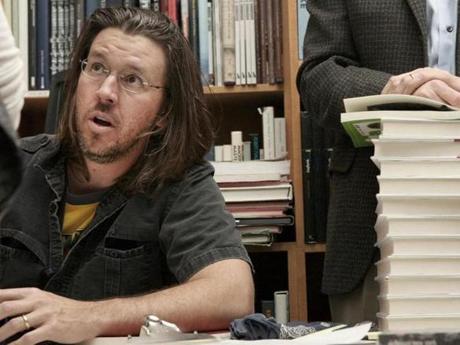
I just finished the recent biography of David Foster Wallace by D.T. Max, Every Love Story is a Ghost Story (come to think of it, I don’t know where that title comes from — can’t remember it appearing in any of Wallace’s work or in any other context).  It’s very good: there’s a blurb on the back by Dave Eggers that says “we should be grateful that this story was told by someone as talented and responsible as D.T. Max” and that seems true; it’s an inherently sensationalistic tale in a lot of ways and it would have been very easy for a biographer to tip it in a more voyeuristic direction.

Speaking of which, I have to cite the craziest moment in the book, about DFW’s tumultuous relationship with the married Mary Karr.  (I think I remember seeing some coverage of this when the book came out earlier this year.)  It’s like something out of Elmore Leonard.

One day in February [1992], he thought briefly of committing murder for her.  He called an ex-con he knew through his recovery program and tried to buy a gun.  He had decided he would wait no longer for Karr to leave her husband; he planned to shoot him instead when he came into Cambridge to pick up the family dog.  The ex-con called Larson, the head of Granada House, who told Karr.  Wallace himself never showed up for the handover and this ended what he would call in a letter of apology “one of the scariest days of my life.”  He wrote Larson in explanation, “I now know what obsession can make people capable of” — then added in longhand after — “at least of wanting to do.”  To Karr at the time he insisted that the whole episode was an invention of the ex-con and she believed him.

He was in and out of psychiatric hospitals for chronic depression, and he often behaved pretty oddly, but there’s nothing else quite like this. He got a tattoo of “Mary” on his arm– which is a pretty intense thing to do in re: a married lover (although maybe they were briefly an acknowledged couple at this point, I forget).  Later when he got married, he “had a strikeout drawn through the fading word ‘Mary’ on his tattoo and placed and asterisk under the heart symbol; further down he added another asterisk and ‘Karen,’ turning his arm into a living footnote.”  Too perfect!

One part I found especially sad has to do with DFW’s reaction to winning a MacArthur “genius” award.

…He was ‘paralyzed’ by fear of failure. He worried that whatever ‘magic’ or ‘genius’ people said they’d seen in his last two books would not be in evidence.  He would, he worried, be ‘obliterated or something (I say ‘obliterated’ because the fear most closely resembles some kind of fear of death or annihilation, the kind of fear that strikes one on the High Dive or if one has to walk a high tightrope or something).’  He was now frozen by his own need to be the person others saw him as.  They could let go of it more easily than he could.  And since the success of Infinite Jest the problem had gotten worse, so that he feared the ‘slightest mistake or miscue’ would knock the statue down.  The prospect terrified him…

I found fascinating the ways DFW’s chronic depression, addiction, and history of frequent hospitalization (for both) functioned as a kind of purloined-letter-style concealed absence in his work and biography.  In retrospect, it seems amazing that everyone didn’t catch on about this, but Wallace and his editors and friends provided various kinds of cover stories.  And perhaps he seemed so erudite & brilliant that people couldn’t quite imagine that he had in fact spent long stretches in the kinds of no-frills addiction treatment centers he describes in Infinite Jest.  So for example, after the publication of that novel, Frank Bruni wrote about him for the New York Times Magazine and the journalist “went along to a dinner at the home of a couple named Erin and Doug Poag.  They ate Kentucky Fried Chicken and heroes on trays and watched The X-Files… Wallace did not mention that his connection to the Poags was from his recovery circle — he claimed to have met them at a ‘Mennonite church.’  And, understandably, without that information, Bruni was left with the impression that Wallace’s fondness for ordinary Midwestern people might be a put-on.”

Max can be critical of DFW, as for example in his comment about Wallace’s famous 2005 Kenyon College commencement speech: “Over the past 25 years his mental life had run a huge circuit through the most astonishing complexities to arrive at what many six-year-olds and nearly all churchgoers already understood.”  Although actually Max evinces a lot of sympathy for DFW’s personal journey through heights of high-philosophical braininess, post-modernist fictional experimentation, sexual promiscuity (“Other than the classroom, his favored venue for meeting women was St Matt’s, the church in whose rectory his recovery group met”), and then eventually to a kind of serious earnestness and monogamy.  (Btw Jonathan Franzen was a big influence on him in this regard — Franzen was his most important long-term peer/ friend/ competitor/ correspondent).

Of course, the writing never stopped being extremely thorny, dense, and weird.

I now am finally going to read The Pale King!

p.s.  I mentioned the DFW story “The Depressed Person” here a year or two ago.  My take on it at that point was that the irony in retrospect — in relation to how angry the story made some readers for its seemingly cruel depiction of a depressed person — was that that person obviously was Wallace.  Max asserts that it’s in fact a depiction of Elizabeth Wurtzel, whom he was pissed off at for sexually rejecting him.  I actually don’t quite buy this…

Joyce Carol Oates’ *Blonde*

I emerged blinking and slightly dazed the other day from Joyce Carol Oates’ big novel based on Marilyn Monroe’s life, Blonde.   I got the idea to read it from the recent interview with Oates in the Times Book Review in which she comments,

I can say that the novel that exhausted me the most, wrung my emotions the most and left me determined never again to write a thousand-page novel with a sympathetic protagonist who must die on the last page is “Blonde,” imagined as a tragic-epic of the life of Norma Jeane Baker/“Marilyn Monroe.”

My edition was 738 pages, but it actually went pretty quickly for such a doorstop.  I’ve never been all that fascinated by Monroe, and didn’t know the details of her biography all that well beyond the broad strokes; not sure if that was an advantage or the opposite for reading this.  I’ve also only seen a few of her best-known movies e.g. (of course) Some Like it Hot, and the novel makes you see that movie a bit differently.  I did constantly find myself wondering to what degree various details were accurate, based on reality, or simply made up.  For example, for a long stretch in the novel “Monroe” maintains a kind of menage a trois relationship with the embittered sons of Charlie Chaplin and Edward G. Robinson, which is treated as a hugely important relationship for her, but as far as I can tell this is all in the category of unverified rumor.  I would have liked an annotated version of this novel with footnotes explaining what Oates is doing with the known facts and how she’s entering into Marilynology and engaging with the mythologies.  (Oates depiction of Marilyn’s death is pretty bold, for example, and could fall into the category of conspiracy theory.)

Marilyn with Arthur Miller, 1960 © Bruce Davidson/Magnum Photos

The novel sometimes brings to mind Nathaniel West and Bruce Wagner in its mostly nightmarish depiction of Hollywood and of Marilyn/Norma Jeane’s exploitation.  Even to call her Marilyn can feel like participation in that exploitation — she never liked the name and, in the novel, never really accepts it as her own.  The original reviewer in the Times back in 2000, Laura Miller, claimed that “‘Blonde,” although sometimes sloppy and sentimental, is perhaps the most ferocious fictional treatise ever written on the uninhabitable grotesqueness of femininity.”  That’s a pretty strong claim, but I don’t think it’s absolutely over-the-top. Oates’ Norma/Marilyn is a bottomlessly needy creature shaped and deformed by her desirability.  “Men’s eyes.  The hawk plunging its beak into the songbird’s breast.”  She is transformed and vivified and also destroyed by the camera.  Oates depicts her as seemingly in a “panic-fugue state” half the time, fundamentally bewildered by her own effects on men and viewers.  Watching herself in The Seven Year Itch: “maybe she’d been exhausted by melancholy, a combination of Nembutal and champagne and the strain of the divorce, and she’d seen the giant Technicolor screen in a haze as if underwater hearing laughter around her buzzing in her ears and she’d had to fight sleep in her gorgeous stitched-in body in a strapless evening gown so tight in the bust she could barely breathe, her brain deprived of oxygen, and her eyes glazing over inside the ceramic Marilyn mask her makeup man Whitey had sculpted over her sick sallow skin and bruised soul.”  I guess that sentence also typifies the rather hysterical pitch of the incantatory prose, which is often “too much” for sure, but generally in ways that fit the subject.

Another somewhat exemplary passage (not that the entire book is so horrific) that reminds me of Ellroy’s My Dark Places: “These killings in Los Angeles County, there’d been another one last month, a ‘red-haired model’ the papers described her, only seventeen years old.  Sometimes the murderer buried the girl in a ‘shallow grave’ and rain washed the sandy soil away to expose the body, or what remained of the body.  But no harm had ever come to Norma Jeane.  Each of the eight or nine or ten raped-and-mutilated girls was known to her, or might have been known to her, sister starlets at the Studio… yet were not ever her.  What did that mean?  That she was destined for a longer life?  A life beyond the age of thirty and a life beyond Marilyn?”

The novel does also, however, tap into Monroe’s occasional joy in performance and what Oates presents as the genius of that performance.  You feel that Oates loves her hapless and very sad protagonist– who could also be very funny, loving and insightful.  (Well, “hapless” may not be the word if it means luckless; Norma Jeane had the kind of incredibly good luck that turns out to be bad luck, I suppose.)  You really find yourself rooting for Norma Jeane, this girl from the L.A. orphanage with a completely crazy and abusive mother, to make it, to get to a place where she could achieve some sense of self-control and autonomy.  (Needless to say she does not quite get there.)

Marilyn reading Ulysses, 1955, © Eve Arnold/Magnum Photos

*Margaret* as Gerard Manley Hopkins film adaptation

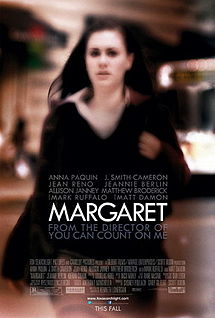
Kenneth Lonergan’s 2011 movie Margaret, his vexed sequel to You Can Count on Me (you may have read the NYT Magazine piece on “Lonergan’s Thwarted Masterpiece”), could plausibly considered as a film adaptation of Gerard Manley Hopkins’ great poem “Spring and Fall.”  That’s pushing the boundaries of how we usually define an adaptation, but the movie can serve as an intriguing limit case for how far the concept can be stretched.

Here’s the poem:

Márgarét, áre you gríeving
Over Goldengrove unleaving?
Leáves like the things of man, you
With your fresh thoughts care for, can you?
Ah! ás the heart grows older
It will come to such sights colder
By and by, nor spare a sigh
Though worlds of wanwood leafmeal lie;
And yet you wíll weep and know why.
Now no matter, child, the name:
Sórrow’s spríngs áre the same.
Nor mouth had, no nor mind, expressed
What heart heard of, ghost guessed:
It ís the blight man was born for,
It is Margaret you mourn for.

One of many details about the film that the producers probably were not crazy about is the fact that there is no character in it named Margaret.  The movie stars Anna Paquin as Lisa Cohen, a troubled Manhattan private school teenager (Paquin is 30 now with twins but was only 23 or so when the movie’s shooting wrapped in 2005), raised by an actress single mother, who witnesses and bears some responsibility for a tragic bus accident that leads to a pedestrian’s death.  The movie reminded me to a surprising degree of the excellent recent Iranian art-house hit A Separation: both movies use a similar structure to explore the legal, psychological, and ethical aftermath of a deadly accident, paying close to attention to the impact on this process of class differences and class privilege.

I thought Paquin gave a really good performance as Lisa, a pretty insufferable yet, to me, still sympathetic, spoiled and unhappy teenager trying to figure out how to be an ethical person or how to respond ethically to a tragedy.

Lisa is Hopkins’ Margaret (King Lear is another intertext, by the way).  The main thrust of the movie explores the process by which she “weeps” and “know[s] why,” coming to “sights colder” and encountering the “blight man was born for”, namely an understanding of death and loss.

The movie is very interested in pedagogy and classroom experience and how “learning” of various forms occurs.  Two of the primary supporting roles are played by Matthew Broderick (who apparently ended up bankrolling part of the film) and Matt Damon as teachers at this Dalton or St Ann’s-like NYC tony private school.  The Damon character is specified as being from Indiana, so you know he’s upstanding and a bit naive. You really start to feel for these earnest teachers (or at least I did) as they struggle to teach and expand the horizons of their very bright, privileged, rather unbearably narcissistic charges.  (Although I also felt a little envious at how quick the students are to talk and argue in class!)  The title of the movie comes from a particular scene where Broderick is teaching “Spring and Fall”, but the themes of the poem extend throughout the movie as Lisa undergoes hard lessons in self-awareness and moving beyond her self-centered worldview.

I just found this “interactive feature” that tries to match short clips from the film to particular lines in the poem— I think the connections could use some further glossing, though (I just watched the video for “And yet you will weep and know why” and am not clear why the makers of this widget chose that scene in particular for this line).

We watched the 150-minute theatrical release, but now I kind of wish we’d gone for the three-hour director’s cut.  The version we saw is a strange and somewhat awkward movie but also at times a ravishingly beautiful one that offers all kinds of food for thought — I haven’t even touched on what it does with theater and opera (the moving final scene involved a kind of catharsis as Lisa and her Broadway actress mother watch Offenbach’s The Tales Of Hoffmann at the Met) or how it works as a post- 9/11 movie exploring the consequences of that trauma in and for NYC (remember, shooting was completed back in 2005).

This is a good piece, from a blog about music in film, that presses on a line from the movie, Lisa’s protest, “My life isn’t an opera!”  As the author of the blog argues, Margaret ultimately does become not just operatic but a kind of opera in film.  And I think one could make a similar claim about the film’s relationship to Hopkins’ poem.  All in all, it’s a movie with interesting things to say about cross-media representations and influences.

Don Winslow’s *Savages*: A Narrative of the Captivity and Restoration of O.

Is there a verb for going back to read the book that inspired a new movie?  Retroreading or some such?  I have not seen Oliver Stone’s adaptation of Don Winslow’s novel Savages but was inspired by the coverage of the movie (and reviews of the novel’s sequel) to check it out.

I get why it was popular/successful… it has a Quentin Tarantino/ Elmore Leonard / James Ellroy hipness, speed, sex, violence and general nastiness that makes for a quick and in some ways fun read.  I didn’t love it, though.

One problem: I found the basic premise of much of the story to be implausibly silly.  (Spoilers to follow, but I won’t give away the actual ending.) The high-end Berkeley Laguna Beach [Ben’s parents are Berkeley liberals and he went to UC Berkeley] pot dealers Chon and Ben cross a brutal Mexican drug cartel who respond by kidnapping their friend/ shared girlfriend/ girl-toy Ophelia a.k.a. “O” and threatening to behead her if Chon and Ben fail to comply with every demand.  Our Laguna stoner young men in turn start putting on masks and robbing the drug cartel… who for some inexplicable reason can’t seem to decide if this sudden string of bold robberies, performed by two tall white men in masks, might just possibly be connected to Chon and Ben.  So they leave “O” alone and allow plenty of time for the revenge/recapture of O plot to unwind.

I also think the book is ultimately racist in effect in ways that turns up the general nastiness/nihilism factor to an uncomfortable degree.  Every brown-skinned person in the book, pretty much, is a disgusting, sadistic, torturing thug. (There are some semi-exceptions like O’s relatively good-hearted guard.  Aww, he loves his girlfriend!)  The book turns into what’s hard not to read as an allegory of slacker white America shaking off its pot lethargy and rising up to kick the ass of the brutal brown invaders.

This theme is laid out explicitly towards the end:

Chon has read a lot of history.

The Romans used to send their legions out to the fringes of the empire to kill barbarians.  That’s what they did for hundreds of years, but then they stopped doing it.  Because they were too distracted, too busy fucking, drinking, gorging themselves.  So busy squabbling over power they forgot who they were, forgot their culture, forgot to defend it.

The barbarians came in.

And it was over.

Winslow to some degree protects himself against accusations of racism with occasional ironic shifts in perspective when we see that to some of the Mexican narco-terrorist types, it’s Chon and Ben and O., in their shiftless Anglo ways, who are are the “savages.”  I didn’t really buy it, though, and it’s not enough of a counter-weight against the morbid wallowing in visions of the sadistic kingpin Lado contemplating the rape and then beheading of O.  It’s a classic old-fashioned captivity narrative with the beautiful Anglo in the clutches of the dark-skinned savage, with all the suspense of the narrative depending on the question of whether she will be rescued before she is raped.

[That one of our heroes is named “Chon” is perhaps symptomatic of the tensions/ambiguities around ethnicity in the novel… it sounds like a Hispanic name, but it’s actually a nickname for John]

The nastiness is often witty but felt too xenophobic/racist in worldview in the end for my tastes.  And the premise of the revenge plot just didn’t make sense to me.  That said, it does have style to burn and can be pretty funny.

I’ve read very mixed reports on the Oliver Stone movie: some seem to see it as a return to form and his best film in years, but I’ve seen a couple reviews that call it borderline unwatchable and absurd.

“‘Good-bye, everybody!'”: Hart Crane Revival in *The Paris Review*

I started subscribing to the Paris Review a while ago and enjoy it– find it consistently interesting/good to great.  I think what may have spurred me to start subscribing was the serial publication of the Roberto Bolano novel The Third Reich last year.  Other good recent-ish contents that come to mind: the Wallace Shawn interview in #201; a portfolio of “anonymous photographs of children from the personal collection of Terry Castle” in issue #198.  The art portfolios always tend to be interesting and the fiction is almost never boring or predictable.

Got the new issue #202 the other day.  What has leapt out at me about it, thus far, is that it contains TWO different stories that include reference to Hart Crane’s supposed last words.

David Gordon’s “Man-Boob Summer”: the 38-year old narrator seems to have recently finished a Comp Lit thesis and is depressed and living for the summer with his parents.  He starts flirting with the young lifeguard at the apartment complex’s pool who is reading Crane’s Collected Poems.

“You know what his last words were? As he jumped off the steamship?”

She was watching me very closely now.  She shook her head.

“‘Good-bye, everybody!'”

She laughed abruptly, a short burst, and covered her mouth with her hand.

“It’s true,” I said.  “I think, anyway.  I read it somewhere.”  And then while I wasn’t looking, she kissed me.  (p. 28)

And Sam Savage’s strange, long “The Meininger Nude,” narrated by a dyspeptic, dying art collector:

I was always fascinated by great-artist suicides.  By Hart Crane, for example, who called out, ‘Good-bye, everybody,” before leaping from the stern of a steamship.  He was 270 miles North of Havana, returning from a year in Mexico, where he had written nothing.  (p. 90)

Coincidence?  Something else?  Will I find any additional citations of this line as I keep reading the issue?

Dylan’s *Tempest*, *Where’d You Go, Bernadette*, *Homeland*

Several great things I have recently read/seen/heard:

The new Bob Dylan album Tempest (I try not to buy everything on Amazon these days but I will note that it is $5 for the Mp3s on Amazon).  I’ve only listened to it 2-3 times can say that it continues his amazing late-career run.  For a long time I took for granted that nothing Dylan had done since 1975 (Blood on the Tracks) was even remotely in the same ballpark of quality or significance of much of his music before that point.  But ever since, I guess, World Gone Wrong in 1993 it’s all been great, much of it amazing.  (I don’t know about Christmas in the Heart, I gave that to my dad for Xmas but have not really checked it out myself!)   Some of the new one sounds like, I don’t know, Western Swing, Johnnie Cash, Nashville Skyline; weird, craggy, old-timey; funny, tender, & mean.

Where’d You Go, Bernadette.  This is the funniest book (novel) I have read in quite some time– totally sharp, witty, entertaining, and moving too.  The author, Maria Semple, used to write for Arrested Development so the funny part is not surprising.   One reviewer sums it up pretty accurately as “a wry slice of a life– one that’s populated by private school helicopter parents, obsessively eco-conscious neighbors, and green-juice swilling, TED-talking husbands.”  The social satire is hilarious and spot-on even for someone who doesn’t know Seattle– Seattle stands here for a certain kind of techie contemporary bourgeois bohemian that one finds everywhere.  The private school shenanigans are priceless. What’s most immediately impressive and amusing is Semple’s facility with the different voices, jargons, and styles contained in all the documents she incorporates seamlessly into the novel — which is a dossier of texts, somewhat in the style of Clarissa or Wilkie Collins’ The Moonstone, I suppose, with no real central narrator but only Bernadette’s 8th-grade daughter, who (we eventually figure out) has collected the set of texts and is collating them and turning them into a narrative.  There are emails back and forth from various parties; a psychiatrist’s report; memos from the head of the not-quite-A-list Seattle private school; a cruise ship’s log; a news article or two; tributes by famous architects to the protagonist Bernadette, who designed an influential early “green”/eco house, won a MacArthur, and mysteriously retired; some IM messaging within Microsoft’s system, etc.  In this way it brings to mind A Visit From the Goon Squad a tiny bit — and there’s one riff about the pauses between songs on a CD that almost seems a homage to Egan’s novel — but the mode is more brightly comic and satirical.

Homeland, the Showtime show starring Clare Danes.  Season one is recently out on DVD and we are devouring it (waiting for the 3rd and final DVD to arrive).  Danes is fantastic and the show is addictively suspenseful– I’ve never seen 24 but I imagine it has some things in common with that?  It is, interestingly, a remake of an Israeli t.v. series.  Danes plays a somewhat unstable C.I.A. officer who has become convinced that Nicholas Brody, a war hero and former POW recently captured and brought back from Iraq, is in fact a mole or double agent who was turned by Al Quaeda.  Three episodes left and I do not know how it’s going to turn out, although I have some theories.  Season Two starts pretty soon.

Dreaming about Kim Gordon

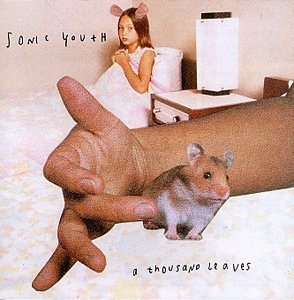
I picked up Goodbye Twentieth Century: A Biography of Sonic Youth (by David Browne) at my mother in law’s house (have no idea whatsoever what it was doing there).  I enjoyed it and it sent me off on an ongoing Spotify tour of Sonic Youth’s music from the past 10-15 years that I ignored or gave short shrift to at the time (e.g. I’m enjoying A Thousand Leaves).

Here are a few things I learned or found edifying:

  • Reading the book and going back to some of the music, I was struck by how very Catholic Thurston Moore’s songs are.  No wonder he loved Madonna!  There’s the great “(I Got a) Catholic Block,” of course: “I got a Catholic block/ Inside my head/… Guess I’m out of luck.”  But so many others.  “She said Jesus had a twin who knew nothing about sin/ She was laughing like crazy at the trouble I’m in.”  Have any Religious-Studies types gotten on this?
  • I guess I always realized that the band’s name was inspired by Big Youth, but I don’t think I ever thought about their serious debt to reggae & dub.  “The deep, undulating rhythms of reggae and dub had infiltrated the downtown music scene.  Moore was so invested in the genre he’d begun taking subway trips to a warehouse in Queens that specialized in reggae LPs, and he told Gordon to practice at home by playing along with the bass lines on a Black Uhuru album.”  This actually makes perfect sense as a way to think about the claustrophobic sound & rhythms of their early music: No Wave meets Lee Perry.
  • This was a favorite moment of mine:  “Phil Morrison, the up-and-coming filmmaker who’d directed the “Titanium Expose” video, starting having dreams in which [Kim] Gordon would suddenly appear, casting a judgmental eye on whatever he was doing.  Talking with friends, he discovered he wasn’t alone. “Lots of people dreamed about Kim,” he says.  “That was a real phenomenon.  And it wasn’t about sex.  She was the person you’d be most concerned about whether they think you’re cool or not.”  This most perfectly encapsulated the band’s role as taste-makers, cool-hunters and -arbiters, commanding the hipster unconscious of their era. I do think some of the music absolutely stands up as some of the greatest of the era (Sister is my personal fave), but the book kind of makes the case that their greatest importance lay in their stewardship of the underground as “the imposing older siblings of the new alternative world order.”  Thurston was the ultimate record-collector boy (someone hypothesizes that they invited Jim O’Roarke to join the band primarily so Thurston would have someone to go record shopping with on tour!) and Kim the arch-cool underground art/fashion diva.

  • They had the kind of career that creates a bit of a letdown in the last third of the book.  Their big pop push with Goo and Dirty in the mid-90s never really happened, and so there’s a little disillusionment as they soldier on making new records to diminishing expectations every year or two.  That said, they’re actually really impressive as a model of a band that figured out new models for their career as they went along (e.g. Thurston’s immersion in experimental & improvised music, the band’s own SYR Records, and so on).  There are some funny lines from Geffen execs or others expressing their mild frustration or resignation about the band’s increasingly willfully anti-pop moves.  “The cover [of 1998’s A Thousand Leaves] was given over to “Hamster Girl,” a piece by L.A. artist Marnie Weber.  In keeping with Weber’s disturbing cut-and-paste montages, “Hamster Girl” juxtaposed a small rodent with a young girl… who was sporting animal horns.  ‘It was obviously not something they put together to sell a lot of records,’ recalls Farrell…”

*In the latest SY-related news, Thurston Moore has apparently just joined “black metal supergroup” Twilight.  He does keep himself busy.

Recent reads: Ellen Ullman, Brian Moore, Chad Harbach, Sara Levine

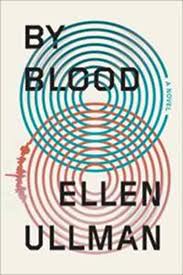
By Blood by Ellen Ullman.  This 2012 novel takes place in San Francisco in the 1970s, narrated by a professor who is on work leave following what, we eventually suss out, was some kind of sex scandal or impropriety (shades of Coetzee’s Disgrace?).  He is deeply depressed and, simply to keep himself sane and to force himself to leave his bedroom, he rents an office to go to every day.  In the office he soon realizes that he can hear the sessions conducted by the psychoanalyst in the room next door.  Our creepy narrator starts listening in and becomes obsessed with one particular patient, a lesbian woman struggling with issues related to her adoption and her heritage.

This is one of those novels that’s super-literary and smart but also has thriller/pulp fiction tendencies. (I noticed it was recommended recently in the NYT Magazine’s “summer reads” feature.)  Complex issues of Jewish/Israeli/ German identity come to the fore in unexpected ways, and to be honest, at times it’s all laid on a bit thick, but it kept me hooked.

Brian Moore, The Lonely Passion of Judith Hearne (the recent NYRB reissue edition).  This 1955 novel was Brian Moore’s first success and was made into an 1987 film starring Maggie Smith and Bob Hoskins that I believe I saw at the time.  Set in 1950s Belfast.  From the NYRB site: “Judith Hearne is an unmarried woman of a certain age who has come down in society. She has few skills and is full of the prejudices and pieties of her genteel Belfast upbringing. But Judith has a secret life. And she is just one heartbreak away from revealing it to the world.”  The novel is, in part, about alcoholism, and about Catholicism at this period in Ireland.  Great novel, kind of devastating.  It’s a very lonely passion…

Chad Harbach’s The Art of Fielding.  This was the/a big literary breakthrough this year.  I think I did not like it quite as much as many others did, but I didn’t regret reading it either and liked/enjoyed various things about it.  I probably just came to it too late in the hype/backlash cycle.

Sara Levine’s Treasure Island!!!  This weird and very funny novel is narrated by a feckless young woman who could, maybe, fit into the world of Lena Dunham’s Girls.  She has a crappy job, mooches off her parents and her long-suffering boyfriend, sister, and friends, and longs for excitement.  A chance reading of Stevenson’s novel sets her off on a misguided quest for “adventure.”  It’s very amusing, sharp and surprising.