David Vann’s “Caribou Island:” Frost-Bound World

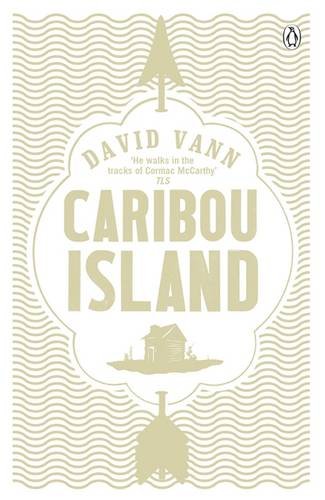
David Vann’s Caribou Island is a pretty intense read.  It’s the story of the disintegration of the marriage of Gary and Irene, who are in their late 50s or so.  They met at Berkeley where Gary was working on a (never-completed) PhD in Medieval Studies; they ended up in Alaska, where, it becomes clear, he has been pursuing some kind of fantasy about the sort of pure, pre-modern/pre-industrial community that he had formerly studied in Icelandic and English epics.  Gary recites lines from the Anglo-Saxon elegy The Seafarer in the woods — “frost-bound world/ hail fell on earth/ coldest of grains” — and obviously sees himself as some kind of modern Seafarer.  Gary has now decided they must move from the mainland to a deserted island where they will live in a simple wood cabin that Gary, with no training and having not even consulted a manual, will build by hand as the early Alaskan winter closes in.  Irene is sure Gary will leave her if she resists, so she goes along with it, sometimes complaining bitterly.

The level of bitter marital invective and bile is quite high, e.g. “Fuck you;” “You think you deserved someone better than me;” “Maybe I did.”  “Why not punch me in the face?”  And — this an especially memorable one — “You’ve destroyed my life, you fuck.” Gary and Irene’s grim spiral is intercut with the experiences of their sympathetic daughter Rhoda, who works as a veterinary assistant, and her awful dentist husband Jim and the young campground tourist he picks up and has an affair with.  The novel is somewhat odd, tonally.  Without giving too much away, it goes to some very bleak places, but it can also be mordantly amusing.  Much of the novel dwells on the landscape, the woods, the freezing water, and Gary and Irene’s desperate attempts to make their way through this beautiful but indifferent and overwhelming nature and to make a home in it.  (Vann is great on the claustrophobia of nature, the feeling of huddling in a plastic tent or a badly-constructed wood cabin and feeling the woods and weather pressing down at you.)  But there’s also social comedy in the depiction of the Alaska town with its bourgeois, hippies, tourists, druggies, wilderness freaks, etc., which feels sociologically accurate and sharply observed (Vann grew up in Alaska).

The novel made me think of Coetzee’s Disgrace occasionally in, again, its willingness to go all the way to extreme limit cases and to think about experiences of something like “bare life,” human beings pushed to a state of some kind of brute destitution: “Why did everything have to be taken?… All gone.  What was left?” Rhoda’s work as a vet’s assistant also made me think about Disgrace‘s David Lurie and his work incinerating the dogs killed at the pound; and both novels bear the influence of pre-20th-c English literature, albeit of different eras (the medieval epics here, Romantic poetry in Coetzee).

There were a couple moments when the implicit metaphor of the doomed cabin as a figure for Irene and Gary’s marriage threatened to become too explicit. “Maybe you can nail each layer down into the next, Irene said.  With longer nails.  That might bring them [the boards] closer together.  And she was thinking this was a kind of metaphor, that if they could take their previous selves and nail them together, get who they were five years ago and twenty-five years ago to fit closer together, maybe they’d have a sense of something solid.”  But, they’re literary people, he a former English PhD student, she a school teacher, and people who read a lot do think about metaphors in their lives in this way, so I decided this was OK.

I listened to the interview with Vann on WKCR’s Bookworm in which Vann discusses his father’s suicide (when Vann was 13) and the several other suicides within his recent family history.  I think he said that his step-mother’s mother shot herself while on the phone with his step-mother; or wait, was that his father’s suicide?  Too many.  Vann comes off as a pretty cheerful and funny guy, not grim at all in manner, although he says that he spent much of his early adult life consumed by a sense of “doom” that he would reenact his father’s experience. Bookworm‘s host Michael Silverblatt was somewhat relentless in pressing some of the implications, for Vann, of writing about these experiences (his previous work of fiction, Legend of a Suicide, was based directly on Vann’s own experience with his father).  Silverblatt said something like, “I can see how writing about this could be therapeutic, but on the other hand, did you ever worry that in doing so, you would bring yourself closer to enacting these tragedies yourself?”  Vann sort of laughed and said that he did think about that although no one has ever put it “quite so directly.” 
Hanif Kureishi on the Kama Sutra

Hanif Kureishi on the Kama Sutra in the Guardian, great piece!

It suggests that the gentleman should keep away from lepers, malodorous women and anyone with white spots. It is arch, comical and amazing – less Byron and more the sort of thing that Jeeves would have said to a priapic Bertie Wooster had Bertie been Indian and PG Wodehouse without the sense to omit sex from his books. It states, for example, that “intercourse with two women who have good feelings for each other is known as the ‘combination’. The same with many women is called ‘the herd of cows’.”… If it turned out that the woman was also consulting a similar manual then the two characters in this drama would be playing roles that would ensure they’d remain outside the experience. Both would be in a fixed place and the relationship would merely be an exchange of fantasies….Like Alfred Kinsey’s reports at the end of the 1940s and early 50s, the Kama Sutra tries hard to turn passion into science.

A genuinely useful self-help guide to bearing pleasure might have to contain advice about putting up with the envy, contempt and hatred of oneself as well as of others, along with any self-disgust, guilt and punishment that may follow. It would be an education in determination and ruthlessness and, to a certain extent, in selfishness and in forgetting….It might be important to recognise that our pleasures have to be guarded from our own aggression, much as our freedoms are.

Newspaper Obituaries/ Tom Rachman’s *The Imperfectionists*

Sometime over the last few years I started to appreciate the New York Times‘ obituaries for the first time.  I started reading parts of the NYT at a pretty young age but I don’t know that I ever made it through an obituary in my youth, unless perhaps for someone like John Lennon.  My new interest in the genre must have had something to do with getting older myself, although I have to say that I think it’s less about that or anything morbid than appreciating the obituary as a concentrated little life narrative.  I’ve never done this, but I’ve considered bringing in some examples to a class, perhaps with wedding announcements, as a way to think about life narratives and their conventions and forms.  The NYT ones are usually little gems, filled with surprises, twists, and wonderfully vivid and odd details.

Today has an especially good collection.  (Or at least, these are the ones in my Sunday paper — of course now the concept of “today’s paper” is mutable.)  The longest one is of Poppa Neutrino, “an itinerant philosopher, adventurer and environmentalist… who founded his own church, crossed the Atlantic on a raft made from scrap and invented a theoretically unstoppable football strategy.”  He invented “the Neutrino Clock Offense, a system of secret hand signals, based on the face of a clock, designed to let passer and receiver communicate while a play is in progress. Despite his best efforts, Mr. Pearlman was unable to persuade any college football teams to adopt it.”

Also on the page are Eleanor Galenson, a psychoanalyst who revised Freud’s accounts of the origins of sexual identity and concluded “that children make the discovery of genital difference between the ages of 15 to 19 months, and that this has an impact on their play, their relationship with their own bodies, their relationship with their parents.” Also Bernd Eichinger, screenwriter and producer of many films including the Hitler film Downfall, criticized by Wim Wenders for generating a “kind of benevolent understanding” of the Nazi leaders by virtue of seeing the world through their perspective.  (Maybe a missed opportunity here: why no mention of the Downfall internet meme?)

And finally — in some ways this is my favorite kind of obituary, a mini-biography of someone one is guaranteed never to have heard of before — an account of the life of Milton M. Levine, who made his fortune on “Uncle Milton’s Ant Farm,” over 20 million of which have been sold since he invented it in 1956, inspired by the red ants at a July 4th picnic.  The obit concludes, “I found out [the ants’] most amazing feat yet… They put three kids through college.”

There’s a neat story or section in Tom Rachman’s excellent novel The Imperfectionists about the writing of an obituary.  This novel revolves around a broad cast of characters who worked at various times, from the 1950s through the present, for an English-language newspaper in Rome; Rachman worked at the International Herald Tribune so I presume that’s the model, although the novel’s paper seems maybe like a more second-rate version of the IHT?  The book reminded me a little of Jennifer Egan’s A Visit From the Goon Squad in its revolving/expansive/overlapping cast of characters.  It’s not as innovative as Egan in its use of this structure, however, perhaps a bit more like Winesburg, Ohio or (a more recent example) Olive Kitteridge.

The novel has a bit about a journalist with a flagging career who’s been assigned to do “preparedness” for an obituary of a forgotten Austrian feminist of the 1960s and 70s: “preparedness” meaning the research a paper does ahead of time for a potential subject of an obituary.  A potentially awkward situation, of course:

[N]othing is worse than obit interviews.  He must never disclose to his subjects why he’s researching because they tend to become distressed.  So he claims to be working on ‘a profile.’  He draws out the moribund interviewee, confirms the facts he needs, then sits there, pretending to jot notes, stewing in guilt, remarking, ‘Extraordinary!’ and ‘Did you really!’  All the while, he knows how little will make it into print — decades of a person’s life condensed into a few paragraphs, with a final resting place at the bottom of page nine, between Puzzle-Wuzzle and World Weather.

I won’t give away how it turns out, but the experience is surprising in various ways.

The novel is a valedictory love letter to print journalism and simply to print itself in its pre-internet forms.  This passing detail from the final chapter, about one of the book’s more peripheral characters, nicely captures that mourning and the sense that from our perspective, 1950-2000 or so feels like an era, an era of print’s gradual decline, not understood until close to the end:

Winston Chang, after a period of sleeping in his parents’ basement, found work at an exotic-animal refuge in Minnesota.  He adored the job overall but disliked lining the monkey cages with newspaper — even the sight of headlines made him panicky these days.  However, this was not to bother him for long: the local paper folded, and he switched to sawdust.  Soon, even the monkeys forgot the comforts of newspaper.

NYRB Classics remainders at Harvard Book Store

Other than the four pairs of pants at Banana Republic for $105, my main Xmas shopping in Cambridge involved remaindered NYRB Classics editions in the basement of the Harvard Book Store.  They must have 30 or so titles down there, mostly for $5.99, some a dollar more.  I love these editions and find them very seductive: the packaging’s great, cool introductions by interesting authors, and you feel that you can take a chance and are likely to find something good.

These are the ones I got (on three different trips, I kept adding more):

  • The Cost of Living by Mavis Gallant (two copies, one a gift)
  • The Diary of a Rapist by Evan S. Connell
  • The Dud Avocado by Elaine Dundy (a gift for my aunt)
  • The Go-Between by L. P. Hartley
  • Monsieur Monde Vanishes by Georges Simenon
  • The Strangers in the House by Georges Simenon
  • The Summer Book by Tove Jansson
  • The Moon and the Bonfires by Cesare Pavese
  • Rogue Male by Geoffrey Household

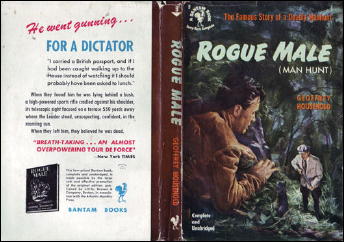
So far of these I’ve read Rogue Male, a 1939 British thriller somewhat along the lines of The 39 Steps, made into a 1941 Fritz Lang film called Man Hunt.  It’s pretty great, kind of a cross between Sherlock Holmes and James Bond.  The narrator is a British man of honor & means who, for somewhat mysterious reasons, has gone off on his own on a quixotic attempt to assassinate a foreign dictator (presumably Hitler).  He’s captured, beaten and left for dead but somehow manages to escape.  Back in England, the operatives of the foreign state cannot afford to allow him to live.  The ensuing manhunt culminates in our hero hiding like a badger in a secret little den he’s constructed in the woods in Dorset.  A minor slip-up puts one of the operatives on his tail and he ends up seemingly trapped in his den.  Interesting things going on with animals and animality; he hunts the dictator like a big-game hunter, and then in turn he is like an animal in his lair, he reverts to his animal instincts, of course; his only friend is a feral cat; and, in a bizarre turn of the plot I won’t fully give away, he uses the body of an animal as a weapon in a ingenious way.

At some level I feel this novel has a family resemblance with something like the Wind in the Willows in its romanticizing of a wild rural England and the snugness of a little hideaway where one can hide away from prying eyes…

Holiday reading: “the Leopard;” Soup or Macaroni?

I finally got around to reading this, my copy of which (not this edition!) I think I picked up at the last-day MLA book exhibit firesale a year or two ago.

The Leopard‘s author Giueseppe di Lampedusa died in 1957 at age 60 having failed to find a publisher for this, his first and only novel, based on the experiences of his great-grandfather, a Sicilian aristocrat going through the Italian unification (Risorgimento) of a century earlier.

I found it really amazing.  A very beautiful and sensual novel, amazing at the sentence level, developing a tension-filled sense of a way of life about to collapse.  Also very ironically funny.  And fascinating as a historical novel and an experiment in evoking a vanished way of life.

This was one of my favorite passages.  The Prince is serving a feast to some of his family and neighbors who are initially concerned that he might begin the meal with soup:

The Prince was too experienced to offer Sicilian guests, in a town of the interior, a dinner beginning with soup, and he infringed the rules of haute cuisine all the more readily as he disliked it himself.  But rumors of the barbaric foreign usage of serving insipid liquid as first course had reached the major citizens of Donnafugata too insistently for them not to quiver with a a slight residue of alarm at the start of a solemn dinner like this.  So when they lackeys in green, gold, and powder entered, each holding a great silver dish containing a towering mound of macaroni, only for the twenty at table avoided showing their pleased surprise: the Prince and Princess from foreknowledge, Angelica from affectation, and Concetta from lack of appetite.  All the others, including Tancredi, showed their relief in various ways, from the fluty and ecstatic grunts of the notary to the sharp squeak of Francesco Paolo.  But a threatening circular stare from the host soon stifled these improper demonstrations.

Good manners apart, though, the appearance of these monumental dishes of macaroni was worthy of the quivers of admiration they evoked.  The burnished gold of the crusts, the fragrance of sugar and cinnamon they exuded, were but preludes to the delights released from the interior when the knife broke the crust; first came a mist laden with aromas, then chicken livers, hard-boiled eggs, sliced ham, chicken, and truffles in masses of piping hot, glistening macaroni, to which the meat juice gave an exquisite hue of suede.

…Tancredi, in an attempt to link gallantry and greed, tried to imagine himself tasting, in the aromatic forkfuls, the kisses of his neighbor Angelica, but he realized at once that the experiment was disgusting and suspended it, with a mental reservation about reviving this fantasy with the pudding.

Brilliant!  Maybe I especially enjoyed this passage in this holiday season of gorging ourselves on feasts — none unfortunately of this kind of macaroni.

The soup vs. macaroni dilemma is a nice minor example of the kind of tension that suffuses the novel more broadly in its superb evocation of a culture in crisis and about to undergo a profound transformation, with much more at stake than the contents of the first course primo.  This is interesting: “After the Lampedusa palace was bombed and pillaged by Allied forces in World War II, Tomasi sank into a lengthy depression, and began to write Il Gattopardo as a way to combat it” (wiki): the novel was a memorial, then, of a way of life and its material embodiment the palace, constructed after its destruction.  This illuminates maybe the novel’s most amazing scene, when Tancredi and Angelica wander through the palace, besotted with mostly-suppressed desire, exploring lost corners and passageways of the palace and uncovering, among other things, a hidden repository of remnants of the “obscure pleasures,” “bizarre extravagances,” “sleeping embryos” of a pre-nineteenth-century erotic life that has been put away into storage: little whips and other accoutrements of an 18th-century predecessor’s secret boudoir. “Tancredi was afraid, also of himself; he realized he had arrived at the secret nucleus, the center from which all the carnal agitation with the palace radiated outward.”  Di Lampedusa wrote this novel after his family’s palace had been bombed and its layers of history, containing these secret histories of desire, had been revealed and destroyed, so the novel becomes an obsessively-detailed memorial to this inheritance.

I have not seen the Visconti adaptation of the novel since high school or something and don’t really remember it.  (I probably saw it at the Brattle Theater.)  But The Leopard is probably a strong contender for the question, which literary masterpiece’s adaptation is itself a stand-alone masterpiece?

By the way, the recent movie I Am Love would be another possible cinematic accompaniment to The Leopard –something to watch after a great Italian meal.

Secret Historian – Samuel Steward

I had the pleasure yesterday of participating in a small seminar-style conversation/presentation at the Kinsey Institute by Justin Spring about his new book SECRET HISTORIAN: The Life and Times of Samuel Steward, Professor, Tattoo Artist, and Sexual Renegade (named a National Book Award finalist last week).  The presentation, basically a powerpoint slide show narrated by Spring, was completely fascinating.

As the NYT review explains,

Somewhere in the United States, there may be an attic containing the written remnants of a previously unchronicled 20th-century life that was even more astonishing than the one the writer Justin Spring discovered in San Francisco a few years ago. But even the most skeptical reader of his new book, “Secret Historian,” will have to admit that the bar is now set high. Samuel Steward, the subject of this absorbing act of biographical excavation, had many identities, including several that the subtitle of the book omits: pioneering sex researcher, collector of celebrity conquests, drug addict, masochist, Catholic (briefly), Navy enlistee (even more briefly), conquistador of vast provinces of America’s pre-Stonewall homosexual subculture. Most fortuitously, he was apparently a graphomaniac who documented his long, dark, exuberant, sad, dangerous life in journals, an unpublished memoir, reams of letters, poems, erotica, semifictionalized short stories and even a 746-entry card catalog of his sexual history, scrupulously maintained over five decades and in some cases ornamented — perhaps for future biographers? — with what Spring decorously calls “DNA-verifiable” evidence of his liaisons.

I’d just been talking about Roland Barthes’ “The Death of the Author” and Michel Foucault’s “What is an Author?” with students and so was thinking about Steward through that lens.  The book seems especially fascinating as a reflection on the category of the “biographical subject.”  Steward has so many identities and aliases, most of them involving one form or another of writing, recording, archiving.  He was a literary novelist, and later an author of gay erotica and porn under the name Phil Andros.  He was a well-liked English professor who became close friend and correspondent with Gertrude Stein and other literary luminaries.  He was a tattoo artist — Phil Sparrow — who for a time was the Hells’ Angels’ primary tattooist in the Bay Area.  And he was a self-archivist-qua-sex researcher whose “Stud File” held scrupulous notes on all 750-odd of his sexual partners.

So, what’s the “work”?  Seward is a poignant, even tragic figure towards the end of his life: an alcoholic hoarder living in squalor, he felt his writing had never been fully appreciated.  But now, of course, those aspects of his life that in another era would have seemed most disreputable, bizarre, or even unmentionable — i.e. the keeping of the Stud File, which sometimes included pubic hair and other physical specimens — can now be seen as part of a brave determination to create a detailed history of mid-20th-century gay life.  Thus “secret historian” as the primary titular identity.

Spring commented that Steward’s various aliases means that he (Spring) is pretty sure there are still a lot of caches of undiscovered material out there, in the Kinsey or elsewhere, under one name or another.

It was fun to learn about this in the Kinsey seminar room, as the Kinsey itself plays a big role in Steward’s life; he became a source for Alfred Kinsey, who encouraged Steward in his self-documentation.  Spring had some tricky negotiations with the Kinsey about privacy issues, as there are a lot of 80-year old former sailors out there who figure in Steward’s stud file, journals, and photographs.  And of course the Kinsey’s ability to collect archives depends, I presume, on being irreproachable as a repository of secrets.  The presentation was making me think about the status and operation of these personal sexual “archives” and the rules and procedures involved in their creation, documentation, and scholarly availability.  I’d guess that all of these procedures are in flux these days as attitudes shift, and perhaps also as an institution like the Kinsey has greater competition among archives interested in such material.

The photographs are pretty amazing.  Spring showed us most or all of those in the book, plus some others.  One showed a “daisy chain” orgy of sailors at a sex party in Steward’s Chicago apartment.  Spring commented wryly that FSG’s legal department was OK with publishing any dirty images “as long as no erect penises were visible,” so this one made the cut.  There are also a lot of weird and imaginative erotic images, such as one of Steward on his knees performing fallatio on a phantasmagoric, inscribed male figure sketched with light on a Polaroid image.

I would have liked to have seen more of Steward’s actual tattoo art, which was a perfect fit for him in the way tattooing allowed him at once to write, create images, and enter into physical relationships with a stream of young men.  (Although he says he only slept with one Hell’s Angel customer and “did not care to repeat it”).

D’Aulaires Book of Greek Myths

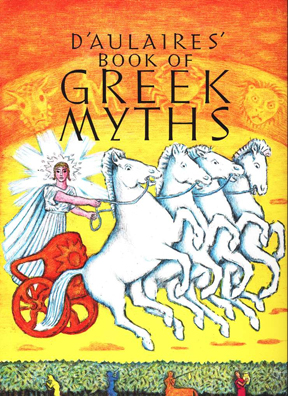
The girls have been very into the D’Aulaires Book of Greek Myths, which Sarah got out of the library in hardback duplicate.  A little greedy, maybe, but the girls were so excited about it initially that they each wanted a copy to read in bed.  We’ve read through the whole thing and now at bedtime they’re taking turns each selecting a favorite story or two to read again.  Great, gruesome stuff.  Last night I read about Cronus devouring each of his first five children (Poseidon, Hades, Hera, Demeter and Hestia) out of fear they would overthrow him.  You can see the little babies glowing in his stomach — the drawings are wonderful, rather light and playful, sometimes with a touch of William Blake Songs of Innocence about them.  Cronus’s wife Rhea then tricks him and gives him a rock swaddled in baby blankets, and so the infant Zeus survives.  I think the girls relate to the Greek gods in their playfulness, tricks and plots, and perhaps also the occasional rage and fury.  They especially love the story of the baby Hermes tricking his big brother Apollo by stealing Apollo’s cows.  We all found the image of Apollo chasing him, while Hermes calls out “I’m just an innocent little babe!” or some such, hilarious.  They also especially liked the illustration of Pandora releasing the demons & imps from her box.  Very relatable for a 6-year-old.

I remember reading this book as a kid as well.  The D’Aulaires do a great job of making the stories accessible and appropriate for childen without bowdlerizing to excess.

I wonder how many Classicists were turned on to Greek mythology from it?

More Nordic thrillers

I thought I’d recommend a couple Nordic mystery series that I’ve enjoyed lately (we’ve — Sarah has read them all too).

The one I’m most excited about is the Swedish trilogy (so far?) by Asa Larsson (no relation to Stieg).  These are Sun Storm, The Blood Spilt, and The Black Path, all featuring as protagonist a troubled young lawyer named Rebecca Martinsson.  In the first novel we learn that although Martissson is working at a fancy law firm in the city, she grew up in the rural far North of Sweden where she was involved in some way with a fundamentalist Christian church.  When the pastor of this church is found brutally murdered, she returns home and gets sucked into the investigation.  Actually, I think the series takes an uptick in quality after this first one; I liked Sun Storm but thought both The Blood Spilt and The Black Path were really impressive.  I hate to invoke this invidious concept, but the latter two in the series seem to transcend the procedural genre, achieving the qualities of really good, complex literary fiction, with a range of highly individualized, distinct consciousnesses all represented precisely and evocatively.  However, it’s worth starting at the beginning with Sun Storm.

The novels have some things in common with Henning Mankell and, yes, with Stieg Larsson.  They don’t have the Tom Clancy-ish, pulpy qualities of Stieg’s — they’re pretty sober and measured in tone with no techo-thriller flourishes — but they are similarly obsessed with misogyny and male institutional/structural domination of women.  And while the “feminism” of the Stieg Larsson series is sometimes challenged on the grounds that his novels wallow in depictions of violence against women, these Asa Larsson books are certainly deeply female and I think feminist in approach.  Sarah remarked on how good they are on parenting and motherhood — subtle depictions of the complicated emotions involved in raising young kids (especially in relation to one very appealing policewoman).

The other series is Arnaldur Indriðason’s Icelandic novelsI wrote about Jar City and Arctic Chill a while ago and just read Voices, the third in this series featuring detective Erlendur Sveinsson.  OK, a Wikipedia check revealed that there are actually TEN in the series and that I’ve read them slightly out of order.  The one I just read, Voices, actually belongs after Jar City and Silence of the Grave (which I’ve also read) but before Arctic Chill.  Anyhoo, these are all excellent, pretty straight-forward procedurals in the Mankell style.  Erlendur is a lot like Kurt Wallender and the novels, like Mankell’s, expose the seamy underbelly of a Nordic society adapting to new forms of immigration, diversity, and associated stresses and pathologies.  Indriðason is particularly obsessed with child abuse and other issues related to children and parents.  Voices takes place in and around a Reykjavik hotel where the longtime handyman/doorman is found stabbed to death in his Christmas Santa Claus outfit.  We soon discover, of course, that the murdered man has an interesting past — he was once a famous child-prodigy choirboy whose rare recordings are now valuable.  Erlendur and his colleagues delve into the mystery while dealing with the usual family pressures of Christmastime (Erlendur is trying to reconcile with his drug-addict daughter).

Anyway — good reads.  If you liked Stieg Larsson they’re worth a try, and in fact if you didn’t like Stieg you might like these as they’re a bit more “literary” and restrained in style, lacking some of Stieg’s pulp-fiction, Ian Fleming-esque excesses (no giant Russian thugs impervious to pain, etc.)

Scott Pilgrim vs. Junior Brown

Damn it, I just wasted too much time trying to create a Venn diagram for this post.  Easy to make one but I couldn’t embed it; I give up.  The failed diagram was my attempt at a graphic representation of my unusually active Friday night, when Sarah and I and our friend Leah went to see Scott Pilgrim vs. the World and then I peeled off from the tired ladies to see Junior Brown performing downtown.

The Venn diagram represented the small overlap between the youthful “Emerging Adults” at Scott Pilgrim (one circle) and the mostly 50/60-ish Hoosier country music fans of Junior Brown (second circle).  The little sliver of overlap between the two circles may only have been only me on this particularly evening: 40ish aging hipsters/ incipient geezers.

If you don’t know, Scott Pilgrim is the film version of a graphic novel series depicting the adventures of young Toronto indie-rock 20-somethings in pseudo-Manga (e.g. Japanese comic) style.  I got the first book or two several years ago and didn’t keep buying it the series, but it’s very witty and fun.  The charm is partly in the casual way the inbred, gossipy, wise-cracking, media-saturated world of these arty hipsters blends into video-game and sci-fi tropes and events (Scott for some reason must battle to the death the seven evil exes of his new girlfriend Ramona).   Probably inevitably, the movie somewhat pumps up the Mortal Combat-esque battle scenes which end up taking over the movie a bit too much.  But it’s all very funny and well done.  One highlight was Scott’s battle with Romana’s ex who possesses the unstoppable force of Vegan power: “we’re just better than non-vegans,” he observes (or some such).  He cannot be defeated, it would seem, until Scott tricks him into accidentally drinking some coffee with half-and-half in it, at which the Vegan Police show up and haul him away.  Michael Cera was not exactly how I imagined Scott, but he was good in his own wimpy way.

From a head-spinningly different universe is Western Swing legend Junior Brown, is actually an Indiana native (which I’d never known) who’s been an Austin fixture for years.  When we visited George in Austin in 1996 or something he took us to see Brown at his then-weekly (I think) show at some cool outdoor restaurant venue.  On Friday night he came out a bit late — someone I ran into there told me this is generally the case b/c Brown is busy smoking his famously excellent pre-show weed backstage.  He is perhaps best known for having invented what he calls his guit-steel, a two-necked guitar.  He’s a virtuoso and many of the songs — mostly country/ Western Swing, with some surf and Hawaiian steel excursions — are designed to allow him to show off his impressive skills.

Although it was a challenge to find any common ground between the world of Scott Pilgrim and Junior Brown, my ever-busy relations-seeking mind led me to imagine JB battling the Katayanagi Brothers (a Japanese synth rock duo) in one of the battles-of-the-bands from the movie.  He’s definitely stand a decent chance, especially with the power of the guit-steel’s double neck, one available to vie with each evil brother.

Soso a.k.a. Osip a.k.a. Koba a.k.a. Pockmarked a.k.a. Stalin

The family story goes that my maternal grandmother’s several brothers (three?) were all killed by Stalin in the purges of the 1930s.  (The family was Latvian.) The only other story I remember about these brothers is that one of them was a devoted collector of birds’ eggs who was once attacked by a hawk while near the top of the tree and barely made it down while fighting off the bird.  I think as a kid in my mind these stories somehow conjoined into one scary Latvian-Gothic image.

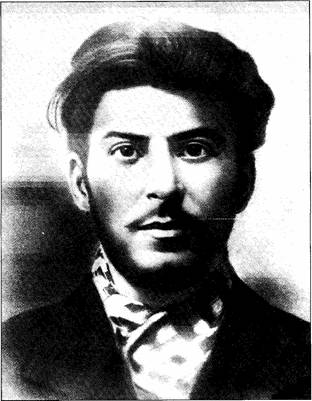
Anyway, I recently read Simon Montefiore’s Young Stalin about the dictator’s youth up to the Revolution in 1917.   The book is a page-turner, sometimes to a fault — as one critical Amazon reviewer put it, it can occasionally read “as if he thinks he competes with Dan Brown (Well, maybe he does?),” in a highly florid, sensationalistic style filled with dramatic reenactments of events from 90 years ago.  It was certainly entertaining to read, though, and based on troves of absolutely new materials from the archives that offer major revisions of our understanding of the man. He was a total thug — basically the guy who’d get things done and who raised funds for the cause via outrageously daring and brutal robberies and hold-ups.  Interestingly, though, he was also something of an intellectual and a poet.  And very much a Georgian before a Russian.

Other aliases used at one time or another by Stalin: K. Safin; The Milkman; The Priest; K. Kato; The Loper.  There’s a whole appendix with a list of about 40 he used in his long years in the revolutionary underworld.

This was one of my favorite passages:

Kamenev gave Stalin The Prince by Machiavelli, perhaps an unwise gift for someone who was already Machiavellian enough.  At a boozy dinner, Kamenev asked everyone around the table to declare their greatest pleasure in life.  Some cited women, others earnestly replied that it was the progress of dialectical materialism towards the workers’ paradise.  Then Stalin answered: “My greatest pleasure is to choose one’s victim, prepare one’s plans minutely, slake an implacable vengeance, and then go to bed.  There’s nothing sweeter in the world.”

He does have a point.