Australian Slang

brokentemple

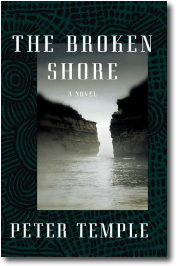
Am almost done with this Australian mystery novel, The Broken Shore by Peter Temple.  It’s very good although to tell the truth, I’ve sometimes had trouble following the plot because of the Australian slang/jargon.  There’s a whole Glossary at the end which is helpful.  Here are some good items:

Quickpick: A lottery ticket that spares the buyer the task of choosing numbers by randomly allocating them.  Anything chosen without much thought or care.  Also a term for someone, not necessarily a prostitute, picked up for sex.

Pommy:  Someone from England.  The English are often known as Pommy bastards.  This has been known to be said affectionately.  The term derives from “pomegranate” as rhyming slang for “immigrant.”

Bludger: Once, a man living off a prostitute’s earnings; now applied to anyone who shirks work, duty or obligation.  A dole bludger is someone who would rather live on unemployment benefits than take a job.

I tried out one of the book’s pieces of slang, not one of the ones about prostitutes, on our Australian friend Catherine, and she immediately recognized it: spaggy bol, “Spaghetti bolognese.  Also called spag bol.  Italian immigrants to Australia were once called spags.

Last Days of David Foster Wallace

Excerpt from Rolling Stone article: The Lost Years & Last Days of David Foster Wallace.

Last night I had some time to kill and went to Borders, ended up reading this whole long article about D.F. Wallace.  It’s very sad — he’d suffered from chronic depression, including hospitalizations, since high school or so.  The suicide itself was far from a surprise; it had followed an earlier attempt, and he was in terrible terrible shape in the final months, trying to adjust to a new medication regime.

This is from a short story he published in an Amherst College literary magazine as an undergraduate:

You are the sickness yourself…. You realize all this…when you look at the black hole and it’s wearing your face. That’s when the Bad Thing just absolutely eats you up, or rather when you just eat yourself up. When you kill yourself. All this business about people committing suicide when they’re “severely depressed;” we say, “Holy cow, we must do something to stop them from killing themselves!” That’s wrong. Because all these people have, you see, by this time already killed themselves, where it really counts…. When they “commit suicide,” they’re just being orderly.

When I heard about his death, aside from sadness, I had a strong feeling of disappointment and of having been cheated of what he would have written in the future.  But this article suggests that his depression was so overwhelming that it was not clear he would have ever been able to emerge from it well enough to write another novel.  (Although perhaps he just never received the proper treatment and it could have been different.)

On a more light-hearted note, the most amusing detail in the article (not in this excerpt) is that he went through an Alanis Morissette obsession in the early 90s (I think) during which he had a huge poster of her on his wall.  This succeeded long Melanie Griffith and (get this) Margaret Thatcher obsessions.

Here’s a NY Times article about a recent service held for Wallace.

Alan Greenspan/ Thomas Gradgrind

Sorry for all the Dickens-related posts, but this amazing scene of Alan Greenspan admitting the failure of his free-market ideology reminds me of Thomas Gradgrind’s anguished confession to his daughter Louisa, whose life he has destroyed with his inhumane utilitarian philosophy:

“I have proved my — my system to myself, and I have rigidly administered it; and I must bear the responsibility of its failures.  I only entreat you to believe, my favorite child, that I have meant to do right.”

Here’s the Ayn Rand acolyte Greenspan admitting to Congress that his ideology didn’t really turn out so well:

Published: October 23, 2008

Facing a firing line of questions from Washington lawmakers, Alan Greenspan, the former Federal Reserve chairman once considered the infallible maestro of the financial system, admitted on Thursday that he “made a mistake” in trusting that free markets could regulate themselves without government oversight….

“I made a mistake in presuming that the self-interests of organizations, specifically banks and others, were such as that they were best capable of protecting their own shareholders and their equity in the firms,” Mr. Greenspan said.

Referring to his free-market ideology, Mr. Greenspan added: “I have found a flaw. I don’t know how significant or permanent it is. But I have been very distressed by that fact.”

Mr. Waxman pressed the former Fed chair to clarify his words. “In other words, you found that your view of the world, your ideology, was not right, it was not working,” Mr. Waxman said.

“Absolutely, precisely,” Mr. Greenspan replied. “You know, that’s precisely the reason I was shocked, because I have been going for 40 years or more with very considerable evidence that it was working exceptionally well.”

English Professors as Therapists

I loved this, from Andrew Solomon’s The Noonday Demon: An Atlas of Depression:

In an important study done in 1979, researchers demonstrated that any form of therapy could be effective if certain criteria were met: that both the therapist and the patient were acting in good faith; that the client believed that the therapist understood the technique; and that the client liked and respected the therapist; and that the therapist had an ability to form understanding relationships.  The experiments chose English professors with this quality of human understanding and found that, on average, the English professors were able to help their patients as much as the professional therapists.

This leaves me with several questions.  Why English professors?  Is this choice intended to be some kind of extreme example that goes to show that any sensitive person, in any random profession, might be able to do as much good as a trained therapist?  (As in, even an English professor.)  Or were English professors presumed to be relatively intuitive and emotionally sensitive to begin with?  I suppose probably the latter, although I wonder if that assumption would be as likely to be made today; in 1979, before the theory and culture wars, the profession may have seemed seemed more “sympathetic” in some respects that it does today.  (See, for example, movies like Smart People.)

Were self-nominations accepted for English professors possessing these “qualities of human understanding”?  Imagining therapy at the hands of certain English profs I’ve known over the years would be a somewhat scary thought.  But much as we dislike it when students try to turn class discussion into group therapy, I kind of like the implication that there could be some hidden therapeutic benefit in our talking cure (not that this is the point of the experiment).

Anyway, Solomon’s book is excellent and quite moving and eye-opening in its descriptions of the devastating effects of chronic/major depression.  It made me feel sad about David Foster Wallace, who apparently had suffered from very serious depression for years prior to his recent suicide.  (Btw, I feel retrospective guilt about my reaction to his very bleak story “The Depressed Person,” which I took to be somewhat cruel in its depiction of a woman whose depression is overwhelming and tedious to her acquaintances; for some reason it did not occur to me that it might be based on his personal experience as a “depressed person.”)

The Little Kitten, Baby Mouse, & Baby Snake

Iris came home with another doozy of a story.

Once upon a time there was a little kitten.  And he found a baby mouse.  And the mouse said, “I live in a farm.  And they make fun of me because they think my body is very small and I’m so small that I can climb up on them.  But I heard them whispering that they’re making a plan.  To make a fire because they think that if they made a fire they would think that I would think that it would be interesting to look up at closer.  And then they think that I would fall into the fire and die.  But I won’t go near it because then I would die but I don’t want to die.  That’s the whole thing I went out the farm.”  And the kitten said, “Then I can help you because I am very strong and scary.  Because I can arch my back and then they might run away.  And if that doesn’t work I could put my claws out and they would probably run away.”  And then the kitten said, “I have an even better idea.  I will put my claws out and arch my back at the same time.”  The end.

Celie’s is much more cheerful and less complicated this time:

One day a little snake went on a trip.  And he found another baby snake.  And the other little baby snake said, “I’m lost and I can’t find my house.  Can you help me?”  “Yes, I can.”  So he took she to her home and they had dinner and breakfast together.  And then they went on a little bike ride.  And then they went to the palace.  And then they went on a trip to the moon.  And then they went to the pet store to get a little puppy.  And then the first little snake said, “I’m bored.  I want to go to my friend bear’s house.  Come on!”  And they went there and bear was there and they had lots of candy.  The end.

The common denominator here is, I guess, the twin theme of companionship and friendship.  For Celie it’s pure fun: sleep-overs, candy, and the care-taking of pets; for Iris it’s banding together in the face of peer bullying, mockery & violence.  But baby animals can protect themselves and their friends by acting bigger than they really are.  If you put your claws out and arch your back, people might think you’re strong and scary even if you’re just a little kitten.  (This is definitely true of Pot Luck.)

An unusual farm and the giraffe’s birthday

The girls came home with these stories they’d narrated to a teacher.  They’re very nicely illustrated as well but I will just transcribe.

Iris:

Once upon a time there was a little goat.  And he lived in a very unusual farm.  Because the farmer and the farmwife didn’t let him make milk.  But one day he got an idea.  He would trick the farmer and wife.  So he hid behind the milk shed.  He poked the farmer and the wife.  And then he trotted off on a walk.  So that the farmer and his wife thought he was gone.  And then he found a little filly and the filly said, “I live on a farm that’s bright red.  And it has roosters, a cow, and my mommy and daddy horses.  So I need someone to help me get back to the farm.”  And the goat said, “And who would that be?”  “That would be someone who’s smart and who has a tail and can pull me along.”  “That would be me, because I’m smart and I have a tail and I know where the farm is.”  And the pony said, “Ok, then I’ll tie my tail to your tail and you start trotting.”  The end.

And Celie’s:

Once upon a time a little giraffe was so excited because it was his birthday today.  And he had a cake ready and all his friends were there.  And they played pin-the-tail-on-the-donkey and he won.  And then they played checkers.  And then they played dress-up.  And he was the king.  And his sister was the princess.  And the king said, “Princess, go ask your servant to clean the walls.”  And the servant did it.  Soon the walls were shiny clean.  And the servant said, “I am tried of working like this.”  And she asked the princess and king if she could stop.  And they said, “Well… Okay.”  The End.

All I can say is, wow. I am supposed to be some kind of professional analyst of narrative, but I hardly know where to begin.

Netherland

So, about 4/5 of the way through The Savage Detectives I dropped it (do plan to go back to finish) for Joseph O’Neill’s Netherland, which is kind of the polar opposite of Bolano: where The Savage Detectives is sprawling, wild, passionately raw, and multi-voiced, every small chapter introducing a brand new speaker, sometimes, with his or her own worldview, cadence, & set of references — reminding me of On the Road more than anything — Netherland is a classically realist novel with everything focalized through the precise lens of its almost fussy central consciousness.  O’Neill’s protagonist, Hans van der Broek, is a Dutch banker living in NYC with his British wife and son.  After 9/11 the marriage founders and his wife takes the son back to London on a trial separation, and Hans in his loneliness and disorientation gets involved in a cricket-playing outer-boroughs subculture in which he is usually the only white man.

The novel revolves around Hans’s friendship with Chuck Ramkissoon, a Trinidadian cricket enthusiast and would-be entrepreneur who adds a jolt of ethnic striver/hustler energy to Hans’s rarefied life.  (When Hans drives around Brooklyn with Chuck, who is supposedly assisting him in getting his U.S. driver’s license, I thought of the car service in Jonathan Lethem’s Motherless Brooklyn).  Hans’s comment about his wife — “She has accused me of exoticizing Chuck Ramkissoon,… of perpetuating a white man’s infantilizing elevation of a black man” — serves as a tacit admission that the novel could almost be accused of (a very subtle version of) the same thing, in that Chuck brings a kind of “life” and vitality to an otherwise pallid elite white world.  (The novel made me think of Louis Begley, too, in the glimpse it offers into the higher reaches of NYC professional life.)  But cricket functions in this 9/11 novel as a hopeful model of polyglot globalization.  Cricket is loaded with colonialist legacies, but for both Hans and Chuck, the sport is all about form, ritual, skill, memory, and beauty:

the white-clad ring of infielders, swanning figures on the vast oval, again and again converse in unison toward the batsman and again and again scatter back to their starting points, a repetition of pulmonary rhythm, as if the field breathed through its luminous visitors.

Netherland made me want to go back to CLR James’s Beyond a Boundary.  I still really do not understand how cricket works.

Maine: Reading

My pleasure reading in Maine was mostly occupied by Thomas Mann’s The Magic Mountain, the James Woods translation. I’d never read it, and I like to read a long thick novel in Maine — although the situation is prety different now as a parent of young kids, so I don’t have the endless uninterrupted hours that I used to read War and Peace and Middlemarch in high school. And the Mother West Wind and Freddy the Pig books when younger.

Anyway, I enjoyed it a lot and made my way through it off and on, and then a few nights before we left, I put it down on the front porch with 50 or so pages to go and went off on an outing. While we were away, it rained, and the book got soaked. I tried to dry it in the sun and made some progress, but it was still fairly damp when we left. Finally last night on getting back to Cambridge I used a combination of the microwave and a hair dryer on it. On Matt’s suggestion I tore off the last 75 pages of the book and concentrated on that piece, managing to dry it pretty well.

It’s a good holiday reading book, in a way: sort of about an endless vacation, unbroken leisure to the point of maddening tedium. At this point what may stick most in my mind is the scene where Hans Castorp (why is he always referred to by his full name?) goes skiing and gets lost in a snowstorm. Also his rival in love the amazing Mynheer Peepercorn. And the takings of one’s temperature several times a day and wrapping oneself up in a camel’s-hair sleeping bag for afternoon rest.  And the philosophical musings on time.  It is a strange book and often pretty hilarious. I’d like to read some criticism on the novel — I suppose it must be an allegory of pre-WWI Europe to some degree.

Also have read 2/3 or Orhan Pamuk’s Snow. Turned my attention to that as I waited for Thomas Mann to dry out. Also a strange and funny book with memorable snow as Ka the poet wanders around Kors during a military coup. I also want to read Pamuk’s nonfiction book about Istanbul.

Kathryn Davis’s The Thin Place

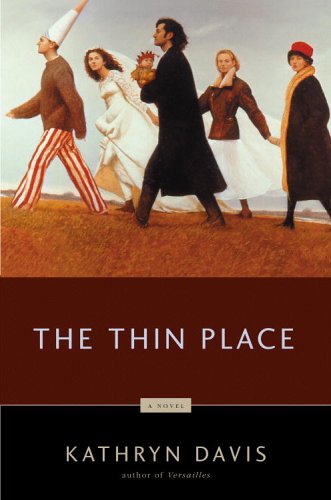
Kathryn Davis’s The Thin Place is a really unusual, enchanting novel. “Everyone prefers to stick with the subject of people” but this novel opens up the characterological range to include several dogs, moose, beavers, a pike, tadpoles, and even lichen. As well as old people, children, and a more usual range of human persons. It has a Virginia Woolf quality in its roving free-indirect-discourse that slips easily in and out of multiple consciousnesses and voices. “So many things are alive: lichen, moss, grass. Also people. So many people are alive and that’s what’s strange, not that things like stones aren’t.” Also, a range of written modes and forms including police logs, newspaper reports, a diary, an astrological report; and working within various time frames and registers including the present day, the late nineteenth century, and the geological or evolutionary time of glaciers and rock. The surprising thing is, though, that the novel does not feel contrived or very “experimental;” it’s involving and funny in its depiction of a New England town during a summer with some odd things happening; you could almost imagine it as an Oprah pick. Maybe it was Davis’s half-hearted attempt at selling out and writing a popular book — if so, I hope it worked.

It’s especially good on “the minds of twelve year-old girls,” filled with “human sacrifices, cockeyed sexual adventures both sadistic and masochistic, also kitties with balls of yarn… and disembowelings.”

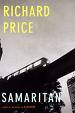
Richard Price’s Samaritan

Richard Price is the author of Clockers and has also written film scripts (e.g. The Color of Money) and episodes for the Wire. I was going to check out his much-praised new one, Lush Life, but in the NY Review of Books Michael Chabon said that it was a slight let-down after Samaritan (which he calls one of Price’s two masterpieces along with Clockers), so I decided to start there. It has a mystery plot, with an unsolved crime and a policewoman looking into it: the sometime t.v. writer, former cokehead cab-driver Ray Mitchell lies in a hospital bed, floating in and out of consciousness. When he’s conscious, he won’t say who bashed in his head, although he seems to have at least some idea. The plot develops in two temporal strands, one leading to the act of violence, the other one a couple months later following the investigation, mostly at the hands of Nerese Ammons, a pudgy African-American cop who used to go to school in a tough neighborhood in New Jersey with Ray (who is white).

I won’t explain the plot in detail, but the novel plays out its epigraph: ”When thou doest thine alms, do not sound a trumpet before thee, as the hypocrites do in the synagogues and in the streets, that they may have glory of men.” It’s all about white guilt, privilege and shame in the face of the lack of opportunity, violence, and hopelessness in the inner city. (Although note that one of the quotations below questions how fundamental race is to the dynamic.) Ray has a few hundred thousand dollars left over from a stint writing for a t.v. show about an inner-city highschool much like the one he attended. The story begins with Ray’s impulsive act of generosity in giving an old neighborhood acquaintance several thousand dollars to pay for the funeral of her son, an O.D. From there we begin to realize that Ray has a compulsion to be a samaritan, to give away money, to try to help the needy people around him, and that this compulsion has all kinds of unresolved baggage, about which he is only partly self-aware. I saw that Michiko Kakutani criticized the novel as overly-schematic and insistent in this theme, but I found it compelling, Ray’s out-of-control desire to use his wealth to “console” and heal and to absolve him of all kinds of guilt and bad feeling with origins that are both personal/ psychological and sociological/structural. And perhaps to get “glory” for his “alms.” I’d guess that there’s at least something autobiographical in the novel’s representation of a former-addict t.v. writer who has become (relatively) rich and famous through gritty portrayals of the disenfranchised, an implicitly/potentially exploitative situation that leaves him confused and guilty.

Price is really great at dialogue, at delineating character with concise details, and at immersing the reader in a vivid consciousness: here, mostly Ray’s but also Nerese’s. The book has the form of a mystery novel but is much less about the plot than psychology and sociology. It’s hard to think of too many other contemporary fictions aside from the Wire and novels by George Pelacanos (who also writes for the Wire) that are this good and sharp in the depiction of race & class and interracial friendship and relationships. I was going to say “this good and comfortable” but of course “comfortable” is not quite the right word for Price’s depiction of race.

“Ray felt it lurch to life in him, the slightly suspect desire to give, to do, and attempted to police it, convert it into mere words of advice”(181).

This is Nerese, the cop: “the constant black-white casting made her uncomfortable — no, made her angry; but that anger was tempered by the intuition that this compulsion in him wasn’t really about race; that the element of race, the chronic hard times and neediness of poor blacks and Latinos was primarily a convenience here, the schools and housing projects of Dempsy and other places like a stocked pond in which he could act out his selfish selflessness over and over whenever and wherever the opportunity presented itself, and that he was so driven by this need, so swept away by it, that he would heedlessly, helplessly risk his life to see it played out each and every time”(215).

“the all too familiar urge to give something… something, some gift” (315); “Ray found himself burning with the desire to give this kid something both enduring and in some way consoling”(335)

The novel could be interesting to think about in a longer historical framework, considering the racial and class dynamics of charity, benevolence, and “gratitude.” (See Don Quixote’s book on the latter.) Nick Hornby’s How to be Good is definitely schematic and not really a great novel but is also kind of interesting on these issues.