Holiday reading: “the Leopard;” Soup or Macaroni?

I finally got around to reading this, my copy of which (not this edition!) I think I picked up at the last-day MLA book exhibit firesale a year or two ago.

The Leopard‘s author Giueseppe di Lampedusa died in 1957 at age 60 having failed to find a publisher for this, his first and only novel, based on the experiences of his great-grandfather, a Sicilian aristocrat going through the Italian unification (Risorgimento) of a century earlier.

I found it really amazing.  A very beautiful and sensual novel, amazing at the sentence level, developing a tension-filled sense of a way of life about to collapse.  Also very ironically funny.  And fascinating as a historical novel and an experiment in evoking a vanished way of life.

This was one of my favorite passages.  The Prince is serving a feast to some of his family and neighbors who are initially concerned that he might begin the meal with soup:

The Prince was too experienced to offer Sicilian guests, in a town of the interior, a dinner beginning with soup, and he infringed the rules of haute cuisine all the more readily as he disliked it himself.  But rumors of the barbaric foreign usage of serving insipid liquid as first course had reached the major citizens of Donnafugata too insistently for them not to quiver with a a slight residue of alarm at the start of a solemn dinner like this.  So when they lackeys in green, gold, and powder entered, each holding a great silver dish containing a towering mound of macaroni, only for the twenty at table avoided showing their pleased surprise: the Prince and Princess from foreknowledge, Angelica from affectation, and Concetta from lack of appetite.  All the others, including Tancredi, showed their relief in various ways, from the fluty and ecstatic grunts of the notary to the sharp squeak of Francesco Paolo.  But a threatening circular stare from the host soon stifled these improper demonstrations.

Good manners apart, though, the appearance of these monumental dishes of macaroni was worthy of the quivers of admiration they evoked.  The burnished gold of the crusts, the fragrance of sugar and cinnamon they exuded, were but preludes to the delights released from the interior when the knife broke the crust; first came a mist laden with aromas, then chicken livers, hard-boiled eggs, sliced ham, chicken, and truffles in masses of piping hot, glistening macaroni, to which the meat juice gave an exquisite hue of suede.

…Tancredi, in an attempt to link gallantry and greed, tried to imagine himself tasting, in the aromatic forkfuls, the kisses of his neighbor Angelica, but he realized at once that the experiment was disgusting and suspended it, with a mental reservation about reviving this fantasy with the pudding.

Brilliant!  Maybe I especially enjoyed this passage in this holiday season of gorging ourselves on feasts — none unfortunately of this kind of macaroni.

The soup vs. macaroni dilemma is a nice minor example of the kind of tension that suffuses the novel more broadly in its superb evocation of a culture in crisis and about to undergo a profound transformation, with much more at stake than the contents of the first course primo.  This is interesting: “After the Lampedusa palace was bombed and pillaged by Allied forces in World War II, Tomasi sank into a lengthy depression, and began to write Il Gattopardo as a way to combat it” (wiki): the novel was a memorial, then, of a way of life and its material embodiment the palace, constructed after its destruction.  This illuminates maybe the novel’s most amazing scene, when Tancredi and Angelica wander through the palace, besotted with mostly-suppressed desire, exploring lost corners and passageways of the palace and uncovering, among other things, a hidden repository of remnants of the “obscure pleasures,” “bizarre extravagances,” “sleeping embryos” of a pre-nineteenth-century erotic life that has been put away into storage: little whips and other accoutrements of an 18th-century predecessor’s secret boudoir. “Tancredi was afraid, also of himself; he realized he had arrived at the secret nucleus, the center from which all the carnal agitation with the palace radiated outward.”  Di Lampedusa wrote this novel after his family’s palace had been bombed and its layers of history, containing these secret histories of desire, had been revealed and destroyed, so the novel becomes an obsessively-detailed memorial to this inheritance.

I have not seen the Visconti adaptation of the novel since high school or something and don’t really remember it.  (I probably saw it at the Brattle Theater.)  But The Leopard is probably a strong contender for the question, which literary masterpiece’s adaptation is itself a stand-alone masterpiece?

By the way, the recent movie I Am Love would be another possible cinematic accompaniment to The Leopard –something to watch after a great Italian meal.

Princess Mononoke, Touchez Pas au Grisbi

Two movies this weekend…

With the kids, Miyazaki’s The Princess Mononoke, which I’d always remembered as his best.  We’d held off for several years on showing it to the girls, making do with My Neighbor Totoro, Koko’s Delivery Service, Ponyo in the theater last year, and, more recently, Spirited Away, the latter of which is closer in spirit to Mononoke.  I actually think Mononoke was after all pretty heavy for young 7-year-olds… it’s an intense movie with a lot of violence, horror, sorrow and rage.  James Cameron ripped it off so heavily for Avatar, Miyazaki should get a tiny cut of the profits (enough to fund several of his movies, probably).  And actually, in practice I felt about it somewhat as I did about Avatar, that the long final Lord of the Rings-esque battle for the soul of nature becomes somewhat enervating, a bit too much.  The first 3/4, though, is sheer brilliance, an amazing, mind-bending, moving merging of Disney animation, Japanese manga, Tolkein, Japanese myth, in the service of pondering modernity’s costs and the possibilities of living in a non-exploitative relationship to nature.  In this world gods and demons are real, often impossible to tell apart, and must be fought, killed, prayed to, thanked and blessed, sometimes in succession.

C&I’s favorite part were the little ghostly forest creatures, I forget what they’re called, the evanescent white specters whose faces spin around like dials or children’s toy rattles.

Touchez Pas au Grisbi.  (a.k.a. something like “Don’t Touch the Loot.”)  This 1954 French noir, a come-back for the at-the-time washed-up Jean Gabin, & one of the early movies of the lovely Jeanne Moreau (she’s the brunette above).  This is really great… obviously heavily influenced by American gangster movies, but v. French with wonderful cinematography capturing shadowy early 1950’s Paris.  Gabin plays an aging gangster Max who has made what he hopes is the final big score — 20 pounds of gold from the Orly airport, we never learn much more about the heist — which will now allow him to retire.  My favorite scene is the one where Max brings his somewhat hapless buddy Riton, whom he calls Porcupine Head, to his secret apartment to hide out for a night (some goons are after him).  Max lays out the bedding, fluffs the pillow, gives Riton a pair of neatly folded p.j.s, but only after sitting down for some white wine and biscuits with pate.  It’s so charmingly French… they take the meal very seriously.  (There’s a lot of talk about food; Max explains at one point that if he and Riton stick around for their girlfriends’ burlesque show, they’ll have to stay up past midnight, and then take the girls out for onion soup and then sex — he’s way too sleepy for any of this.)  When Max brings out the p.j.s, I half-expected him to toss Riton a teddy bear too: it’s a very cozy little hideout. The bond between Max and Riton goes far deeper than any erotic link between the gangsters and the flighty molls; the dames are always enjoining them to stay up too late and run around town for onion soup, when they’d much rather be making a snack alone together in their p.j.s…

Best bit from the DVD extras: the guy who plays one of the young gangster associates of Max and Riton explains that he was filming Grisbi outside Paris at night and some other movie during the daytime, I forget where, but he had to take a flight back and forth.  The director pointed out to him that there was no way he could keep up this schedule for 10 days, but he responded that he was already in the scene, what else could they do?  So they added in a scene where inexplicably, Max stops the car and pushes him out to the side of the road, whereupon he kicks the dirt angrily.  The actor points out that there was absolutely no point to or explanation for this, it was just an expedient to get him out of the scene so he could get some sleep.

Family Movie Night: “The Thief of Bagdad”


1940 British Arabian Nights fantasy film produced by Michael Korda, directed by Michael Powell and others.

Conrad Veidt is the evil (and scary) Gran Vizier Jaffar; Teenage Indian actor “Sabu” as the lovable thief Abu.  It reminded me of The Wizard of Oz in certain ways (the music, the cheesy yet magical special effects, the all-out fantasy unconstrained by naturalism).  When Abu goes to capture the All-Seeing-Eye jewel from the head of the statue in the temple on the highest mountain in the world, it feels very much like Dorothy and the gang’s infiltration of the castle of the Wicked Witch of the West — and in fact the guards seemed like they could have been re-using the Flying Monkey uniforms.

Scariest moment (for me): when the Sultan is embraced by the very erotic multi-armed blue statue belonging to the Grand Vizier, which proceeds to pull out a dagger and stab him in the back of the neck.

Race, ethnicity and accents are all quite confusing.  The princess, originally supposed to be Vivian Leigh but played by the English June Duprez, has a father (the Sultan) who’s almost Dickensian.  Why are they British?  This seems pretty typical of movies of this era, though.

When Abu is flying, holding onto the ponytail of the Djinn of the lamp, Iris remarked that you could see the string holding them up.  This didn’t seem to bother her at all.  The Sultan flying above the city on the magic horse was really kind of… magical.  You can feel the excitement of these early special-effects experimenters figuring out how to do these tricks for the first time.  The flying horse, the scary murderous statue, the All-Seeing-Eye, the flying carpet — all seem linked to movie-making as arts and gadgets of spectacle and illusion.  The foolish Sultan prides himself on possessing the world’s greatest collection of toys, and he trades his daughter away for the flying horse — he seems like a Hollywood mogul.

Looking at some online reviews, I think it was a mistake for us to see it as a Netflix on-demand movie; everyone raves about the spectacular beauty of the technicolor, and I don’t think this came through fully.  I’ll see it again on DVD at some point.

More on “Meet Me in St Louis”

Pulling together some of the things I gleaned from the DVD extras:

  • The movie was adapted from a series of New Yorker sketches by a writer named Sally Benson (who wrote Shadow of a Doubt for Hitchcock!) about her youth in St. Louis.  A lot was invented and added (including the drama of the potential move to New York, I think), but all of the children’s names are taken directly from her story and life; she was “Tootie.”
  • Already mentioned in a comment: in the original version, the lyrics to “Have Yourself a Merry Little Christmas” went like this, “…It may be your last…”  Like a Christmas horror movie!!  Judy Garland told the songwriter that people would think she was a child abuser if she sang that to Tootie, so he revised the lyrics.
  • The songwriter also commented that they had directions from Minnelli to write a song for the trolley scene “about a trolley.” They kept hinting to him, “does it have to be a song about a trolley?  Can’t it just be sung on a trolley?”  But he insisted.
  • The movie was a groundbreaking musical in the way all of the music is integrated diegetically, as part of the narrative itself (characters singing at a party or the like); I don’t think there are any songs that interrupt and stand apart from the narrative world of the story.
  • Margaret O’Brien explains that Garland seemed to feel a special bond with her as a child actor/star; Garland said something like “she has no life of her own, and I know what that’s like.”  (Garland was I think 21 at this point — she married director Vincent Minnelli a year later).  But O’Brien commented that this wasn’t really true; by this time, child labor laws had become routinely enforced in Hollywood; she always had a teacher present on set, rules were  enforced for the number of hours she could perform a day, and so on.  She said this was completely different from Garland’s experience as a child, kept up all night with uppers to perform.  Really sad.
  • Big debate over what it took to get Tootie to cry hysterically for that killing-the-snow-family scene.  Minnelli says that on O’Brien’s mother’s advice, he told her that her dog had been kidnapped and shot.   In her interview, O’Brien flatly denies this on the grounds that it would have been too sadistic, but my sense was that she might have misremembered and misunderstood, because Minnelli was clearly suggesting that O’Brien understood it at the time as a fiction and an acting exercise: he said she asked “was there a lot of blood?” (which sounds very Tootie) and then when she was ready, went out there and bawled.  She claims however that she had an ongoing competition with another actress (I forget who), and all her mother had to do was say “boy, so-and-so was really crying up a storm” and she’d rise to the occasion.  O’Brien also said that the hardest part of the Holloween scene was to act scared, because everything was so much fun, the mean old man was really nice, the supposedly fierce attack dog was a sweetheart, etc.  I would like to know more about her life… I hope she was not miserable as a washed-up child star.  [I could check this out although it sounds more like a factual resource/compendium than a narrative biography.]

Family Movie Night: “Meet Me in St Louis”

Family Movie Night this Saturday: Meet Me in St Louis.

I looove Meet Me in St Louis.  To me it has the perfection of ideology.  Is it an “example” of “the movie musical”?  I can’t really accept that.  It defines its own form, genre, ideals.On this viewing I was fascinated by the free-range children.  On Holloween all the 5-9 year-olds go out on the street and build a huge bonfire into which they throw old furniture.  All of this absolutely unsupervised.   Then they put up the 5-year-old, Tootie, to go trick or treating at the house of the meanest old man around, whom they suspect of poisoning cats.  But what this means, in St. Louis in 1903, is not going to the door in your fairy costume, with your mommy hanging back decorously, so you can get a lollipop.  No, it means marching up there alone, ringing the bell, and when the mean man answers, throwing flour in his face from your paper bag and screaming “I hate you!!!”  Then running back in triumph to the giant bonfire, to be celebrated as the bravest of them all by your peers.

And this is what happens in the fancy neighborhood.  I hate to imagine what they did on the wrong side of the tracks.

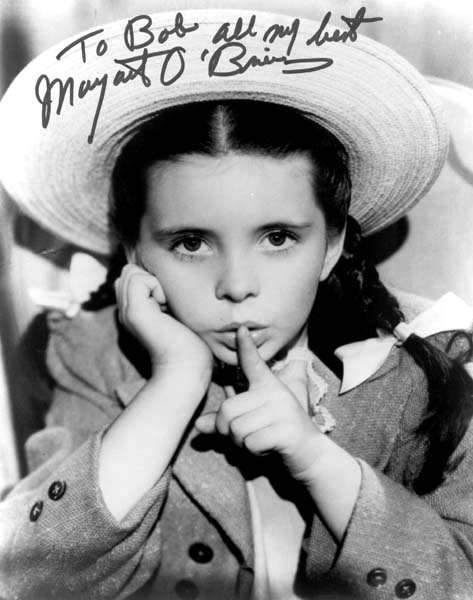
I was generally fascinated by Margaret O’Brien as Tootie on this viewing.  She seems to have been the prototypical Child Star.  Played Adele in the 1944 Jane Eyre, starred in The Secret Garden, but never made it as an adult actress.

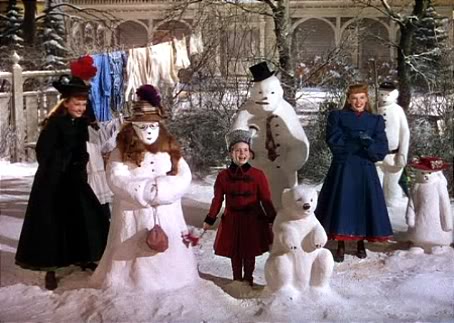
She’s incredible: almost feral.  Her dolls always come down with fatal diseases, so she’s buried scores in the back yard.  For me the greatest scene is when, having stayed up late on Christmas Eve, their last Christmas before the big move to New York, Tootie loses it and goes out in the moonlight and starts chopping off the heads of the snowmen she’s made because she would rather kill them than leave them for the strangers who will be moving into their home.  You also sense it’s a kind of rage against growing up, against the future of becoming a young lady like her sisters and organizing her life around boys and dances and visiting.  She just lets loose, with her uncontrolled, shattering 5-year-old-girl rage, against this parallel ice family, leaving the bodies destroyed on the ground.  And of course she gets her way: dad can’t take it, the move’s off, Eden is restored.

I forgot to mention when Tootie and her slightly older sister, just for kicks, put a straw body on the trolley tracks in hopes of driving it off the rails.  Tootie is almost hit by the trolley and is a bloody mess, and as a cover story, she claims the teenage neighbor boy beat her up.  Her big sister Judy Garland goes over and beats him up.  Then they realize it was all a big misunderstanding born out of Tootie’s pathological hooliganism and lying.  The doctor gives Tootie stitches on her lip, and when dad comes home and he wonders what’s going on, mom tells him not to worry about it.  He just accepts this, no further questions.

Wow.  Don’t you ever feel that things have become kind of buttoned-up?

(The girls seemed to love it, if you were wondering.)

Recent movies: American Psycho, Heat, Wizard of Oz

In the last couple weeks we saw two movies I’d been meaning to watch for a while.

Michael Mann’s Heat was fantastic.  The glittering surfaces of Mann’s fantasy L.A. define a really original noir setting in which Pacino and DeNiro maneuver with melancholy anger until one inevitably destroys the other.  Pacino comments in a DVD extra that in his mind, his character was high on coke half the time, which helps to explain some of his scenery-eating instant-classic rants.  As I watched, I started to realize that 40% of The Dark Knight is taken directly from Heat.  This becomes clearest in the bank heist — the robbery that begins The Dark Knight is practically cut and pasted from one in Heat, including the ominous soundtrack.  There’s also a direct link in the actor William Fichter: he has a modest but important role in Heat and then he shows up as a the mafia bank employee in the opening heist scene of The Dark Knight.  Was this a subtle tribute/acknowledgment on Christopher Nolan’s part?

American Psycho.  Also impressed by this one.  The violence remains disturbing (I actually think it gave me a nightmare), but I found it compelling and original as an exploration of hallucinatory dementia.  It’s also hilarious at moments (Patrick Bateman’s narrated record reviews of Robert Palmer, Huey Lewis and the News, and Phil Collins, whose bland AOR music he seems to require to motivate him to either sex or violence, are very funny) and really interesting as a “historical” film: made in 2000, set in 1987, the representation of Bonfire of the Vanities-era yuppie NYC is stylized and almost cartoonish at times (the giant cell phones) but in ways that I found surprising/unexpected.  It becomes much more than the obvious allegory (heartless Wall Street yuppie as psychopath) you might expect.

The film’s back story is interesting.  Leonardo DeCaprio was set to star until Gloria Steinem prevailed on him to withdraw for the sake of his teenage female fans.  Mary Harron was fired and rehired.  Oliver Stone and David Cronenberg were both attached to it at various times, as was Johnny Depp.  I haven’t read Brett Easton Ellis’s novel, but it seems that Harron did him a real favor by turning it into a narrative that’s at least plausibly feminist.  Easton Ellis, for his part, is still undecided about whether women can be great film directors, because “there’s something about the medium of film itself that I think requires the male gaze.”  Wow: does Laura Mulvey have this to answer for?

We watched The Wizard of Oz with the girls.  I was amused by the 1939 special effects.  Basically, a 12-year-old with a Mac could create more sophisticated effects now (the flowers in Munchkinland are obviously plastic), but here we are, still enjoying it 70 years later, and the Wicked Witch of the West’s sky-writing is still scary.  We had this exchange afterwards:

Iris:  I didn’t think the flying monkeys were so scary.  I would if I saw them in real life, though.  I’d pee my pants off.

Celie, not missing a beat:  If I saw a real flying monkey, I’d pee every piece of pee my body would ever pee.

The Middle-Aged Man Confronts the Bright-Eyed Kiddies

This is my second post on Greenberg and my first on Jonathan Franzen’s Freedom, which I just finished.

Even if you haven’t seen Greenberg, you probably saw the ads/previews [this part starts at 2:09] including the scene where the 40 y.o. Greenberg sits uncomfortably, surrounded at a party by young 20-somethings, expressing his sense of generational alienation: “your parents were too perfect at parenting.  All the Baby Mozart and Dan Zanes songs?  You’re all ADD and carpal tunnel… Hope I die before I meet one of you in a job interview.”  Part of what’s funny about the scene is Greenberg’s fight with some of the party-goers about what music to play.  He’s just done cocaine and thinks Duran Duran would be the perfect soundtrack; interestingly, the kids don’t want to play anything current, but AC/DC (I think).  Suggesting that part of the generational divide has to do with the lack of generational divide.  Greenberg actually shares many of the same cultural references and touchstones with these kids, there isn’t the easy and maybe comfortingly blatant taste gap, which renders more ambiguous and unsettling the sharp differences that do exist.  That he wants to listen to Duran Duran definitely marks him off from them, but not for completely obvious reasons.

There’s a similar scene in Freedom when two of the 40ish protagonists, Walter the environmental lawyer and his college roommate Richard Katz (once the leader of the punk band the Traumatics, now achieving new success with an alt-Americana outfit called Walnut Surprise) go to a club in Washington D.C. to see “the suddenly hot band Bright Eyes, fronted by a gifted youngster named Conor Oberst.”  Walter, who is (at this point) idealistic and enthusiastic, loves the show, but it freaks Richard out:

Katz hadn’t gone to a show as an actual audience member in several years, he hadn’t gone to hear a kiddie idol since he’d been a kiddie himself, and he’d become so accustomed to the older crowd at Traumatics and Walnut Surprise events that he’d forgotten how very different a kiddie scene could be.  How almost religious in its collective seriousness…. He and Walter were at least twice the age of everyone else at the club, the flat-haired boys and fashionably unskinny babes….

Kiddies were streaming onto the floor from every portal, Bright-Eyed (what a fucking youth-congratulating name for a band, Katz thought) and bushless-tailed.  His feeling of having crashed did not consist of envy, exactly, or even entirely of having outlived himself.  It was more like despair at the world’s splinteredness.  The nation was fighting two ugly ground wars in two countries, the planet was heating up like a toaster over, and here at the 9:30, all around him, were hundreds of kids… with their sweet yearning, their innocent entitlement — to what?  To emotion.  To unadulterated worship of a superspecial band.  To being left to themselves to ritually repudiate, for an hour or so on a Saturday night, the cynicism and anger of their elders…. They gathered not in anger but in celebration of their having found, as a generation, a gentler and more respectful way of being.  A way, not incidentally, more in harmony with consuming.  And so said to him: die.

Completely brilliant and spot-on!  Further evidence of some kind of new generation gap emerging.  I came across this hostile review of the Gary Shteyngart novel that reads it as an “attack on the young,” a mocking salvo in the war between the bitter, uglifying 39-year-olds and the hopeful, pretty 24 year-olds.

It is so on!  As an aging hipster who tries to “keep up,” I’ve definitely been there.  Last year we went to see Richard Thompson and Joanna Newsom (different shows) in close succession, and it was weird how we seemed to be among the youngest in the whole place for Richard T. and among the oldest for Newsom.  It almost felt a little creepy in the latter show.  The Buskirk-Chumley keeps the lights on pretty high and so it all feels very blatant and unavoidable: “yes, I could almost be your dad, is my non-youthful presence a downer for you?”

By the way, for the record, I am a big Conor Oberst fan.  He is now 30 years old, though, so may not be entirely on the side of the kiddies anymore (or quite as bright-eyed — actually my favorite of his albums is his most recent solo record on which he is definitely more jaded than he used to be).  Wonder if Franzen or anyone let him know about the reference or if it came out of the blue; kind of a cool tribute, really.  (There’s also a funny passing reference to Ian McEwan — the character Joey got Atonement from his sister for Christmas and he “struggles to interest himself in its descriptions of rooms and plantings;” since Joey is a young Republican, this is not necessarily a diss on Franzen’s part, though a little tricky to interpret.)

Also for the record, Freedom is, as advertised, brilliant and memorable.  I couldn’t stop reading it and got through a big chunk in one long insomniac session.  It feels almost eerily of the moment, the Way We Live Now, unsettlingly consonant with the bad vibes of the summer of 2010 with its gushing oil spill, environmental despair, and calcifying angry politics.  Probably the single most memorable moment of the novel involves the speech that takes a wrong turn and ends with the speaker screaming “WE ARE A CANCER ON THE PLANET!  WE ARE A CANCER ON THE PLANET!” until he’s pulled from the mike and violently beaten up (the video of the speech becomes a Youtube internet meme).

Greenberg/ Shampoo

We happened to watch Noah Baumbach’s Greenberg a week or two after Hal Ashby’s Shampoo (which I’d seen years ago and barely remembered) and it was clear to me that Baumbach was drawing pretty heavily on Ashby’s film. Shampoo is great — it felt to me like a cross between a more typical Hollywood studio film of the period (although is there such a thing actually?) and something by Cassavetes in its fluid, meandering, non-teleological and semi-improvised-feeling style.  One of my favorite scenes: Warren Beatty’s character George is turned down for a loan for a new hair salon at the bank; he storms out, tears off his jacket and tie, tosses them in the garbage can, then kicks it over.  As he stalks off, a single bottle fortuitously rolls towards the camera — it’s really lovely.

That scene is where Beatty is at his most Greenberg-like.  That’s not really where the strong parallels are.  Needless to say Ben Stiller and Beatty don’t have a lot in common, it’s more the larger structure of the films and the representation of L.A.  Some “rhyming” elements: the punctuated scenes of characters walking on paths in the Hollywood Hills, giving a surprisingly bucolic vision of the city; the stumbling-upon of the sexy daughter character who’s popped up in the parents’ mansion (this is a great pre-Star Wars Carrie Fisher in Shampoo; after a couple minutes of hostile exchanges with Beatty, she abruptly asks “wanna fuck?” Beatty’s George reminded me a little of Humphrey Bogart in The Big Sleep in the way almost literally every women he meets comes on to him; maybe Bogart is the secret connecting link between Beatty’s pulchritude and Stiller’s slightly simean charismatic ugliness?); and most obviously, the sprawling youth/hipster party towards the conclusion of both films.  Here Greenberg is in the Lester role from Shampoo, the out-of-place member of an older generation slumming it among the nubile youth-culture student-types for whom L.A. is their playpen.  My crowning piece of evidence, pun intended, is a tiny detail: early on, Ben Stiller is sitting on his friend’s couch when he aimlessly picks up a scissors and snips off a piece of his own hair.  It may appear to be just another random act of passive-aggression, but to those in know, it’s a loving homage.

N.B. Both Stiller and Beatty are wearing purple shirts.

Joan Jett’s fictional leather pants

Finally got around to watching The Runaways. It was all right… somewhat entertaining… directed by a music-video auteur (Floria Sigismondi, who did that apparently influential Marilyn Manson video “The Beautiful People” — which I do recall for some reason) and (so?) enlivened by random bursts of arty visual sequences that don’t really add up to much.  Kristen Stewart was in my opinion simply bad as Joan Jett.  Just felt like a miscasting.  She does her best to be the tough working-class Philadelphia chick, but she’s too delicately refined and it doesn’t come off.  Michael Shannon is entertaining, although I suspect way too benign, as the famously creepy/evil producer Kim Fowley, the Fagin/Svengali who put the band together.

I found the commentary track with Kristen Stewart, Dakota Fanning and Joan Jett very amusing.  Stewart and Fanning seem properly awed by Jett and sort of babble on school-girlishly about their various acting choices.  You have to feel for Stewart — must’ve been embarrassing to have to sit through the scenes in which she attempted to recreate Jett’s teenage years with the icon herself.  My favorite exchange (I only watched for 20 minutes or so) was when Jett complained that she never in fact wore leather pants.  Stewart had some convoluted justification about how it was important that the character always be dressed exactly the same way, to which Jett responded, in her almost Patty-or-Selma-Simpson-esque growl, “Yeah… but I could’ve always just been wearing jeans.”

Here’s the re-incarnation and the original:

An interesting fact I learned from the credits (though this is from Wikipedia):

Jett’s self-titled solo debut was released in Europe on May 17, 1980. In the US, after the album was rejected by 23 major labels,[8] Jett and Laguna released it independently on their new Blackheart Records label, which they started with Laguna’s daughter’s college savings. Laguna remembers, “We couldn’t think of anything else to do, but print up records ourselves, and that’s how Blackheart Records started.”

I presume this means that Jett was one of the first women to helm her own record label.  I’m also curious, given the enormous success of that album and the finances of the music industry in those days, whether she made a fortune from it.  She was all of 22 years old when her post-Runaways solo album came out.

Scott Pilgrim vs. Junior Brown

Damn it, I just wasted too much time trying to create a Venn diagram for this post.  Easy to make one but I couldn’t embed it; I give up.  The failed diagram was my attempt at a graphic representation of my unusually active Friday night, when Sarah and I and our friend Leah went to see Scott Pilgrim vs. the World and then I peeled off from the tired ladies to see Junior Brown performing downtown.

The Venn diagram represented the small overlap between the youthful “Emerging Adults” at Scott Pilgrim (one circle) and the mostly 50/60-ish Hoosier country music fans of Junior Brown (second circle).  The little sliver of overlap between the two circles may only have been only me on this particularly evening: 40ish aging hipsters/ incipient geezers.

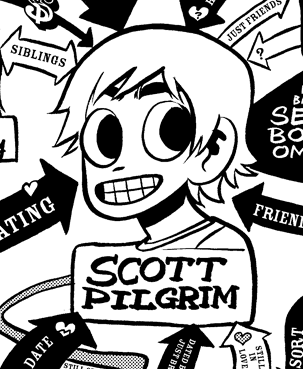
If you don’t know, Scott Pilgrim is the film version of a graphic novel series depicting the adventures of young Toronto indie-rock 20-somethings in pseudo-Manga (e.g. Japanese comic) style.  I got the first book or two several years ago and didn’t keep buying it the series, but it’s very witty and fun.  The charm is partly in the casual way the inbred, gossipy, wise-cracking, media-saturated world of these arty hipsters blends into video-game and sci-fi tropes and events (Scott for some reason must battle to the death the seven evil exes of his new girlfriend Ramona).   Probably inevitably, the movie somewhat pumps up the Mortal Combat-esque battle scenes which end up taking over the movie a bit too much.  But it’s all very funny and well done.  One highlight was Scott’s battle with Romana’s ex who possesses the unstoppable force of Vegan power: “we’re just better than non-vegans,” he observes (or some such).  He cannot be defeated, it would seem, until Scott tricks him into accidentally drinking some coffee with half-and-half in it, at which the Vegan Police show up and haul him away.  Michael Cera was not exactly how I imagined Scott, but he was good in his own wimpy way.

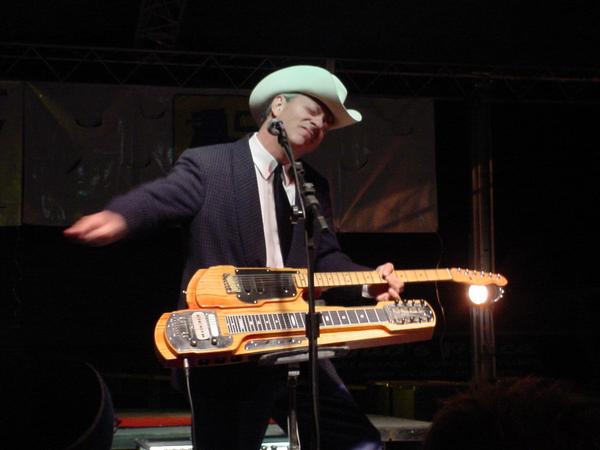
From a head-spinningly different universe is Western Swing legend Junior Brown, is actually an Indiana native (which I’d never known) who’s been an Austin fixture for years.  When we visited George in Austin in 1996 or something he took us to see Brown at his then-weekly (I think) show at some cool outdoor restaurant venue.  On Friday night he came out a bit late — someone I ran into there told me this is generally the case b/c Brown is busy smoking his famously excellent pre-show weed backstage.  He is perhaps best known for having invented what he calls his guit-steel, a two-necked guitar.  He’s a virtuoso and many of the songs — mostly country/ Western Swing, with some surf and Hawaiian steel excursions — are designed to allow him to show off his impressive skills.

Although it was a challenge to find any common ground between the world of Scott Pilgrim and Junior Brown, my ever-busy relations-seeking mind led me to imagine JB battling the Katayanagi Brothers (a Japanese synth rock duo) in one of the battles-of-the-bands from the movie.  He’s definitely stand a decent chance, especially with the power of the guit-steel’s double neck, one available to vie with each evil brother.