Marc Maron: Cats know more than we can understand

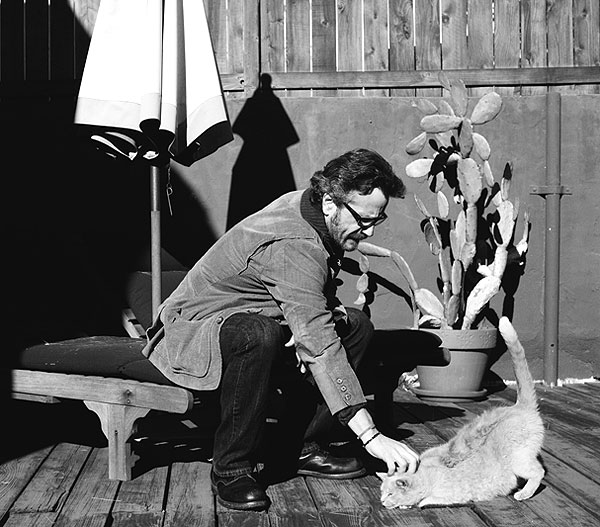
cat-Marc-Maron-Boomer-by-Dimitri-von-KleinMarc Maron with Boomer: [Photo by Dimitri von Klein from Catster]
I kind of wished I’d blogged about Marc Maron before he suddenly became ubiquitous… I’ve been listening to his podcast WTF (I get it on iTunes) occasionally but regularly for the past year or two.  I’m not sure what his secret is, but some of these conversations have been really memorable, so much so that I can remember where I was walking the dog or walking home as I listened to some of them. David Cross, Fiona Apple, Pamela Adlon, Mike White, John Oliver, Stephen Merchant, ‘Weird Al’ Yankovic, Diablo Cody… I guess those are the ones I remember most vividly. Maron is an over-sharer, he’s self-laceratingly critical and confessional, smart but insecure about his knowledge & status, obviously needy and competitive, but not too aggressively so, melancholic, eager to connect… And he seems to bring out a similarly confessional, over-sharing spirit in his guests.  Part of it may simply be the podcast’s length and flexible structure — it’s an open-ended conversation (conducted in Maron’s garage studio, which is now immortalized in the opening credits of his t.v. show), and as far as I can tell, he’s not aiming for a particular length, so the exchange can go into some slow patches, and then can pick up or open out into something new. (For example, I was feeling disappointed by his Lucinda Williams podcast– he seemed nervous, and interrupted her too often — but then eventually she got into fascinating stories about life as a child with her bipolar, alcoholic mother.)  The Mike White conversation was especially great, with some pretty startling moments of self-revelation on White’s part (but I am a huge fan of his anyway- he’s the creator of Enlightened as well as movies like Chuck and Buck).

Btw, one tip — although I know this makes Maron mad: every podcast begins with about 10 minutes of him riffing and ranting and promoting Stamps.com, so if you mostly want to hear the interview, you need to fast-forward.  (There’s often good stuff in the rants, though!)

I also just read Maron’s memoir, Attempting Normal, which is good.  You have to have a certain degree of patience for incessant discussion about his grim-hotel-room (and other) masturbation habits — generally pretty amusing, though.  The book more or less tells the story of his comedy career, his two marriages, his career slide and serious depression that preceded his comeback that began with his beginning WTF.  It’s episodic, though, and many of the chapters are basically little mini-essays or fragments, some of them artfully constructed.  The chapter “the Clown and the Chair,” about the role played by a particular piece of thrift store furniture in the endgame of his second marriage, is excellent, for example.  I also really liked his discussions of the weird, exhausting, and often alienating life he led in the late 80s and 90s as a “road comic” playing casinos, restaurants, and small clubs, in his case mostly around New England. There’s an amazing story about a comedian, Frankie Bastille, who’s since died, who snorted heroin in the passenger seat as Maron drove them to a show out of town (Maron was opening); when they got to the club, Maron had to physically haul in the seemingly comatose Bastille, who then proceeded to deliver a killer show, and then nodded out again on heroin on the drive home.

One thing that struck me, and that I found refreshing, is the degree to which Maron is basically a male Crazy Cat Lady.  The chapter “Cats” explains how he acquired his collection of formerly feral pets; they come up repeatedly elsewhere, and the book ends with a moving tribute to Boomer, his favorite cat who disappeared right when Maron was beginning to tape his new IFC show, Maron. [That is Boomer in the photo above.]

Why he vanished just as my life was changing drastically demands interpretation. I am not religious or spiritual, but I am prone to connecting dots in equations so that they defy coincidence.  Someone suggested that maybe this was the end of our journey together, that he had taken me as far as he could and that it was time for him to move on. I like that angle….

If you are awake and alive, sadness is a fluctuating constant. Hope is fleeting, a decision you make out of faith, desire, or desperation. Cats know more than we can understand. I don’t care about biology or brain size.

Sniff…

So far I’ve seen two episodes of his new show, #3 and #4.  I give it a 7.5 so far… or maybe an 8… It’s good and smart in some ways, and funny, but he and his story feel a bit constrained by the scripted sitcom format, and a lot of it feels a bit like a slight variation on Curb Your Enthusiasm: needy, narcissistic comedian in L.A. playing a just slightly fictionalized version of himself.  Louie too, I guess (Maron and Louie C.K. are old friends; there’s an amazing conversation about how they had a falling out and kind of patched it up on Maron’s recent Fresh Air interview), but so far I don’t think Maron has managed to get to the kind of raw insight, formal innovations, and originality that Louie offers.

The last episode, in which Maron decides to date “an age-appropriate woman” for once (i.e. not in her early/mid 20s), was seeming not-so-great to me, and then it took a twist and actually became much better than I expected. Maybe Maron is Marc Maron’s Lucky Louie and he needs to have this one cancelled and then regroup for his next great one. Or maybe this one will get better as it goes.

Ai Weiwei and African Textiles & Art in Indianapolis

Road trip to Indianapolis.  First, to the Indianapolis Museum of Art and, to start, the Ai Weiwei show: According to What?  This photo is of the kids looking at “a new sculpture made from steel rebar that was salvaged from schools that collapsed during the 2008 Sichuan earthquake.”  He and collaborators/assistants painstakingly bent all the rebar back so that it was perfectly straight and arranged it in a kind of rising and falling wave pattern.  Behind, you can see a list on the wall of the names of the many hundreds of victims of the earthquake, names you can also hear recited out loud from a speaker in the corner.

image

I liked the show — I think we all did — although I find Ai Weiwei’s work comes across pretty effectively on video and in description, i.e. it’s not totally transformative to see it in person.  I guess this is to say that he’s basically a conceptual/ relational artist whose work is as much about the social dynamics and processes that lie behind it as about its physical instantiation. So, seeing the documentary Ai Weiwei: Never Sorry, for example, I’m not sure you get so much less of an authentic experience of his work than you do from going to the show. With the steel rebar piece above, part of the point is that it looks like a minimalist abstract work, but is in fact much more a polemical, political statement that exists in relation to, and as a sort of record of, all of Ai Weiwei’s other activities related to his protest of the Chinese government’s response to the earthquake.

Sarah made the point that in some ways his approach to art resembles Jeff Koons’; like Koons, he has (or had) a big studio and a lot of assistants whom he oversees as they produce large, sculptural works based on the ideas he comes up with.  There’s definitely not a whole lot of emphasis on individual craft skill or anything like that.  (Of course, his ideas are much more interesting and affecting than Koons’, which seem to mostly just be about the ubiquity of commercial culture.)

Actually one part of the show I liked a lot were the walls of his photos taken during his years in the mid-late 1980s through 1992 or so he spent living in NYC on the Lower East Side.  It’s fun and fascinating to see these glimpses into his life as an expat unknown Chinese would-be artist, chronicling the Tompkins Square riots and the like. There are big group dinners in what look like cheap Chinatown restaurants, scenes in peoples’ tiny bedrooms, hanging out with Allen Ginsburg.  Makes you wonder to what degree his later political activism was some kind of syncretic blend of Chinese/ U.S. practices coming out of those Lower East Side years.

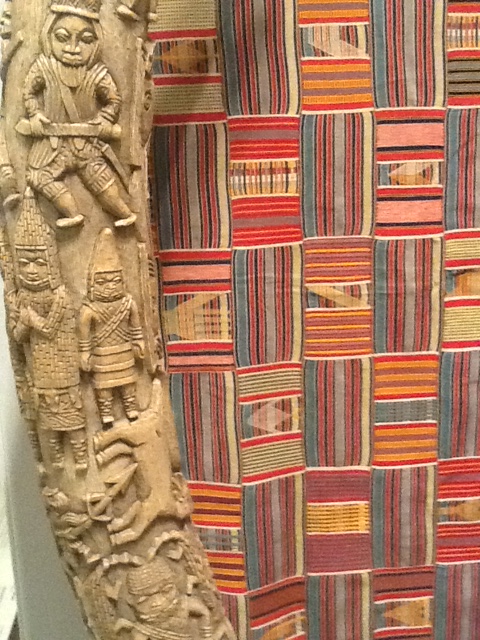
Anyway, all that said, I think he’s a fascinating & important figure, and needless to say a powerful voice of dissent, but I don’t personally love the artworks as art.  For sheer sensuous/aesthetic pleasure, they were kind of blown away for me by the stuff on display in the Majestic African Textiles exhibit next door.  When I saw these (below) across the room I actually said to Sarah, “oh, look, they have some Nick Cave soundsuits!” [see my post about those, with some images, here]- but these were in fact Nigerian mid-20th century masquerade/dance costumes of the sort that must have inspired Cave’s soundsuits.

These are so spectacular!

imageCheck out the penis & boobs on this one:

image

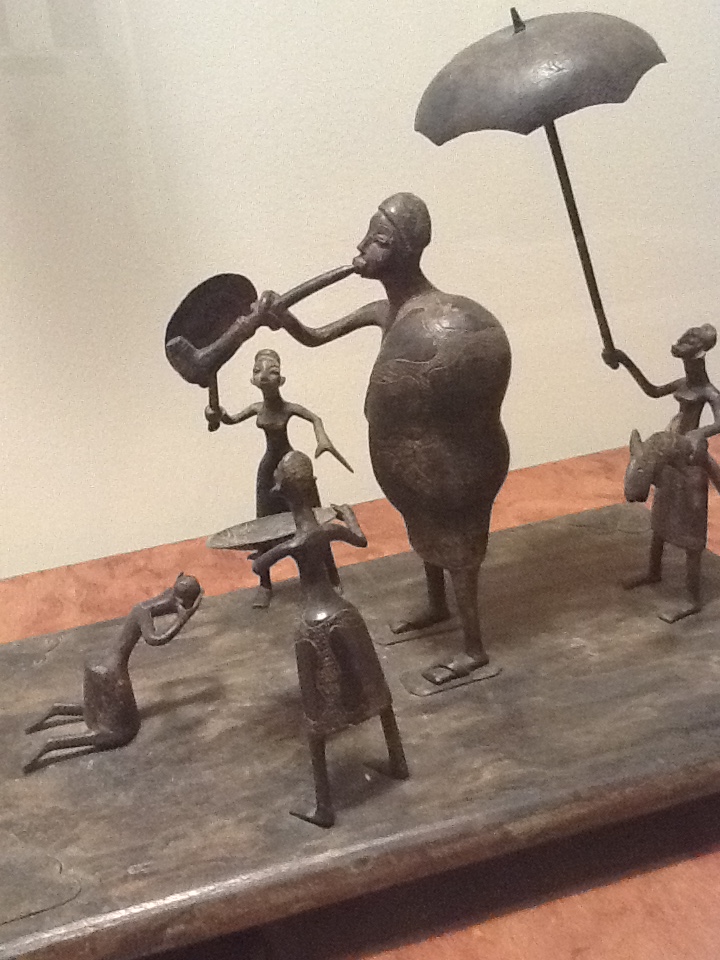
And then these gorgeous, sometimes scary masks & figurines:

image

imageimagephotophotoCall me a traditionalist formalist, but at the end of the day I’ll probably always take the art that, when you’re in the room with it, overwhelms you with sensuous/ tactile/ visual  qualities that you can’t experience the same way in reproduction.

So, go see the Ai Weiwei show, but be sure also to visit the Majestic African Textiles show.

Posted in art

Elena Ferrante and the Novel of Female Rage

77810

I learned about Italian novelist Elena Ferrante, four of whose books are out in English translation on Europa Editions, from James Wood’s good piece on her work in the January 21, 2013 New Yorker.  That Wood is a fan makes me pretty sure that Ferrante’s work influenced his wife Claire Messud’s new novel The Woman Upstairs; I haven’t read that yet, but I’ve heard several interviews with Messud in which she explains her desire to write a novel in a voice of female rage, of a kind familiar from ranting-narrator books like Notes from Underground, but much less familiar in a woman’s voice.

Maybe or maybe not, but Ferrante’s The Days of Abandonment is definitely a novel of female rage — and of female abjection, humiliation, disgust.  Wood writes that “the literary excitement of The Days of Abandonment lies in the picture it gives of a mind in emergency, at the very limits of coherence and decency, a mind that has become a battlefield between reason and insanity, survival and explosion.” The plot is simple: the narrator Olga, a 38 year-old woman, a mother of two young kids who had published one book in her 20s, but in recent years has more or less abandoned her vocation as a writer (this also reminiscent of the Messud novel’s themes), is suddenly left by her husband Mario with no real explanation.  Mario takes up with the 20 year-old daughter of a former close friend, and Olga is left alone with the kids and an unhappy German Shepherd, struggling to keep the household and her mental state in any kind of working order.

Most of the novel takes place in and around Olga’s increasingly claustrophobic apartment; the novel sometimes reminded of Roman Polanski’s great, disturbing psychological horror movie The Tenant. More to prove that she can than out of any real desire, Olga has a one-night stand with a kind but seedy downstairs classical musician, one of the greatest Really Bad Sex scenes I can recall. It’s very graphic, but what’s shockingly memorable are the embarrassing, intimate details of what goes down between them.  Bodily fluids of various kinds, not just sexual but also vomit and human and dog blood, spill out throughout the book, always emphasizing Olga’s sense of dismay and lack of control over the boundaries between herself and others, and her own inside and outside.

Women don’t often get to rant in novels, Messud has been commenting — and/but The Days of Abandonment is one long, sometimes unhinged, mesmerizing rant.  “Obscenity came to my lips naturally… As soon as I opened my mouth I felt the wish to mock, smear, defile Mario and his slut.”  She’s haunted by a childhood memory, recurring throughout the narrative, of a neighbor her mother had called the “poverella,” that “poor woman,” who was left by her husband and descended into despair, eventually drowning herself.

I haven’t really conveyed the ways the novel is, implausibly, also somewhat hilarious at times. Hard to take at moments — the plot involving the German Shepherd Otto is upsetting, for example — but a great read.  And not as much of a downer in the end as you fear.

I should also mention that Ferrante is an author of Thomas Pynchon-like mystery; her name is a pseudonym, and virtually nothing is known about her personally. Rumors apparently swirl about who she may really be. Must be hard these days to maintain that kind of secrecy.  Here’s a brief interview with her (conducted via email). And her 2008 NYT Op-Ed about the “stinking, polluted filth” of her hometown of Naples.

I want to read her most recent, My Brilliant Friend, apparently the first book in a trilogy.

Shredding: Top Ten Douchiest Guitarists of All Time

I found Sound of the City’s “Top Ten Douchiest Guitarists of All Time” very edifying in general, but I especially treasured these two amazing clips.  Michael Angelo Batio I had never even heard of, so this was a particular revelation.  So much of it is in the facial expressions.  And the double (or more) guitars.

When you’re a world-class guitar player and you know it, there’s a fine line between sexy and, well, douchey. You know, that rocker who poses on his knees for just a little too long, gives us just a little too much “O” face during every solo and is hell bent to show us all how many guitars he/she can play at once. History (namely the 80s) is full of these guys, but Douchey Guitar Player Disease (a/k/a DGPD) is still a scourge on the music industry today. With that in mind, we’d like to present our list of the Top 10 Douchiest Guitar Players of All Time.

Steve Vai

Michael Angelo Batio

“Batio was voted the “No. 1 Shredder of All Time” by Guitar One Magazine in 2003.He was also listed as one of the “Top 100 Greatest Metal Guitarists of All Time” by Guitar World Magazine, for which he wrote the column Time to Burn, and one of the “20 Greatest Shredders of All Time” by Total Guitar Magazine, both in April 2008…. In 2011, Michael debuted his multi media show “Hands Without Shadows – A Tribute to Rock Guitar” in Las Vegas. In 2012 Michael toured the world with this show. It is a chronological tribute to rock guitar. Michael is touring the world with his tribute to rock guitar show in 2013 as well” – wiki.

Living, Loving, Partygoing with the Future Bible Heroes and Henry Green

It appears that the new Future Bible Heroes single, “Living, Loving, Partygoing,” is a tribute to the English modernist novelist Henry Green. And more specifically, to the Penguin edition that collects all three of those novels.  (Penguin is onto this.)

I’m not all that surprised that Stephin Merritt would be a Henry Green fan.  Perhaps his recent hearing problems/ tinnitus led him to the “odd, haunted, ambiguous” Green, who is famous for his Altman-esque overlapping conversations.  From a Paris Review interview with Terry Southern, “The Art of Fiction” #22, from 1958:

TERRY SOUTHERN: I’d like to ask you some questions now about the work itself. You’ve described your novels as “nonrepresentational.” I wonder if you’d mind defining that term?

GREEN: “Nonrepresentational” was meant to represent a picture which was not a photograph, nor a painting on a photograph, nor, in dialogue, a tape recording. For instance, the very deaf, as I am, hear the most astounding things all round them which have not in fact been said. This enlivens my replies until, through mishearing, a new level of communication is reached. My characters misunderstand each other more than people do in real life, yet they do so less than I. Thus, when writing, I “represent” very closely what I see (and I’m not seeing so well now) and what I hear (which is little) but I say it is “nonrepresentational” because it is not necessarily what others see and hear.

Another good moment from this interview occurs when Southern asks how Green came to the plot/story for Loving:

I got the idea of Loving from a manservant in the Fire Service during the war. He was serving with me in the ranks, and he told me he had once asked the elderly butler who was over him what the old boy most liked in the world. The reply was: “Lying in bed on a summer morning, with the window open, listening to the church bells, eating buttered toast with cunty fingers.” I saw the book in a flash.

I’ve kind of been waiting for the ripples from Downton Abbey-mania to reach Green. Henry Green Revival!

Merritt’s lyrics seem less faithful to than perhaps generally inspired by the mood of Green’s novels, e.g.: “At Mink Stole’s birthday/ in gay Provincetown/ I came to DJ/ and left with the clown.”

Image

Rilo Kiley: I can do the frug, I cannot fall in love

Rilo Kiley was one of my very fave rock/pop bands of the Oughts… I really-like-to-love their four original albums, Takeoffs and Landings (2001), The Execution of All Things (2002), More Adventurous (2004), and their attempted/ unsuccessful major-label mainstream/ pop bid, Under the Blacklight (2007). (My favorite is More Adventurous.) (There’s also the Jenny Lewis solo album Rabbit Fur Coat which I kind of forgot about, need to go back to that one… and it looks like she had a second one that I did not even know about.) So I was happy to get this new odds-and-sods unreleased collection, RKives, which is of high consistency and offers a good tour through their various sounds & styles– indie pop, Nashville-y faux country, folky, rock and roll, even a dance-rap collaboration with Too Short (that one maybe a bad idea).  You can get the MP3s on Amazon for $7.49.

I’d always wondered where they got the band name, and it turns out to be pretty funny: “On the syndicated radio show Loveline in August 2005, [Blake] Sennett explained that he had a dream in which he was being chased by a sports almanac: “when it got me, I leafed through it…and I came upon an Australian rules football player from the 19th century named Rilo Kiley. It’s kind of embarrassing.” When asked by co-host Drew Pinsky if he had ever seen this name in reality, Sennett said, “I don’t think so, I don’t think that character exists.”

I think I’d put Jenny Lewis with Stephin Merritt and the Drive-by Truckers guys as, IMO, the best American singer-songwriters of that period (late 90s-late oughts) working within a pop/rock approach.  She was a former child actress: made her debut in a Jell-O commercial; appeared in teen movies like Troop Beverly Hills. Most of Rilo Kiley’s music didn’t exactly fit with what you might expect from someone with that backstory, sounding more like smart-English-major fare: literate, well-crafted and -played, with thorny, ironic lyrics.  Lewis became an indie-pop female star in a Liz Phair mode: smart & sexy, feminist, frank about sex but with a pastoralism in the generally pretty music. Then Under the Blacklight felt like a concept album about a seamy L.A. underworld of “money for sex” and other varieties of selling oneself– perhaps an acknowledgment of the Hollywood sleaze that Lewis must have known about from her child and teen-actress days, and maybe making an implicit point about the process of signing with Warner Bros.  (Being a sexy singer for a pop band must sometimes feel like “money for sex.”)  I think a lot of fans found it disappointing, and I didn’t care so much for the album’s first single (“the Moneymaker”– kind of hard rock, sounds almost like Heart?), but I liked the attempt to go somewhere new and I think at least a few of the songs are totally brilliant, e.g. these two:

This one the “money for sex” song:

Considering Lewis, Merritt and the Drive-by Truckers’ Patterson Hood and Mike Cooley together underlines the pull of country music on any pop songwriter these days who cares a lot about storytelling. Country is so dominant as the mode for songwriting of this type that even artists like Lewis and Merritt may feel compelled to drop in and out of country or country-inflected modes.  (Merritt a more marginal case: I’m thinking of the Magnetic Fields’ The Charm of the Highway Strip (1994), a kind of thematic “country music” album.)  It’s almost as if, when you write a song in any genre that tells a story, you are in effect working within country music, even it can only be recognizable as such with a certain accent and particular references.

I should say something more specific about Rkives.  (Oh– I just got the title– say it out loud if you didn’t.) Maybe this is the obvious single: a bubblegum dance tune revealing brief glimpses of heartache: “And I can do the frug/ I can do the Robocop/ I can do the Freddie/ I cannot do the Smurf/ And I can hate your girl/ I can tell you that she’s real pretty/ I can take my clothes off/ I cannot fall in love.”

Here’s a video from 1999:

Taylor Mead’s Ass!

MEAD2-obit-articleInline

I love New York Times obituaries.

In September 1963, Mr. Mead accompanied Warhol on a cross-country trip to Los Angeles. The entourage filmed scenes for what would become, in 1964, Mr. Mead’s first film for Warhol, “Tarzan and Jane Regained … Sort Of.”

Mr. Mead played Tarzan, edited the film and handled the sound. On screen, his sarong kept falling off while climbing trees, prompting a critic to say that he really did not want to see any more two-hour films of Mr. Mead’s derrière.

Warhol wrote a letter to The Village Voice saying that after searching “the vast Warhol archives,” he could find no two-hour film of Mr. Mead’s behind. “We are rectifying this undersight,” he said, and soon made what would become a little-seen cult classic, the title describing in three words precisely what the critic did not want to see (though the coarser Anglo-Saxon term was used instead of the French).

I kind of like the way the NYT has maintained a regime of prudery and delicacy that requires this kind of work-around.  The Times music listings for the band [Pissed Jeans] they call “****** Jeans” are always amusing: “His band, from Philadelphia, has a name that lies just on the other side of what’s printable here; it describes a basic bladder-related humiliation, something that happens to the drunk or scared or infantile.”  OK, that’s actually just kind of silly.

Check out the piece on the man J. Hoberman called “the first underground movie star.” Also, here is the IMDb listing for Warhol’s 1965 film, and its more-detailed Wikipedia entry.

Amis’s The Green Man: Fawlty Towers meets The Turn of the Screw

images

The great New York Review of Books Classics series has a new edition out of Kingsley Amis’s 1969 The Green Man.

It is a strange book.  Imagine a cross between Fawlty Towers, a nudge-nudge swinging circa 1970 English sex farce, and James’ The Turn of the Screw interlaced with a matrix of references to English folklore and anthropology.  One in which the narrator’s quest to get to the bottom of the haunting of his hotel by a malignant 17th-century ghost is presented as not-necessarily more urgent than his well-thought-through (if ultimately not fully successful) plan to convince his wife and mistress to participate in a threesome with him. The novel’s narrator Maurice Allington is the Basil Fawlty figure, a witty alcoholic who runs a B&B-style hotel in the English countryside.  Kingsley cleverly updates James’ novella (among other classic ghost stories) by rendering his narrator’s heavy drinking and tendency to black out and, perhaps, experience hallucinations as a source of ambiguity about the strange phenomena he starts to see around his hotel: strange men and women coming up the stairs and appearing in the window, and a very creepy Wicker Man-esque primaeval forest creature comprised of branches and plants.  Or rather, we ourselves don’t really doubt that something supernatural is occurring, but Allingham’s reputation among his family and friends is such that no one takes him too seriously when he seems to be seeing things.

If you’ve read Lucky Jim you know that Amis can be hilarious; Allington is an extremely mordant, amusingly cranky and misanthropic narrator.  Here’s a favorite passage:

I missed out the artichoke, a dish I have always tended to despise on biological grounds. I used to say that a man with a weight problem should eat nothing else, since after each meal he would be left with fewer calories in him than he had burnt up in the toil of disentangling from the bloody things what shreds of nourishment they contained.  I would speculate that a really small man, one compelled by his size to eat with a frequency distantly comparable to that of the shrew or the mole, would soon die of starvation and/or exhaustion if locked up in a warehouse full of artichokes, and sooner still if compelled besides to go through the rigmarole of dunking each leaf in vinaigrette.  But I did not go into any of this now, partly because Joyce, who liked every edible thing and artichokes particularly, always came back with the accusation that I hated food.

This is true enough.  For me, food only interrupts everything while people eat it and sit around waiting for more of it to be served, but also casts a spell of vacancy before and after.  No other sensual activity must take place at a set time to be enjoyed by anybody at all, or comes up so inexorably and so often.  Some of the stuff I can stand.  Fruit slides down, bread soon goes to nothing, and all pungent swallowables have a value of their own that transcends mere food.  As for the rest of it, chewing away at the vile texture of meat, pulling bones out out of tasteless mouthfuls of fish or emcompassing the sheer nullity of vegetables is not my idea of a treat. At least sex does not demand a simultaneoius outflow of talk, and drink needs no mastication.

A truly committed alcoholic’s theory of food and eating.

The novel definitely feels somewhat dated or at least of its moment in its unapologetic sexual objectification of women.  It might be possible to explain this away as an effect of an ethically unreliable narrator whose attitudes towards women we are not invited to share — Allington does eventually get a kind of comeuppance and enlightenment — but you have to be able to deal with a lot of verbal ogling and the long-range planning of the intended threesome, etc.

What seems unique about The Green Man is the intertwining of its humor and supernatural horror.  It actually is kind of scary which seems a tough trick to pull off in the midst of all the dirty-old-man-innkeeper humor. Kingsley also offers some surprising and cool metaphysical developments late in the novel that you don’t see coming.

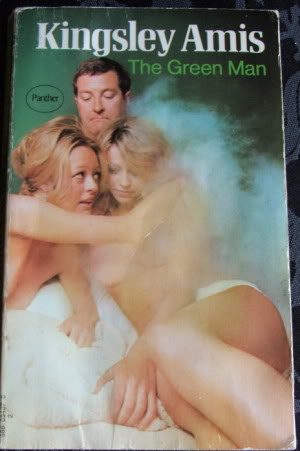
Oh wow — here’s an old paperback edition, from a t.v. adaptation?

GreenMan1

Keeping it classy!  Relieved we can’t see the guy’s body. That is definitely something I’d be embarrassed to be seen reading on a bus.

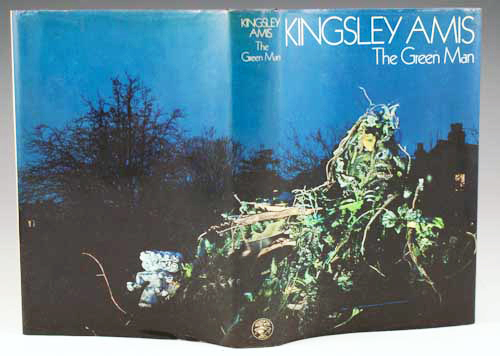
And another, a cool one:

SONY DSC

‘I Will Ruin Him’: James Lasdun’s memoir of being stalked

0224-Bradfield-articleLargeillustration from NYT Book review

James Lasdun’s Give Me Everything You Have: On Being Stalked is a creepy and compelling story of a teacher-student relationship gone bad, a memoir of being stalked, and an investigation into reputation and identity within 21st-century internet culture.  It also touches on other topics including contemporary Jewishness, Israel, and anti-semitism, and a son’s reflection on his relationship with and to a famous father (Lasdun’s father was the architect Denys Lasdun who designed the Royal National Theater in London among other prominent structures).

The Chronicle of Higher Ed ran an excerpt from the book a while ago and I sometimes felt that this narrative’s proper length may have been somewhere between that short piece and this full-length book.  Still, it is gripping and smart throughout, with a canny self-awareness about this story’s resonance with a long literary history of Gothic doppelgangers and mysteriously implacable enemies (I thought of, e.g., William Godwin’s Caleb Williams and Nabokov’s Lolita among other such tales).  The title of the excerpt, “‘I Will Ruin Him’: How it Feels to be Stalked” evokes one of Lasdun’s major themes: the vulnerability of reputation and personal identity today, its susceptibility to “ruin” through online means.  I thought also of the recent story (which on reading, prompted me to go through the minor hassle of setting up two-factor authorization for my Gmail account; you should probably do it too) by journalist Mat Honan that begins, “In the space of one hour, my entire digital life was destroyed. First my Google account was taken over, then deleted. Next my Twitter account was compromised, and used as a platform to broadcast racist and homophobic messages. And worst of all, my AppleID account was broken into, and my hackers used it to remotely erase all of the data on my iPhone, iPad, and MacBook.”

I personally do find it terrifying to reflect on how easily a determined, malicious enemy — or random hacker — can target you and wreak very serious havoc on your life.  Lasdun’s story is one of a personal encounter that goes wrong, but part of the takeaway from his story is the ease with which anyone can today do you harm through digital means.  There are a lot of Iagos out there on laptops and smartphones.

The book ends with the situation unresolved: his stalker, Nasreen, is still hounding him, posting invented accusations on online sites (she claims Lasdun raped, abused, and manipulated her in countless other ways, including plagiarizing her writing and stealing her work), emailing employers and colleagues, and so on.  It’s irresistible to look for possible signs of her activity out there now that the book has been published.  For example, there’s this recent Amazon review: “This was such a boring book. It was awful. I can’t believe this guy teaches writing…and no, this is not Nasreen writing (although your paranoid and egotistical self will probably think it is).”

And I found this one fascinating:

As a recovering stalker, this has changed my life,March 13, 2013

By Buckshot – See all my reviews

I was never as menacing or hateful as Nasreen, I never was talked to by the police or given any threats about legal action, and I never smeared my professor’s name, but in most other ways, this story is shockingly parallel to my life experience. The stalking took place in Western NY with my creative writing professor, between the years of 2007 to (well, today I had to send him a blurb about this book as a goodbye). That’s several years of unwanted emails. Which, like Nasreen’s, came in ‘fevers’ between silences. Sometimes addressing him like an ‘ever-dependable mentor’ and sometimes in a phase of hyperbolic disgust, sprinkled throughout with coherence and self-reflexive apologies, even humor. I relate to Nasreen so deeply, her existence gives me some strange relief. The author treats the subject with the respect and humanity that I always hoped I would be seen with. The increases in frequency of these unwanted emails correlates to times in my life that are more stressful and filled with doubt, as they probably did for Nasreen. The chasm between how I seem in real life (coy, near-mute, clumsy) with how I am in the emails is similarly jarring. For christsake I even used to use the phrase, “intimacy terrorist.” At times, I thought this book was written under a false identity of my professor. He kept a solid silence up, that confuses me to this day, but reading this book I think I understand what it’s like from the other side, and I don’t want to inflict that on anyone. I don’t want to be pathological. Again, I was never as extreme or punitive as Nareen, but the frequency and intensity of my emails are similar, and the origins and reasons for the attachment, nearly exact.