Family Movie Night: “Meet Me in St Louis”

Family Movie Night this Saturday: Meet Me in St Louis.

I looove Meet Me in St Louis.  To me it has the perfection of ideology.  Is it an “example” of “the movie musical”?  I can’t really accept that.  It defines its own form, genre, ideals.On this viewing I was fascinated by the free-range children.  On Holloween all the 5-9 year-olds go out on the street and build a huge bonfire into which they throw old furniture.  All of this absolutely unsupervised.   Then they put up the 5-year-old, Tootie, to go trick or treating at the house of the meanest old man around, whom they suspect of poisoning cats.  But what this means, in St. Louis in 1903, is not going to the door in your fairy costume, with your mommy hanging back decorously, so you can get a lollipop.  No, it means marching up there alone, ringing the bell, and when the mean man answers, throwing flour in his face from your paper bag and screaming “I hate you!!!”  Then running back in triumph to the giant bonfire, to be celebrated as the bravest of them all by your peers.

And this is what happens in the fancy neighborhood.  I hate to imagine what they did on the wrong side of the tracks.

I was generally fascinated by Margaret O’Brien as Tootie on this viewing.  She seems to have been the prototypical Child Star.  Played Adele in the 1944 Jane Eyre, starred in The Secret Garden, but never made it as an adult actress.

She’s incredible: almost feral.  Her dolls always come down with fatal diseases, so she’s buried scores in the back yard.  For me the greatest scene is when, having stayed up late on Christmas Eve, their last Christmas before the big move to New York, Tootie loses it and goes out in the moonlight and starts chopping off the heads of the snowmen she’s made because she would rather kill them than leave them for the strangers who will be moving into their home.  You also sense it’s a kind of rage against growing up, against the future of becoming a young lady like her sisters and organizing her life around boys and dances and visiting.  She just lets loose, with her uncontrolled, shattering 5-year-old-girl rage, against this parallel ice family, leaving the bodies destroyed on the ground.  And of course she gets her way: dad can’t take it, the move’s off, Eden is restored.

I forgot to mention when Tootie and her slightly older sister, just for kicks, put a straw body on the trolley tracks in hopes of driving it off the rails.  Tootie is almost hit by the trolley and is a bloody mess, and as a cover story, she claims the teenage neighbor boy beat her up.  Her big sister Judy Garland goes over and beats him up.  Then they realize it was all a big misunderstanding born out of Tootie’s pathological hooliganism and lying.  The doctor gives Tootie stitches on her lip, and when dad comes home and he wonders what’s going on, mom tells him not to worry about it.  He just accepts this, no further questions.

Wow.  Don’t you ever feel that things have become kind of buttoned-up?

(The girls seemed to love it, if you were wondering.)

Secret Historian – Samuel Steward

I had the pleasure yesterday of participating in a small seminar-style conversation/presentation at the Kinsey Institute by Justin Spring about his new book SECRET HISTORIAN: The Life and Times of Samuel Steward, Professor, Tattoo Artist, and Sexual Renegade (named a National Book Award finalist last week).  The presentation, basically a powerpoint slide show narrated by Spring, was completely fascinating.

As the NYT review explains,

Somewhere in the United States, there may be an attic containing the written remnants of a previously unchronicled 20th-century life that was even more astonishing than the one the writer Justin Spring discovered in San Francisco a few years ago. But even the most skeptical reader of his new book, “Secret Historian,” will have to admit that the bar is now set high. Samuel Steward, the subject of this absorbing act of biographical excavation, had many identities, including several that the subtitle of the book omits: pioneering sex researcher, collector of celebrity conquests, drug addict, masochist, Catholic (briefly), Navy enlistee (even more briefly), conquistador of vast provinces of America’s pre-Stonewall homosexual subculture. Most fortuitously, he was apparently a graphomaniac who documented his long, dark, exuberant, sad, dangerous life in journals, an unpublished memoir, reams of letters, poems, erotica, semifictionalized short stories and even a 746-entry card catalog of his sexual history, scrupulously maintained over five decades and in some cases ornamented — perhaps for future biographers? — with what Spring decorously calls “DNA-verifiable” evidence of his liaisons.

I’d just been talking about Roland Barthes’ “The Death of the Author” and Michel Foucault’s “What is an Author?” with students and so was thinking about Steward through that lens.  The book seems especially fascinating as a reflection on the category of the “biographical subject.”  Steward has so many identities and aliases, most of them involving one form or another of writing, recording, archiving.  He was a literary novelist, and later an author of gay erotica and porn under the name Phil Andros.  He was a well-liked English professor who became close friend and correspondent with Gertrude Stein and other literary luminaries.  He was a tattoo artist — Phil Sparrow — who for a time was the Hells’ Angels’ primary tattooist in the Bay Area.  And he was a self-archivist-qua-sex researcher whose “Stud File” held scrupulous notes on all 750-odd of his sexual partners.

So, what’s the “work”?  Seward is a poignant, even tragic figure towards the end of his life: an alcoholic hoarder living in squalor, he felt his writing had never been fully appreciated.  But now, of course, those aspects of his life that in another era would have seemed most disreputable, bizarre, or even unmentionable — i.e. the keeping of the Stud File, which sometimes included pubic hair and other physical specimens — can now be seen as part of a brave determination to create a detailed history of mid-20th-century gay life.  Thus “secret historian” as the primary titular identity.

Spring commented that Steward’s various aliases means that he (Spring) is pretty sure there are still a lot of caches of undiscovered material out there, in the Kinsey or elsewhere, under one name or another.

It was fun to learn about this in the Kinsey seminar room, as the Kinsey itself plays a big role in Steward’s life; he became a source for Alfred Kinsey, who encouraged Steward in his self-documentation.  Spring had some tricky negotiations with the Kinsey about privacy issues, as there are a lot of 80-year old former sailors out there who figure in Steward’s stud file, journals, and photographs.  And of course the Kinsey’s ability to collect archives depends, I presume, on being irreproachable as a repository of secrets.  The presentation was making me think about the status and operation of these personal sexual “archives” and the rules and procedures involved in their creation, documentation, and scholarly availability.  I’d guess that all of these procedures are in flux these days as attitudes shift, and perhaps also as an institution like the Kinsey has greater competition among archives interested in such material.

The photographs are pretty amazing.  Spring showed us most or all of those in the book, plus some others.  One showed a “daisy chain” orgy of sailors at a sex party in Steward’s Chicago apartment.  Spring commented wryly that FSG’s legal department was OK with publishing any dirty images “as long as no erect penises were visible,” so this one made the cut.  There are also a lot of weird and imaginative erotic images, such as one of Steward on his knees performing fallatio on a phantasmagoric, inscribed male figure sketched with light on a Polaroid image.

I would have liked to have seen more of Steward’s actual tattoo art, which was a perfect fit for him in the way tattooing allowed him at once to write, create images, and enter into physical relationships with a stream of young men.  (Although he says he only slept with one Hell’s Angel customer and “did not care to repeat it”).

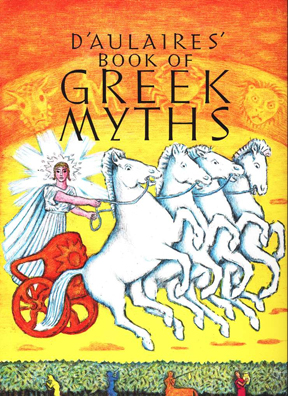
D’Aulaires Book of Greek Myths

The girls have been very into the D’Aulaires Book of Greek Myths, which Sarah got out of the library in hardback duplicate.  A little greedy, maybe, but the girls were so excited about it initially that they each wanted a copy to read in bed.  We’ve read through the whole thing and now at bedtime they’re taking turns each selecting a favorite story or two to read again.  Great, gruesome stuff.  Last night I read about Cronus devouring each of his first five children (Poseidon, Hades, Hera, Demeter and Hestia) out of fear they would overthrow him.  You can see the little babies glowing in his stomach — the drawings are wonderful, rather light and playful, sometimes with a touch of William Blake Songs of Innocence about them.  Cronus’s wife Rhea then tricks him and gives him a rock swaddled in baby blankets, and so the infant Zeus survives.  I think the girls relate to the Greek gods in their playfulness, tricks and plots, and perhaps also the occasional rage and fury.  They especially love the story of the baby Hermes tricking his big brother Apollo by stealing Apollo’s cows.  We all found the image of Apollo chasing him, while Hermes calls out “I’m just an innocent little babe!” or some such, hilarious.  They also especially liked the illustration of Pandora releasing the demons & imps from her box.  Very relatable for a 6-year-old.

I remember reading this book as a kid as well.  The D’Aulaires do a great job of making the stories accessible and appropriate for childen without bowdlerizing to excess.

I wonder how many Classicists were turned on to Greek mythology from it?

Dear Tooth Fairy: I Cannot Find My Tooht, But Pleas Give me a Preset

Iris’s note for the tooth fairy.

We lost teeth on successive days– it’s killing us!  We ran out of cash, didn’t have any ones the second day.  And the worst part is that we somehow got ourselves into this pattern where when Twin #1 loses a tooth, she gets a present (or “preset”) for both twins.  I don’t know why.  I think this was a work-around when they were 4 years old and there was no way Iris was going to be able to handle Celie getting a present when she didn’t.  Now, maybe she could handle it (an open question), but we seem locked into the double-jackpot system.

As this note suggests, the teeth often seem to get misplaced before bedtime, but again, it’s tails I win, heads you lose: double-gift all the same.  Which to me somewhat undermines the model of gift exchange.

Iris noticed a small pad of yellow lined paper on the stairs and observed, “look, that’s the pad the Tooth Fairy uses for her notes!”  This whole pack of lies is due to come crashing down soon…

Recent movies: American Psycho, Heat, Wizard of Oz

In the last couple weeks we saw two movies I’d been meaning to watch for a while.

Michael Mann’s Heat was fantastic.  The glittering surfaces of Mann’s fantasy L.A. define a really original noir setting in which Pacino and DeNiro maneuver with melancholy anger until one inevitably destroys the other.  Pacino comments in a DVD extra that in his mind, his character was high on coke half the time, which helps to explain some of his scenery-eating instant-classic rants.  As I watched, I started to realize that 40% of The Dark Knight is taken directly from Heat.  This becomes clearest in the bank heist — the robbery that begins The Dark Knight is practically cut and pasted from one in Heat, including the ominous soundtrack.  There’s also a direct link in the actor William Fichter: he has a modest but important role in Heat and then he shows up as a the mafia bank employee in the opening heist scene of The Dark Knight.  Was this a subtle tribute/acknowledgment on Christopher Nolan’s part?

American Psycho.  Also impressed by this one.  The violence remains disturbing (I actually think it gave me a nightmare), but I found it compelling and original as an exploration of hallucinatory dementia.  It’s also hilarious at moments (Patrick Bateman’s narrated record reviews of Robert Palmer, Huey Lewis and the News, and Phil Collins, whose bland AOR music he seems to require to motivate him to either sex or violence, are very funny) and really interesting as a “historical” film: made in 2000, set in 1987, the representation of Bonfire of the Vanities-era yuppie NYC is stylized and almost cartoonish at times (the giant cell phones) but in ways that I found surprising/unexpected.  It becomes much more than the obvious allegory (heartless Wall Street yuppie as psychopath) you might expect.

The film’s back story is interesting.  Leonardo DeCaprio was set to star until Gloria Steinem prevailed on him to withdraw for the sake of his teenage female fans.  Mary Harron was fired and rehired.  Oliver Stone and David Cronenberg were both attached to it at various times, as was Johnny Depp.  I haven’t read Brett Easton Ellis’s novel, but it seems that Harron did him a real favor by turning it into a narrative that’s at least plausibly feminist.  Easton Ellis, for his part, is still undecided about whether women can be great film directors, because “there’s something about the medium of film itself that I think requires the male gaze.”  Wow: does Laura Mulvey have this to answer for?

We watched The Wizard of Oz with the girls.  I was amused by the 1939 special effects.  Basically, a 12-year-old with a Mac could create more sophisticated effects now (the flowers in Munchkinland are obviously plastic), but here we are, still enjoying it 70 years later, and the Wicked Witch of the West’s sky-writing is still scary.  We had this exchange afterwards:

Iris:  I didn’t think the flying monkeys were so scary.  I would if I saw them in real life, though.  I’d pee my pants off.

Celie, not missing a beat:  If I saw a real flying monkey, I’d pee every piece of pee my body would ever pee.

“You Can Never Quarantine the Past:” Pavement Redux

Reports from the Pavement reunion tour have been sending me down memory lane.   I must obnoxiously boast that I think I saw one of Pavement’s first few shows ever.  Or at least outside of Stockton?   This must have been the summer of 1989 when I was back in Cambridge after my junior year of college.

[OMG, this was 21 years ago!!!!  How can that be??  21 years prior to 1989 was 1968!!  Does that mean I’m like an oldster talking about seeing Moby Grape at the Fillmore?? And if Malkmus is in his 40s like me how come he has that full head of hair?  Can an artist entering middle age really effectively communicate the melancholy nuances of adult life without having experienced male pattern baldness?]

Sorry.  Pavement’s first e.p., Slay Tracks (1933-1969), had just come out and it was being played to death at WHRB, Harvard’s radio station where I did a summer fill-in show (not sure if it was that summer) and had various friends who DJ’d. I loved that record (and the other ones that soon followed).  To me they felt like this perfect, out-of-nowhere combination of Sonic Youth noise, Swell Maps/the Fall grime/static, and New Zealand/Flying Nun pop tuneage.   They played in the smaller back room of the Middle East in Central Square.  I remember being amazed that they were, minus the hippie freak drummer Gary Young, these wholesome, good-looking college boys.  Slay Tracks was all mystification and unexplained references — the title reminded me of the Swell Maps in its inexplicable 20th-century history timeline — and I certainly didn’t expect guys who looked like they could’ve been on the U VA soccer team or something.  (Well, fencing maybe.)

They were definitely the Vampire Weekend of their day in that respect.  College-boy sex appeal.

I saw them again around when Slanted and Enchanted came out in 1992 — I was living in NYC and saw them somewhere downtown.  Malkmus was outside and I kind of screwed up my courage and went up to say hi and that I loved the album or some such.  I awkwardly introduced myself by asking “S.M.?” and he seemed embarrassed and corrected me kindly, “Stephen.”  At that point they still identified themselves by their aliases S.M., Spiral Stairs, et al — part of the veils and obscurings of identity and meaning that were at that point beginning to lift as they became really big.

I wrote a while ago about Big Star as an example of “mystery and the mysterious” in pop music in the pre-internet age.  Before Google & Pitchfork, etc, this was such a major part of what it meant to learn about bands: information scarcity.  I actually remember getting hold of some kind of xeroxed Velvet Underground fanzine when I first got into them in 1983 or so.  With an obscure band like Big Star, there were only a few places to go for information, and a lot remained unexplained.  A band like Pavement played with this and turned it into a strip-tease.  The early records were red-herring-filled and explained almost nothing.  Maybe you’d start to get third-hand stories and reports via fanzines or elsewhere, but the particular brand of celebrity was all about a paucity of information and the imaginative investments and projections that would foster.

By the time I introduced myself to “S.M.,” Pavement was starting to give up on that whole project.  Crooked Rain really inaugurated Pavement 2.0, the college-radio favorites with the handsome, patrician lead singer whom Courtney Love dubbed the Grace Kelly of indie rock.  Pavement 2.0 had funny, witty songs that communicated well on the radio and they functioned very well in the post-grunge alterna-media environment.  Even their gestures of negation — “Smashing Pumpkins, they ain’t got no function” — were also effective moves in that game.

I know this is boringly anti-populist, but I never loved Pavement 2.0 the way I did the Pavement of 1989-1994.  Of course I do love Crooked Rain and a lot of the later stuff, but the “Range Life” Pavement, the Pavement exploring the possibilities of becoming a California pop band, bathed in sunlight, to me always lacked some of the noir shadows and epistemological sinkholes and ambiguities of the early art-punk version.   I’d take Slanted and Enchanted over Crooked Rain any day, “Loretta’s Scars” and “Perfume-V” over “Cut Your Hair” and “Range Life” in a second.

The early releases reminded me of Flying Nun records in the way they functioned as talismans, fetishes, sacral objects with a numinousness created by a dearth of reference.  “Pastor’s flock, no church” (“Perfume-V”): “Song is sacred” as Malkmus put it in “Shoot in the Singer.”  The project was to generate sacral value out of limited networks of small-circulation records, intensely original aesthetics, passionately minor fan communities, and shrouded identities. I don’t blame them in the least for becoming Pavement 2.0 — the “early” approach was no longer available; it was a smart and effective move to go the direction they did, I personally just didn’t connect quite as strongly any more, though I still always liked the music a lot and thought Malkmus was a damn fine indie Grace Kelly.*

*I realize I am not accounting for the late psychedelic turn, e.g. Terror Twilight, which was perhaps an effort to restore some version of the old mystery/distancing tactics in a new form, although I’d have to go back to that album again.

Anyone have an extra ticket to the reunion tour?

It’s So Obvious: No Age

I went out to mingle w/ the kiddies again at the No Age show at the all-ages teenage club that is, coincidentally, immediately next door to my kids’ school.

I really like No Age.  There’s a purity and directness to them, and also a kind of opacity.  The music seems simple and the influences fairly obvious — e.g. the Ramones & 1980s hardcore — but there’s something in it that remains unexplained or surprising.  I suppose it’s partly the way the sheerly assaultive noise combines with the underlying pretty melodies — it almost reminds me of My Bloody Valentine.  There’s also something intriguing in the sense of political commitment, the veganism and the veneration for the Black Flag/ SST era communitarian approach to punk (they’re named after a 1987 SST instrumental compilation featuring Black Flag and others), and yet the politics don’t translate in any direct way to the lyrics.  They seem to draw on skater culture too which comes out partly in a sense of headlong physical abandon in the performance (which you don’t get in a lot of arch/withholding contemporary indie rock).

The chorus of “Boy Void” is lifted straight from Wire, I think: “it’s so obvious, so obvious, so obvious.”  I have no idea what the song is about or what is “obvious,” unless it’s actually a song about abstraction and about the perception of abstractions (like noise, color, forms): “Why don’t you try these fields across my eye…”

All of No Age’s music is pretty “obvious” in certain ways (a few chords, a wall of noise, tunes you can hum to) but there’s a conceptual heft to the aesthetics (all the way down to the simple and memorable t-shirts: I almost broke my longstanding taboo on rock t’s, but they didn’t have the one I wanted in the right size)  (and no, it’s not that I’m too fat for the teenage/kiddie shirts, as Sarah assumed when I mentioned this; they only had extra large and I wanted large).

They know how to deploy “minimalist” effects in resonant ways; they’re involved in the L.A. art scene so my guess is that they have a well-informed historical sense for how minimalist aesthetics work.

Ed and I got there and found out they might not go on until 10:45, so we wandered up the street to get a beer at the Bishop where a band called the California Guitar Trio were playing.  Tickets were $20 but someone offered us a pair for free so we caught the last 10 minutes — kind of a virtuoso classical-guitar/jazz thing.  They ended with the William Tell Overture.  Then back to the club where No Age went on by 10:30.  They did not play any t.v. theme songs.  We left early — it was a school night and we were both tired, but they were really great.  Good vegans that they are, they gave a shout-out to Bloominfoods: praised the balsamic-vinegar brussels sprouts in the cold bar.

Also need to mention: singing drummer.  Unusual.

I guess they’re opening for Pavement at the Hollywood Bowl on September 30th — funny to play at Rhino’s to about 125 people, and the Hollywood Bowl to 17,000 (?) in the same two weeks.  New album is out — just heard a somewhat disappointed report about it, so we’ll see.

Wait, they were nominated for a Grammy?  I missed that…

The Middle-Aged Man Confronts the Bright-Eyed Kiddies

This is my second post on Greenberg and my first on Jonathan Franzen’s Freedom, which I just finished.

Even if you haven’t seen Greenberg, you probably saw the ads/previews [this part starts at 2:09] including the scene where the 40 y.o. Greenberg sits uncomfortably, surrounded at a party by young 20-somethings, expressing his sense of generational alienation: “your parents were too perfect at parenting.  All the Baby Mozart and Dan Zanes songs?  You’re all ADD and carpal tunnel… Hope I die before I meet one of you in a job interview.”  Part of what’s funny about the scene is Greenberg’s fight with some of the party-goers about what music to play.  He’s just done cocaine and thinks Duran Duran would be the perfect soundtrack; interestingly, the kids don’t want to play anything current, but AC/DC (I think).  Suggesting that part of the generational divide has to do with the lack of generational divide.  Greenberg actually shares many of the same cultural references and touchstones with these kids, there isn’t the easy and maybe comfortingly blatant taste gap, which renders more ambiguous and unsettling the sharp differences that do exist.  That he wants to listen to Duran Duran definitely marks him off from them, but not for completely obvious reasons.

There’s a similar scene in Freedom when two of the 40ish protagonists, Walter the environmental lawyer and his college roommate Richard Katz (once the leader of the punk band the Traumatics, now achieving new success with an alt-Americana outfit called Walnut Surprise) go to a club in Washington D.C. to see “the suddenly hot band Bright Eyes, fronted by a gifted youngster named Conor Oberst.”  Walter, who is (at this point) idealistic and enthusiastic, loves the show, but it freaks Richard out:

Katz hadn’t gone to a show as an actual audience member in several years, he hadn’t gone to hear a kiddie idol since he’d been a kiddie himself, and he’d become so accustomed to the older crowd at Traumatics and Walnut Surprise events that he’d forgotten how very different a kiddie scene could be.  How almost religious in its collective seriousness…. He and Walter were at least twice the age of everyone else at the club, the flat-haired boys and fashionably unskinny babes….

Kiddies were streaming onto the floor from every portal, Bright-Eyed (what a fucking youth-congratulating name for a band, Katz thought) and bushless-tailed.  His feeling of having crashed did not consist of envy, exactly, or even entirely of having outlived himself.  It was more like despair at the world’s splinteredness.  The nation was fighting two ugly ground wars in two countries, the planet was heating up like a toaster over, and here at the 9:30, all around him, were hundreds of kids… with their sweet yearning, their innocent entitlement — to what?  To emotion.  To unadulterated worship of a superspecial band.  To being left to themselves to ritually repudiate, for an hour or so on a Saturday night, the cynicism and anger of their elders…. They gathered not in anger but in celebration of their having found, as a generation, a gentler and more respectful way of being.  A way, not incidentally, more in harmony with consuming.  And so said to him: die.

Completely brilliant and spot-on!  Further evidence of some kind of new generation gap emerging.  I came across this hostile review of the Gary Shteyngart novel that reads it as an “attack on the young,” a mocking salvo in the war between the bitter, uglifying 39-year-olds and the hopeful, pretty 24 year-olds.

It is so on!  As an aging hipster who tries to “keep up,” I’ve definitely been there.  Last year we went to see Richard Thompson and Joanna Newsom (different shows) in close succession, and it was weird how we seemed to be among the youngest in the whole place for Richard T. and among the oldest for Newsom.  It almost felt a little creepy in the latter show.  The Buskirk-Chumley keeps the lights on pretty high and so it all feels very blatant and unavoidable: “yes, I could almost be your dad, is my non-youthful presence a downer for you?”

By the way, for the record, I am a big Conor Oberst fan.  He is now 30 years old, though, so may not be entirely on the side of the kiddies anymore (or quite as bright-eyed — actually my favorite of his albums is his most recent solo record on which he is definitely more jaded than he used to be).  Wonder if Franzen or anyone let him know about the reference or if it came out of the blue; kind of a cool tribute, really.  (There’s also a funny passing reference to Ian McEwan — the character Joey got Atonement from his sister for Christmas and he “struggles to interest himself in its descriptions of rooms and plantings;” since Joey is a young Republican, this is not necessarily a diss on Franzen’s part, though a little tricky to interpret.)

Also for the record, Freedom is, as advertised, brilliant and memorable.  I couldn’t stop reading it and got through a big chunk in one long insomniac session.  It feels almost eerily of the moment, the Way We Live Now, unsettlingly consonant with the bad vibes of the summer of 2010 with its gushing oil spill, environmental despair, and calcifying angry politics.  Probably the single most memorable moment of the novel involves the speech that takes a wrong turn and ends with the speaker screaming “WE ARE A CANCER ON THE PLANET!  WE ARE A CANCER ON THE PLANET!” until he’s pulled from the mike and violently beaten up (the video of the speech becomes a Youtube internet meme).

Greenberg/ Shampoo

We happened to watch Noah Baumbach’s Greenberg a week or two after Hal Ashby’s Shampoo (which I’d seen years ago and barely remembered) and it was clear to me that Baumbach was drawing pretty heavily on Ashby’s film. Shampoo is great — it felt to me like a cross between a more typical Hollywood studio film of the period (although is there such a thing actually?) and something by Cassavetes in its fluid, meandering, non-teleological and semi-improvised-feeling style.  One of my favorite scenes: Warren Beatty’s character George is turned down for a loan for a new hair salon at the bank; he storms out, tears off his jacket and tie, tosses them in the garbage can, then kicks it over.  As he stalks off, a single bottle fortuitously rolls towards the camera — it’s really lovely.

That scene is where Beatty is at his most Greenberg-like.  That’s not really where the strong parallels are.  Needless to say Ben Stiller and Beatty don’t have a lot in common, it’s more the larger structure of the films and the representation of L.A.  Some “rhyming” elements: the punctuated scenes of characters walking on paths in the Hollywood Hills, giving a surprisingly bucolic vision of the city; the stumbling-upon of the sexy daughter character who’s popped up in the parents’ mansion (this is a great pre-Star Wars Carrie Fisher in Shampoo; after a couple minutes of hostile exchanges with Beatty, she abruptly asks “wanna fuck?” Beatty’s George reminded me a little of Humphrey Bogart in The Big Sleep in the way almost literally every women he meets comes on to him; maybe Bogart is the secret connecting link between Beatty’s pulchritude and Stiller’s slightly simean charismatic ugliness?); and most obviously, the sprawling youth/hipster party towards the conclusion of both films.  Here Greenberg is in the Lester role from Shampoo, the out-of-place member of an older generation slumming it among the nubile youth-culture student-types for whom L.A. is their playpen.  My crowning piece of evidence, pun intended, is a tiny detail: early on, Ben Stiller is sitting on his friend’s couch when he aimlessly picks up a scissors and snips off a piece of his own hair.  It may appear to be just another random act of passive-aggression, but to those in know, it’s a loving homage.

N.B. Both Stiller and Beatty are wearing purple shirts.

America’s Got Aerial Dancing

Somehow it seems that whenever I turn on the t.v. I’m assaulted by Howie Mandel’s irritating goatee on America’s Got Talent.  I usually turn the channel ASAP, but the other day I got sucked into the Michael Lipari/ Ashleigh Dejon “aerial dancing” performance.  This completely cracked me up and I had to catch up a bit on their previous history.  A few weeks ago they delivered this performance.  (There’s a minute or two of introductory blather; the key part of the performance lasts from about 2:30 to 3:00.)

Sharon Osbourne’s little clutch at Howie’s arm, and then his painfully fake/ stilted performance of confused concern just before Lipari & Dejon Rise from the Flames, are priceless.  The whole thing is so… old-school.  The athleticism is admittedly impressive.

Here’s their most recent performance.  This one brings the aesthetics of the Victoria’s Secret “Angels” line/ an over-the-top bachelorette party to the kind of bad acting you rarely get to see on national t.v.  The effect makes me think of the figures on top of a wedding cake come alive and swinging around maniacally on ropes and ribbons, pausing every few seconds to emote in operatic fashion.

“We decided to go the direction of being a little bit more heartfelt.  Last time we shocked the judges, and America.  And this time… we want to touch their heart.”

“People often think we’re a couple, but actually we’re just friends and partners.”  Wait, is it possible that Michael Lipari is not straight?